
They called it “fairness.”
The judge called it unconstitutional.
We call it the Blue Lobster.
Virginia Democrats spent $56.4 million on a ballot campaign to sell one of the most extreme partisan gerrymanders in American history as an act of “fairness.” They put President Trump’s image on billboards in rural Republican counties to trick GOP voters into voting yes. Their governor had promised she would never do this. Their ballot question was ruled “flagrantly misleading” by a judge. The new map would have flipped Virginia’s congressional delegation from 6-5 Democratic to 10-1. One day after voters narrowly approved it, a Virginia circuit court declared the entire process unconstitutional and blocked the maps.
One day after the vote. All of it: unconstitutional.
On April 23, 2026 — exactly one day after Virginia voters narrowly approved the redistricting referendum — Tazewell Circuit Court Judge Jack Hurley issued a sweeping ruling declaring the entire process unconstitutional. His order declared that “all votes for or against the proposed redistricting amendment were unconstitutional” and barred state officials from certifying results or taking any action to implement the new maps.
Judge Hurley found multiple constitutional violations: the referendum skirted a 90-day public notice requirement, the ballot question presented to voters was “flagrantly misleading,” and the entire amendment process failed to meet Virginia’s constitutional requirements for how constitutional amendments must be passed — specifically, the requirement that an amendment pass the General Assembly twice with a valid intervening election between the two passages.
Source: WJLA ABC 7 / CBS News / Democracy Docket, April 23, 2026.
Virginia Attorney General Jay Jones (D) announced an immediate appeal. “An activist judge should not have veto power over the People’s vote,” Jones declared. The case is expected to move swiftly to the Supreme Court of Virginia, which will have the final say. Ken Cuccinelli, who has been monitoring the litigation, predicted final resolution by May 2026. Four separate constitutional challenges are currently working through Virginia courts simultaneously.
Before: six seats. After: ten. One district looks like seafood.
Virginia currently has 11 congressional seats, split 6-5 in favor of Democrats — a genuinely competitive delegation in a genuinely competitive state that Donald Trump lost by only 5 points in 2024. The current map was drawn in 2021 by court-appointed redistricting experts following a bipartisan redistricting commission process that Virginia voters approved in 2020 with 66% of the vote.
The new Democratic map would change that 6-5 split to 10-1. Ten seats Democrat. One Republican. In a state where the most recent presidential race was 52-47. The map shreds county lines to dilute Republican communities across multiple districts — a technique UVA Center for Politics dubbed “baconmandering” because Northern Virginia was sliced up like strips of bacon.
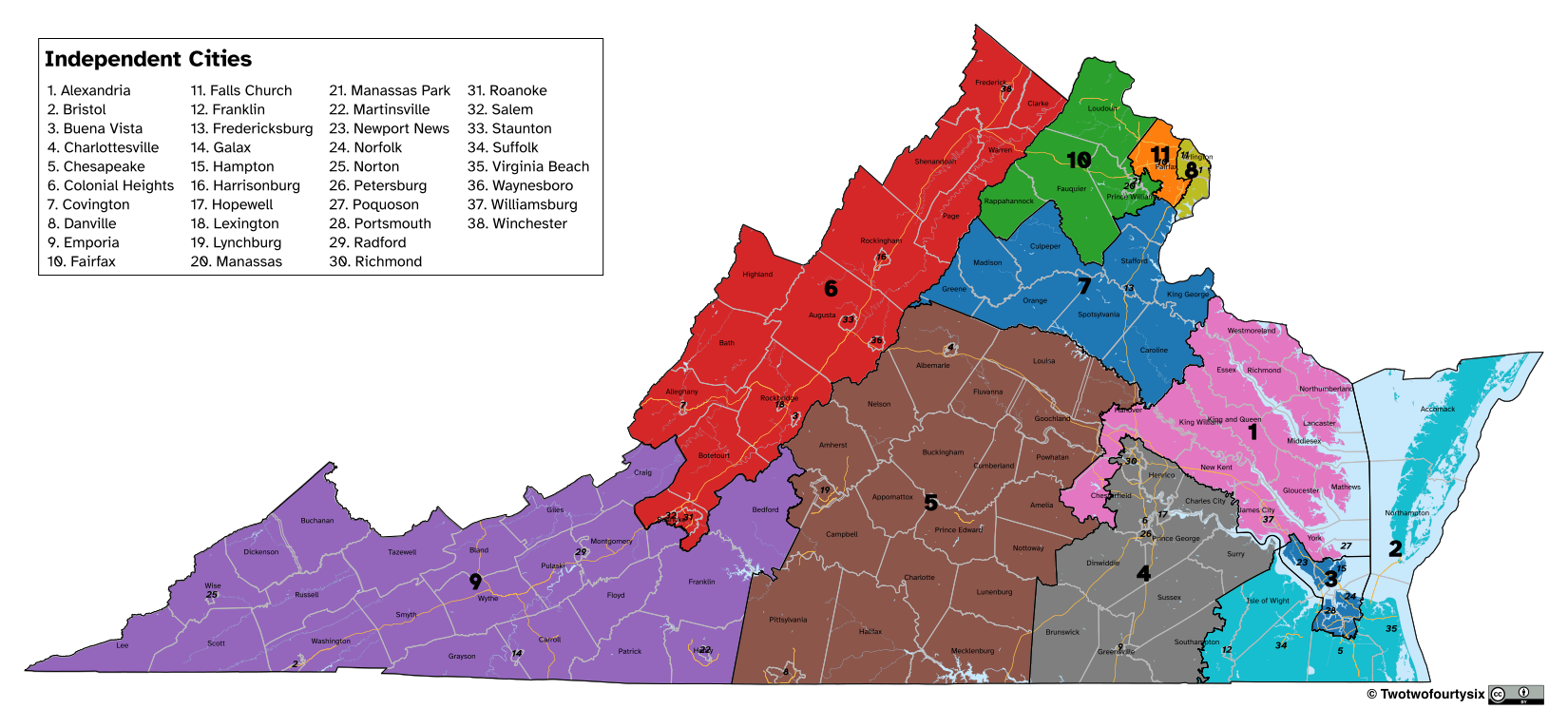
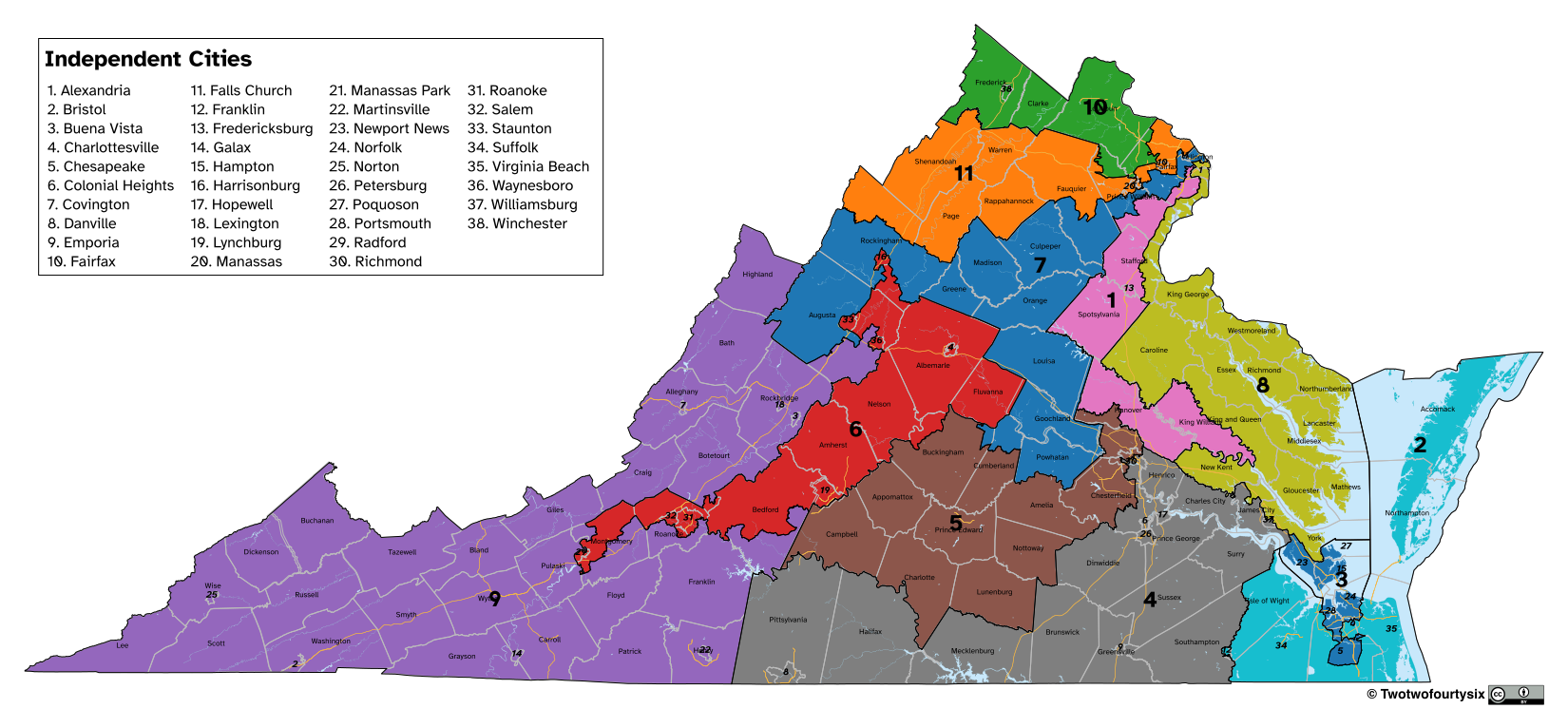
The most infamous feature of the new map is the 7th Congressional District, nicknamed the “Blue Lobster” because it visually resembles a crustacean. The 7th starts with a long skinny tail anchored in deep-blue Northern Virginia along the Potomac River, then splits into two wide claws — one stretching west into the Shenandoah Valley and Rockingham County near the West Virginia border, the other curving south toward the Richmond suburbs. The split avoids picking up more Democratic turf near Charlottesville — that blue territory is carved into a different district for maximum Democratic efficiency.
Prince William County is sliced from 2 congressional districts to 5. Fairfax County goes from 3 to 5. Rep. Ben Cline’s agriculture-heavy district — which he had described as connected to Virginia farming communities — is shredded into five separate pieces, each attached to a different Democratic anchor.
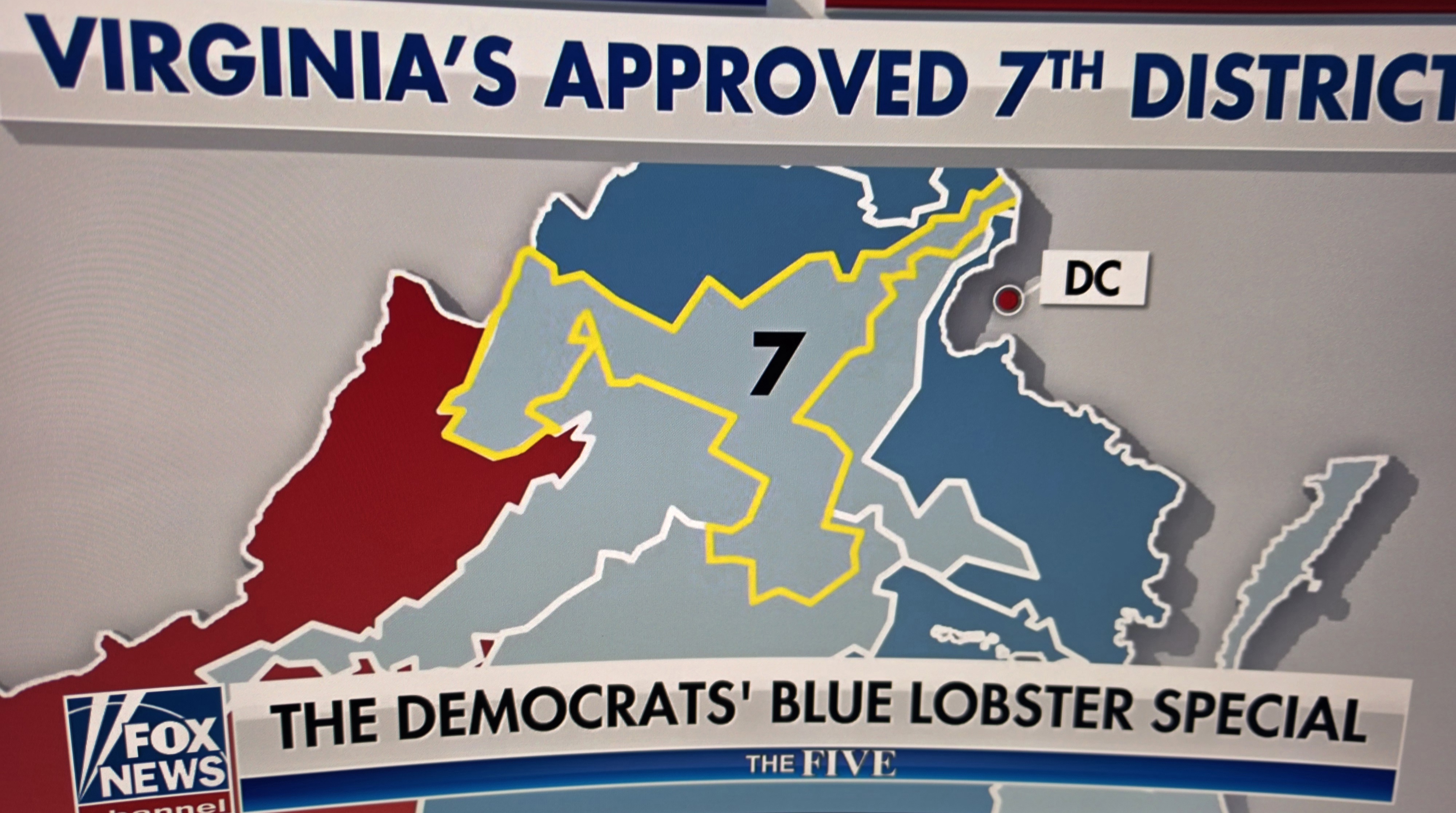
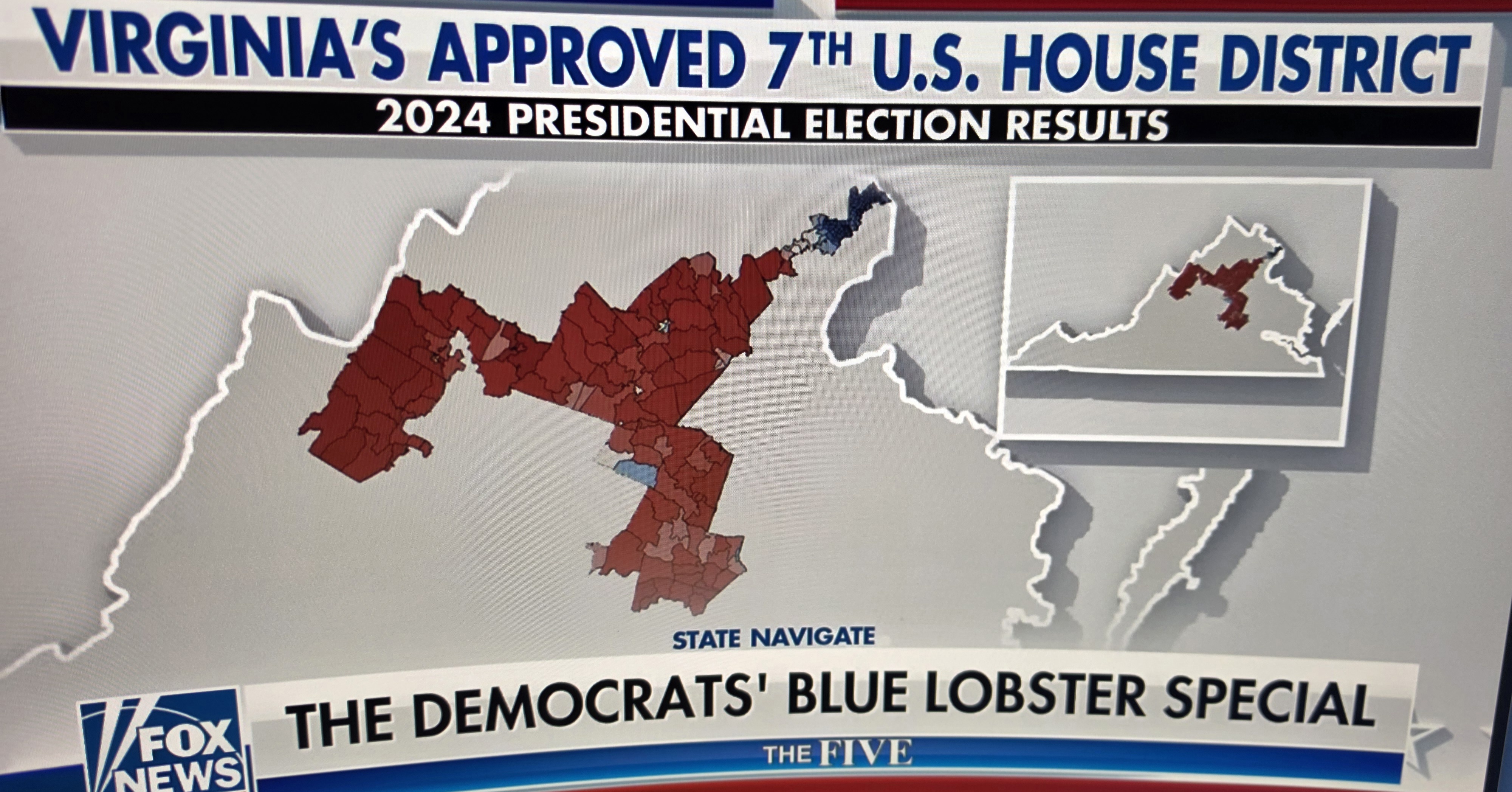
The second image from The Five makes the strategy brutally clear: when you overlay the 2024 presidential results on the new 7th District, the lobster claws sweep through deeply red rural Virginia — Shenandoah Valley farming communities that voted overwhelmingly Republican. The design isn’t accidental. The shape exists specifically to dilute those Republican votes by attaching them to the deep-blue Northern Virginia tail, where they are arithmetically overwhelmed.
This is the same technique Democrats used in Maryland (to eliminate the state’s only Republican district) and Illinois (to engineer a 14-3 Democratic advantage). In Virginia, they attempted to scale it to 10-1. A court blocked it.
$56 million. Obama ads. “Restore fairness.” And a fake Trump billboard.
The “Yes on Redistricting” campaign spent $56.4 million — more than twice the $24.6 million invested by groups opposed to the map. Total spending reached $83.2 million, making this the most expensive referendum in Virginia history. With that mountain of money, Democrats ran a campaign built on three pillars: a celebrity endorser, a deceptive ballot question, and in at least one case, outright voter deception.
Former President Barack Obama was prominently featured in Virginians for Fair Elections ads, urging 'yes' votes on the ballot measure. Supporters framed the gerrymander as a necessary check on President Trump — a 'fairness' measure. This from the same party that, in 2019, had its governor publicly declare gerrymandering 'detrimental to our democracy.'
The ballot question asked voters whether Virginia's constitution should be amended 'to restore fairness in the upcoming elections.' Judge Hurley ruled the language 'flagrantly misleading.' The Republican National Committee's February 2026 lawsuit had already called it 'a misleading statement — if not an obvious falsehood.' Creating a 10-1 partisan map in a 52-47 state is not 'restoring fairness.' It is manufacturing outcomes.
In Page County — a deeply rural, Republican-leaning county in the Shenandoah Valley inside the lobster claw — Democrats erected a billboard using President Trump's image and falsely attributing a quote to him: 'President Trump says, Take over the voting. Vote yes on redistricting April 21.' Trump had explicitly urged Virginia voters to vote NO, calling the redistricting a 'blatant partisan power grab.' The billboard was a fabrication designed to confuse Republican voters in a community that was being carved up by the very map they were being deceived into supporting.
When confronted about voter confusion caused by the barrage of conflicting ads and the misleading ballot language, the 'Yes' campaign manager claimed they were 'overcoming nearly $40 million spent on spreading MAGA lies and misinformation to confuse voters.' This from the campaign that fabricated a Trump quote on a rural billboard.
“Voters who came in were really kind of shaking their heads about having no idea what was going on, based on the barrage of ads coming from both sides.”
NPR report — 'Voters say they feel confused and misled on Virginia's redistricting vote' — April 20, 2026
“The outcome was not unexpected given the tilted playing field created by misleading ballot language and a massive spending advantage.”
Virginia House GOP Leader Terry Kilgore — April 21, 2026, on the narrow Democratic win
Open the post on X to view the full content — text, image, or video.
She ran as a moderate. She signed the gerrymander.

Abigail Spanberger won the 2025 Virginia gubernatorial election by the largest margin in the state since 2009 — 15.36 points, a landslide. She ran as a pragmatic moderate: a former CIA case officer with a reputation for breaking from her party, capable of winning a purple state by building cross-partisan coalitions. Virginia voters believed her.
During the campaign, Spanberger was explicit. She stated she had “no plans” to redraw Virginia’s congressional map and would not join the partisan gerrymandering cycle that had intensified following Texas Republicans’ mid-decade redistricting. In 2019, when she was a member of Congress, she had stated publicly that “gerrymandering is detrimental to our democracy.”
As governor, she signed the redistricting bill into law and actively campaigned for the referendum — the same 10-1 gerrymander she had promised not to pursue. Former Virginia Attorney General Jason Miyares put it bluntly: Spanberger “reminds voters that she lied to them.” Del. Michael Webert posted: “Behold the great bait and switch.” Rep. Rob Wittman: “Governor Spanberger said it clearly: ‘I have no plans to redistrict Virginia.’ But now, Richmond politicians are pushing a referendum to do exactly that.”
“Behold the great bait and switch.”
Del. Michael Webert (R-VA) — April 2026, responding to Spanberger supporting the redistricting she promised to oppose
2019 (as a member of Congress): “Gerrymandering is detrimental to our democracy.”
April 2026 (as governor): Signs the gerrymander. Campaigns for it. Calls Judge Hurley’s ruling an overreach.
The Christian Science Monitor headline from April 18, 2026 — three days before the vote:“As Virginia redistricting looms, Spanberger struggles to keep ‘moderate’ image.”
They destroyed the commission voters built. Then broke the rules doing it.
In 2020, Virginia voters went to the ballot box and approved — with 66% of the vote — a constitutional amendment creating a bipartisan redistricting commission. The commission was designed specifically to take partisan gerrymandering off the table. It was a genuine reform, passed by a genuine supermajority, embedded in the state constitution.
Less than six years later, Democrats who control the state government bypassed that same commission, passed a partisan map through the legislature, and put it on the ballot as a constitutional amendment. They wanted to make permanent a gerrymander that would undo everything the 2020 reform was designed to prevent — before the 2030 census, when the commission would normally take over.
To do this, Virginia’s constitution required the amendment to pass the General Assembly in two separate sessions, with a general election held between the two passages — so voters would have the opportunity to elect a new legislature that could weigh in on the second vote. Democrats passed first passage on Halloween, October 31, 2025. The problem: early voting for the referendum had opened on September 19, 2025. More than one million Virginians had already voted before the General Assembly even took its first vote on the amendment. Republicans argued that the election could not serve as the required “intervening election” if it had started before the legislature acted. Judge Hurley agreed.
Virginia didn’t invent this. Democrats have a two-century track record.
The word “gerrymander” itself was coined to describe a Democratic maneuver. In 1812, Massachusetts Governor Elbridge Gerry— a Democratic-Republican — signed a state senate district so contorted that a political cartoon compared it to a salamander. The portmanteau stuck. The party that invented the practice has spent two centuries refining it.
Maryland Democrats drew a congressional map that effectively erased the sole competitive Republican district, folding its Republican communities into safe Democratic seats. The result: a delegation that bears no resemblance to the state's actual partisan composition.
Illinois Democrats engineered a congressional map giving them a 14-3 advantage in a state with a substantial Republican voter base. Chicago's Democratic machine dominates the drawing, creating tentacle-like districts that reach into Republican suburbs and rural areas to dilute GOP votes.
New York Democrats attempted a sweeping gerrymander in 2022 that would have all but eliminated Republican competitiveness in the state's congressional delegation. New York courts struck it down. An independent redistricting commission's map was used instead. Democrats lost several seats they expected to control.
Virginia Democrats attempted to transform a genuinely competitive 6-5 delegation into a 10-1 gerrymander. They lied about it during the campaign. They used a misleading ballot question. They ran fake Trump billboards in rural counties. They destroyed the bipartisan commission Virginia voters built. A court blocked it.
But Virginia’s bipartisan commission map — the one voters approved in 2020 with 66% of the vote — was not a Republican gerrymander. It was a genuinely competitive map. Democrats won 6 of 11 seats under it.
The argument was not about fairness. It was about power. Hakeem Jeffries made the subtext text: “Maximum warfare, everywhere, all the time.”
From campaign promise to gerrymander to court block: the documented record.
Democrat Abigail Spanberger wins the Virginia governorship by 15.36%, the largest gubernatorial margin in Virginia since 2009. During the campaign she explicitly states she has 'no plans' to redraw Virginia's congressional map. Critics would later call this the original lie.
In 2019, when the shoe was on the other foot, then-Congresswoman Spanberger publicly declared that gerrymandering harms democracy. The quote would be used against her repeatedly when she backed the 2026 gerrymander as governor.
Spanberger is sworn in as Virginia's first female governor, taking office with a Democratic trifecta — Democratic majorities in both chambers of the General Assembly. Within weeks, the same party that campaigned against gerrymandering began drawing maps.
Early voting begins for the April 21, 2026 referendum. More than one million Virginians cast their ballots in the weeks that follow — before the Virginia General Assembly even voted on the amendment for the first time. This sequence becomes central to the constitutional challenge.
On Halloween night, the Virginia General Assembly passes the redistricting amendment as 'first passage' — but more than one million voters had already cast ballots. Virginia's constitution requires the amendment to pass the General Assembly twice, with a general election in between. Republicans immediately argued that election had already been corrupted.
The Virginia General Assembly passes the amendment a second time, completing the technical legislative requirement. Republicans challenged whether the intervening election was valid given that voting had begun before first passage.
The Republican National Committee files a lawsuit against the Virginia Department of Elections challenging the ballot title, which reads: 'restore fairness in the upcoming elections.' The RNC brief calls the phrase 'a misleading statement — if not an obvious falsehood — that...destroys fairness, is the product of unfairness and is intended to increase unfairness.'
The Supreme Court of Virginia allows the April 21 referendum to proceed despite pending legal challenges. The ruling does not resolve the underlying constitutional questions — it only allows the vote to take place while litigation continues.
Virginia voters narrowly approve the redistricting amendment: 1,575,367 Yes to 1,486,451 No — a margin of 88,916 votes out of 3.06 million cast. Democrats celebrate. Republicans immediately move to courts. The $83.2 million campaign — the most expensive referendum in Virginia history — concludes.
President Trump posts on Truth Social calling the result a 'rigged election' and a 'travesty of justice,' citing the misleading ballot language, the massive Democratic ad spending advantage, and the false billboard in Page County that used his image to deceive Republican voters.
Tazewell Circuit Court Judge Jack Hurley issues a ruling declaring the entire redistricting amendment process unconstitutional. All votes — for and against — are declared 'ineffective.' State officials are barred from certifying results or implementing the new maps. Virginia Attorney General Jay Jones immediately announces an appeal.
The Supreme Court of Virginia has the final word.
Attorney General Jay Jones filed an immediate appeal of Judge Hurley’s ruling. The case is expected to move swiftly through the Virginia Court of Appeals to the Supreme Court of Virginia, which will issue the definitive ruling on whether the redistricting amendment was constitutionally enacted. Ken Cuccinelli, monitoring the litigation, predicted final resolution by May 2026 — weeks before any new maps would need to be in place for the November 2026 elections.
Four separate constitutional challenges are simultaneously working through Virginia courts. The central question in all of them is the same: did the General Assembly’s Halloween-night first passage — after more than a million citizens had already voted — constitute a valid constitutional amendment process? The Virginia Supreme Court’s answer to that question determines whether the Blue Lobster lives or dies.
Under current maps — the bipartisan commission map that Virginia voters approved in 2020 — the November 2026 elections would proceed with the existing 6-5 competitive delegation. Virginia remains one of the genuinely competitive congressional battlegrounds in the country, and the courts may keep it that way.
A judge blocked all of it. The appeal is pending. This page will be updated as the Virginia Supreme Court rules.
All facts, vote totals, spending figures, court ruling details, and quotes on this page are sourced to primary court records, official Virginia election results, campaign finance disclosures, and contemporaneous reporting from Fox News Digital, CBS News, VPM, NPR, WJLA, Democracy Docket, and the Virginia Mercury. The redistricting process is ongoing. Judge Hurley’s ruling is under appeal. Last reviewed: April 23, 2026.