
He released the video
on Election Day.
The head was already off.
On November 8, 2016 — Election Day — Marilyn Manson released a music video teaser for his song “SAY10.” It showed a blond man in a dark suit and red power tie lying decapitated in a pool of blood, with Manson holding a knife. The director was Tyler Shields. Six months later, Shields shot Kathy Griffin’s severed Trump head photo. Griffin’s attorney cited Manson’s video as precedent. Manson said the body “could have been a preacher.”
“SAY10.” Election Day, 2016. A red tie. A knife. A body.
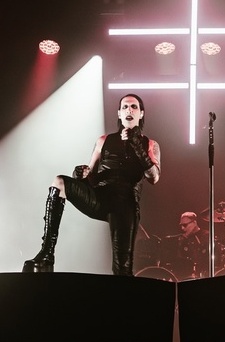
Brian Warner — known professionally as Marilyn Manson, a stage name combining Marilyn Monroe and Charles Manson — released a teaser for his song “SAY10” on November 8, 2016. The song title reads simultaneously as “Satan,” “Say Ten,” and the Roman numeral X (ten) — a deliberate layering Manson has used throughout his career. The teaser was published first via The Daily Beast.
The footage shows Manson seated in a dark, smoky room, tearing pages from a Bible. The camera moves to a blond man in a dark suit and red power tie — the signature look associated throughout the 2016 campaign with Donald Trump — lying decapitated in a pool of blood. Manson holds a bloodied knife. The decapitation itself is not shown; its result is. The video was reported by Rolling Stone, IndieWire, Dazed Digital, Global News, and multiple entertainment outlets as Trump-inspired.
His defense: the red tie could have been a preacher’s.
When asked about the video’s political intent in a September 2017 interview, Manson offered what the Irish News reported as his official position: “Well, there was no actual decapitation shown. It was implied. And no Trump. There was just a guy in a red tie. Could have been a preacher. It’s funny that people see what they want to see.”
When the teaser was released on November 8, 2016, he told The Daily Beast: “As an artist my duty is to ask the questions. The viewer must answer them.” He also stated in Rolling Stone that the lyrics were “written before the 2016 U.S. presidential election,” while simultaneously choosing to release the visuals on Election Day — a scheduling decision that required no ambiguity about intent.
“There was just a guy in a red tie. Could have been a preacher. It's funny that people see what they want to see.”
Marilyn Manson — September 2017 · Reported by Irish News, NME
The same director. Six months later. Kathy Griffin.
Tyler Shields directed the SAY10 teaser in November 2016. On May 30, 2017 — six months later — Shields photographed Kathy Griffin holding a realistic prop of Donald Trump’s severed, bloody head. Griffin published the photos on her social media. The backlash was immediate: CNN fired her from its New Year’s Eve broadcast, the Secret Service opened an investigation, and she lost multiple touring engagements.
When Griffin held a press conference to address the fallout, her attorney Lisa Bloom cited Manson’s SAY10 video as precedent — arguing that male artists who had produced comparable imagery faced no professional consequences, while Griffin was being singled out. Breitbart reported in June 2017 that the decapitated head prop from the Manson teaser may have been the same prop used in the Griffin shoot, though this has not been independently confirmed.
May 30, 2017: Tyler Shields photographs Kathy Griffin holding a realistic severed and bloody Trump head. CNN fires Griffin. Secret Service opens an investigation. Griffin loses bookings nationwide. Her attorney cites the Manson video as evidence of a double standard.
One director. Six months apart. Two decapitations. Radically different outcomes.
What didn’t end his career. What did.
Marilyn Manson built a 30-year career on transgression. In 1999, he was falsely blamed in congressional hearings for the Columbine massacre — senators named him directly. The accusation was debunked. In Michael Moore’s Bowling for Columbine, Manson was asked what he would say to the Columbine students. He answered: “I wouldn’t say a single word to them — I would listen to them. That’s what nobody did.” It is widely considered the film’s best moment.
The SAY10 video did not end his career. The “Heaven Upside Down” album charted in 17 countries and reached number 8 on the Billboard 200. He continued touring. What ended his career — or at least severely damaged it — was a different matter entirely: in February 2021, actress Evan Rachel Wood publicly named Manson as her abuser, alleging he had groomed her from age 18 and subjected her to years of abuse. More than 15 women came forward. Loma Vista Records dropped him. His management and booking agency dropped him. He was cut from television productions including American Gods and Creepshow.
Manson denied all allegations and filed a defamation suit against Wood. In 2024, he agreed to pay her approximately $327,000 in legal fees and dropped the suit. Wood won a separate defamation case against him. The TDS video harmed no one. The 2021 allegations harmed everyone involved.
In February 2021, abuse allegations surfaced. His label, management, booking agency, and two television productions dropped him within days. He has stated the allegations “ruined his career.” The SAY10 video is not the reason. It is a footnote.
He chose Election Day. He chose not to vote.
In Rolling Stone, Manson was asked why he wasn’t voting for president. His answer: “I don’t think that, as an artist, I can make as much of a difference voting as I can the commentaries I make in music on my next record, Say10.” He described the Trump-Clinton choice as “cat shit and dog shit.” He had voted for Obama in 2012.
So: on the day Americans voted for president, Manson released footage of a Trump look-alike’s decapitation rather than cast a ballot — a choice that presumably made an enormous difference in the outcome. Trump won 306 electoral votes. He won again in 2024. The SAY10 album sold well. The message, whatever it was, did not land where intended.