
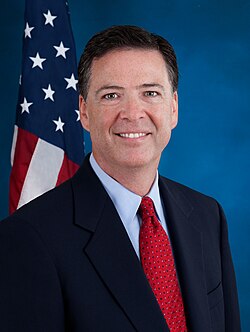
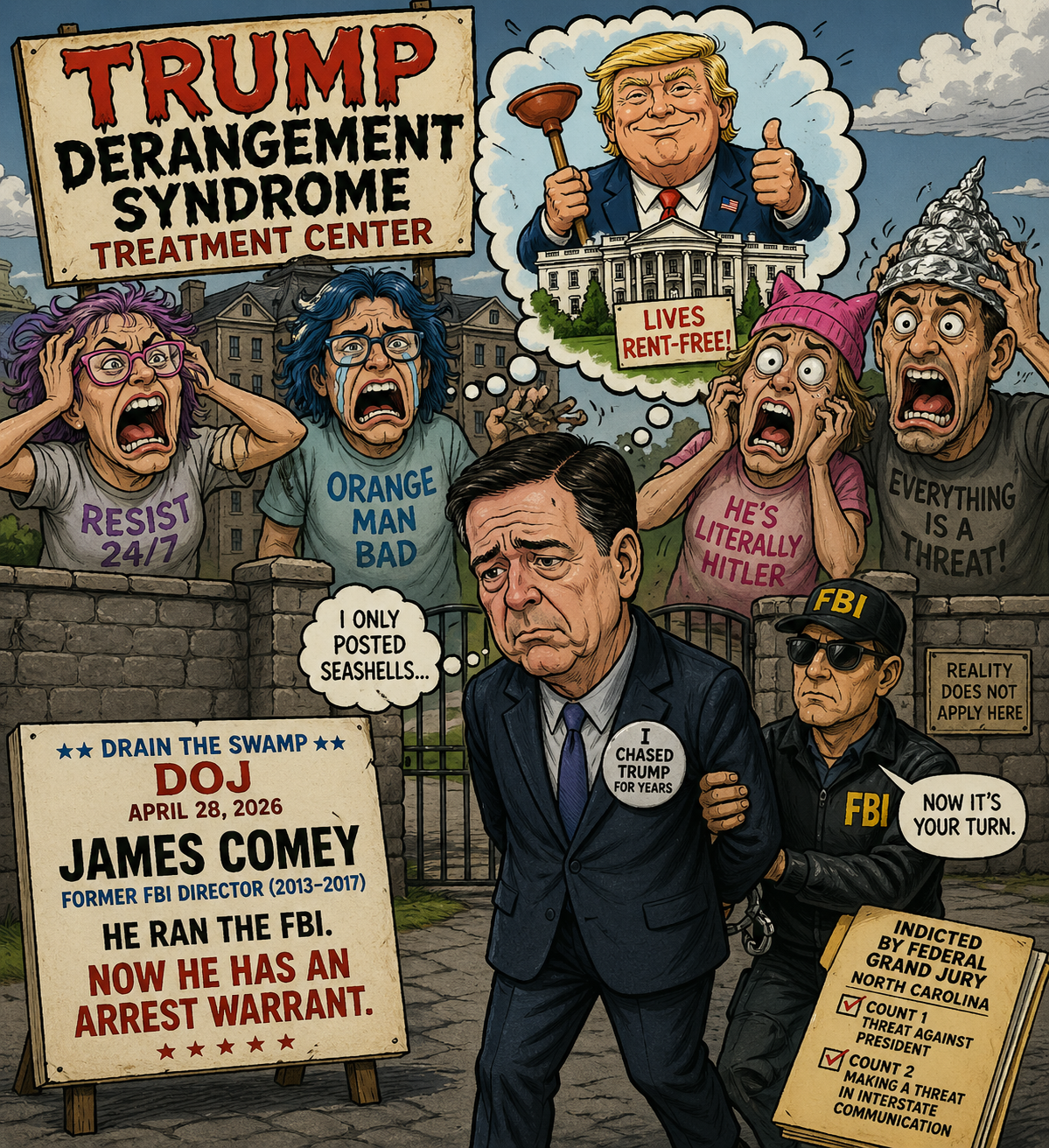
He Ran the FBI.
Now He Has an Arrest Warrant.
In May 2025, former FBI Director James Comey posted a photo on Instagram of seashells arranged to spell “86 47” — street slang for eliminating someone, applied to the 47th president. A federal grand jury in North Carolina agreed that was a threat. On April 28, 2026, they indicted him on two counts. The man who spent years chasing Donald Trump is now the one being chased.
The lead prosecutor just walked away.
No explanation given.
The prosecution lost its lead lawyer days before this update. According to a notice of substitution filed in the Eastern District of North Carolina late Friday, May 29, 2026, Assistant U.S. Attorney Matthew Petracca— the rookie federal prosecutor who took the “86 47” threat charges to the grand jury — has stepped off the case. He is being replaced by Assistant U.S. Attorney Timothy Severo “as counsel for the government.” The filing, according to NBC News, CBS News, and Fox News, gives no reason for the change.
Petracca's exit is not isolated. According to court filings reviewed by CBS News, he has come off at least three other criminal cases in the district in recent days. According to NBC News, citing two people familiar with the matter, Petracca had considered leaving the Justice Department altogether but decided to remain after taking a week off. He was hired months ago by U.S. Attorney W. Ellis Boyle and is, per the reporting, a former Republican county committeeman from New Jersey with limited prosecutorial experience — echoing the inexperience critics flagged in the first, dismissed case.
The departure does not dismiss the indictment. The two threat counts remain on the docket, and the case is heading toward an October 2026 trial after the court granted Comey's request for a delay. But losing the prosecutor who personally built the case — with no public explanation, amid his withdrawal from a string of other matters — hands Comey's defense a fresh line of attack on a prosecution his lawyers already argue was politically driven. Comey remains presumed innocent.
A “notice of substitution of counsel” is the routine docket filing by which one government lawyer replaces another. It does not, by itself, signal a problem with the underlying case — but here the lead prosecutor who originated the charges left without a stated reason, while simultaneously dropping off other district cases.
U.S. Attorney W. Ellis Boyle, whose office brought the indictment, has said: “No one is above the law in the Eastern District of North Carolina.” Acting Attorney General Todd Blanche has previously described the case as one spearheaded by “local prosecutors” and “local agents,” saying, “I don't even know their names.” The new lead is AUSA Timothy Severo. Comey is presumed innocent until convicted.
“Cool shell formation on my beach walk.”
On a day in May 2025, James Comey — former Director of the Federal Bureau of Investigation, the man who oversaw the Russia investigation targeting Donald Trump — posted a photo to Instagram. The caption: “Cool shell formation on my beach walk.”
The seashells in the photo were arranged to spell 86 47.
In American slang, “86” means to get rid of, eliminate, or kill someone. “47” is Donald Trump's presidential number — the 47th President of the United States. The phrase appeared, according to the federal indictment, to mean: kill Trump.
When the post drew immediate backlash, Comey deleted it and posted a response: “I posted earlier a picture of some shells I saw today on a beach walk, which I assumed were a political message. I didn't realize some folks associate those numbers with violence. It never occurred to me, but I oppose violence of any kind, so I took the post down.”
Federal prosecutors did not believe him. Specifically, they argued that a man who ran the FBI for four years — who oversaw counterterrorism, protective intelligence, and threat assessment at the highest level of American law enforcement — was not a man who could credibly claim not to know what “86” meant.
The man who ran threat assessment at the FBI
didn't know what “86 47” meant.
The indictment's central argument is straightforward: under federal threat law, the question is not whether Comey actually intended to carry out the act — it is whether “a reasonable recipient who is familiar with the circumstances would interpret [the communication] as a serious expression of an intent to do harm.”
A reasonable recipient, prosecutors contend, would read “86 47” as exactly what the slang has meant for decades — and Comey, a Yale Law graduate who led 35,000 FBI agents and supervised threat analysis units, is not a reasonable person unfamiliar with the circumstances. He is one of the most legally sophisticated individuals in the country.
The indictment also notes the context: Comey posted the image during a period of documented anti-Trump political hostility, on a public platform, with no clarifying caption. After widespread coverage of the post as a threat, he deleted it and claimed ignorance. Prosecutors call that claim not credible.
“James Comey disgracefully encouraged a threat on President Trump's life and posted it on Instagram for the world to see. As the former Director of the FBI, he knew full well the attention and consequences of making such a post.”
Kash Patel, FBI Director, on the original September 2025 indictment
Two counts. Up to 10 years. An active arrest warrant.
On April 28, 2026, a federal grand jury in the Eastern District of North Carolina returned an indictment against James Brien Comey on two counts:
- Count 1 →Knowingly and willfully making a threat to take the life of or inflict bodily harm upon the President of the United States — in violation of federal criminal statute.
- Count 2 →Knowingly and willfully transmitting in interstate and foreign commerce a communication containing a threat to kill President Donald Trump.
Each count carries a maximum sentence of up to 5 years in federal prison. The presiding judge is Hon. Louise Wood Flanagan, U.S. District Judge for the Eastern District of North Carolina. An arrest warrant was issued the same day.
The case was filed by the U.S. Department of Justice under Acting Attorney General Todd Blanche— formerly Donald Trump's personal criminal defense attorney, elevated to Acting AG after Pam Bondi was fired in early April 2026. AUSA Matthew Petracca signed the indictment.
The indictment invokes two separate federal statutes:
18 U.S.C. § 871 — Threats against the President: makes it a federal crime to knowingly and willfully threaten to take the life of or inflict bodily harm on the President. Maximum: 5 years per count (this count).
18 U.S.C. § 875(c) — Interstate threats: makes it a federal crime to transmit any communication in interstate commerce containing a threat to injure another person. Maximum: 5 years.
Combined maximum exposure if convicted on both counts: up to 10 years. Comey is presumed innocent until convicted.
The first indictment was on different charges. A judge threw it out.
The second indictment is not the first attempt to prosecute Comey. On September 25, 2025, the DOJ brought a separate, two-count indictment in the Eastern District of Virginia on entirely different charges:
- →Making false statements to Congress (18 U.S.C. § 1001) — based on Comey's September 30, 2020 Senate Judiciary Committee testimony in which he allegedly denied authorizing anonymous media leaks tied to Operation Arctic Haze, the FBI's Russia/2016 probe.
- →Obstruction of a congressional proceeding (18 U.S.C. § 1505).
Comey was arraigned October 8, 2025, and pleaded not guilty. Almost immediately, procedural problems surfaced. The EDVA U.S. Attorney who had overseen the case — Erik Siebert — resigned September 19, 2025, reportedly after recommending against prosecution. He was replaced by Lindsey Halligan, Trump's former personal attorney with no prior prosecutorial experience.
On November 5, 2025, Magistrate Judge William Fitzpatrick sharply criticized the government, writing that the prosecution appeared to have taken an “indict first, investigate second” approach. On November 24, 2025, Senior U.S. District Judge Cameron McGowan Currie dismissed both the Comey and Letitia James indictments on a procedural basis: Halligan's appointment violated 28 U.S.C. § 546 because the Attorney General's 120-day appointment authority had expired in May 2025 — months before her September 22 installation.
The DOJ appealed to the Fourth Circuit on February 9, 2026. Meanwhile, prosecutors convened a new grand jury in North Carolina — a different court, a different prosecutor, and different charges.
Blanche. Patel. And a preview that came true.
Approximately 10 days before the second indictment, FBI Director Kash Patel appeared on Fox News' Sunday Morning Futures with Maria Bartiromo and said: “Arrests are coming soon... Comey is not the only one... We've got all the evidence we need.” On April 28, that prediction landed on the court docket.
The legal authority behind the second prosecution is Acting AG Todd Blanche. Blanche is a former federal prosecutor who represented Donald Trump in his Manhattan criminal case and his federal documents case before being named Deputy Attorney General under Pam Bondi. After Bondi was fired in early April 2026, Blanche was elevated to Acting AG. He is the signatory authority on the new Comey prosecution.
Critics, including Rep. Jamie Raskin (D-MD), argue that Blanche's personal history defending Trump while now prosecuting Trump's perceived enemies is a conflict of interest that undermines the case's legitimacy. Legal analysts on both sides agree the second indictment — focused on the cleaner threat charges, in a new court, with a lawfully appointed prosecutor — is procedurally stronger than the first.
“Today, after firing his own choice for U.S. Attorney in the Eastern District of Virginia, Donald Trump finally got a subservient new replacement to carry out his revenge prosecution against former FBI Director James Comey.”
Rep. Jamie Raskin (D-MD), Ranking Member, House Judiciary Committee, September 2025
The former top cop's own documented record.
James Comey served as FBI Director from September 2013 to May 2017, when Trump fired him — an act that became central to the Russia investigation Comey had been running. The Inspector General found in 2019 that Comey violated FBI policy by leaking personal memos documenting his conversations with Trump to a friend, who shared them with the media. The DOJ declined to prosecute at that time.
His conduct in the 2016 election — reopening the Clinton email investigation days before Election Day, then closing it two days later — has been criticized by Democrats and Republicans alike. His handling of FISA applications in the Russia investigation drew a scathing IG report in 2019 documenting at least 17 “significant inaccuracies and omissions” in Carter Page surveillance warrants.
The man now facing federal threat charges is the same man who signed off on wiretapping a U.S. presidential campaign based on a dossier paid for by that campaign's opponent — and who, after being fired, admitted he'd never have allowed such an investigation to proceed the way it did had there been more oversight.
From Russia probe to arrest warrant.
The man who ran the FBI, oversaw threat assessment for 35,000 agents, and led the Russia investigation is now the subject of a federal arrest warrant for allegedly posting a threat against the president he was investigating.
The first prosecution collapsed on a technicality — an unlawfully appointed prosecutor. The second is on cleaner charges in a different court — but on May 29, 2026, the lead prosecutor who built it, AUSA Matthew Petracca, abruptly stepped off the case with no explanation, handing the defense a fresh line of attack ahead of an October 2026 trial. Comey is presumed innocent. The legal question at trial will be whether a former FBI Director, better than anyone, understood exactly what “86 47” meant.
All facts cite primary sources: DOJ press releases, federal court filings, and wire-service reporting (NBC News, CBS News, CNBC). Comey is presumed innocent until convicted. Quotes attributed to Trump and Patel are sourced from contemporaneous press reports cited above. The prosecution is ongoing; this page will be updated as the case develops.