
The Supreme Leader is dead. His son is missing. The IRGC runs the country. The navy is at the bottom of the sea.
On February 28, 2026, a joint U.S.-Israeli strike ended Ali Khamenei’s 36-year rule. In the 40 days that followed, U.S. and Israeli forces flew over 10,000 combat missions, struck 13,000 targets, sank 90% of Iran’s navy, destroyed 80% of its air defenses, collapsed its daily missile launches by 98%, and hit 80% of its nuclear industrial base. Iran responded with 1,206 drone and missile strikes on Day 1 alone — then watched that number fall to 24 by ceasefire day. Hegseth called it a “decisive military victory.” The IRGC calls it an opportunity. A fragile ceasefire holds. The blockade does not move.
He ran Iran for 36 years. He was not hiding well enough.
Operation Epic Fury launched at 1:15 AM ET on February 28, 2026. U.S. and Israeli forces struck simultaneously across more than ten Iranian provinces. In the opening 24 hours, over 1,000 targets were hit. Among the confirmed dead: Supreme Leader Ali Khamenei, 85, who had ruled Iran since 1989; IRGC Commander Mohammad Pakpour; Defense Minister Amir Nasirzadeh; military adviser Ali Shamkhani; and Chief of Staff Mohammad Bagheri. The core of the Iranian national security apparatus was decapitated in a single night.
Iran’s response was immediate and massive. On Day 1, Iran launched 867 one-way attack drones and 339 ballistic missiles — 1,206 projectiles in 24 hours, a rate that exceeded Russian drone campaigns against Ukraine at their peak. U.S. and Gulf partner forces intercepted 1,700 ballistic missiles across the full campaign, achieving a 92% interception rate. The strikes depleted 14% of the United States’ total THAAD interceptor stockpile — a supply that would take three to eight years to replenish at current production rates.
Aircraft deployed: B-2 Spirit, B-52 Stratofortress, B-1B Lancer, F-35, F-15E, Predator drones, and strike fighters from two carrier groups. 18 B-2 sorties flew round-trip from Whiteman AFB, Missouri — 30+ hours each — the largest B-2 combat deployment in history.
GBU-57 MOP employment: 2 Massive Ordnance Penetrators on Natanz; 12 on Fordow.
Sources: Pentagon fact sheet (defense.gov, Mar 3, 2026); Vision Times; Air & Space Forces Magazine; Army Recognition.
“We have destroyed and sunk 9 Iranian Naval Ships, some of them relatively large and important. We are going after the rest — they will soon be floating at the bottom of the sea, also!”
President Donald Trump, Truth Social, March 1, 2026 — Day 2 of Operation Epic Fury
Open the post on X to view the full content — text, image, or video.
1,206 on Day 1. 24 by ceasefire. A 98% collapse in 38 days.
Iran fired everything it had on Day 1. By the end of the first week, drone launches were down 83% and ballistic missile launches were down 90% from that opening rate, according to CSIS analysis and CENTCOM statements. By April 8 — the ceasefire date — Defense Secretary Hegseth reported drone attacks had fallen 95% from peak. The Jerusalem Post reported the missile fire rate had “collapsed by 92%.” The chart below shows why: the Pentagon had struck 800 one-way attack drone storage facilities, every Shahed manufacturing plant, 450+ ballistic missile storage depots, and 77% of Iran’s missile tunnel entrances. There was nothing left to fire.
339m
180m
95m
35m
28m
22m
6m
158 ships at the bottom. CENTCOM: "we aren't done." The entire Soleimani-class: gone.
The destruction of Iran’s navy happened in stages, each confirmed by CENTCOM or Pentagon officials. Day 10 (March 9): the Pentagon’s own fact sheet confirmed 50 vessels damaged or destroyed. Day 11 (March 11): CENTCOM Commander Admiral Brad Cooper confirmed 60+ ships struck or sunk, including the destruction of the entire Soleimani-class as a category. Day 16 (March 16): Adm. Cooper updated the count to “more than 100 Iranian naval vessels destroyed” — adding, “we aren’t done.” By April 13, when Trump announced the naval blockade, the figure had reached 158. Trump’s Truth Social post: “Iran’s Navy is laying at the bottom of the sea, completely obliterated — 158 ships.” (He noted fast attack craft were spared: “we did not consider them much of a threat.”) The final Pentagon assessment: 90% of Iran’s maritime fleet destroyed, 95% of naval mines eliminated.
Specific confirmed losses include: IRIS Dena (Jamaran-class frigate, torpedoed by USS Charlotte, a Los Angeles-class submarine); IRIS Makran (Iran’s forward base ship); both Bayandor-class corvettes at Konarak; all four Soleimani-class warships; and the Kilo-class submarine Tareq, struck at Bandar Abbas. Iran’s naval headquarters at Bandar Abbas was set ablaze. The Strait of Hormuz — which Iran had mined — was cleared of 95% of those mines by U.S. Navy mine-countermeasure ships as part of the blockade operation.
Open the post on X to view the full content — text, image, or video.
10,000 missions. 62 bomber runs. The F-14s Iran flew for 45 years: destroyed on the ground.
Gen. Dan Caine confirmed that U.S. forces flew over 10,000 combat missions across the 40-day campaign, sustained at a pace of 300–500 strike sorties per day after the opening surge. Of the 62 bomber missions, 18 were B-2 Spirit sorties flying non-stop from Whiteman Air Force Base in Missouri — 30+ hours round-trip, the most extensive long-range B-2 deployment in military history. B-52s and B-1Bs supplemented the strategic bomber force. HIMARS were deployed against hardened coastal missile sites near the Strait of Hormuz.
Iran’s air force — already the weakest branch of its conventional military — was decimated on the ground. Satellite imagery confirmed 8+ F-14 Tomcats destroyed at Isfahan’s Shahid Beheshti Airport on March 9. Israeli footage documented F-4 and F-5 fighters struck at Tabriz. Qatar’s air force shot down two Su-24 Fencer bombers; CENTCOM filmed a third Su-24 destroyed at Qasem Soleimani Airport. Iran’s air defense went first — 80% of SAM batteries eliminated in the opening hours, including every Russian-supplied S-300 battery it possessed. Subsequent air operations over Iran faced minimal defensive response.
Before 1979, Iran was a close U.S. ally under Shah Mohammad Reza Pahlavi. Washington sold Tehran some of its best hardware — and Iran paid full price.
F-14 Tomcat — Iran was the only foreign country ever cleared to receive the F-14. The Shah bought 79 of them in 1974, along with AIM-54 Phoenix missiles. When the 1979 revolution ousted him, the planes were already in Iran. They just… stayed.
F-4 Phantom II — F-4D and F-4E variants, used heavily in the Iran-Iraq War (1980–88).
F-5 Tiger II — Light fighters, still in limited Iranian service through 2025.
C-130 Hercules & P-3 Orion — Transport and maritime patrol aircraft, purchased under the same pre-revolution military relationship.
After 1979, the U.S. immediately cut off spare parts, technical support, and all further sales. Iran spent the next 47 years cannibalizing its own fleet — stripping one F-14 for parts to keep two others flying. By 2025, estimates put operational F-14s at 10–15 aircraft, down from 79. Iran put the F-14 on a postage stamp. A country that cannot source replacement tires for an airplane tends to commemorate it philatelically.
March 9, 2026: Satellite imagery confirmed 8+ F-14 Tomcats destroyed at Isfahan’s Shahid Beheshti Airport. The planes America sold Iran in 1974 were destroyed by American bombs in 2026. A 52-year arc, closed.
3,000 missiles before the 2025 war. Every Shahed factory: rubble.
Before the June 2025 Twelve-Day War, Iran held an estimated 3,000 ballistic and cruise missiles — the largest stockpile in the Middle East. That war reduced it by roughly half. The 2026 campaign then struck 450+ ballistic missile storage facilities, 77% of underground tunnel entrances, and four key manufacturing plants. By ceasefire, Iran’s daily missile launch rate had collapsed 98% from Day 1 levels. The Pentagon destroyed Iran’s entire Shahed drone manufacturing infrastructure — “every factory,” per Hegseth — along with 800 one-way attack drone storage centers.
The nuclear program received the most permanent damage. In June 2025, seven B-2s dropped GBU-57 Massive Ordnance Penetrators on Natanz, Fordow, and Isfahan. In March 2026, additional strikes followed. By April, the Pentagon assessed approximately 80% of Iran’s nuclear industrial base had been damaged or destroyed: Natanz’s Pilot Fuel Enrichment Plant (1,700 advanced centrifuges destroyed), Fordow (dormant post-strikes), and Isfahan’s metallurgy and conversion facilities. Netanyahu stated Iran “can no longer enrich uranium.” One unresolved problem: approximately 400 kilograms of 60%-enriched uranium remain unaccounted for, possibly entombed in rubble, possibly relocated pre-strike. Bloomberg’s investigation: “Trump’s Iran Plan Faces Reality of Hidden Nuclear Stockpiles.”
Iran’s navy is sunk. Iran’s state TV says it sank a U.S. aircraft carrier. CENTCOM has thoughts.
As its military infrastructure collapsed, Iran’s information operation accelerated. The regime deployed three primary propaganda tools: AI-generated video, animated fabrications, and outright false military claims.
The AI Khamenei videos. Since Mojtaba Khamenei’s disappearance after the February 28 strike, Iranian state television has aired AI-generated videos showing him delivering addresses and commanding forces from a war room. One viral clip showed a figure styled as Mojtaba standing before a targeting display showing Israel’s Dimona nuclear reactor. Multiple fact-checkers — Deccan Herald, IBTimes UK, Tribune India — confirmed the footage was AI-generated: blurred faces, unnatural lighting, glitch-like transitions, facial overlays on older footage of his father. X flagged the videos as AI-generated content. YouTube removed an IRGC-linked AI animation channel. Iran’s Revayat-e Fath Institute — IRGC state media — has produced dozens of deepfake and AI videos since the war began. Brookings published an analysis: “Generative AI as a weapon of war in Iran.”
The LEGO propaganda. The Revayat-e Fath Institute also produced a series of AI-generated LEGO animations showing Trump and Netanyahu as miniature figures being defeated by Iranian forces — broadcast on Iranian state TV, then distributed via X, TikTok, and Instagram. In one video, a Lego Trump figure cowers as Iranian rockets launch. The Jerusalem Post reported that YouTube eventually banned the IRGC-linked animation channel producing the content. Yahoo News covered it: “With Legos, trolling and Twain, Iran pushes war narrative on social media.”
The fake carrier claim. Iran’s regime repeatedly claimed it had sunk a U.S. aircraft carrier. CENTCOM addressed this directly on X, noting that the only carrier struck was theShahid Bagheri — an Iranian drone carrier, not an American one — hit by U.S. forces within hours of the operation’s launch.
LEGO animations: IRGC’s Revayat-e Fath produced Lego-style Trump/Netanyahu defeat videos for state TV distribution. YouTube banned the channel.
Fake carrier sinking: IRGC claimed to have sunk a U.S. aircraft carrier. CENTCOM debunked on X: the only carrier hit was Iran’s own Shahid Bagheri drone carrier, struck by U.S. forces.
AI rap and social media: bne IntelliNews documented Iran deploying “AI rap” and coordinated hashtag campaigns. IntelBriefing traced synchronized deepfake posting windows to regime-linked accounts.
Open the post on X to view the full content — text, image, or video.
Declared Supreme Leader on March 8. Not seen since. Possibly in a coma.
Mojtaba Khamenei, 56, was appointed Supreme Leader by the Assembly of Experts on March 7–8, 2026, following the confirmation of his father’s death. He did not appear at the memorial service. He has not appeared in public since. As of April 22, 2026 — 45 days after his appointment — no verified, live footage of Mojtaba Khamenei exists. Iranian state television has aired written statements attributed to him, read by anchors, and AI-generated videos of him delivering addresses.
Reports on his condition are consistent in suggesting severe injury, inconsistent on the details. A diplomatic memo described by Aawsat, reportedly based on U.S. and Israeli intelligence, calls him “unconscious” and “incapacitated,” unable to participate in any decision-making. The Week India reported he may have “lost a leg” and suffered disfiguring facial injuries. WION News: “zero proof of life.” CNN (April 21): his absence may paradoxically be “helping the regime to survive” by denying the U.S. and Israel a clear second decapitation target.
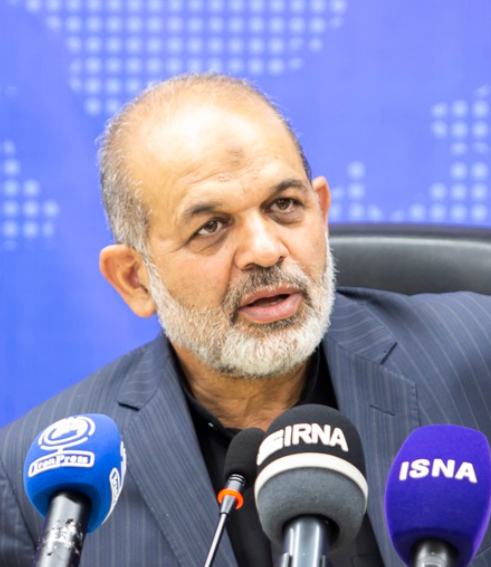
Ahmad Vahidi is running Iran. He’s on the U.S. terror list. He has been since 1994.
IRGC Commander Major General Ahmad Vahidi has effectively seized control of Iran’s government. He has blocked President Masoud Pezeshkian’s appointments, erected a security cordon around the missing Supreme Leader, and instructed Iran’s civilian negotiating team that they do not have authority to agree to terms. IRGC-affiliated media announced on April 18 that Iran would not participate in another round of U.S. negotiations due to “excessive demands.” On April 22, the IRGC captured two vessels in the Strait of Hormuz, calling it a response to “disrupting order and safety.”
Vahidi has been on a U.S. terrorism watch list since the 1994 AMIA bombing in Buenos Aires, which killed 85 people. He is the most powerful man in what used to be the Islamic Republic of Iran. He views the current military crisis not as a catastrophe but as the IRGC’s long-awaited opportunity for all-out confrontation with the West. The Christian Science Monitor described the new regime as “less restrained, more hard-line” than its predecessor. The predecessor was the man who funded Hamas, Hezbollah, and the Houthis for three decades.
Open the post on X to view the full content — text, image, or video.
7,650 killed in Iran. 13 Americans. The interceptor stockpile will take a decade to rebuild.
Iranian human rights organization Hengaw documented 7,650 killed in the first 40 days, including 1,030 civilians (13.5%). IDF intelligence estimated 6,000+ IRGC members killed; HRANA (Human Rights Activists in Iran) documented 6,620 military deaths. On the U.S. side, the Pentagon’s Defense Casualty Analysis System confirmed 13 Americans killed and 373 wounded in action (330 returned to duty). A separate count of 520+ total injured includes smoke inhalation casualties aboard USS Gerald R. Ford. The Intercept reported CENTCOM may be undercounting by as much as 23%, citing a gap between CENTCOM’s stated figures and DCAS records.
Iran’s strikes damaged allied infrastructure too. A THAAD radar system at Muwaffaq Salti Air Base in Jordan was struck. Storage structures for a THAAD battery at Al Ruwais and Al Sader in Abu Dhabi were damaged. Israel suffered 26 killed and 7,693 wounded — a 92% interception rate means 8% of Iranian ballistic missiles got through. Those that did struck civilian areas in Arad and Dimona, injuring 115+. The U.S. expended 14% of its entire THAAD interceptor stockpile defending the region. The Jerusalem Post: rebuilding that stockpile will take three to eight years.
April 8: ceasefire. April 21: extended. April 22: IRGC captures two ships. The blockade remains.
On April 8, 2026, the United States and Iran agreed to a two-week ceasefire mediated by Pakistan. Hegseth declared “decisive military victory” at a Pentagon briefing. The Strait of Hormuz was declared open to commerce. The naval blockade was not lifted. Peace talks in Islamabad with JD Vance, Steve Witkoff, and Jared Kushner representing the U.S. failed to produce an agreement. Iran rejected the U.S. framework — which required ending its nuclear program, limiting missiles, restricting proxy groups, and reopening the Strait — and submitted a 10-point counter- proposal insisting on Iranian control of the Strait and U.S. withdrawal from the Middle East.
On April 21, 2026, Trump extended the ceasefire “until Iran submits a proposal,” citing the government as “seriously fractured.” CNBC quoted Trump officials warning that his Truth Social posts about Iran risk “killing peace talks.” On April 22 — today — the IRGC captured two vessels in the Strait of Hormuz. Al Jazeera reported Iran’s IRGC framing it as a response to the blockade. The ceasefire is extended. The blockade is active. The IRGC is running Iran. Mojtaba Khamenei has not appeared in public. Nothing is resolved.
Apr 8 (same day): Iran accuses U.S. of violating ceasefire as Israeli operations in Lebanon continue. CBS News confirms the accusation.
Apr 11: Vance/Witkoff/Kushner arrive in Islamabad. Talks fail. No deal.
Apr 13: Trump announces naval blockade. 158 Iranian vessels claimed destroyed/seized.
Apr 18: IRGC announces Iran will not participate in further negotiations.
Apr 21: Trump extends ceasefire. Blockade remains. Iranian government described as “seriously fractured.”
Apr 22 (today): IRGC captures two vessels in Strait of Hormuz. Peace talks in limbo. CNBC: “‘New cards on the battlefield’: U.S., Iran ratchet up rhetoric.”
A clinical summary
In 40 days, the United States flew 10,000+ missions, struck 13,000 targets, sank 90% of Iran’s navy, destroyed 80% of its air defenses, collapsed its missile launch capability by 98%, hit 80% of its nuclear industrial base, and killed its supreme leader and most of his senior command. Iran responded with the largest drone-and-missile salvo since the Russian invasion of Ukraine — and watched it fail at a 92% interception rate while its entire manufacturing base was erased.
The regime that spent 36 years building the Middle East’s largest missile program, the world’s most extensive drone-warfare infrastructure, and a nuclear enrichment capability that terrified Western governments for two decades now runs its state television on AI-generated deepfakes of a Supreme Leader nobody has seen in 45 days. Its propaganda arm makes LEGO videos of Trump losing. CENTCOM posts the real footage. The real footage shows ships sinking.
A ceasefire holds — technically. A blockade squeezes. The IRGC, designated a terrorist organization since 2019, now runs the country and is blocking the peace talks its own civilian government is trying to hold. The man running it, Ahmad Vahidi, has been on a U.S. terror list for 32 years. The new Supreme Leader may have lost a leg. His press office says he’s fine. The press office provides AI videos instead of press conferences. We are told this is a stable situation.
“Operation Epic Fury was historic. America's retribution was decisive. 80 to 90 percent of Iran's weapons factories, air defenses, naval fleet, and nuclear infrastructure — destroyed.”
Secretary of Defense Pete Hegseth, Pentagon briefing, April 2026 — Washington Free Beacon