
They Called It
Civil Rights.
The Court Called It Racial Gerrymandering.
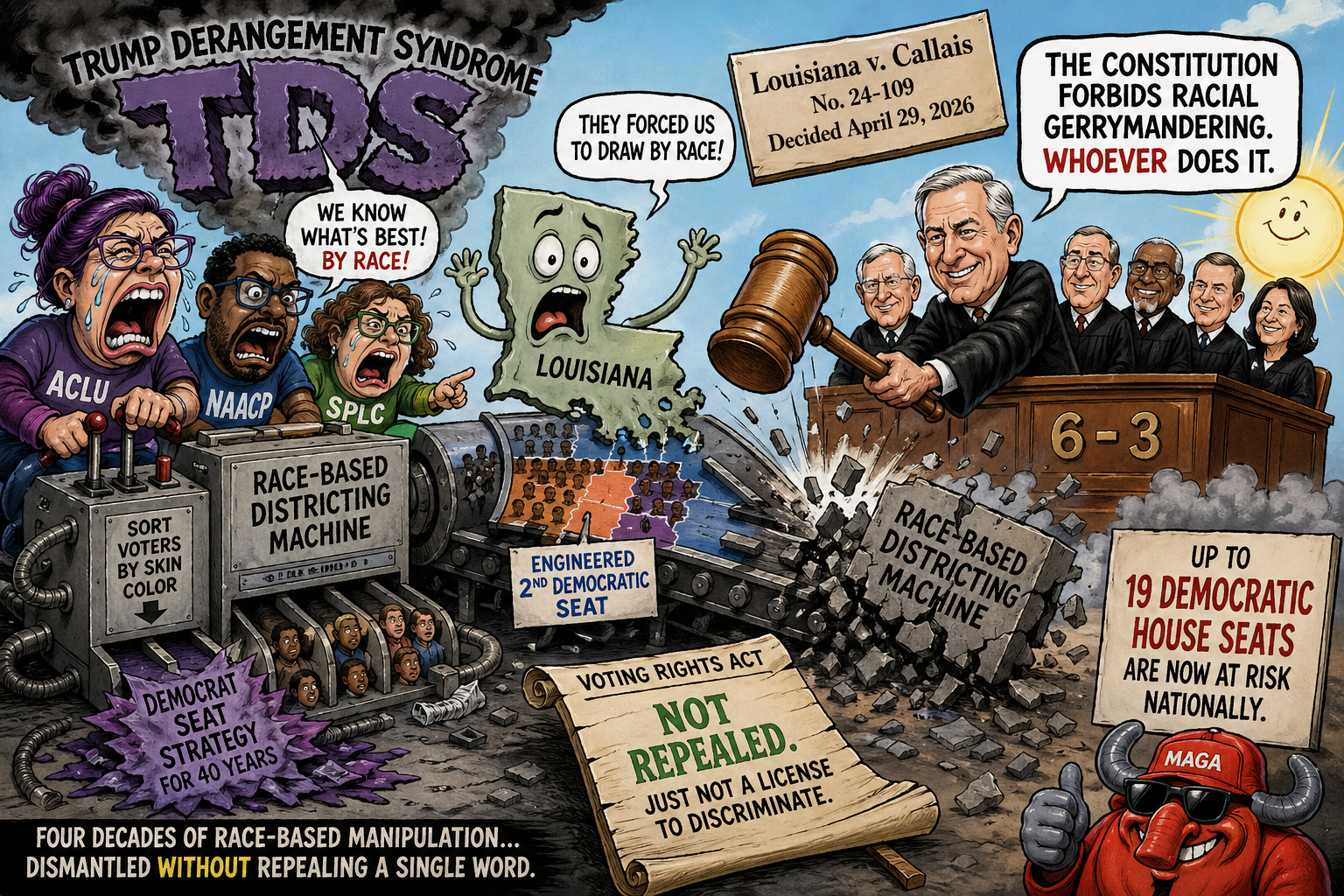
For four years, Democratic-aligned civil rights organizations used federal courts to force Louisiana to sort voters by skin color — manufacturing a second safe Democratic congressional seat. The Supreme Court, 6-3, said the Constitution forbids it. Whoever does it.
Up to 19 Democratic House seats are now at risk nationally. The VRA’s race-based districting machine — a cornerstone of Democratic seat strategy for four decades — has been effectively dismantled without a single word of the statute being repealed.
The ruling: Louisiana’s race-redrawn 6th Congressional District is an unconstitutional racial gerrymander. The Voting Rights Act did not require the state to create it. Using race without a valid VRA justification violates the Equal Protection Clause.
The majority: Alito (author), Roberts, Thomas, Gorsuch, Kavanaugh, Barrett — 6 votes.
The dissent: Kagan (author), Sotomayor, Jackson — 3 votes.
What it kills: The standard VRA Section 2 enforcement framework built on Thornburg v. Gingles (1986) is gutted. States can no longer be compelled to draw majority-minority districts unless plaintiffs prove present-day intentional racial discrimination — not merely racially polarized voting or historical disadvantage.
National exposure: Up to 19 Democratic House seats, 25% of Congressional Black Caucus seats, and active redistricting litigation in AL, GA, TX, FL, MS, NC, SC, and VA.
How Democrats Used Federal Courts to Draw Their Own Districts.
After the 2020 census, the Republican-controlled Louisiana legislature passed House Bill 1 in February 2022 — a congressional map with five non-Black-majority districts and one majority-Black district. Louisiana’s Black population was 33% of the state. Critics argued that threshold mathematically supported two majority-Black seats.
Within days of HB 1’s passage, the NAACP Legal Defense and Educational Fund (LDF) and the Power Coalition for Equity and Justice — a Louisiana progressive voter mobilization group aligned with Democratic organizing infrastructure — filed Robinson v. Ardoin in federal court. The lawsuit named nine individual Black voters and two organizations as plaintiffs.
Their argument: under Thornburg v. Gingles (1986), the state’s Black population was large enough, compact enough, and politically cohesive enough to support a second majority-Black district, and racially polarized white voting consistently defeated Black-preferred candidates. Louisiana’s one-district map diluted Black votes in violation of Section 2 of the VRA.
In June 2022, Federal District Judge Shelly Dick — an Obama appointee in the Middle District of Louisiana — ruled for the plaintiffs and ordered the legislature to draw a second majority-Black district. Behind this litigation, publicly: Eric Holder, former Obama Attorney General and chairman of the National Democratic Redistricting Committee, had been vocally advocating aggressive Section 2 enforcement as an explicit Democratic strategy to reclaim congressional seats in Republican-controlled states.
Plaintiffs: NAACP LDF + Power Coalition for Equity and Justice + 9 Black Louisiana voters
Presiding judge: Judge Shelly Dick, Middle District of Louisiana (Obama appointee, 2013)
Political backing: Eric Holder (D), former U.S. AG · National Democratic Redistricting Committee
Supporting briefs: ACLU, multiple Democratic state parties
What they won: A court order forcing Louisiana to draw a second majority-Black — and reliably Democratic — congressional district
SCOTUS Told Louisiana to Draw It. Then SCOTUS Said Drawing It Was Unconstitutional.
In June 2023, the Supreme Court decided Allen v. Milligan — a near-identical case from Alabama where the same question was posed: does Section 2 require a second majority-Black district? In a 5-4 decision, with Chief Justice Roberts and Justice Kavanaugh joining the three liberal justices, the Court said yes. States with sufficient Black population must draw majority-minority districts where the Gingles conditions are met.
Louisiana, now under binding court orders and aligned with the precedent of Allen v. Milligan, enacted Senate Bill 8 in 2024 — creating a new 6th Congressional District as the second majority-Black seat. Attorney General Liz Murrill later said Louisiana drew it “under protest.”
Almost immediately, conservative plaintiffs organized by lawyers connected to the Project on Fair Representation — the Edward Blum-affiliated organization that ended race-conscious college admissions in Students for Fair Admissions v. Harvard/UNC (2023) — filed Callais v. Landry, arguing SB 8 was itself an unconstitutional racial gerrymander. The Trump administration’s DOJ supported the Callais plaintiffs, with Principal Deputy Solicitor General Hashim Mooppan calling the map a “reverse partisan gerrymander” based on “purely racial” considerations.
The case was argued twice — March 2025 and October 15, 2025 (the Court unusually ordered re-argument, signaling it wanted to settle deeper constitutional questions). On April 29, 2026, the ruling came down: 6-3. The map Louisiana was ordered to draw was unconstitutional all along.
Feb 2022: Louisiana passes HB 1 — one majority-Black district. NAACP LDF sues within days.
June 2022: Judge Shelly Dick (Obama appointee) orders Louisiana to draw a 2nd majority-Black district.
June 2023: SCOTUS, 5-4 (Roberts + Kavanaugh with liberals), affirms in Allen v. Milligan — states must draw majority-minority districts under VRA Section 2.
2024: Louisiana enacts SB 8 under court deadline — 2nd majority-Black district created. AG Murrill calls it “under protest.”
2024–25: Callais plaintiffs (Blum-linked) sue: SB 8 is an unconstitutional racial gerrymander.
Oct 15, 2025: Second SCOTUS oral argument. NAACP LDF President Janai Nelson argues for Louisiana’s Black voters — her first Supreme Court argument.
April 29, 2026: SCOTUS, 6-3: SB 8 is an unconstitutional racial gerrymander. Louisiana was wrong to draw it, even under court orders.
6-3. Alito Writes. Thomas Wants More. Kagan Says the VRA Is Dead.
Justice Alito’s majority held that Louisiana had no valid compelling interest to use race in drawing SB 8, because Section 2 of the VRA — properly construed — did not require the district in the first place. The Court rewrote the evidentiary standard for Section 2 claims: plaintiffs can no longer rely on racial polarization alone or historical discrimination. They must produce evidence of present-day intentional racial discrimination — a standard Congress explicitly removed from the VRA when it amended the statute in 1982.
“Because the Voting Rights Act did not require Louisiana to create an additional majority-minority district, no compelling interest justified the State's use of race in creating SB8, and that map is an unconstitutional racial gerrymander.”
Justice Samuel Alito — Majority opinion, Louisiana v. Callais (2026)
“The Constitution almost never permits a State to discriminate on the basis of race, and such discrimination triggers strict scrutiny. Allowing race to play any part in government decision-making represents a departure from the constitutional rule that applies in almost any other context.”
Justice Alito — Majority opinion
Justice Thomas (joined by Gorsuch) concurred but argued the majority did not go far enough. Thomas called the entire Gingles framework a “disastrous misadventure” — built on the “race essentialism” premise that all members of a racial group think alike and vote as a bloc. He has held this view for decades and signaled willingness to strike down Section 2’s race-based districting requirements entirely.
Justice Kagan’s dissent was pointed:
“Today's decision renders Section 2 all but a dead letter. Under the Court's new view of Section 2, a State can, without legal consequence, systematically dilute minority citizens' voting power.”
Justice Elena Kagan — Dissent, Louisiana v. Callais (2026)
“Today's decision is the latest chapter in the majority's now-completed demolition of the act. I dissent because the Court betrays its duty to faithfully implement the great statute Congress wrote.”
Justice Kagan — Dissent
Kagan noted that Alito’s majority effectively “revived the intent standard Congress rejected in 1982” — reimposing a requirement that Congress had deliberately removed to make the VRA more enforceable.
Louisiana’s Own AG Refused to Defend the Map She Was Forced to Draw.
In an extraordinary move, Louisiana Attorney General Liz Murrill (R) refused to defend SB 8 before the Supreme Court — the very map her state had been ordered to draw. She argued the map existed only because of unconstitutional federal court pressure, and she wanted no part of defending a race-based system she found repugnant.
“Our Constitution prohibits the sorting of Americans into voting districts based on their skin color — and Louisiana wants no part of that abhorrent system.”
Louisiana AG Liz Murrill (R) — statement on Louisiana v. Callais
“We did so under protest and defended it because the Supreme Court's backwards precedents permit that district. But I am grateful that the Court has now asked the parties to brief whether this entire system is constitutional. My answer: it is not.”
AG Murrill — same statement
Murrill also noted that the 14th Amendment “commands that the government ‘may never use race as a stereotype or negative.’ Yet race-based redistricting rests on an invidious stereotype: that all minorities, by virtue of their membership in their racial class, think alike and share the same interests and voting preferences.”
The White House:
“The color of one's skin should not dictate which congressional district you belong in. We commend the court for putting an end to the unconstitutional abuse of the Voting Rights Act and protecting civil rights.”
Abigail Jackson, White House Spokeswoman — April 29, 2026
Up to 19 Democratic Seats. Eight States. The 2026 Map Is Being Redrawn.
The ruling does not only affect congressional districts — it governs all redistricting at every level of government: state legislative chambers, county commissions, school boards, municipal councils. Every majority-minority district in America drawn under the old Gingles standard is now potentially vulnerable to challenge.
The Democratic Redistricting Machine — and the Group That Stopped It.
The original Robinson v. Ardoin lawsuit was a coordinated legal campaign. The NAACP LDF is the oldest civil rights legal organization in America and is historically aligned with the Democratic Party’s political coalition. The Power Coalition for Equity and Justice is a Louisiana progressive organizing group embedded in Democratic voter mobilization. The ACLU filed supporting briefs.
Behind the litigation strategy: Eric Holder (D), Obama’s Attorney General from 2009 to 2015, who chairs the National Democratic Redistricting Committee. Holder has publicly described aggressive VRA Section 2 enforcement as a mechanism for Democrats to reclaim House seats in states where they lack control of the legislature. It was, in plain terms, a partisan seat strategy wrapped in civil rights language — relying on the premise that majority-Black districts produce majority-Democratic representatives, which they reliably do at 85–95% Democratic vote shares.
The Callais counter-litigation was organized by lawyers affiliated with the Project on Fair Representation— Edward Blum’s organization, the same group that ended race-conscious admissions at Harvard and UNC in 2023. The Trump DOJ joined their side, characterizing Louisiana’s court-ordered map as a “reverse partisan gerrymander” based on “purely racial considerations.”
For race-based districts: NAACP LDF · Power Coalition · ACLU · Eric Holder’s NDRC · Obama-era DOJ litigation infrastructure
Against race-based districts: Project on Fair Representation (Edward Blum) · Trump DOJ · Louisiana AG Murrill · 6-3 SCOTUS majority
The constitutional reality: The 14th Amendment says the government may never use race as the predominant factor in how it treats citizens. The Court ruled this applies to congressional redistricting — whoever does it, whatever the justification.
For forty years, the Voting Rights Act was used as a seat-manufacturing tool — forcing states to draw race-based districts that reliably elected Democrats in states those Democrats couldn’t otherwise win.
Louisiana v. Callais ends that mechanism. Not by repealing the VRA — not a word of the statute changes. But by raising the evidentiary bar so high that the standard Gingles claim is no longer viable. The new rule: unless you can prove present-day intentional racial discrimination, a state has no obligation to draw race-based districts.
The deeper irony: Louisiana drew SB 8 because Allen v. Milligan (2023) told it to. Three of the five justices who voted for that mandate — Roberts, Kavanaugh, Barrett — switched sides here. The state did exactly what the court ordered and got struck down for it.
Attorney General Murrill, who refused to defend a district her own state was compelled to draw, put it plainly: you cannot sort Americans into voting boxes by the color of their skin. The Constitution says so. It always did. It took twenty-three years of VRA litigation to get back to that sentence.
- 1.SCOTUS — Louisiana v. Callais, No. 24-109 (full opinion PDF)
- 2.SCOTUS docket — No. 24-109
- 3.NAACP LDF — Louisiana v. Callais case page
- 4.NAACP LDF — Robinson v. Landry (original lawsuit)
- 5.Fox News — Supreme Court rules on Voting Rights Act / redistricting
- 6.NBC News — Supreme Court limits use of race in redistricting
- 7.CBS News — Supreme Court / Louisiana congressional map
- 8.The Hill — Supreme Court Voting Rights Act ruling
- 9.Axios — SCOTUS redistricting / race gerrymander
- 10.Louisiana AG Liz Murrill — official press release
- 11.Louisiana Illuminator — full procedural history of the redistricting case
- 12.Stanford Law — oral argument analysis, Louisiana v. Callais (Oct 2025)
- 13.WHYY — How VRA ruling affects Black congressional districts
- 14.Issue One — How Louisiana v. Callais could impact pre-midterm redistricting
- 15.The Post Millennial — SCOTUS rules using race in redistricting unconstitutional
- 16.Democracy Docket — opposing perspective on the ruling
- 17.Wikipedia — Louisiana v. Callais