
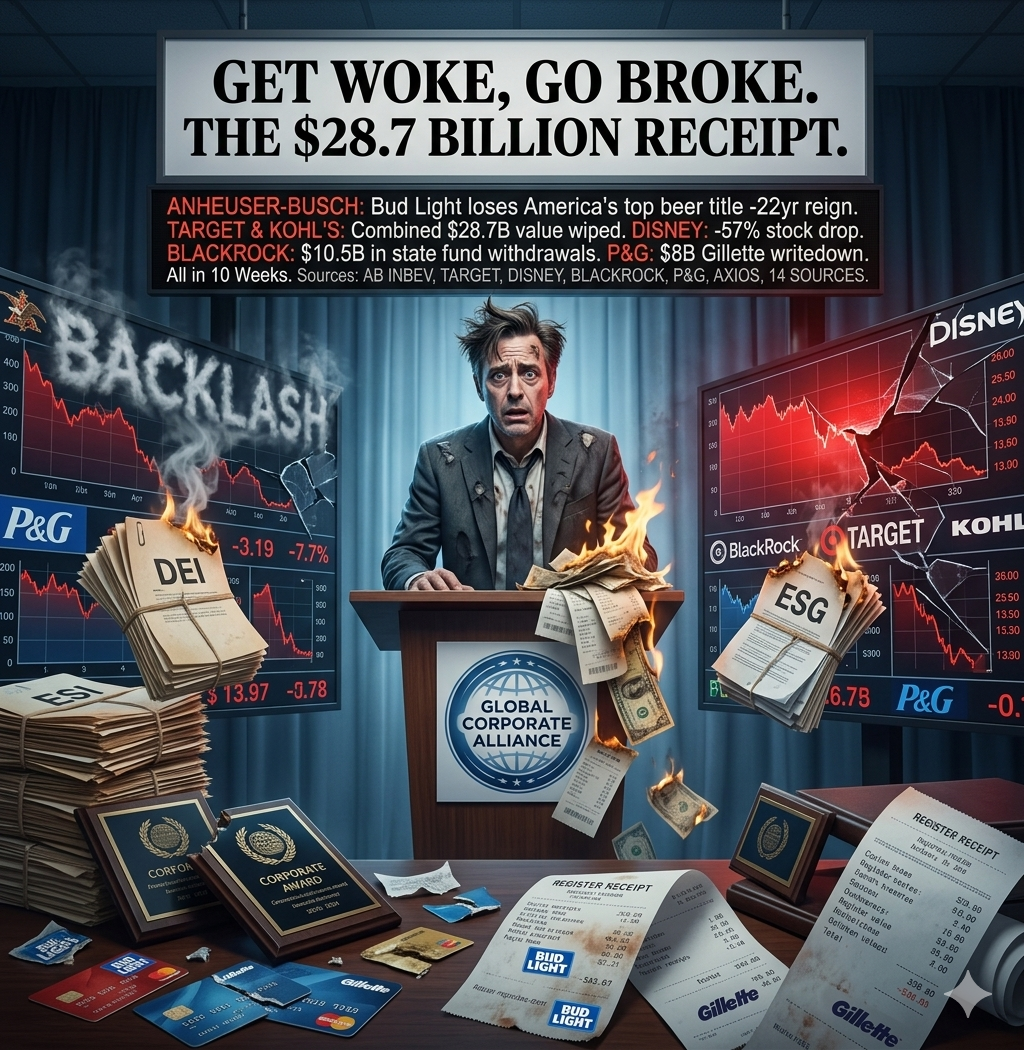
Get Woke,
Go Broke.
The $28 billion receipt.
In 2023 alone, Target, Anheuser-Busch, and Kohl’s wiped out $28.7 billion in combined market value after consumers revolted against their progressive brand campaigns. Bud Light lost its 22-year title as America’s best-selling beer. Disney’s stock collapsed 57% from its 2021 peak. BlackRock watched states pull $10.5 billion in funds over ESG. P&G took an $8 billion writedown on Gillette after the “toxic masculinity” ad campaign. This is the documented financial record of woke going broke — in exact numbers, dated, sourced.
Three Companies. Ten Weeks. Twenty-Eight Billion Dollars.
On June 16, 2023, Axios published the summary figure: Target, Anheuser-Busch, and Kohl’s had collectively shed at least $28.7 billion in combined market capitalization since the beginning of April — a ten-week stretch in which each company either launched a progressive brand campaign, faced a consumer backlash, or both.
The story was not that consumers boycotted products over politics — that happens routinely. The story was the scale: the dollar amounts were large enough to show up in quarterly earnings reports, on analyst calls, and in SEC filings. These were not Twitter mobs with no purchasing power. These were actual customers, at scale, who stopped buying.
Anheuser-Busch / Bud Light: Dylan Mulvaney partnership announced April 1, 2023. Stock dropped ~$5B in first two weeks. US volume down 14%, US revenue down 10.5% in Q2. Full-year North America revenue loss: $1.4 billion.
Target: Pride Month merchandise controversy broke ~May 22, 2023. Stock fell from $152 to $131 — roughly $9 billion in market cap erased. Q2 same-store sales: −5%.
Kohl’s: Boycott calls over LGBTQ children’s clothing starting May 30, 2023. KSS stock fell more than 5% in a single day; down 11.78% over the prior month.
Open the post on X to view the full content — text, image, or video.
22 Years as America’s Best-Selling Beer. Gone in one partnership.
Bud Light had been the best-selling beer in the United States for 22 consecutive years. On April 1, 2023, the brand partnered with transgender influencer Dylan Mulvaney for a social media promotion. Mulvaney posted a custom Bud Light can with her face on it to celebrate “365 days of girlhood.” The boycott response was immediate and, as the earnings reports would confirm, lasting.
The full-year 2023 toll: North America organic revenue fell $1.4 billion. CNN put the total 2023 sales loss at over $1 billion. By mid-2023, Modelo Especial had dethroned Bud Light as the best-selling beer in America — a position Bud Light had held uninterrupted since 2001. One year after the boycott began, Bud Light’s sales were still approximately 40% below pre-boycott levels.
Two executives were placed on leave in the immediate aftermath. Alissa Heinerscheid, VP of Marketing for Bud Light, was replaced by Todd Allen. Daniel Blake, VP of Mainstream Brands, was also placed on leave simultaneously. AB InBev described these as voluntary. Former employees described them differently.
“Bud Light had been kind of a brand of fratty, kind of out-of-touch humor, and it was really important that we had a campaign that was truly inclusive and actually had a moment of real authenticity.”
Alissa Heinerscheid, Bud Light VP of Marketing — prior to being placed on leave, April 2023
Donald Trump · Truth Social · February 6, 2024 — Anheuser-Busch 'deserves a Second Chance' after 'mistake of epic proportions'
Open the post on X to view the full content — text, image, or video.
A $9 Billion Market Cap Loss. In two weeks.
Target’s 2023 Pride Month collection launched in late May and included merchandise from a brand whose owner had publicly discussed “Satanic” themes — a detail picked up by conservative media that went viral almost immediately. Target subsequently moved some displays toward the back of stores in Southern states after receiving safety threats. That decision drew criticism from both directions: the right for doing the display at all, the left for “caving” to pressure.
The stock market verdict was unambiguous. TGT stock dropped from approximately $152 to $131 within days of the controversy breaking — a 14% decline. Fox Business cited a market cap loss of $9 billion. Other measurements, using a slightly wider window, show the market cap declined from over $74 billion to $60.3 billion — a loss of roughly $14 billion. Target’s Q2 2023 same-store sales fell 5% overall; e-commerce was down 10%.
Shareholders filed suit, alleging the company’s executives knew the campaign was politically volatile and failed to disclose that risk to investors. The lawsuit named specific internal communications. Target settled the dispute without any public admission of wrongdoing or release of those communications.
Open the post on X to view the full content — text, image, or video.
Stock price: $152 → $131 within days of the controversy — approximately −14%
Market cap lost: ~$9 billion (Fox Business) to ~$14 billion (broader measurement)
Q2 2023 same-store sales: −5% overall; e-commerce −10%
Shareholder lawsuit: Filed, alleging failure to disclose political risk. Settled.
$200 to $85. A 57% Collapse. The most expensive culture war in entertainment history.
Disney’s stock hit an all-time closing high of $197.26 on March 8, 2021. By the time CEO Bob Chapek was fired on November 20, 2022, the stock had fallen to approximately $85 — a 57% decline in 20 months. Disney’s total return for 2022 alone was −43.91%, the worst annual performance in five decades.
Multiple factors drove the collapse: COVID shutdowns of theme parks, massive streaming spending losses, and broader market conditions. But the proximate political trigger was Chapek’s handling of Florida’s Parental Rights in Education Act in early 2022. Internal employee groups pressured Chapek to publicly oppose the legislation. He did — clumsily, late, and to devastating effect. Florida Governor Ron DeSantis retaliated by revoking Disney’s Reedy Creek special district, which had functioned as a self-governing municipal entity since 1967. Disney was also battling internal employee walkouts over its DEI commitments, which critics argued were simultaneously not enough for progressives and too much for the audience.
The streaming losses were staggering on their own: Disney’s Direct-to-Consumer segment posted an operating loss of $4 billion in FY2022— losing $1 for every $5 in Disney+ subscription revenue. Chapek was fired and Bob Iger returned. Iger subsequently told a town hall that Disney had become “too preachy” and that it had “enrage[d] the audience.” He received a $20+ million severance. Chapek, not Iger, took the public blame.
“I've asked [creative executives] to quiet some of that down a bit. I want to get back to pure storytelling. Not as a message movie, but as a good story.”
Bob Iger, Disney CEO — returning after Chapek's firing, December 2022
Donald Trump · Truth Social · April 18, 2023 — 'DeSanctus is being absolutely destroyed by Disney. His original P.R. plan fizzled.'
Florida. Texas. $10.5 Billion. And Larry Fink stopped saying the word “ESG.”
BlackRock CEO Larry Fink had spent years writing annual letters to CEOs urging companies to align their corporate behavior with environmental, social, and governance (ESG) principles. By 2022, Republican-led states had seen enough. The coordinated pushback came in two major waves.
In December 2022, Florida CFO Jimmy Patronis announced the withdrawal of $2 billion from BlackRock — $600 million in short-term investments removed immediately and $1.43 billion in long-term securities frozen. Texas school retirement funds had already moved $8.5 billion out of BlackRock, the largest single state divestment from the firm. Louisiana, Missouri, and other Republican-controlled states followed with additional withdrawals. Nineteen attorneys general from GOP-led states wrote to BlackRock warning that ESG strategies may violate fiduciary duties to public pension beneficiaries.
In June 2023, Fink told an audience that he had stopped using the term “ESG” in conversations. “It’s been weaponized by the far left and weaponized by the far right,” he said. The man who had written the annual ESG letters now found the word too politically toxic to say out loud.
Texas: $8.5 billion withdrawn from BlackRock — largest single state divestment over ESG
Florida: $2 billion withdrawn by CFO Patronis — $600M immediate, $1.43B frozen (December 2022)
Louisiana, Missouri, and others: Additional withdrawals; 19 GOP state AGs wrote to warn of fiduciary violations
Larry Fink’s response: Stopped using the term “ESG” publicly — June 2023
P&G Took an $8 Billion Writedown on Gillette. The ad came first.
On January 14, 2019, Procter & Gamble released “We Believe: The Best Men Can Be” — a Gillette ad that lectured men about “toxic masculinity,” bullying, and sexual harassment. The ad received 1.5 million dislikes on YouTube (before the dislike count was hidden) and sparked an immediate, polarized reaction. Gillette’s brand had built its franchise on athletic achievement and aspiration; the new campaign reframed the customer as a moral problem to be solved.
In its fiscal fourth quarter 2019, P&G reported an $8.0 billion noncash impairment charge on Gillette’s goodwill and intangible assets — resulting in a net loss of $5.24 billion for the company. The $8 billion figure is real and documented in P&G’s official earnings filing.
P&G’s official explanation attributed the writedown to currency fluctuations, increased competition from cheaper brands (Dollar Shave Club, Harry’s), and a secular trend of men shaving less frequently. The company did not name the “toxic masculinity” ad as a contributing factor. Critics — including multiple financial analysts and conservative commentators — argued the ad had accelerated brand erosion by alienating Gillette’s core demographic. P&G never confirmed or denied the ad’s contribution to the impairment. The $8 billion writedown is documented fact. The causal link to the specific ad remains contested. Both things are true simultaneously.
Impairment charge: $8.0 billion noncash — Gillette goodwill and intangible assets
Net result: P&G reported a net loss of $5.24 billion for the quarter
Official P&G explanation: Currency headwinds, competitive pressure, declining shaving frequency among men
The ad timeline: “Best Men Can Be” released January 14, 2019 — impairment reported July 2019
Who Decides to “Go Woke”? Follow the marketing department.
In every documented case, the decision to align the brand with progressive social politics came from a specific layer of the corporate hierarchy: marketing and communications leadership, frequently (though not exclusively) in companies headquartered in major coastal metros, under pressure from activist employee groups and ESG-oriented institutional investors. The C-suite often ratified rather than initiated.
At Bud Light, the decision came from Alissa Heinerscheid — who explicitly said the goal was to make the brand “more inclusive” and shed its “fratty, out-of-touch” image. The customer base she described as “out-of-touch” was the customer base that had made Bud Light America’s best-selling beer for 22 years. It stopped buying. Heinerscheid was placed on leave within three weeks.
At Disney, internal “inclusion” and “diversity” initiatives became central to the content pipeline under Chapek. Leaked internal meetings showed executives discussing goals of increasing LGBTQ representation in every quarter of content output. When the Florida fight forced the political position into the open, Chapek’s core dilemma was documented: he couldn’t satisfy progressive employees without alienating Florida, and he couldn’t satisfy Florida without triggering the progressive employees. He satisfied neither. He was fired.
The pattern is the same across companies. A senior marketing or DEI-adjacent executive makes a bet that progressive brand alignment will attract new customers and retain progressive employees — and that the core customer base either won’t notice, won’t care, or won’t act. In 2019 it was largely correct. By 2023, that bet was being repriced.
The market sent the message in the only language corporations actually hear: earnings reports.
$28.7 billion in market cap erased in ten weeks across three companies. Bud Light, which had been America’s best-selling beer for 22 years, lost that title permanently. Disney fired a CEO who tried to steer the company into a Florida culture war and watched his stock fall 57%. BlackRock watched Republican states pull $10.5 billion in pension funds. P&G took an $8 billion writedown on Gillette six months after lecturing its customers about toxic masculinity.
None of these companies were forced into these campaigns. Each was a deliberate executive decision, made by identifiable people, with a theory of the business that the numbers subsequently disproved. The customers did not boycott because they hated diversity. They stopped buying because the brands decided to make a political argument at the point of sale — and the customers decided they weren’t buying the argument.
Larry Fink now refuses to say “ESG.” Bob Iger said Disney was “too preachy.” AB InBev’s two lead marketing executives were placed on leave within three weeks. The market consensus has been filed. The receipts are above.
- 1.Axios — The financial toll of right-wing backlash: At least $28B in market value (June 16, 2023)
- 2.AB InBev Q2 2023 Earnings — US revenue −10.5%, depletions −14%, EBITDA −28.2% (BusinessWire, August 2, 2023)
- 3.AB InBev Full Year 2023 Results — North America organic revenue −$1.4B, volume −12.1% (BusinessWire, February 2024)
- 4.CNN — Bud Light sales losses: Over $1 billion in 2023 (February 2024)
- 5.NielsenIQ via multiple outlets — Bud Light volume down 29.5% week ending May 20, 2023
- 6.Fox Business — Target market cap loses $9 billion in Pride Month backlash (May 2023)
- 7.CNN — Two Bud Light executives placed on leave following Dylan Mulvaney backlash (April 2023)
- 8.Newsweek — Modelo Especial dethrones Bud Light as America's top-selling beer (June 2023)
- 9.CNBC — Florida CFO Jimmy Patronis withdraws $2 billion from BlackRock (December 2022)
- 10.Washington Examiner — Texas pulls $8.5 billion from BlackRock over ESG (largest state withdrawal)
- 11.P&G Fiscal Q4 2019 Earnings — $8.0 billion Gillette impairment charge, net loss $5.24B
- 12.Reuters — Disney stock 2021–2023 decline; Chapek firing November 20, 2022
- 13.Disney FY2022 Annual Report — $4 billion streaming operating loss (Direct-to-Consumer segment)
- 14.Wall Street Journal — Larry Fink says 'ESG' has become too politicized (June 2023)