
98 Cents Gone. The Rial, the Blockade, and the Body Count.
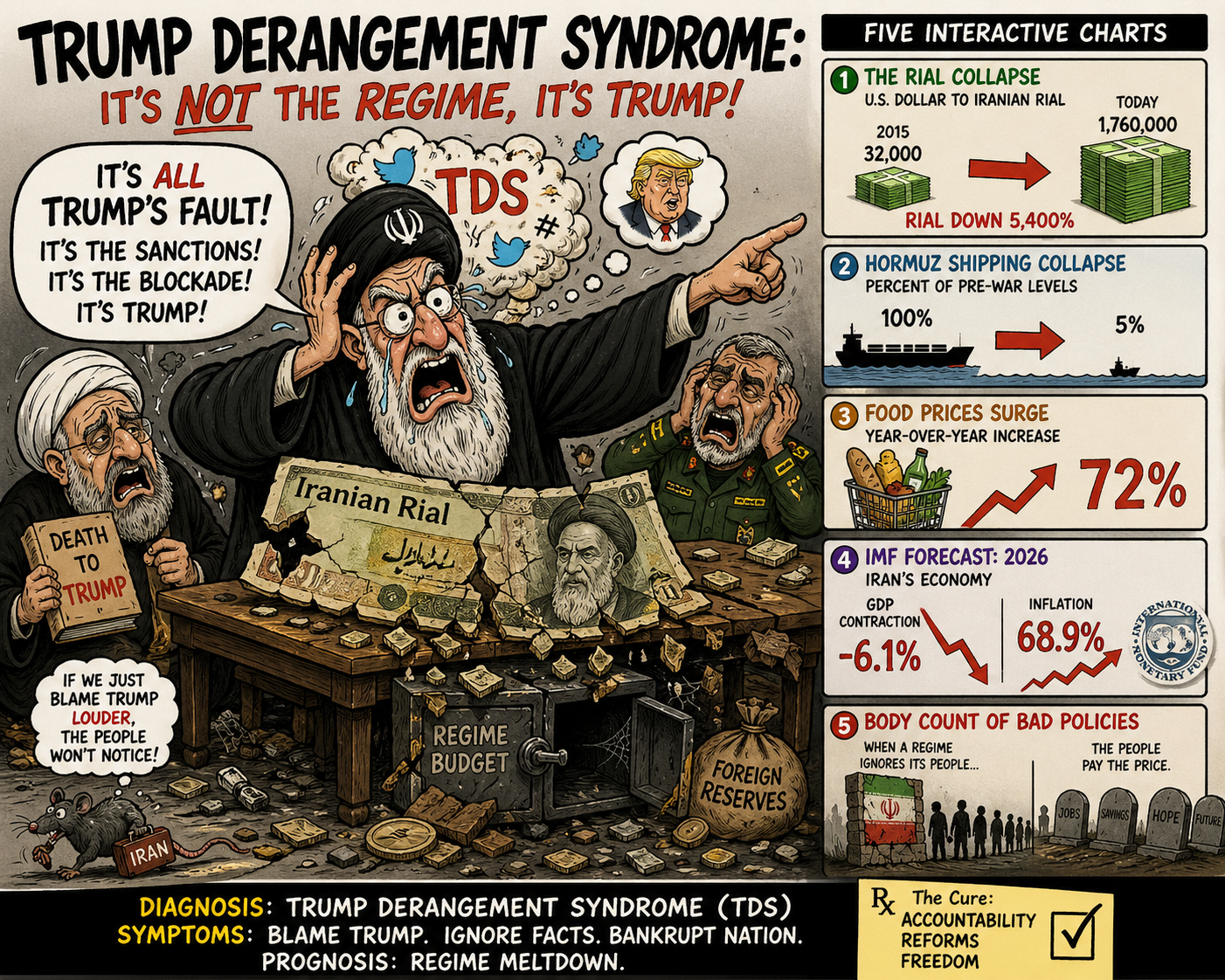
In 2015, one U.S. dollar cost 32,000 Iranian rials. Today it costs 1.76 million. The naval blockade has cut Hormuz shipping to 5% of pre-war levels. Food prices are up 72% year-over-year. The IMF projects Iran’s economy to contract 6.1% in 2026 — with 68.9% inflation. The regime that built this situation is running out of money to hold it together.
Primary sources: IMF World Economic Outlook · U.S. Treasury OFAC · Iran State Statistics Center · Kpler/Vortexa tanker tracking · HRANA human rights data · World Bank · FDD oil analysis.
The Iranian rial has been collapsing for a decade, but the pace since 2024 is categorically different. In July 2024, when President Masoud Pezeshkian took office, the rate stood at 584,000 rials per dollar. By December 29, 2025 — the day mass protests erupted across 200 Iranian cities — it had crashed to 1.42 million rials per dollar. As of April 29, 2026, it is 1.76 million.
That is a 98% devaluation against the dollar since 2015. For Iranian households paid in rials and buying any imported goods — food, medicine, fuel, clothing — that is not an economic statistic. It is the destruction of purchasing power in real time.
The Central Bank governor resigned on December 30, 2025, one day after the currency hit its record low. Parliament voted 182–273 to fire Economy Minister Abdolnaser Hemmati on March 2, 2025, citing his failure to control the currency and food prices. Pezeshkian then appointed Hemmati as Central Bank governor — the same man parliament had just removed for failing at the equivalent job.
The Central Bank maintains an official rate of approximately 1,315,000 rials/USD. The open market rate is 1,761,500. The gap — 34% — represents the premium Iranians pay to actually convert their money. Most ordinary transactions happen at the market rate. The official rate exists mainly so the government can subsidize politically sensitive imports (wheat, medicine) at below-market prices.
Oil is the Iranian government’s primary revenue source. Before maximum pressure 1.0 in 2019, Iran exported approximately 2.5 million barrels per day. Trump’s first-term sanctions drove that to roughly 400,000 bpd by mid-2019. The Biden years saw a recovery to 1.4–2.15 million bpd as enforcement relaxed and Chinese teapot refineries absorbed Iranian crude at steep discounts.
That recovery reversed fast. NSPM-2 — Trump’s February 4, 2025 maximum pressure directive — immediately tightened enforcement. OFAC sanctioned over 60 additional tanker vessels in Iran’s shadow fleet in 2025, and designated Chinese teapot refineries that were the primary end-buyers. Iranian crude was already selling at an $8/barrel discount to Brent by end-2025.
Then the naval blockade began. On April 13, 2026, following the failure of U.S.-Iran talks in Islamabad, CENTCOM imposed a full naval blockade of Iranian ports. Vessel traffic through the Strait of Hormuz dropped to approximately 5% of pre-conflict levels.
Iran’s headline inflation hit 52.6% year-over-year in December 2025, per Iran’s own State Statistics Center. The IMF ranked Iran fourth globally for inflation — behind only Venezuela, Sudan, and Zimbabwe — and projects the rate will accelerate to 68.9% in 2026.
Food inflation is far worse than the headline. Food, beverages, and tobacco were up 72% year-over-year in December 2025. The State Statistics Center specifically cited dairy products and bread as leading monthly increases — the staples that make up the core of a working-class Iranian diet.
The rial’s collapse explains most of it. Iran imports a significant share of its food (wheat, cooking oil, feed grains, processed goods) and pays for those imports in hard currency. As the rial loses value, the rial-denominated price of anything imported rises in direct proportion. A bag of rice imported from India for $1 that cost 32,000 rials in 2015 costs 1.76 million rials today — a 5,400% increase in domestic-currency terms, even though the dollar price never changed.
As of April 2026 (Numbeo, Hikersbay, PriceIran live data):
- 12 large eggs2,252,810 rials~$1.28 at market rate
- Chicken (1 kg)3,300,000–3,500,000 rials~$1.87–$1.99
- Rice — domestic (1 kg)5,000,000 rials~$2.84
- Hamburger (restaurant)5,000,000 rials~$2.84
- Fried egg (restaurant)1,000,000 rials~$0.57
The dollar figures look modest. What they obscure: Iran’s official monthly minimum wage is approximately 160 million rials — equivalent to ~$91/month at current market rates. A kilogram of rice at 5 million rials consumes 3% of the monthly minimum wage. Experienced workers earning 22 million tomans (~$125/month) report nothing left after housing, utilities, and transport. Bread is still subsidized but subsidy coverage has been cut repeatedly; sangak and lavash prices are up 400–600% in nominal rial terms since 2021.
Iran had been growing — modestly, despite sanctions — through 2023 and 2024. The sanctions-evasion oil trade to China was providing real revenue; the construction sector was active; domestic manufacturing was limping along. That trajectory reversed sharply.
The IMF projects Iran’s real GDP to contract 6.1% in 2026 — simultaneously with 68.9% inflation. That combination — falling output, collapsing currency, and hyperinflationary price increases — is the definition of stagflation at its most severe. The World Bank projects a 16% decline in total exports for 2026 and notes that Iranian GDP already contracted in the final quarter of the fiscal year ending March 2026 as Hormuz tensions accelerated.
On December 28, 2025, the day the rial hit 1.45 million per dollar and food inflation was running at 72%, workers at Tehran’s Grand Bazaar stopped working. Within 48 hours, protests had spread to more than 200 cities and 675 locations across all 31 Iranian provinces. Encyclopaedia Britannica described it as the largest uprising in Iran since the 1979 Islamic Revolution.
The protests were economic in origin and political in demand. Workers, bazaar merchants, online businesses, and social media influencers joined a nationwide strike. The chants evolved from “we can’t afford bread” to calls for the end of the Islamic Republic.
“Down with the dictator. We want bread, work, and freedom.”
Protest chant documented across 200+ Iranian cities — December 2025
Supreme Leader Ali Khamenei ordered live fire. An internet and telecom blackout was imposed on January 8, 2026. HRANA, the Human Rights Activists News Agency, confirmed at least 7,015 deaths and 53,552 arrests as of February 5, 2026. Reports from local health officials cited by major outlets including Iran International and the Guardian put the death toll significantly higher — up to 30,000–36,500 killed during the January 8–9 crackdown alone. Iran recruited Iraqi militia fighters and Hezbollah operatives to assist in suppressing the uprising.
The Iranian government claimed 3,117 dead (calling many “terrorists”). HRANA confirmed 7,015 from documented cases. Iran International, citing local health officials operating under the internet blackout, reported 12,000+ as of January 13; some sources put the January 8–9 single-day toll at 30,000+. The internet blackout makes precise verification impossible. NPR reported “at least 6,126 killed” as of January 27. Whatever the true number: the regime used lethal force on its own population at a scale not seen since 1988.
Iran’s regional power has always been built on cash. The IRGC-Qods Force funds Hezbollah in Lebanon, Hamas and Palestinian Islamic Jihad in Gaza, the Houthis in Yemen, and Iraqi Shia militias — a proxy network that costs hundreds of millions of dollars annually and that Tehran can only afford when oil is flowing and the government has revenue to export.
The pipeline is degrading. The December 2024 fall of Assad in Syria severed a key financial conduit and smuggling route that Iran and Hezbollah relied on for years. OFAC designated Hezbollah exchange-house networks used to move Iranian cash. Houthi attacks on commercial shipping fell from 150 in 2024 to 7 in 2025, and Houthi operations outside Yemen have largely stopped since October 2025.
A U.S. official confirmed in November 2025 that Iran’s IRGC-Qods Force had transferred over $1 billion to Hezbollah since January 2025 — suggesting Iran has not formally cut Hezbollah off. But the structural conditions for sustained proxy funding are deteriorating: the Assad route is gone, OFAC is targeting the financial intermediaries, and Iran’s own budget is under extreme pressure.
The U.S. pressure campaign that preceded the February 28, 2026 military operation was deliberate and escalating.
- Feb 4, 2025Trump signs NSPM-2 (National Security Presidential Memorandum 2) reimposing Maximum Pressure on Iran. Steptoe / Baker McKenzie analysis confirms scope targets all Iranian oil revenues.
- Feb 6, 2025OFAC designates an international network for shipping Iranian crude to China — targeting entities in China, India, and UAE linked to Iran's Armed Forces General Staff and front company Sepehr Energy.
- Mar 2025OFAC begins sanctioning Chinese teapot refineries (Shandong Province) that were the primary buyers of Iranian crude. Iranian crude discount widens to $8/bbl vs. Brent.
- Dec 2025U.S. sanctions 29 additional vessels in Iran's shadow fleet. Over 60% of tankers that loaded Iranian crude in the prior 12 months are now sanctioned.
- Apr 24, 2026Washington Post: 'U.S. targets China's shadow trade with Iran in sweeping sanctions' — Treasury action against Chinese intermediaries.
- Apr 13, 2026U.S. imposes naval blockade on Iranian ports. 10,000+ personnel, 12+ warships, dozens of aircraft enforcing CENTCOM operation. Hormuz traffic: ~5% of pre-conflict levels.
Iran can't get their act together. They don't know how to sign a nonnuclear deal. They better get smart soon!
Iran’s government faces a simultaneous collapse across every pillar of economic stability. The currency has lost 98% of its dollar value since 2015 and is still falling. Oil exports — the primary revenue source — have been cut by the naval blockade to near-minimum pressure 1.0 levels. Inflation is at 52.6% and headed for 68.9%. GDP is projected to contract 6.1%. The largest protests since 1979 have already killed thousands and failed to unseat the regime — but demonstrated the depth of the social fracture.
Supreme Leader Ali Khamenei was killed in the February 28, 2026 U.S.-Israeli air campaign. His son Mojtaba was declared Supreme Leader but has not been publicly seen. The IRGC has consolidated control. Peace talks as of April 29, 2026 remain stalled: Iran has offered to reopen Hormuz in exchange for lifting the blockade, but has made zero nuclear concessions. Trump: “We have all the cards.”
The regime’s core problem: it needs oil revenue to fund the IRGC, the proxies, the food subsidies, and the patronage network that keeps the apparatus intact. The blockade eliminates that revenue. Every month the blockade holds, the fiscal position deteriorates. The question is not whether Iran can survive economically under these conditions. It cannot. The question is what the IRGC does when it cannot pay its people.
- IMF World Economic Outlook, April 2026 — Iran GDP and inflation projections (-6.1% GDP, 68.9% inflation)
- U.S. Treasury OFAC — Iran Sanctions (active designations, shadow fleet, teapot refineries)
- U.S. Treasury OFAC press release SB0308 — Hezbollah exchange network designations
- OFAC designation, February 6, 2025 — Iran Armed Forces shipping network, Sepehr Energy
- National Security Presidential Memorandum 2 (NSPM-2), February 4, 2025 — Maximum Pressure directive
- Iran State Statistics Center — December 2025 CPI data (food +72%, health +50%, headline 52.6%)
- World Bank Macro Poverty Outlook — Iran 2026 (GDP -2.8% projected, export decline 16%)
- Iran International — Rial collapse to 1.42M/USD, December 28–29, 2025
- Iran International — Economy Minister Hemmati fired by parliament, March 2, 2025
- PBS News — Central Bank governor resigns as rial hits record low, December 30, 2025
- Foundation for Defense of Democracies — Iran crude exports peak at 2.15M bpd, October 2025
- Bloomberg — Iran rial, Economy Minister firing, currency crisis (March 2, 2025)
- Al-Monitor — 44% year-over-year rial depreciation, March 2026
- HRANA — 2025–2026 Iran protests: 7,015 confirmed deaths, 53,552 arrests (February 2026)
- CNAS — Sanctions by the Numbers: 2025 Year in Review (1,300+ OFAC designations)
- Baker McKenzie / Steptoe — OFAC Iran maximum pressure 2.0 enforcement analysis, 2025–2026
- CBS News — U.S. naval blockade of Iran begins, April 13, 2026