
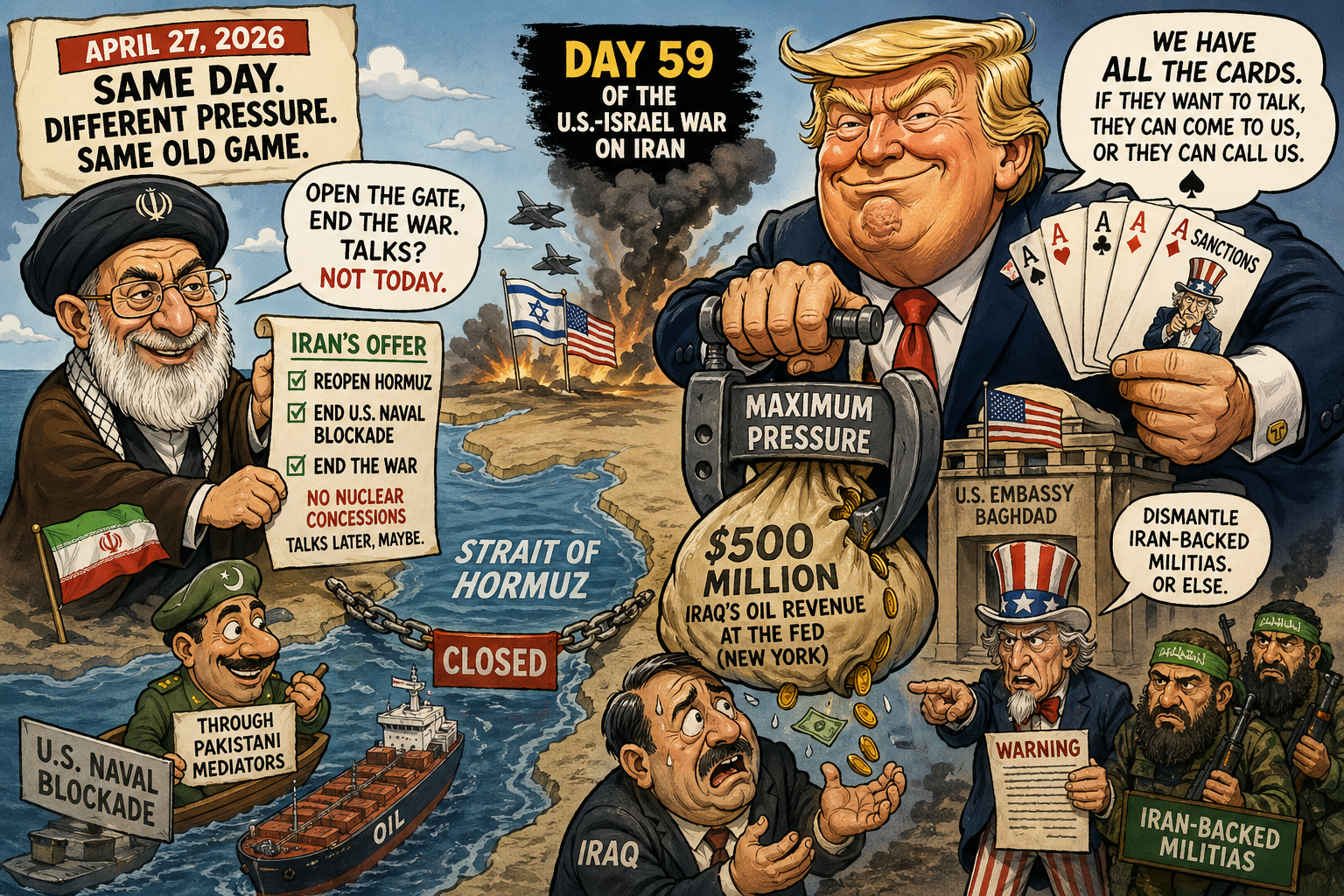
Iran offers to reopen Hormuz. Trump squeezes Iraq’s cash. Same day.
On Day 59 of the U.S.-Israel war on Iran, Tehran extended a new offer through Pakistani mediators on Monday, April 27, 2026: reopen the Strait of Hormuz if Washington lifts its naval blockade and ends the war. The offer makes no nuclear concessions — Iran wants those talks postponed to a later phase. Same morning, the U.S. Embassy in Baghdad warned the Iraqi government to dismantle Iran-backed militias, and the Treasury blocked a $500 million dollar shipment from Iraq’s oil-revenue accounts at the Federal Reserve Bank of New York. President Trump on Iran: “We have all the cards. If they want to talk, they can come to us, or they can call us.”
Pakistan walks the proposal in. Hormuz first. Nuclear later.
Per Reuters reporting cited by Fox News, PBS, the Washington Post, and Axios, Iran on Monday delivered a phased proposal to the United States via Pakistani mediators. The offer reorders the negotiation sequence Tehran had previously rejected: instead of nuclear concessions up front, Iran proposes three sequential stages:
“We have all the cards.”
President Trump met with his national security team on Monday morning, White House Press Secretary Karoline Leavitt confirmed — but cautioned the administration is not yet considering Iran’s offer in the form delivered. Speaking to Fox News on Sunday ahead of the formal proposal’s arrival, Trump set the tone:
“We have all the cards. If they want to talk, they can come to us, or they can call us.”
President Donald Trump · Fox News interview · April 26, 2026
Secretary of State Marco Rubio identified the structural problem from the U.S. side: Iran’s post-Khamenei leadership is itself “fractured”, with negotiators publicly contradicting each other on what Tehran is willing to concede. Trump’s extension of the ceasefire on April 21, per CNBC, cited the same “seriously fractured” framing.
Araghchi flew to Moscow. Sharif called Pezeshkian.
The diplomatic geography around the offer matters. Iran’s Foreign Minister Abbas Araghchi traveled to Russia Monday for talks with President Vladimir Putin — Iran’s most prominent remaining international backer outside of China. Pakistani Prime Minister Shehbaz Sharif, whose country has served as the principal mediator since the April 8 ceasefire, separately spoke with Iranian President Masoud Pezeshkian and warned about ceasefire violations.
Pakistan’s mediating role has been extensively documented since February: Islamabad brokered the original April 8 two-week ceasefire, hosted ongoing talks, and was the originally announced venue for the follow-on Kushner-Witkoff round Trump canceled on Friday. The Iranian negotiating team that was expected to return to Pakistan has, per the Iranian state outlet Tasnim, signaled that they will not appear for further in-person talks at this stage — making the Pakistani-conveyed written proposal Tehran’s primary current channel.
Treasury blocked $500 million in Iraqi oil dollars. The State Department warned Baghdad.
The Hormuz offer did not arrive in a vacuum. On the same Monday morning, the U.S. Embassy in Baghdad posted a public warning to the Iraqi government over Iran-backed militia activity — and the Wall Street Journal reported that Treasury had blocked a $500 million cash shipment from Iraq’s oil-revenue accounts at the Federal Reserve Bank of New York. It is the second blocked dollar delivery to the Central Bank of Iraq since the start of the U.S.-Israel war on February 28.
“Harakat Ansar Allah al-Awfiya terrorists have launched attacks across Iraq and the region, including the April 8 ambush of U.S. diplomats near the Baghdad International Airport. HAAA terrorists continue to undermine Iraqi sovereignty while threatening the safety and security of both Iraqi and U.S. civilians. The United States will not tolerate attacks on U.S. interests and expects the Iraqi government to immediately take all measures to dismantle the Iran-aligned militia groups in Iraq.”
U.S. Embassy in Baghdad · Official statement on X · April 27, 2026
The Trump administration has additionally suspended funding for some counterterrorism and military training programs with Iraqi forces until the militia attacks end and Baghdad takes verifiable steps to dismantle the Popular Mobilization Forces (PMF) — the umbrella Iran-backed militia network that operates inside the Iraqi state.
The reporting, in motion.
- ✓Iran has formally offered, via Pakistani mediators, to reopen the Strait of Hormuz IF the U.S. lifts its naval blockade and the war ends. Reuters, Fox News, PBS, Washington Post, Axios, Fortune, Al Jazeera, MS Now — all confirm.
- ✓The proposal makes ZERO nuclear concessions. Tehran wants nuclear talks postponed to a third stage, only after the war ends and the blockade lifts.
- ✓Iran's proposal arrived through Pakistan — Prime Minister Shehbaz Sharif called Iranian President Pezeshkian to convey/warn over ceasefire.
- ✓Iranian Foreign Minister Abbas Araghchi traveled to Russia Monday for talks with Putin — Iran's primary remaining major-power backer.
- ✓Trump met with his national security team Monday morning to discuss the proposal. Press Sec. Karoline Leavitt: 'I wouldn't say they're considering it.' Trump on Iran via Fox News Sunday: 'We have all the cards.'
- ✓Trump CANCELED the planned Kushner-Witkoff U.S. delegation to Pakistan on Friday, April 25 — talks already cooling before the Hormuz offer arrived.
- ✓Same morning the offer arrived: U.S. Treasury blocked a $500 million cash shipment from Iraq's oil-revenue accounts at the Federal Reserve Bank of New York. Second such block since the war began Feb 28.
- ✓U.S. Embassy in Baghdad publicly warned the Iraqi government to dismantle Iran-backed militias, naming Harakat Ansar Allah al-Awfiya (HAAA) and citing the April 8 ambush of U.S. diplomats near Baghdad International Airport.
- ✓U.S. has additionally suspended funding for some Iraqi counterterrorism and military training programs pending militia disbandment.
- ✓Trump's April 21 ceasefire extension cited Iran's 'seriously fractured' government as a primary obstacle. SecState Marco Rubio reaffirmed the framing Monday.
- ✓U.S. Navy retired its Bahrain-based minesweepers last year and now relies on drones / unmanned systems for any Hormuz mine-clearing — relevant given intelligence reports that Iran has laid 'at least a dozen mines' in the strait.
- ?Whether Trump will engage with the offer at all, modify it, or reject it outright. Press Sec. Leavitt's 'not considering it' framing leaves all three open.
- ?Whether Iran's 'fractured' leadership can deliver on any phased agreement even if Washington accepted Stage 1.
- ?Identity of the Iranian official who authored the proposal — Iran's negotiating team has been publicly contradicting itself for weeks.
- ?Specific terms of the proposed Hormuz reopening: timeline, mine-clearing responsibility, monitoring/verification mechanism.
- ?Whether Russia's separate Araghchi meeting in Moscow signals coordinated Tehran-Moscow positioning or a divergent backup plan.
- ?Iraqi government's response to the U.S. embassy's Monday militia ultimatum and the second blocked $500M dollar shipment.