
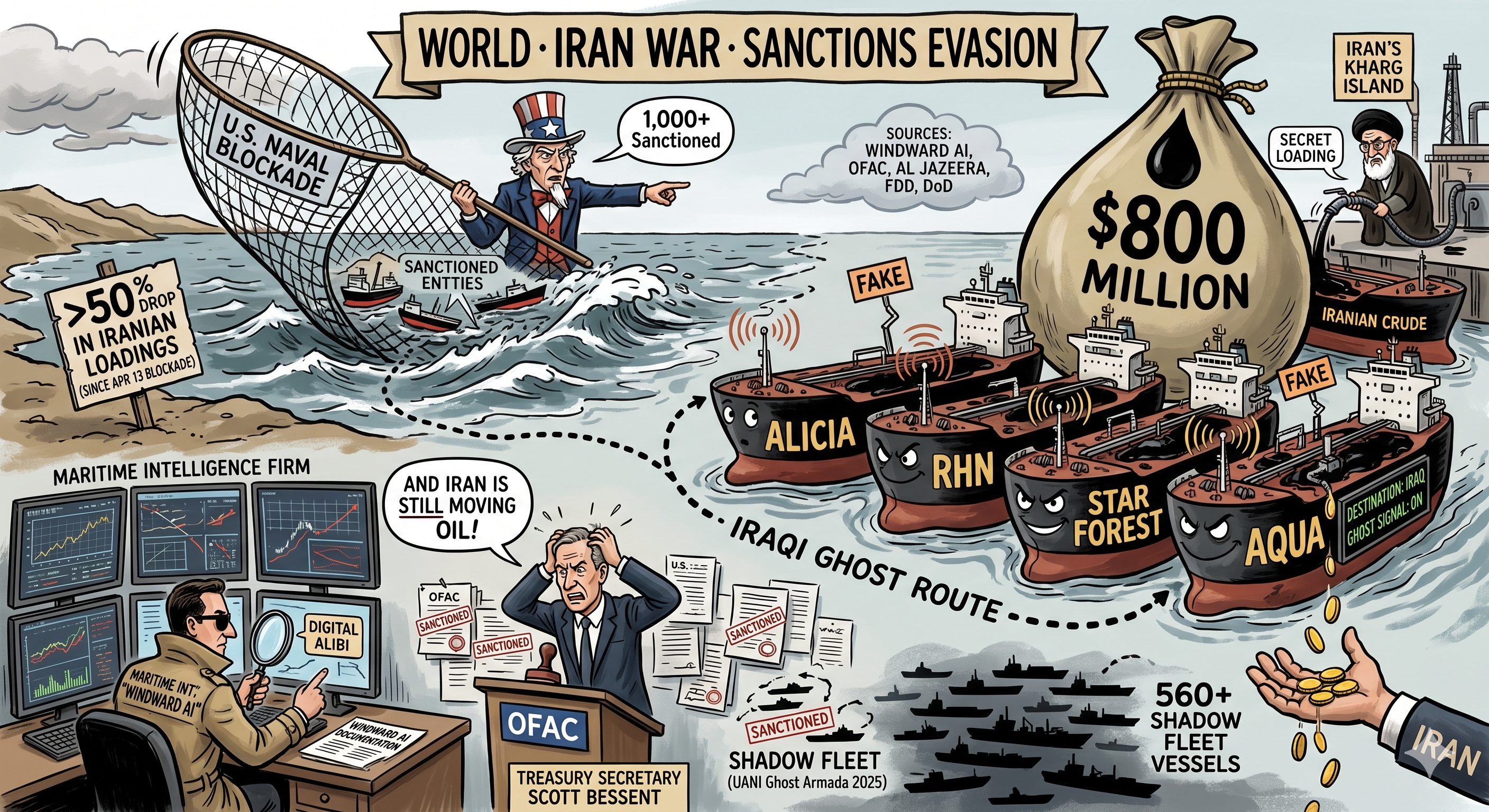
The Digital Alibi. Four tankers. $800 million. The Iraqi ghost route through the U.S. blockade.
Since the U.S. naval blockade of Iranian ports began April 13, four sanctioned Very Large Crude Carriers — the Alicia, RHN, Star Forest, and Aqua — have been broadcasting fake destination signals to Iraqi ports while secretly loading at Iran's Kharg Island. Combined capacity: 8 million barrels. Street value at current oil prices: $800 million. The method is called a "digital alibi." Maritime intelligence firm Windward AI documented it. Treasury Secretary Scott Bessent is sanctioning a thousand vessels. And Iran is still moving oil.
On April 13, 2026, the United States Navy began a formal blockade of Iranian ports — the most direct economic chokehold Washington has ever imposed on Tehran. Within days, Iranian oil loadings fell by more than half.
But four Very Large Crude Carriers — VLCCs, the largest class of oil tanker, each capable of hauling up to 2 million barrels — didn't stop. They found a workaround in data itself.
According to maritime intelligence firm Windward AI, the four ships — the Alicia (IMO 9281695), the RHN (IMO 9208215), the Star Forest (IMO 9237632), and the Aqua (IMO 9248473) — have been broadcasting Automatic Identification System (AIS) signals declaring their destination as Iraqi ports: Basrah, Khor Al Zubair. Legal. Routine. Iraqi oil is not sanctioned.
The actual destination: Kharg Island, Iran's primary oil export terminal. Each VLCC loaded sanctioned Iranian crude while its transponder told the world it was anchored off Iraq.
Eight million barrels. Approximately $800 million at prevailing prices. Moving right through the blockade on a lie broadcast in real time.
Every commercial vessel over 300 gross tons is required by international maritime law to carry an AIS transponder — a GPS-linked radio that continuously broadcasts the ship's identity, position, speed, and declared destination. The system was designed for collision avoidance. Sanctions enforcers rely on it to track oil smugglers.
Iran's shadow fleet has spent years defeating it. Three techniques dominate:
- 1. AIS Off (dark sailing). The simplest approach — switch off the transponder entirely. The ship goes invisible on global tracking platforms. Problem: large gaps in a vessel's voyage history raise flags. Analysts call these disappearances "dark events."
- 2. AIS Spoofing (the digital alibi). More sophisticated. The ship keeps broadcasting — but feeds the system false position data or a false declared destination. To any satellite receiver or port authority watching, the vessel appears to be doing something routine. The Alicia, RHN, Star Forest, and Aqua all used this method: broadcasting Iraqi port destinations while physically docking at Kharg Island, Iran.
- 3. Ship-to-Ship Transfer (STS). Iranian crude loads onto a flagged tanker in Iranian waters. That tanker sails into international waters — often near Malaysia, Oman, or the East of Port Klang anchorage (EOPL) — and transfers the oil to a second vessel with cleaner paperwork. The second vessel relabels the cargo as Malaysian or Indonesian origin and delivers it to China.
Windward AI documented what it calls "erratic voyage trails" in all four vessels — patterns of positional data that don't match the declared route. The ships' AIS records show them anchored off Iraq. Satellite imagery, vessel movement analytics, and cross-referenced port data show them in Iran.
Windward AI identified four VLCCs executing the Iraqi-alibi maneuver as of the blockade's first two weeks. All four are already subject to U.S. sanctions. IMO numbers — the maritime equivalent of a VIN — are permanent; they cannot be changed even if a ship is renamed or re-flagged.
Windward AI additionally identified the Paola, Adena, Aqualis, Kush, Charminar, and Royal H as part of the broader sanctions-evasion network — the last of which was newly designated by OFAC in February 2026.
“These tankers were Iranian. Baghdad accuses Tehran of forging Iraqi documents to evade oil sanctions.”
Foundation for Defense of Democracies · March 24, 2025 — citing Iraq Oil Minister Hayan Abdul Ghani
The AIS alibi is only half the scheme. The other half is paperwork.
Iraq's State Oil Marketing Organization (SOMO) issues certificates of origin for every barrel of legitimate Iraqi crude that enters the export market. Iranian smugglers obtain counterfeit SOMO documentation — current market price: approximately $12,000 per cargo, according to the Foundation for Defense of Democracies — and use it to present Iranian oil as Iraqi to buyers, insurers, and port authorities in third countries.
In a press conference on March 24, 2025, Iraq's Oil Minister Hayan Abdul Ghani publicly accused Iran of exactly this. His ministry found Iranian tankers carrying forged SOMO paperwork. The scheme is not theoretical — Baghdad caught it.
OFAC's September 2025 sanctions action against Iraqi-Kittitian businessman Waleed al-Samarra'i provided the most detailed operational picture to date: his company Babylon operated a fleet of Liberia-flagged tankers — including the Adena, Liliana, Camilla, Delfina, and Paola — conducting ship-to-ship transfers in the Arabian Gulf to blend Iranian and Iraqi crude, then marketing the blend as purely Iraqi.
Mohammad Hossein Shamkhani — son of now-deceased senior Iranian security official Ali Shamkhani. Treasury's April 15, 2026 "Economic Fury" action describes him as head of a multi-billion-dollar Iranian and Russian petroleum sales empire, enriching regime-connected families at the expense of the Iranian people. OFAC designated 25+ individuals, companies, and vessels in his network.
Waleed al-Samarra'i — Iraqi-Kittitian businessman. OFAC September 2025: leads Babylon shipping company, nine Liberia-flagged tankers, conducts STS blending of Iranian and Iraqi crude in the Arabian Gulf and at Iraqi ports.
Salim Ahmed Said network — OFAC July 2025: also smuggled blended Iraqi and Iranian oil. Preceding target ahead of the al-Samarra'i action.
Treasury Secretary Scott Bessent has presided over the most aggressive Iran sanctions enforcement in U.S. history. Since February 2025, OFAC has sanctioned approximately 1,000 Iran-related persons, vessels, and aircraft under what Treasury branded the "Economic Fury" campaign — a direct echo of the military operation's name, Operation Epic Fury.
The campaign's key actions, in chronological order:
The April 24, 2026 action included a significant escalation: OFAC sanctioned Hengli Petrochemical (Dalian) Refinery Co., Ltd., a Chinese state-linked "teapot" refinery described as one of Iran's largest crude customers, having purchased billions of dollars' worth of Iranian petroleum. Sanctioning a Chinese entity is diplomatically costly — it signals that Washington is willing to impose secondary sanctions on major Chinese industrial companies rather than let the evasion network operate with impunity.
On April 21, 2026, U.S. forces boarded the MT Tifani (IMO 9273337) between Sri Lanka and Indonesia — more than 2,000 miles from the Persian Gulf. The vessel was carrying 1.9 million barrels of Iranian crude oil it had loaded at Kharg Island on April 5, passed through the Strait of Hormuz on April 9, and was en route to China.
The seizure — executed by USS forces operating under INDOPACOM authority — served an unmistakable message: the blockade is not limited to the Persian Gulf or the Strait of Hormuz. Any vessel carrying Iranian oil, anywhere in the world's oceans, is subject to interdiction. The physical geography of the enforcement perimeter just expanded to include the Indian Ocean.
Iran's Parliament Speaker Mohammad Ghalibaf responded publicly, signaling that Tehran was watching the enforcement escalation and was prepared to retaliate — though the nature of any retaliation remains within the bounds of the ongoing ceasefire negotiations.
Mohammad Ghalibaf — Speaker of Iran's Parliament (Majlis). Former IRGC general, former Tehran mayor. Publicly responded to the MT Tifani seizure.
Iran's Supreme Leader Ali Khamenei was assassinated February 28, 2026, during the opening strikes of Operation Epic Fury. The regime's chain of command is contested and fragmented.
Scott Bessent — U.S. Treasury Secretary (R), overseeing OFAC's "Economic Fury" sanctions campaign against Iran's oil revenue infrastructure.
The four VLCCs Windward AI identified are not aberrations. They are the visible tip of a 560-vessel fleet that Iran assembled specifically to evade Western sanctions.
The United Against Nuclear Iran (UANI) Ghost Armada tracker — the most comprehensive open-source database of the shadow fleet — counted 560 vessels as of late 2025, with 83 newly identified that year alone. The fleet's characteristics:
In 2025 — before the war and the blockade — Iran was exporting an average of 1.69 million barrels per day, with roughly 90% flowing to China. The Reuters estimate of the Iraqi blending scheme alone: more than $1 billion annually in additional revenue Iran generates by disguising its oil as Iraqi.
The destination for nearly all of Iran's sanctioned crude is China — specifically a network of small, privately operated refineries in Shandong province known as "teapot refineries." These facilities are willing to purchase heavily discounted Iranian crude that Western-integrated companies refuse to touch.
OFAC's April 24 designation of Hengli Petrochemical (Dalian) — one of the largest and most sophisticated of these buyers — signals that Washington is no longer limiting its enforcement to the shipping side of the transaction. The refinery that purchases the oil is now also a target. This matters because sanctioning the buyer creates downstream pressure on Chinese banking, insurance, and logistics firms that service Hengli.
The EOPL (East of Port Klang anchorage, off Malaysia) has become the primary transshipment hub in the Indian Ocean — CNN's April 27, 2026 investigation described it as a "lawless floating gas station" where Iranian shadow fleet tankers offload to Chinese-bound vessels under cover of Malaysian waters. Kpler's data shows the MT Tifani made multiple journeys through EOPL before its seizure.
Three enforcement tracks are running simultaneously:
- 01.OFAC sanctions designationsTreasury's "Economic Fury" campaign has designated ~1,000 Iran-related persons, vessels, and aircraft since February 2025. Each designation cuts the target off from the U.S. financial system and exposes any non-U.S. counterparty that continues doing business with them to secondary sanctions.
- 02.U.S. Navy physical interdictionCENTCOM and INDOPACOM forces are physically boarding and seizing Iranian oil tankers on the high seas. The MT Tifani seizure established that the enforcement radius extends to the Indian Ocean. Trump has additionally ordered U.S. forces to 'shoot and kill' Iranian small boats deploying mines at the Strait of Hormuz.
- 03.Maritime intelligence + trackingWindward AI, Kpler, and UANI's Ghost Armada tracker are the open-source backbone. OFAC relies on their vessel analyses to build sanction designations. Without the ability to track AIS anomalies and dark events via satellite, the digital alibi scheme would be nearly undetectable.
The U.S. blockade of Iranian ports is working — Iranian oil loadings fell by more than half in its first two weeks. But it is not airtight. Four VLCCs carrying an estimated $800 million in sanctioned crude defeated the blockade with a lie in their AIS transponders: "destination Iraq."
The broader Iranian shadow fleet — 560 vessels identified by UANI, 90% of exports flowing to China — represents a sanctions architecture built over a decade of maximum pressure evasion. It does not fall apart in two weeks. It adapts.
Washington's response has three levers. OFAC is pulling hard on the financial one: ~1,000 designations since February, escalating to Chinese buyers. The Navy is pulling on the physical one: MT Tifani, seized 2,000 miles away. Maritime intelligence firms are making the digital alibi increasingly visible.
The question is whether those three levers, applied simultaneously, can close a gap that Iran has spent years — and billions — designing specifically to survive Western pressure. The $800 million currently moving through that gap suggests the answer is not yet.
Iran's $800M oil smuggling scheme uses tankers posing as Iraqi ships to dodge blockade — citing Windward AI maritime intelligence
'Economic Fury' sanctions: Mohammad Hossein Shamkhani network, multi-billion-dollar Iranian/Russian petroleum sales operation
'Economic Fury' — Hengli Petrochemical (China) sanctioned; 19 shadow fleet vessels designated for transporting billions in Iranian crude
Analysis of sanctioned tanker AIS spoofing tactics, fake destination broadcasts, and digital alibis used to evade U.S. blockade
Iraq Oil Minister Hayan Abdul Ghani accuses Iran of forging SOMO export documentation; fraudulent certs sold for ~$12,000/cargo
U.S. forces detain Iran-linked tanker Tifani carrying 1.9M barrels of Iranian oil, seized between Sri Lanka and Indonesia
560 vessels in Iran's shadow fleet as of end 2025; 83 newly identified in 2025; 21% flagged Panama
Treasury intensifies pressure on Iranian oil smuggling and sanctions evasion schemes in Iraq; al-Samarra'i network sanctioned — Liberia-flagged ADENA, PAOLA, and others
OFAC targets Iran-Iraq oil smuggling network: blending Iranian and Iraqi oil at sea for sale as purely Iraqi origin
U.S. operations against Iran expand to Indian Ocean with tanker capture
The lawless floating gas station where the Iranian shadow fleet trades oil — EOPL transshipment hub in the Indian Ocean
Background on AIS spoofing, flag hopping, ship-to-ship transfers, and shadow fleet scale and history