
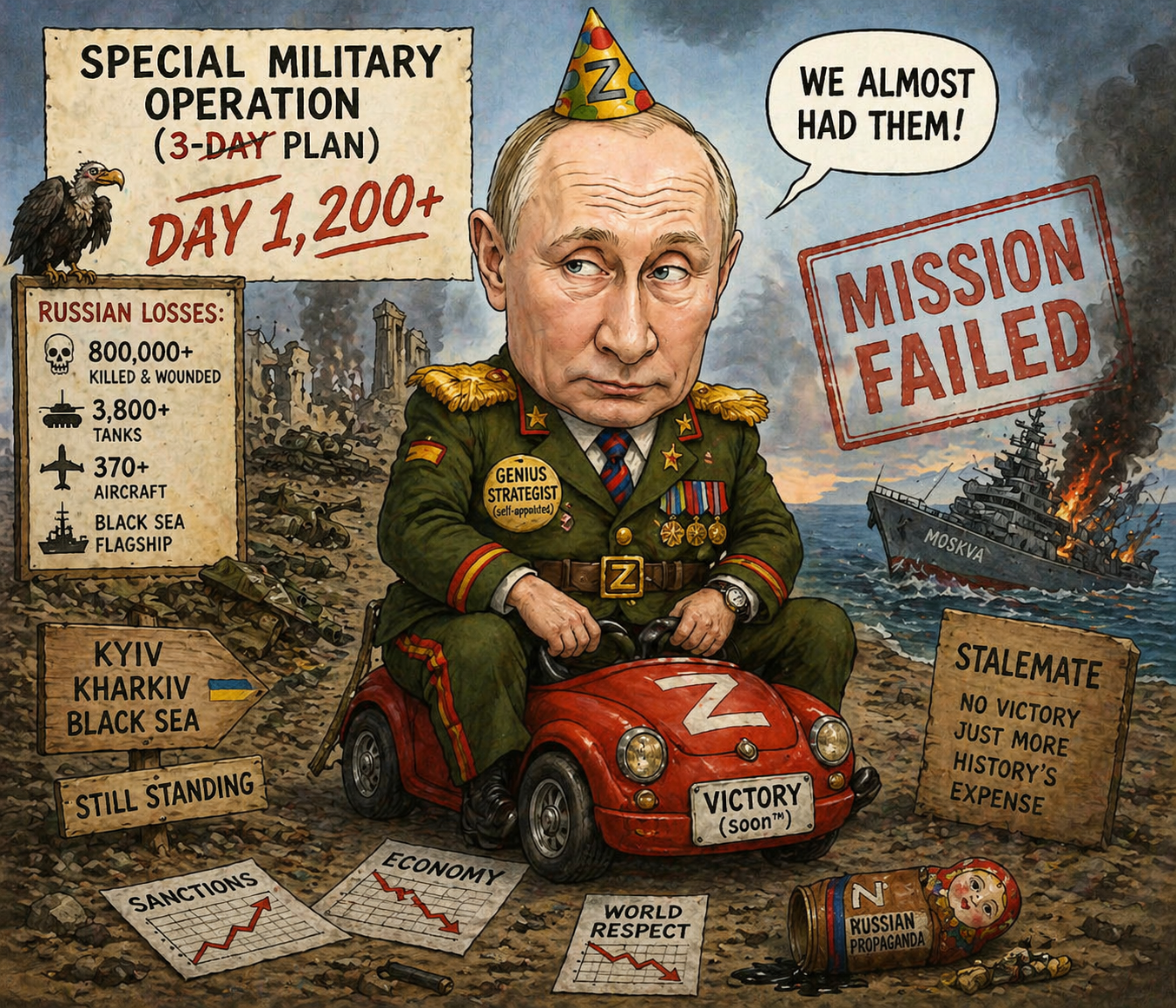
Russia’s War on Ukraine: From Invasion to Stalemate.
On February 24, 2022, Vladimir Putin launched what the Kremlin called a three-day special military operation to “demilitarize and denazify” Ukraine. Over 1,200 days later: Russia has lost an estimated 800,000+ military casualties — killed and wounded — along with 3,800+ tanks, 370+ aircraft, and its Black Sea flagship. Ukraine still controls Kyiv, Kharkiv, and its Black Sea access. Neither side can achieve a decisive breakthrough. This is the complete record: the full timeline, every major battle, all the casualty figures, the equipment ledger, the allied aid totals, and the hard arithmetic of a war that has become the largest land conflict in Europe since 1945.
The 2022 full-scale invasion did not begin in 2022. It began in 2014 — with Russia’s annexation of Crimea, the manufactured insurgency in the Donbas, and eight years of low-intensity war that killed more than 14,000 people before a single tank crossed the line of February 24. To understand what happened on that date, you have to understand what happened on February 27, 2014 — and in the 3,000 days between.
The standard Western framing — that NATO expansion provoked Russia — requires believing that a defensive alliance’s enlargement justifies the invasion of a sovereign nation, the deportation of tens of thousands of children, and the deliberate targeting of civilian infrastructure. That is not what international law says. The Budapest Memorandum (1994) committed Russia to respect Ukraine’s territorial integrity in exchange for Ukraine surrendering its Soviet nuclear arsenal — the world’s third largest at the time. Russia violated it. Ukraine gave up nuclear weapons. Russia invaded anyway.
“Russia has committed to respect the independence, sovereignty and existing borders of Ukraine and to refrain from the threat or use of force against Ukraine.”
Budapest Memorandum on Security Assurances — December 5, 1994 — signed by Russia, the United States, and the United Kingdom
At 5:00 AM Kyiv time on February 24, 2022, Vladimir Putin appeared on Russian state television and announced the start of a “special military operation.” Within minutes, Russian missiles struck targets across Ukraine — from Kyiv in the north to Odessa in the south. Russian armor rolled across the border from four directions simultaneously.
The Russian plan — later reconstructed from captured documents and prisoner interrogations — assumed Kyiv would fall within 72 hours. The scenario: Russian VDV airborne forces would seize Hostomel/Antonov Airport north of Kyiv, creating an air bridge. Follow-on forces would race to Kyiv along three axes. President Zelensky would flee or be killed. A puppet government would be installed. Ukraine — the second-largest country in Europe — would be “demilitarized” before the world could respond.
None of it happened. The Hostomel assault failed on Day 1. Russian columns ran out of fuel within 50km of Kyiv. Logistical trains stretched 40 miles, immobile on roads that thawed in a warm February, becoming impassable mud. Ukrainian civilian and military resistance was ferocious and immediate. Zelensky stayed in Kyiv and broadcast himself from the city streets: “I need ammunition, not a ride.”
- 05:00: Putin speech; Russian missiles strike Kyiv, Kharkiv, Mariupol, Odessa, Lviv, and other cities simultaneously.
- 06:00: Russian armored columns cross Ukrainian border from Belarus (toward Kyiv), Crimea (toward Kherson/Melitopol), Russia/Belgorod (toward Kharkiv), and Russia/Donbas (pushing west into Donetsk/Luhansk).
- 07:30: Russian Mi-8 helicopters carrying VDV troops land at Hostomel/Antonov Airport. Ukrainian forces counterattack within hours. The airport is contested; the air-bridge plan fails.
- 21:00: Zelensky posts video from Kyiv streets refusing evacuation: “I am here. We are not putting down arms. We will be defending our country.”
- Day 3: Russian columns stall north of Kyiv. The 40-mile convoy is immobile. Fuel, food, and ammunition logistics have broken down. NATO’s assessment: Russia’s plan has already failed.
The Battle of Kyiv lasted 39 days and ended in complete Russian failure. The same week Russia withdrew from Kyiv Oblast, satellite imagery revealed what had happened in its wake: hundreds of civilian bodies in the streets of Bucha, Irpin, and Borodyanka. Bound. Shot. Tortured. The ICC opened a formal investigation. The G7 imposed their most sweeping sanctions package to date.
Russia’s explanation for the Kyiv withdrawal — that it was always a “goodwill gesture” to facilitate peace talks — is contradicted by the evidence: abandoned vehicles still with full fuel tanks, Russian dead left where they fell, forward command posts intact, ammunition dumps undetonated. Russia did not withdraw by plan. It was driven out.
“Russian warship, go fuck yourself.”
Ukrainian Border Guards, Snake Island (Zmiinyi Island) — February 24, 2022 — to the crew of the Russian cruiser Moskva
The Moskva — Russia’s Black Sea Fleet flagship, a guided-missile cruiser of 14,000 tons — was struck by two Ukrainian Neptune anti-ship missiles on April 13, 2022. It sank the following day. Russia claimed an “ammunition fire” and did not acknowledge missile strikes for days. The sinking was the largest warship destroyed in combat since the Falklands War (1982) and demonstrated that Ukraine could deny Russia naval superiority in the Black Sea even without a navy of its own.
When Ukrainian forces re-entered the Kyiv suburb of Bucha on April 2, 2022, journalists documented:
- — Bodies of civilians lying in the streets, some with hands bound behind their backs
- — Signs of execution-style killings and torture
- — Mass graves containing hundreds of bodies near a local church
- — Reports of rape and sexual violence that were later corroborated by UN investigators
MAXAR satellite imagery shows the bodies were present during the period of Russian military occupation — contradicting Russian claims that Ukraine staged the evidence. The UN Human Rights Monitoring Mission documented 458 bodies recovered in Bucha alone.
International response: EU announces 5th sanctions package. 50+ countries expel Russian diplomats. ICC Prosecutor opens formal preliminary examination. The Kremlin: “Staged provocation. No evidence.”
The Western response to the invasion was the most coordinated allied military assistance effort since the Second World War. Within 72 hours of the invasion, the U.S. had approved $350 million in emergency military aid under Presidential Drawdown Authority. Within weeks, the EU had activated its European Peace Facility to reimburse members for weapons transfers. Within months, HIMARS rocket artillery systems were firing on Russian ammunition depots deep behind the front lines.
The Kiel Institute for the World Economy’s Ukraine Support Tracker — the gold-standard independent database of allied support — shows total commitments to Ukraine exceeding $175 billion through the end of 2025, across military, financial, and humanitarian categories. The United States is by far the largest single donor, with over $119 billion committed. Germany — which reversed decades of post-WWII pacifism — is the second-largest bilateral donor.
- HIMARS (High Mobility Artillery Rocket System) — June 2022: The most transformative weapons transfer. Ukraine used HIMARS to strike Russian ammunition depots up to 80km behind the front, degrading Russian artillery supply chains and forcing storage locations to be dispersed. Over 16 HIMARS delivered by US; UK sent equivalent M270 MLRS systems.
- Leopard 2 / Abrams Tanks — January–April 2023: After months of German hesitation (a “Leopard coalition” required German permission to re-export), Germany approved Leopard 2A6 transfers. The US approved M1A1 Abrams. Combined with UK Challenger 2 deliveries, Ukraine received 300+ Western main battle tanks.
- Storm Shadow / SCALP Cruise Missiles — May 2023: UK supplied Storm Shadow cruise missiles (range 250km+) and France supplied equivalent SCALP missiles, allowing Ukraine to strike deep into Russian-held territory and Crimea.
- ATACMS — October 2023 / 2024: Army Tactical Missile System, range up to 300km. Biden administration approved limited transfers in October 2023 (shorter-range variant), then longer-range versions in 2024. Used to strike Russian air bases and logistics in Crimea and occupied oblasts.
- F-16 Fighter Jets — August 2024: The Netherlands and Denmark delivered the first F-16s to Ukraine in August 2024. Up to 100 F-16s promised by multiple allies. The aircraft improve Ukraine’s ability to intercept Russian missiles and provide close air support.
Open the post on X to view the full content — text, image, or video.
Open the post on X to view the full content — text, image, or video.
The casualty figures for the Russia-Ukraine war are among the most contested statistics in modern conflict. Russia publishes almost no meaningful data; Ukraine publishes Russian losses but not its own; independent verification is constrained by access restrictions on both sides.
The most reliable Western estimates for Russian casualties — killed and wounded — are from the UK Ministry of Defence, which puts total Russian casualties at over 800,000 as of early 2026. The Ukrainian GUR (Military Intelligence) uses similar figures. BBC Russia and the independent Russian outlet Mediazona have confirmed over 75,000 named, identified Russian deaths through open-source methods — representing a minimum floor, as many deaths are never publicly documented in Russia.
Russian MoD figures — which Russia has barely published — are known to be dramatically understated. As of mid-2022, Russian official figures claimed fewer than 6,000 dead; Western estimates at the same date were in the range of 40,000–50,000 killed. Russian official figures are not a credible source for the casualty count and are cited here only for reference.
BBC Russia and Mediazona maintain a database of confirmed, named Russian military deaths, verified through obituaries, social media posts by families, official death notices, and local press reports. As of April 2026: 75,000+ confirmed named deaths.
This figure is an absolute minimum floor. Russia suppresses information about military casualties; families are pressured not to publicize deaths; deaths in units from remote regions go unreported at far higher rates than Moscow-area units.
Russia’s military press office has never published a comprehensive casualty count. The gap between the BBC/Mediazona confirmed figure (~75,000) and Western intelligence estimates (~200,000–250,000 killed) suggests that roughly 65–70% of Russian military deaths go undocumented in open sources.
Open the post on X to view the full content — text, image, or video.
The equipment destruction in the Russia-Ukraine war is without parallel in the post-Cold War era. Oryx — the open-source intelligence project that documents losses with photographic or video evidence — has confirmed Russia losing more tanks in this war than the entire NATO alliance’s tank inventory combined. These are conservative minimums; Oryx only counts what is photographically verified.
Russia began the war with approximately 3,500 main battle tanks in active service (plus 7,000+ in storage). By April 2026, Oryx alone had documented over 3,800 Russian tanks destroyed, captured, or abandoned with photographic evidence — meaning Russia has already lost more than its pre-war active inventory and has been drawing heavily on Cold War-era T-62 and T-55 storage (some originally manufactured in the 1950s–1960s).
Open the post on X to view the full content — text, image, or video.
“Russia has lost more main battle tanks in Ukraine than the entire NATO alliance combined possesses in active service.”
IISS Military Balance analysis, 2024 — referencing Oryx and UK MoD confirmed loss data
Russia has systematically targeted Ukraine’s civilian infrastructure — power plants, heating systems, water treatment facilities, hospitals, schools, and bridges — in a strategy that the UN Human Rights Monitoring Mission describes as “designed to destroy the population’s will and ability to resist.”
The World Bank’s third Rapid Damage and Needs Assessment (RDNA3), published in February 2024 and covering damage through December 2023, estimates total reconstruction needs at $486 billion— more than three times Ukraine’s pre-war GDP. The assessment covers housing (largest single category at $80B+), transportation infrastructure, energy, agriculture, health, and education.
Russia has occupied the Zaporizhzhia Nuclear Power Plant— Europe’s largest nuclear facility — since March 4, 2022. The plant has been repeatedly shelled (both sides blame the other). It has lost external power multiple times, forcing reliance on backup diesel generators to cool the reactors. The IAEA has maintained a continuous monitoring presence on site and has repeatedly warned of “nuclear safety and security concerns.”
As of April 2026, all six reactors remain in cold shutdown. The IAEA’s monitoring mission has documented ongoing shelling near the plant, violations of the plant’s “protection zone,” and restrictions on IAEA inspector movements by Russian occupation forces.
Source: IAEA Director General Reports — Zaporizhzhia Nuclear Power Plant Safety Review, ongoing from September 2022.
Open the post on X to view the full content — text, image, or video.
Ukraine has mounted several major counteroffensives against Russian forces. Two — Kharkiv (September 2022) and Kherson (November 2022) — were strategic successes that collectively liberated over 10,000 square kilometers of territory. One — the summer 2023 counteroffensive in Zaporizhzhia Oblast — achieved limited but real tactical gains while failing to achieve its strategic objective of reaching the Sea of Azov and cutting Russia’s land bridge to Crimea.
Open the post on X to view the full content — text, image, or video.
Open the post on X to view the full content — text, image, or video.
By late 2023, the war had entered a phase that military analysts describe as positional warfare — both sides have built extensive defensive fortifications, and neither can achieve a decisive breakthrough with available forces. Russia holds roughly 17% of internationally recognized Ukrainian territory. Ukraine holds its capital, its second city (Kharkiv), all three major seaports (Odessa, Mykolaiv, Chornomorsk), and the west of the country intact.
The arithmetic of the stalemate is grim. Russia can absorb catastrophic losses in manpower because its population is 3.5x Ukraine’s, it has deployed only a fraction of its military potential, and — critically — it has acquired North Korean shells and Iranian drones that have partially offset Western sanctions on its defense industry. Ukraine is defending with a smaller population, facing a mobilization shortage, and dependent on Western ammunition deliveries that have been periodically interrupted by U.S. political disputes.
Russia’s strategy is explicit: wait for Western political will to erode, maintain a high rate of fire regardless of casualties, and hold what it has captured until a negotiated settlement freezes the lines. Russia has increased its monthly artillery shell production from ~1 million rounds in 2022 to an estimated 3+ million rounds per month in 2025, supplemented by ~3 million North Korean shells delivered since late 2023.
Ukraine’s strategy: hold the line, inflict maximum Russian casualties, acquire long-range weapons to strike Russian logistics and Crimea, and maintain Western support long enough for Russia’s economy and political cohesion to crack. Ukraine’s Kursk incursion (August 2024) — the first foreign military operation on Russian soil since WWII — serves a dual purpose: diverting Russian forces and demonstrating offensive capability to maintain Western support.
The key variable: Western political will. U.S. military aid was frozen for six months in 2023–2024 due to a House appropriations dispute. The Kiel Institute data shows aid delivery — not just commitment — is the binding constraint. Ukraine can fight only as long as the shells keep coming.
Ukraine has become the world’s most intensive testing ground for drone warfare. The conflict has transformed how militaries think about inexpensive unmanned systems as both weapons and targets — with consequences for every future conflict.
Russia has launched over 6,500 Iranian-supplied Shahed-136 “kamikaze” drones at Ukrainian cities and infrastructure since October 2022 — primarily targeting power plants, heating systems, and water facilities in mass overnight salvos designed to overwhelm air defenses. Ukraine’s air defense intercept rates have improved dramatically as Western systems (IRIS-T, Patriot, NASAMS) arrived.
Ukraine, in turn, has pioneered the use of inexpensive FPV (first-person-view) racing drones — costing $300–$500 each — as anti-tank weapons and precision strike platforms. Ukraine has also struck deep into Russian territory with its own long-range drones, hitting oil refineries and air bases as far as 1,000km from the front line, including Moscow-area targets.
Ukraine produced an estimated 4+ million FPV drones in 2024, and President Zelensky announced a target of 10 million in 2025. The drones cost roughly $400 each — cheaper than a single artillery shell — and have become the primary anti-armor weapon on the front line.
Ukraine has also deployed Sea Baby maritime drones to attack Russian naval vessels in the Black Sea, sinking or damaging multiple warships including the landing ship Olenegorsky Gornyak (July 2023) and striking the Kerch Bridge (July 2023).
Russia has responded by deploying Lancet loitering munitions (domestically produced) in large quantities, targeting Ukrainian artillery and armored vehicles. The drone war is effectively a new dimension of combat running in parallel with the conventional artillery duel.
Open the post on X to view the full content — text, image, or video.
Multiple rounds of ceasefire talks have occurred. None have succeeded. The most substantive — in Istanbul in March–April 2022 — appeared close to an agreement but collapsed, with both sides disputing why. Ukraine says Russia abandoned the process after Bucha; Russia says UK Prime Minister Boris Johnson pressured Ukraine to walk away.
By 2024–2025, President Trump had made ending the war a stated objective of his administration. Trump spoke with both Zelensky and Putin, and pushed for negotiations. Trump’s position — that Ukraine should accept territorial concessions for peace — has created significant friction with European allies who argue that rewarding Russian aggression would undermine international law and set a dangerous precedent.
Ukrainian position: Will not cede any territory; insists on full restoration of internationally recognized borders, including Crimea; demands security guarantees (NATO membership or equivalent) as condition for any settlement; calls for an international war crimes tribunal.
Russian position: Demands Ukraine formally cede the four partially occupied oblasts (Donetsk, Luhansk, Zaporizhzhia, Kherson) plus Crimea; demands Ukraine renounce NATO membership; demands “denazification” (removal of Zelensky and his government); insists on neutrality enforced by Russian veto.
Trump/U.S. position (2025–2026): Pushed for negotiations; threatened to cut off aid unless Ukraine negotiated; called Zelensky “a dictator” at one point; also proposed a U.S. mineral deal with Ukraine as a form of economic guarantee. Ultimately continued most military aid while pushing for talks.
EU/NATO position: “Nothing about Ukraine without Ukraine.” No deal that rewards aggression. Strong opposition to freezing the lines as a permanent settlement without security guarantees. Europe has begun independent defense commitments to fill potential gaps if U.S. support wavers.
President Trump on Truth Social — calling for negotiations to end the Russia-Ukraine war
President Trump on Truth Social — commenting on Zelensky and the state of negotiations
President Trump on Truth Social — on Putin, Russia, and the war's cost to the United States
Open the post on X to view the full content — text, image, or video.
Open the post on X to view the full content — text, image, or video.
The Russia-Ukraine war is not a regional conflict with regional consequences. It is the foundational test of the post-Cold War international order — the principles that have governed great power behavior since 1945, codified in the UN Charter, the Budapest Memorandum, and the Helsinki Final Act. The question being answered on the battlefield is: can a nuclear-armed great power seize a sovereign nation’s territory by force, and what does the rest of the world do about it?
The stakes beyond Ukraine: Taiwan watches this conflict with direct interest. Every authoritarian government that contemplates territorial seizure by force is watching. Every nation that gave up nuclear weapons under security guarantees — as Ukraine did in 1994 — is watching. The lesson being drawn from this war will shape the next 50 years of international security.
Russia launched a war it expected to win in three days. Over 1,200 days later, it has lost 800,000+ military casualties — more than the entire Soviet Union lost in Afghanistan over a decade — along with 3,800+ tanks, 370+ aircraft, its Black Sea flagship, and a significant portion of its pre-war military capacity. Ukraine still stands. Kyiv is intact. The Ukrainian state functions. Ukraine’s military is larger and better equipped today than at the start of the war, primarily due to Western support.
Russia has suffered economically — $1.5 trillion in estimated capital flight, its currency repeatedly pressured, technology imports cut off, 1,000+ Western companies having exited — but has proved more resilient than the early sanctions optimists projected. The Russian economy has restructured around military production and found alternative markets in China and India for its energy exports.
The war is at a stalemate. Neither side can win decisively. Neither side is prepared to accept the other’s terms for peace. Russia benefits from time if Western political will erodes; Ukraine benefits from time if Western weapons production scales up and Russian attrition continues.
The $486 billion reconstruction bill will not be paid by the country that caused it unless the international community builds mechanisms to compel it — the frozen Russian sovereign assets ($300B+ held in Western accounts) are the most likely source. The ICC arrest warrant for Vladimir Putin, issued March 17, 2023, remains outstanding.
Open the post on X to view the full content — text, image, or video.
Open the post on X to view the full content — text, image, or video.
Open the post on X to view the full content — text, image, or video.
President Trump on Truth Social — on Ukraine aid, NATO, and America's role in the conflict
“I need ammunition, not a ride.”
President Volodymyr Zelensky — February 25, 2022 — when offered evacuation from Kyiv by the United States
Ongoing daily assessments of Russian troop losses, equipment losses, and operational developments. Gold-standard Western military intelligence published openly.
Detailed daily and weekly assessments of front-line changes, Russian operational failures, and Ukrainian counteroffensive progress. ISW is the primary Western think-tank tracking the conflict operationally.
Open-source tracking of Russian equipment losses with photographic or video evidence for each destroyed, captured, or abandoned system. The most reliable minimum estimate of equipment destruction.
The definitive database tracking military, financial, and humanitarian aid to Ukraine by country. Updated regularly. Used by governments and researchers worldwide.
Confirmed civilian casualty figures. As of April 2026: 12,000+ confirmed civilian deaths, 24,000+ injured. Actual figures substantially higher due to documentation delays.
World Bank, EU, and UN joint assessment: $486 billion in infrastructure reconstruction needs as of 2024. Housing, transport, energy, agriculture, education, and health sectors.
CRS analysis of U.S. military, financial, and humanitarian assistance totals. Primary source for Congressional appropriations and Presidential Drawdown Authority usage.
International Institute for Strategic Studies annual assessment of military capabilities, including pre-war Russian and Ukrainian force structures.
IISS casualty estimates and analysis of Russian military effectiveness, attrition rates, and force regeneration challenges.
Ukraine's Ministry of Defence publishes daily Russian loss figures. These are Ukrainian government estimates, likely on the higher end but broadly consistent with Western assessments at broader category level.
Russia's Ministry of Defence publishes minimal loss figures known to be heavily understated. The Russian government claimed <6,000 killed as of mid-2022; Western estimates were 10–15x higher by that date.
Official NATO documentation of allied support, training programs, and defense industry coordination for Ukraine.
DoD fact sheets on Presidential Drawdown Authority packages, total dollar values, and specific systems transferred to Ukraine.
European Commission tracking of financial, humanitarian, and military support. Total EU commitment exceeds €90 billion as of early 2026.
UN tracking of internally displaced Ukrainians and refugees in neighboring countries. Over 6.5 million Ukrainian refugees registered in Europe as of 2024.
FAO assessment of Ukraine's agricultural sector destruction. Ukraine was one of the world's top 5 grain exporters before the war.
IMF GDP projections for Ukraine and Russia. Ukraine lost roughly 30% of GDP in 2022. Russia's economy has proved more resilient than initially forecast due to redirected energy sales.
SIPRI data on defense industry deliveries to Ukraine, including Western tank, artillery, and air defense transfers. Provides independent accounting of major weapons systems.
BBC and Mediazona independent project counting confirmed Russian military deaths using social media verification, obituaries, and other open-source methods. Confirmed 50,000+ as of 2024.
Mediazona (Russian independent outlet) and BBC joint database of confirmed, named Russian military deaths. Represents a minimum floor — actual deaths far higher.
State Department documentation of sanctions imposed on Russia after the 2022 invasion. Over 4,000 individuals, entities, and vessels sanctioned across the G7 coalition.
IMF assessment of Russian economic performance under sanctions. War spending is estimated at ~7-8% of GDP; military-industrial complex has expanded significantly.
CSIS analysis of Ukraine's drone warfare revolution — use of FPV drones, Bayraktar TB2 strikes, and the drone war's operational impact on Russian logistics and armor.
Analysis of the Bucha massacre evidence, international response, and implications for international humanitarian law.
ICC issued arrest warrant for Vladimir Putin on March 17, 2023 for the unlawful deportation of Ukrainian children.
Documentation of violations of international humanitarian law, including attacks on civilian infrastructure, hospitals, and residential areas.
IAEA reports and UN documentation on the Zaporizhzhia Nuclear Power Plant — occupied by Russia since March 4, 2022 — and ongoing safety risks.
Strategic Studies Institute analysis of the Wagner Group mercenary organization, its role in Ukraine, Africa, and the June 2023 mutiny against Russian MoD leadership.
Wire service reporting on Russian GDP performance, ruble stability, oil revenue, and the economic effect of Western sanctions through the war period.
Wire service archive of factual reporting on key events, battles, negotiations, and humanitarian developments throughout the conflict.
Peer-reviewed analysis of Ukraine's military strategy, Western support, and prospects for conflict resolution from leading international security scholars.
Military-specialist journalism covering HIMARS, Abrams tanks, F-16 deliveries, and the operational impact of Western weapons systems.