
80 Years of Protection.
One Week of Merz’s Mouth.
5,000 Troops Gone.
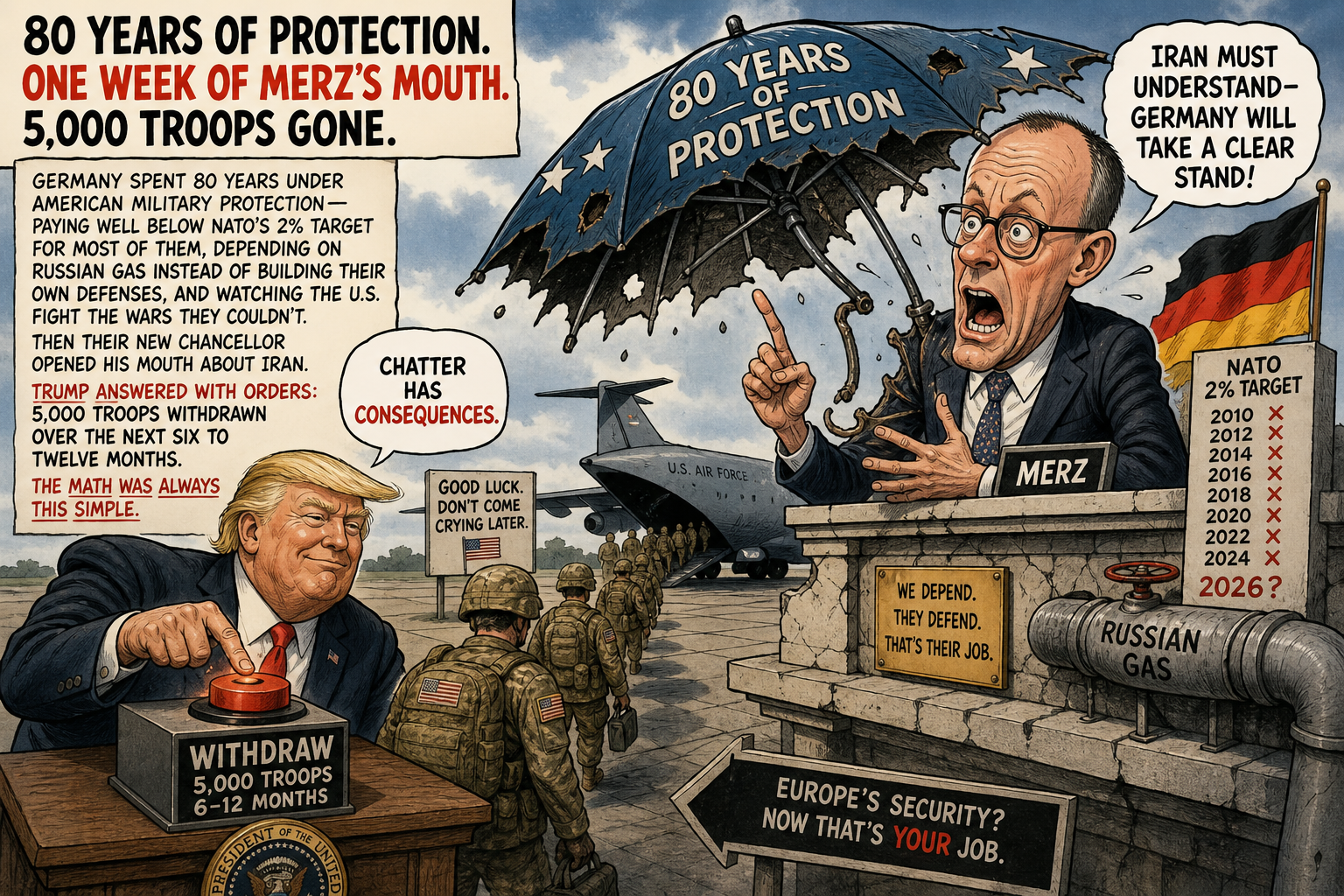
On April 27, 2026, at a school visit in Marsberg, Friedrich Merz (CDU-DE) — Germany’s new chancellor, barely two months into office — decided to share his strategic wisdom about the U.S.-Israel operation against Iran that had been underway since February 28.
“The Americans clearly have no strategy, and the problem with conflicts like this is always that you don't just have to go in; you also have to get out again. We saw that very painfully in Afghanistan for 20 years. We saw it in Iraq.”
Friedrich Merz, Chancellor of Germany · April 27, 2026 · School visit, Marsberg
Merz also described the military campaign as “ill-considered” and suggested Washington was being “humiliated” by Tehran’s negotiating tactics during stalled ceasefire talks. He did all of this while Germany was actively granting U.S. forces overflight permissions and base access for Iran operations through Ramstein Air Base.
Germany’s Ramstein Air Base in Rhineland-Palatinate is the headquarters of U.S. European Command (EUCOM) and one of the most critical U.S. logistics hubs in the world. It was actively supporting Iran-theater operations at the time Merz made these comments.
Germany also granted overflight permissions for U.S. and Israeli aircraft operating in the region — meaning the country whose chancellor called U.S. strategy “ill-considered” was simultaneously providing the infrastructure that strategy ran through.
Trump didn’t wait. Within 24 hours of Merz’s comments, two posts hit Truth Social. He also mischaracterized Merz’s statement — Merz never said Iran should have a nuclear weapon. But the underlying point was the same: Germany’s chancellor was publicly undermining a U.S. military operation while sitting inside the U.S. defense umbrella.
The Chancellor of Germany, Friedrich Merz, thinks it's OK for Iran to have a Nuclear Weapon. He doesn't know what he's talking about! If Iran had a Nuclear Weapon, the whole World would be held hostage. I am doing something with Iran, right now, that other Nations, or Presidents, should have done long ago. No wonder Germany is doing so poorly, both Economically, and otherwise!
The United States is studying and reviewing the possible reduction of Troops in Germany, with a determination to be made over the next short period of time.
The Chancellor of Germany should spend more time on ending the war with Russia/Ukraine (Where he has been totally ineffective!), and fixing his broken Country, especially Immigration and Energy, and less time on interfering with those that are getting rid of the Iran Nuclear threat, thereby making the World, including Germany, a safer place!
Two days later, at 9:05 PM ET on May 1, Secretary of Defense Pete Hegseth signed the order. Pentagon Chief Spokesman Sean Parnell confirmed the withdrawal: approximately 5,000 troops, drawn down over the next six to twelve months.
“This decision follows a thorough review of the Department's force posture in Europe and is in recognition of theater requirements and conditions on the ground.”
Pentagon Chief Spokesman Sean Parnell · May 1, 2026
Open the post on X to view the full content — text, image, or video.
To understand how absurd Merz’s complaint is, you need the full picture. The United States has maintained a military presence in Germany since 1945 — first as an occupying force, then as a Cold War bulwark, then as the backbone of NATO’s European defense. At peak Cold War, nearly 250,000 American soldiers were stationed there. Even after the wall fell, the U.S. kept tens of thousands in place, rebuilt Germany’s security architecture, and absorbed the cost.
not to scale — omitted from chart
Germany today hosts approximately 35,000–38,000 U.S. active-duty military personnel — the largest American military presence of any European country. The three crown jewels: Ramstein Air Base (HQ of U.S. European Command, critical logistics node for European and Middle East operations), Grafenwöhr Training Area (the largest U.S. military training base outside the U.S.), and Landstuhl Regional Medical Center (the largest U.S. military hospital abroad, unaffected by this withdrawal). All built. All funded. All maintained by the American taxpayer.
NATO’s 2% of GDP defense spending commitment isn’t new. It was formalized at the 2014 Wales Summit. Germany signed it. Then ignored it for a decade. From 2014 to 2023, Germany missed the target every single year — not by a little, but by hundreds of billions of euros in cumulative underinvestment. They spent 1.19% of GDP in 2014, 2015, and 2016. They hit 1.36% in 2019 — a full 0.64 points below what they promised — and called it progress.
Germany finally cleared 2% in 2024 — the first time since 1990, a full 34-year gap. By 2025 they were at 2.3%, and they’re pledging 3.5% by 2029. Good. But note the timeline: Germany started getting serious about its own defense only after Russia invaded Ukraine in 2022 and Trump’s return to office made the U.S. security subsidy feel less automatic. Three decades of free-riding, then a sudden conversion when the bill looked like it might actually come due.
2026 defense budget: €108.2 billion — a record. Up 24% year-over-year from 2025.
2025: 2.3% of GDP — finally above the NATO target, for the second consecutive year.
Irony: Germany met Trump’s primary demand just months before Merz decided to lecture the U.S. about its military strategy. They met the bar, then immediately complained about the guy holding it.
The economic relationship runs in one direction: toward Germany. The U.S. military presence is a multi-billion-dollar subsidy to the German economy that rarely gets mentioned when German politicians are congratulating themselves on their defense commitment.
Ramstein Air Base is the single most strategically important U.S. installation in Europe. The base employs roughly 17,000 U.S. military personnel, civilians, and contractors. Its surrounding communities — Kaiserslautern, Zweibrücken, Pirmasens — are economically dependent on the base. Local officials in Rhineland-Palatinate have consistently opposed any drawdown, precisely because they know what a withdrawal actually means in economic terms.
It would be one thing if Germany had a strong track record of strategic competence. It doesn’t. The same country that spent decades freeloading on U.S. defense made one of the most catastrophic energy bets in modern European history: binding itself to Russian natural gas through the Nord Stream pipelines while dismissing American warnings that this created a fatal dependency.
Nord Stream dependency: Germany spent years building deep reliance on Russian gas, dismissing U.S. and Eastern European warnings. When Russia invaded Ukraine in 2022, Germany faced an energy crisis, a manufacturing collapse, and a recession — all self-inflicted.
Economy in contraction: Germany’s GDP contracted in both 2023 and 2024 — the only major European economy to shrink two consecutive years. Manufacturing output — the backbone of the German model — has been declining for 24 consecutive months.
Austerity vs. defense: While refusing to meet NATO spending targets, Germany simultaneously ran strict debt-brake rules (“Schuldenbremse”) that prevented infrastructure and defense investment. The result: crumbling bridges, underfunded military, and a self-satisfied political class that considered fiscal virtue a substitute for actual strategic planning.
And now: The chancellor of this country decided to publicly criticize U.S. military strategy in the middle of an active war, from a country that couldn’t defend itself if it had to.
“The Chancellor of Germany... thinks it's OK for Iran to have a Nuclear Weapon. No wonder Germany is doing so poorly, both Economically, and otherwise!”
President Donald Trump · Truth Social · April 28, 2026
German military officials expressed “surprise” at the withdrawal announcement, telling Reuters they were caught off-guard — even though constructive Pentagon-to-Pentagon meetings had taken place the same day the order dropped. German Foreign Minister Wadephul stressed Germany’s “commitment to the transatlantic alliance.” That commitment, apparently, doesn’t extend to keeping the chancellor quiet when he has opinions about American war strategy.
NATO Secretary General Mark Rutte, for his part, has repeatedly tried to calm things down: “I don’t see it coming” (referring to full U.S. withdrawal from NATO). He’s probably right about that. But 5,000 troops are still coming home, one brigade combat team and one cancelled long-range fires battalion deployment. That’s not nothing. That’s the cost of one week of Merz’s strategic commentary.
More significantly: European security officials note the withdrawal of Patriot missile systems and ammunition from Germany to the Middle East theater as the deeper strategic concern — not the troop numbers, but the hardware. Germany and its neighbors are watching American air defense capability quietly move out of Europe and into the Iran theater. That’s what happens when your chancellor forgets which country holds the missiles.
“Withdrawing thousands of American troops from one of our most important strategic positions in the middle of a war is a serious mistake that will reverberate well beyond this moment. American commitments to our allies are now dependent on the president's mood.”
Sen. Jack Reed (D-RI), Ranking Member, Senate Armed Services Committee · May 1, 2026
Reed is right that the signal matters. He’s wrong that this is purely about mood. Germany has a defense budget, a NATO commitment, a chancellor with an opinion about American military strategy, and a track record of energy policy catastrophe. The United States has troops, infrastructure, and a defense umbrella that Germany has never had to live without. One of these parties has more leverage than the other. Merz just found out which.
Germany got 80 years of American protection. They missed NATO’s spending target for 34 of them. They funded Russian gas pipelines instead of their own military. Then their chancellor called U.S. military strategy “ill-considered.” Five thousand troops are now on their way home. The bill was always going to come due. Merz just handed Trump the invoice.