OpenAI Calls Its Michigan Data Center “1 Gigawatt.” Regulators Approved 1.4 — and It’s Not the Only Number That Kept Growing.
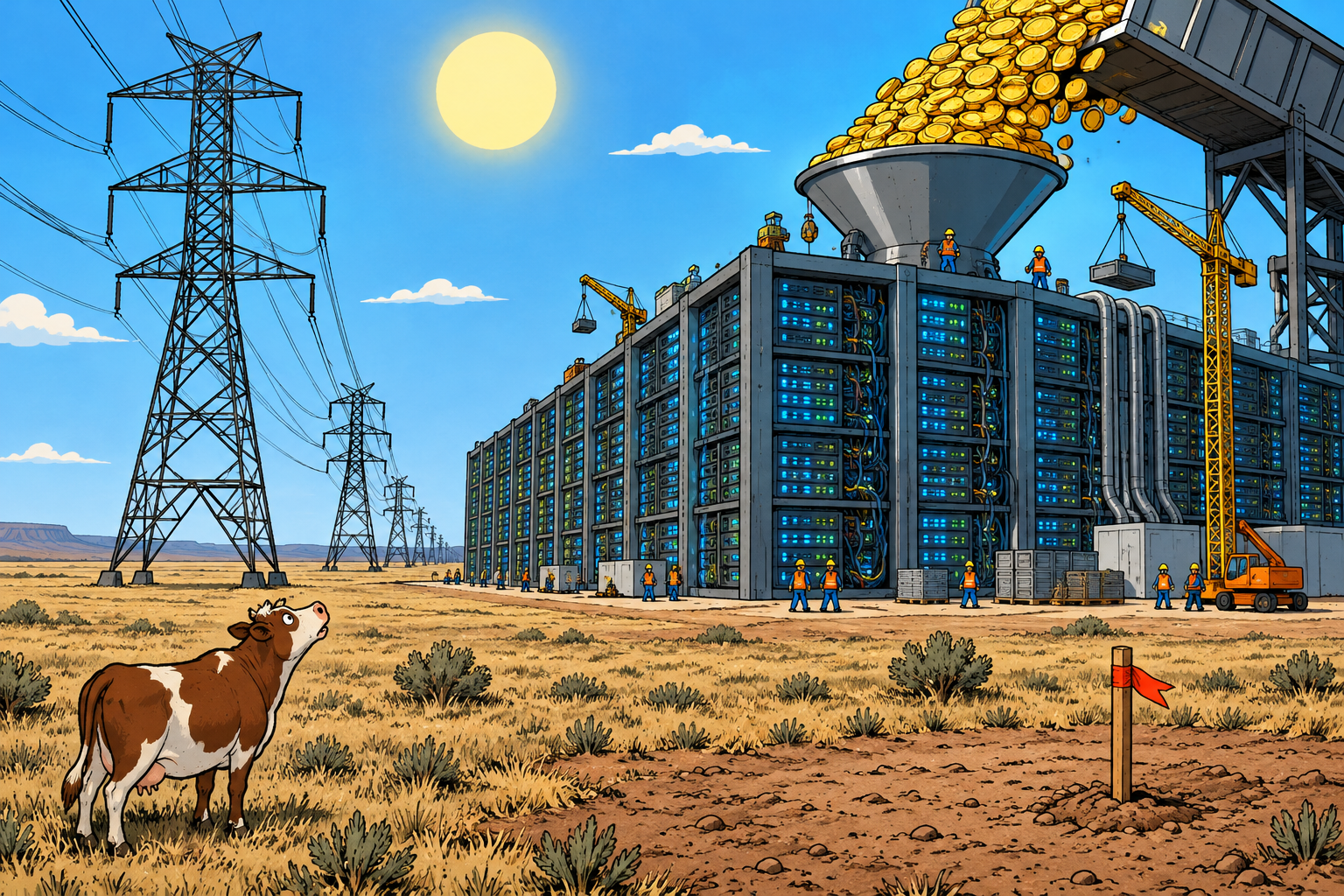
OpenAI’s own blog describes its newest data-center campus, nicknamed “The Barn” after a historic red barn preserved at the entrance, as “a 1GW data center” rising on former farmland in Saline Township, Michigan, about 10 miles southwest of Ann Arbor. The Michigan Public Service Commission’s actual order approving the project’s electricity contracts, issued Dec. 18, 2025, tells a different story: 1.4 gigawatts of new capacity from DTE Energy — 40 percent more than the number in OpenAI’s own marketing. University of Michigan professor Ben Green called that figure, in comments to Truthout, “the energy use of a million households.” Per Bridge Michigan, the single campus adds roughly a quarter to DTE’s entire current electric system load.
Three single-story buildings, 550,000 square feet apiece, are going up under Detroit-based general contractor Walbridge, on acreage reported anywhere from 250 to 575 across different points between the October 2025 site announcement and the June 2026 groundbreaking. OpenAI is the compute customer; Oracle, led by CEO Clay Magouyrk, is leasing and operating the hardware inside; Related Digital, the data-center arm of Related Companies led by CEO Jeff Blau, is the developer; Blackstone Real Estate is financing it. It is the newest build inside the $500 billion Stargate Project, the OpenAI-Oracle-SoftBank infrastructure initiative announced alongside President Trump in January 2025.
Getting to the June 1 groundbreaking — where Sam Altman stood beside Gov. Gretchen Whitmer and predicted the site “could very well turn into the site where cancer gets cured” — took a rezoning vote the township government first refused, a lawsuit that followed within weeks, and a $14 million settlement to make it go away. By mid-July, Whitmer was publicly asking data-center companies to sign a pledge that “Michiganders won’t pay for their power,” and Rep. Rashida Tlaib had broken publicly with her fellow Democrat, calling the project “disgusting.”
- 1.4 GW — capacity the Michigan Public Service Commission actually approved for DTE's contracts serving the site — 40% more than the "1GW" figure in OpenAI's own marketing · Source: MPSC, Dec. 18, 2025 order
- $56 billion — the most granular public estimate of total project cost — $16B site construction plus $40B in Oracle compute hardware — up from ~$7B in initial November 2025 reporting · Source: Bridge Michigan
- $14 million — in community benefits Related Digital agreed to pay Saline Township to settle the lawsuit it filed after the township board first voted 4-1 to deny rezoning · Source: Bridge Michigan, Planet Detroit
- 71% — of Americans say they oppose new data-center construction in their own community, per national polling cited amid the broader backlash · Source: Fortune
- 2,500+ — union construction jobs projected for the build, with 450 permanent onsite positions once operations begin in early 2028 · Source: OpenAI
OpenAI has consistently described Stargate Michigan as “a 1GW data center” — the figure appears in the company’s own announcement post and in its social media messaging around the groundbreaking. But the number that actually governs how much electricity DTE Energy is contracted to deliver comes from the Michigan Public Service Commission, the state body that regulates utility rates and supply contracts. Its Dec. 18, 2025 order approved 1.4 gigawatts of new capacity for the site — not 1. Bridge Michigan, Planet Detroit, and Gizmodo have all reported the 1.4GW figure by citing the actual regulatory filing rather than the round number in OpenAI’s marketing.
The scale is difficult to picture in the abstract, which is why Ben Green’s framing landed: 1.4 gigawatts, he told Truthout, is “the energy use of a million households.” Bridge Michigan’s reporting puts a second number on the same fact — this single campus is projected to add roughly 25 percent to DTE’s entire current electric system load, all from one customer.
The site draws 100 percent grid power from DTE — there is no dedicated on-site generation — and the project pays for new battery storage to help balance the load. But DTE CEO Joi Harris has acknowledged this is only the start of the demand curve: “any new data center load after this 1.4 gigawatts will require additional resources,” she said, pointing to new combined-cycle natural gas plants. DTE has proposed replacing its Monroe coal plant with gas generation partly to meet data-center demand, and environmental advocates warn the dynamic could trigger an “off-ramp” exemption in Michigan’s 2023 clean-energy law, letting utilities keep fossil generation running past its 100-percent-clean-by-2040 target if capacity runs short. DTE says 3 more gigawatts of data-center demand are in late-stage negotiations, with 3 to 4 beyond that; Consumers Energy, the state’s other major utility, separately projects 2.65 gigawatts of new data-center demand by 2035 — a 35 percent jump in its own peak load.
DTE must absorb the cost itself if a projected $300 million in annual savings to other ratepayers — funded by the data center’s own payments — fails to materialize.
The data center loses power before other DTE customers during any shortage — a priority-curtailment condition.
DTE must document that it isn’t using other ratepayers to subsidize the project’s infrastructure, and must propose standardized rates for large power users within 90 days to end one-off contracts going forward.
Quarterly power-demand reports and annual financial reviews of Oracle’s subsidiary, Green Chile Ventures, are required for the life of the contract.
MPSC Chair Dan Scripps defended the resulting contract terms as “on par or better with any that have been approved in the country.” Whether that holds depends on enforcement over the life of a multi-decade contract, not the terms on paper alone.
The project almost didn’t clear its first local hurdle. In September 2025, the Saline Township board voted 4-1 to deny the rezoning Related Digital needed to build. Michigan law requires substantive reasons for that kind of denial, and Related Digital sued, alleging “exclusionary zoning.” Facing legal costs that township attorney Fred Lucas said could exceed its insurance coverage, the board settled within weeks — roughly $14 million in community benefits, including $4 million for farmland preservation and a shared $10 million investment in the Saline Recreation Center. Lucas described the township’s position bluntly: “between a rock and a hard place,” with “limited leverage.” Board member Kelly Marion, the lone “yes” vote on rezoning, said she doubted the township could have won in court.
“If an idea's so great, AI is so great, so beneficial to our community, you don't have to sue your way in.”
Kathryn Haushalter, Saline Township landowner
The fight left real casualties on the local level. Former township treasurer Jennifer Zink resigned in May 2026 after receiving death threats connected to the project. Haushalter separately sued alleging the township’s settlement talks violated the state’s Open Meetings Act, and has raised a narrower but concrete concern: covering hundreds of acres with buildings “changes how water moves through the land,” a drainage question that matters directly to residents on private wells rather than municipal water.

The publicly cited price tag has grown roughly eightfold since the project first surfaced. Early reporting in November 2025 put it around $7 billion; Whitmer’s office and most groundbreaking-day coverage called it $16 billion, “the largest investment in Michigan history”; Altman told CNBC on groundbreaking day it was “more than $45 billion”; and Bridge Michigan’s most granular breakdown puts the full figure at $56 billion — $16 billion for site construction and development, $40 billion for the Oracle compute hardware going inside it. OpenAI is also offering up to $45 million in free Codex credits to Michigan college, community-college, and trade-school students, a figure the company’s own social post rounded to “over $40m.”
We're breaking ground on Stargate Michigan—a 1GW data center utilizing closed-loop cooling that uses water at the rate of a typical office building, creates thousands of union jobs, and brings over $40m in free Codex credits for all college, community college, and trade school students.
The jobs numbers are real but time-limited: 2,500-plus union construction jobs under Walbridge, 450 permanent onsite positions once operations begin, and roughly 1,500 county-wide supporting jobs. Green called the permanent-jobs framing a “false promise” — data centers, he argues, need minimal staffing once construction wraps. Tax revenue is its own unsettled figure: OpenAI projects $1 billion over the lease term, while Bridge Michigan separately cites $150 million annually for the township and local schools — two numbers that don’t obviously reconcile.
Local opinion splits along predictable lines. Saline resident Carol Drayton was blunt: “I think it’s about money. She’s thrilled with the taxes it’s going to bring. I usually don’t agree with Rashida Tlaib, but this time I do.” Ann Arbor resident Jennifer Garrett took the opposite view: “If it benefits this area technologically, that’s awesome.”
The backlash in Michigan isn’t an isolated data point. Nationally, per Fortune, roughly 71 percent of Americans say they oppose new data-center construction in their own community, and Data Center Watch has tracked more than 20 similar projects blocked by local communities in roughly the past three months alone. Michigan’s version produced an unusual split: Whitmer, who stood with Altman at the groundbreaking, spent mid-July publicly asking data-center companies to sign a pledge that “Michiganders won’t pay for their power” — a response to the ongoing criticism, not a preemptive condition. Tlaib went further, breaking with her fellow Democrat in blunt terms.
Disgusting. So disappointed in Governor Whitmer's support of data center expansions in our state especially when so many Michiganders are opposed.
Even the ceremony itself drew skepticism about how much of it was performance. Media critic Ed Zitron pointed out that Altman had posted about steel beams going up at the site months before the “official groundbreaking.”
"official groundbreaking ceremony"? Sam Altman posted late March that the first steel beams went up!
Every number attached to Stargate Michigan grew between announcement and groundbreaking — the power draw, the acreage, the price tag, the political temperature. The Michigan Public Service Commission did attach real ratepayer protections most one-off utility contracts don’t get: priority curtailment, a $300 million savings guarantee DTE itself is on the hook for, and standardized future rates. But the township that first said no to this project settled for $14 million rather than fight it in court, a former local official quit after death threats, and the state’s own governor is now asking the companies she recruited to promise, after the fact, that ordinary Michiganders won’t foot the bill.