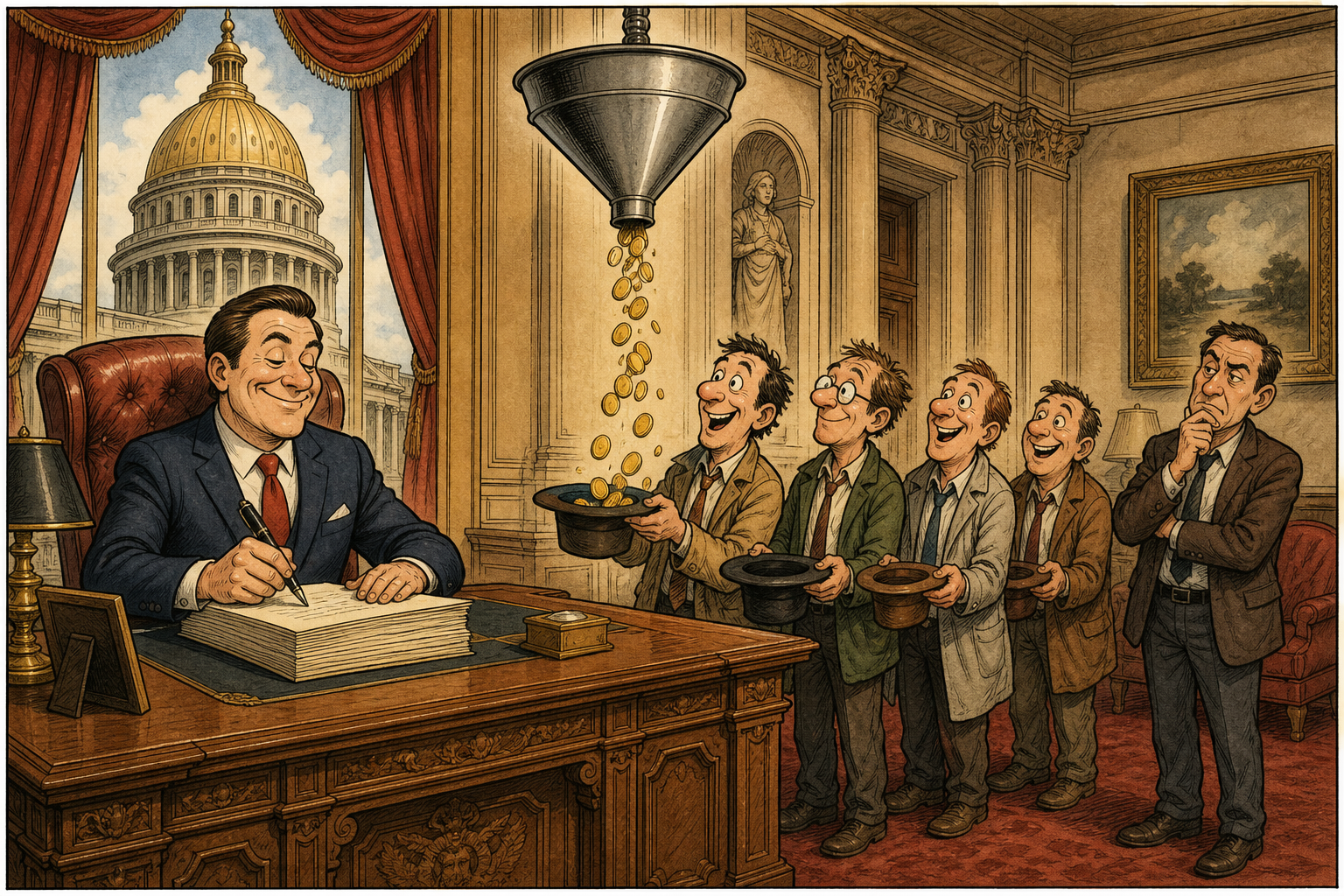
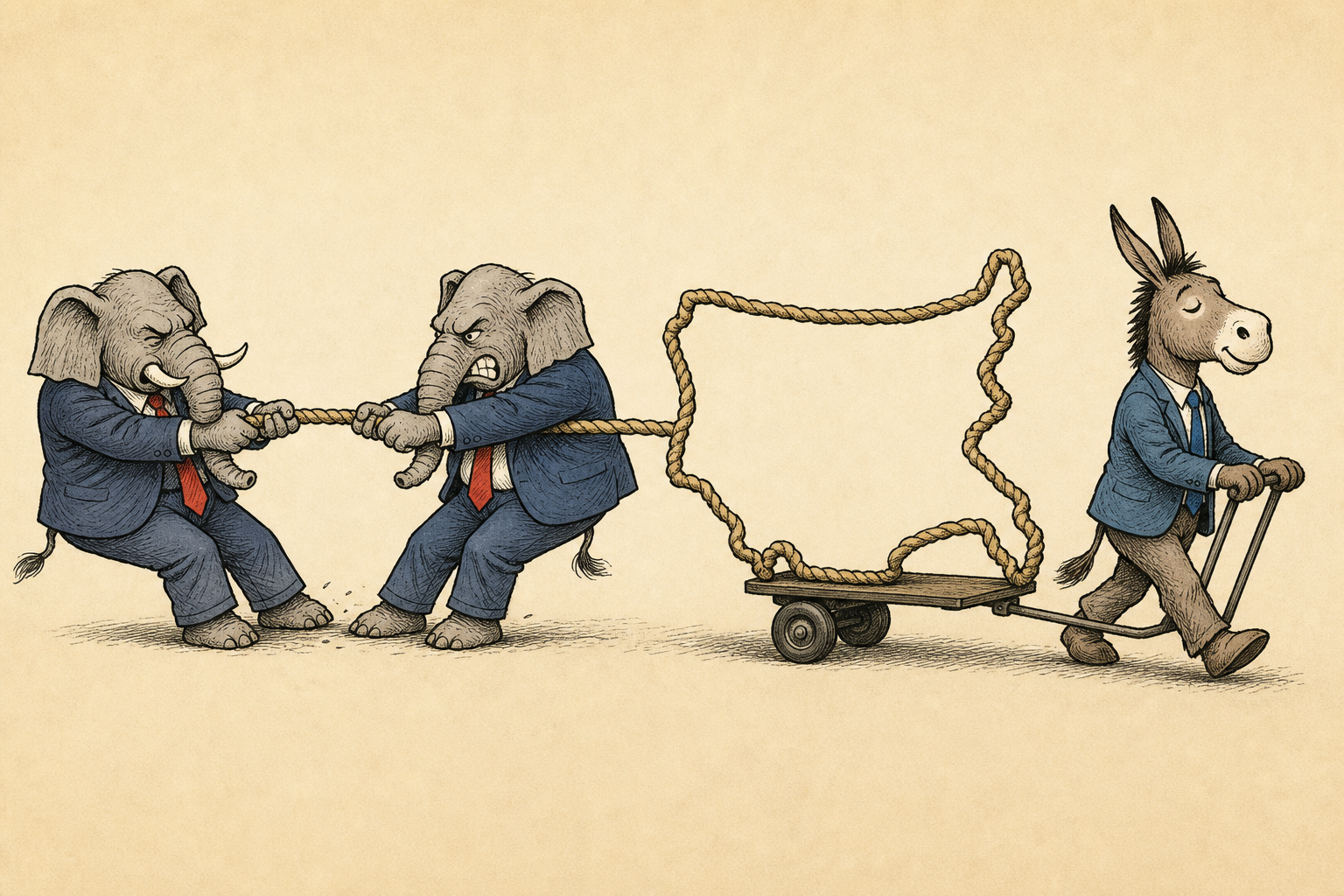
Ten Governors, $5.40 Gas: Newsom and Walz Lobby Congress to Save Their Climate Lawsuits.
On June 18, 2026, ten Democratic governors — Gov. Gavin Newsom (D-CA) and Gov. Tim Walz (D-MN) among them — signed a letter urging congressional leaders to kill the Stop Climate Shakedowns Act, the Cruz–Hageman bill (S.4340 / H.R.8330) that would dismiss their states’ pending lawsuits against oil companies and shield energy producers from climate liability.
The letter’s stated argument is affordability: Congress, it says, should be “helping to make life more affordable for American families,” not protecting “companies that are profiting off of sky-high gas prices.” Yet Californians pay the nation’s highest pump prices — about $5.40 a gallon, roughly $1.57 above the national average — with 63.4 cents of state excise tax on every gallon, and Minnesota’s 100% carbon-free-by-2040 mandate carries a $313 billion price tag through 2050, by one attributed estimate.
Both Newsom and Walz are widely reported 2028 contenders. Governors have no vote on the bill; the letter is a lobbying volley, not a veto. This is the story of ten governors asking Washington to preserve their right to sue Big Oil — while the voters who elected them pay some of the country’s steepest energy bills. Here is what the record shows.
- $5.40per gallonCalifornia regular gas, July 2026 — the highest in the nation, about $1.57 above the $3.83 national average — AAA
- 35.25¢per kWhCalifornia residential electricity — roughly 87% above the 18.83¢ national average, second only to Hawaii — EIA
- $313Bthrough 2050estimated cost of Minnesota's 100% carbon-free-by-2040 mandate — an attributed think-tank estimate, Center of the American Experiment
- 10governorsDemocratic signatories on the June 18 letter urging Congress to kill S.4340 / H.R.8330 — governors' letter

The letter is dated June 18, 2026 and addressed to the four congressional leaders — Senate Majority Leader John Thune (R-SD), Speaker Mike Johnson (R-LA), Senate Minority Leader Chuck Schumer (D-NY), and House Minority Leader Hakeem Jeffries (D-NY). It was distributed a week later by the Center for Climate Integrity, alongside a campaign that delivered more than 135,000 signatures to Democratic leadership. Its ask is specific: reject S.4340 and H.R.8330, the Stop Climate Shakedowns Act of 2026.
The governors frame the bill as a giveaway. “Today twelve attorneys general and dozens of municipal governments collectively representing more than 1 in 4 Americans are engaged in ongoing lawsuits to hold major fossil fuel companies accountable,” the letter states — its own framing of the population represented by the suits the bill would end. The document argues the legislation “would trample on the rights of states and citizens.”
“These proposals would trample on the rights of states and citizens and attempt to hand wealthy fossil fuel corporations a legal shield against accountability.”
Ten-Governor Letter to Congress · June 18, 2026
Gov. Gavin Newsom (D-CA), Gov. Tim Walz (D-MN), Gov. JB Pritzker (D-IL), Gov. Kathy Hochul (D-NY), Gov. Maura Healey (D-MA), Gov. Bob Ferguson (D-WA), Gov. Ned Lamont (D-CT), Gov. Janet Mills (D-ME), Gov. Tina Kotek (D-OR), and Gov. Tony Evers (D-WI).
The one-line irony: the same letter that asks Congress to make life “more affordable” is signed by the governors of the two states — California and, on the projected mandate, Minnesota — whose own taxes, fees, and green rules push energy costs the furthest.
The Stop Climate Shakedowns Act of 2026 is a pair of companion bills. The Senate version, S.4340, was introduced on April 16, 2026 by Sen. Ted Cruz (R-TX), joined by cosponsors Sen. Tom Cotton (R-AR), Sen. Ted Budd (R-NC), and Sen. Mike Lee (R-UT). The House companion, H.R.8330, was introduced the same day by Rep. Harriet Hageman (R-WY) and referred to the House Judiciary Committee.
Per Cruz’s release and the bill text, the legislation would do four things: prohibit climate-related damages suits against energy producers in state and federal court; require pending suits to be dismissed; void state “energy penalty” laws such as the New York and Vermont climate-superfund statutes; and preempt state regulation of interstate and global emissions. Sponsors cast it as a defense against “lawfare” aimed at the energy industry.
“Radical environmental groups have waged a coordinated campaign to weaponize our judicial system against American energy producers… using meritless lawsuits to bankrupt our energy industry, kill good paying jobs, and drive up the cost of electricity and gasoline for hardworking families.”
Sen. Ted Cruz (R-TX) · Sponsor, S.4340 · April 2026
Rep. Harriet Hageman (R-WY) framed the House bill in national-security terms: “Energy security is national security, and we will not self-sabotage our critical industries with a cascade of costly lawsuits.” As of July 4, 2026, both bills sit in committee with no floor vote scheduled — which is why the governors’ letter is a lobbying document, not a response to any imminent vote.

The governors say Congress should make energy more affordable. Their own numbers are the reason that line lands hard. In California, regular gas ran about $5.40 a gallon in early July 2026 — the highest in the country and roughly $1.57 above the $3.83 national average, per AAA. On July 1, the state’s gasoline excise tax rose again, to 63.4 cents a gallon, the steepest in the nation; total state taxes and fees add up to roughly $1.15 of every gallon Californians buy.
Electricity tells the same story. California’s residential rate sits around 35.25 cents per kilowatt-hour, roughly 87% above the 18.83-cent national average and second only to Hawaii, per the U.S. Energy Information Administration. Two California refineries — Phillips 66’s Los Angeles plant and Valero’s Benicia refinery — are closing, taking roughly 284,000 barrels a day of in-state refining capacity offline.
Minnesota is the fairer half of the comparison, and the letter does the state no favors by leading with affordability. Minnesota’s current residential electricity price actually sits below the national average — around 15 to 17 cents per kilowatt-hour — so the state’s exposure is projected, not present. In 2023, Gov. Tim Walz (D-MN) signed a law mandating 100% carbon-free electricity by 2040. The Center of the American Experiment, a conservative Minnesota think tank, estimates that mandate will cost $313 billion through 2050 and add an average of about $1,642 a year to a household’s bills by 2040. That figure is an attributed estimate, not an official one — but it is the number driving the debate over what Walz’s signature will ultimately cost.
Gavin Newsom is raising alarms on climate change again—and getting basic facts wrong. Global warming isn't behind California's wildfires, and fires around the world are declining, writes @BjornLomborg
The claim: Congress should protect families from “companies that are profiting off of sky-high gas prices,” the governors write.
The context they omit: in California, roughly $1.15 of every gallon is state tax and fees, and residential power costs about 87% more than the national average. The single largest controllable input into a Californian’s energy bill is state policy, not oil-company litigation.
The fair caveat: Minnesota’s current electricity is below the national average. The state’s cost story is a projection — the disputed $313 billion mandate — not a present-day bill.
The reason Newsom and Walz have direct stakes is that each governs a state suing the oil industry. In September 2023, Gov. Gavin Newsom (D-CA) and AG Rob Bonta (D-CA) filed People of the State of California v. Big Oil against Exxon, Shell, Chevron, ConocoPhillips, BP, and the American Petroleum Institute, alleging a decades-long campaign to mislead the public about climate risk. In Minnesota, AG Keith Ellison (D-MN) sued API, ExxonMobil, and Koch Industries back in June 2020 on similar deception theories.
These cases are live. On April 15, 2026, the Minnesota Supreme Court denied the defendants’ petition for review, clearing Ellison’s case for discovery. The next month, the Trump DOJ took the extraordinary step of suing Minnesota in federal court to block the state’s own lawsuit, arguing it usurps exclusive federal authority under the Clean Air Act. No court has adjudicated the underlying deception claims; the defendants deny wrongdoing, and the allegations remain allegations.
For today's steaming pile of Jersey horse manure, I proudly present the next multi-million-dollar lawsuit, courtesy of certain Majority members who are in a complicated relationship with reading comprehension: 'POLLUTERS PAY.' Since when do we get to retroactively tax oil…
The fight has also reached the Supreme Court. On February 23, 2026, the justices granted certiorari in Suncor Energy v. Board of County Commissioners of Boulder County— the Colorado climate case first filed in 2018 — with argument expected in the October 2026 sitting. The question is whether federal law preempts state-law climate claims. In other words, the Cruz–Hageman bill is Congress’s parallel track to exactly what the industry is asking the Court to do: end these suits.
The federal government is not a neutral bystander here — it is a party. Beyond suing Minnesota, the Trump administration has spent 2026 attacking California’s energy record directly, and gas prices are the flashpoint. In late June, President Trump (R) used Truth Social to demand that retailers cut pump prices “immediately,” setting a target near $2.50 a gallon against a national average then around $3.85.
Gas prices are TOO HIGH. Retailers must bring them down IMMEDIATELY! The national average should be around $2.50 a gallon — not the $3.85 hardworking Americans are being forced to pay right now.
Paraphrased commentary · not a verbatim post
Truth Social · paraphrasing Trump's June 30, 2026 post on gas prices, reported by Forbes
Interior Secretary Doug Burgum (R) has been the administration’s sharpest voice on California specifically, tying the state’s pump prices to its own refinery closures and import dependence. Burgum has publicly argued that California imports roughly 60% of its oil from foreign countries — a posture he calls a national-security risk — while the administration approves thousands of new domestic drilling permits it says will lower prices nationwide.
California is KILLING their economy! Newsom keeps closing refineries and driving up gas prices, while we just approved thousands of new drilling permits to bring prices down for the entire country.
Paraphrased commentary · not a verbatim post
Paraphrasing Interior Sec. Doug Burgum's public post, reported by Fox News · July 2026
WOW! Trump Interior Sec. Doug Burgum just OBLITERATED Gavin Newsom for whining about energy prices yet purposefully destroying refineries: 'California not only imports 60% of their oil from foreign countries. That is an absolute national security risk. The number one importer…'
The energy clash predates the lawsuit fight. On June 12, 2025, Trump signed Congressional Review Act resolutions terminating California’s electric-vehicle-mandate waivers; California and ten other states sued to block the move, a case that remains pending. That episode set the pattern the current fight follows: California legislates or litigates on climate, Washington moves to override it, and the two sides argue over who is driving up the cost of energy for ordinary drivers.
“We officially rescue the US auto industry from destruction by terminating California's electric vehicle mandate, once and for all.”
President Donald Trump · White House Remarks · June 12, 2025
One fact separates this letter from a routine policy dispute: two of its signatories are widely reported to be running for president. OpenSecrets, in a January 2026 survey of the “shadow campaign,” lists both Newsom and Walz among the Democrats testing 2028 waters, and NBC News has tracked Newsom’s prolific bill-signing through the same lens. We frame that as reported by others, not as our assertion — but it is the context that makes a letter from governors, who have no vote on the bill, worth writing at all. A climate-warrior posture is a primary asset.
The affordability case cuts both ways, and honesty requires naming both edges. The governors have a real states’-rights argument: whether Congress can retroactively wipe out lawsuits already filed in state courts is a genuine constitutional question, and the Supreme Court’s decision to hear the Boulder case shows it is unsettled. But the messenger undercuts the message. When the governors of the two states with the highest pump prices and the steepest projected energy mandates tell Congress the priority is making life “more affordable,” the voters paying $5.40 a gallon are entitled to ask which affordability they mean.
Ten Democratic governors, two of them reported 2028 contenders, asked Congress to kill a bill that would end their states’ lawsuits against oil companies — arguing the priority should be affordability.
They lead the two states whose own policies push energy costs the furthest: California’s $5.40 gas and 63.4-cent excise tax are the nation’s highest, and Minnesota’s carbon-free mandate carries a disputed $313 billion price tag.
The states’-rights question the letter raises is real and headed for the Supreme Court. But governors do not vote on federal bills — so the letter’s clearest audience isn’t Congress at all. It’s the Democratic primary electorate that decides who runs in 2028.