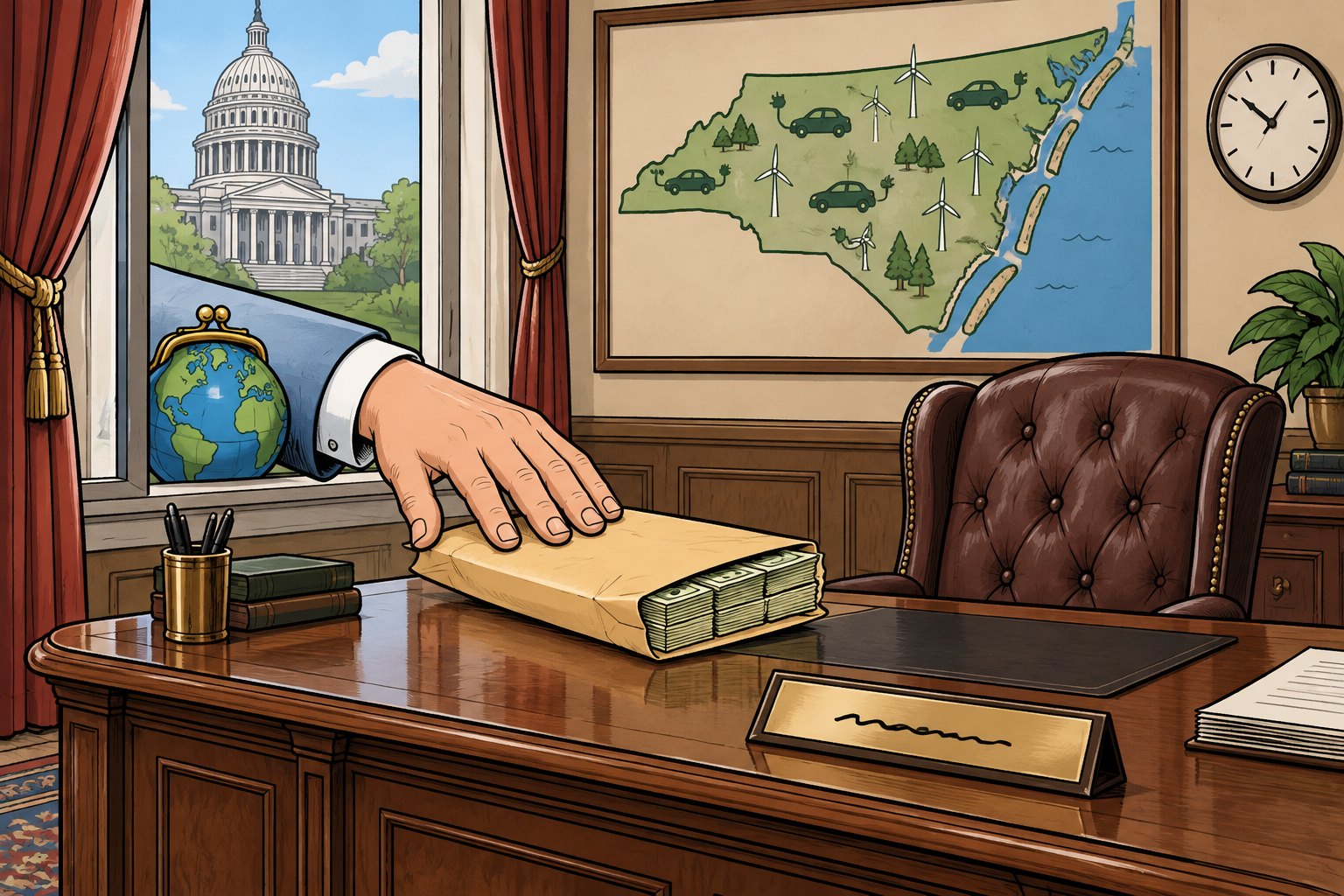
DHS Has Referred Mark Zuckerberg’s Election Data Group to the Attorney General. A Signed Letter Says the 2020 Voter-File Money Machine May Have Broken Federal Privacy Law.
On September 2, 2026, Department of Homeland Security Secretary Markwayne Mullin (R) sent a signed letter to Attorney General Todd Blanche (Trump-appointed) asking the Justice Department to review whether state motor-vehicle agencies illegally shared driver data with the Center for Election Innovation and Research (CEIR) — a nonprofit built substantially on Mark Zuckerberg and Priscilla Chan’s money.
CEIR is a separate organization from the Center for Tech and Civic Life (CTCL), the group behind the original “Zuck Bucks” controversy that sent roughly $350,000,000 to about 2,500 local election offices in 2020. But both trace back to the same philanthropic push, and the letter puts a specific federal statute — the Driver’s Privacy Protection Act — directly in the path of that money for the first time.
This is a referral asking for review — not an indictment, not a civil complaint. No charges have been filed against CEIR or anyone connected to it, and the organization disputes DHS’s account in strong terms.
- $70,000,000+ — in Chan Zuckerberg Initiative funding directed to CEIR before the 2020 election · Source: The Daily Signal, The Federalist
- $13,260,000 — CEIR grant to Pennsylvania in 2020, under a contract requiring the state to “cooperate with CEIR, including providing data, as CEIR reasonably requests” · Source: RedState
- ~$400,000,000 — combined Zuckerberg/Chan election philanthropy across the 2020 cycle, CTCL and CEIR together · Source: Capital Research Center
- 29 states — have banned or restricted private election-office funding since 2020, including Wisconsin as the 28th in 2023 · Source: Capital Research Center, Fox News
- Zero indictments — filed against CEIR, CTCL, or any individual over this data-sharing question as of publication — this is a DOJ review request, not a criminal case · Source: Civic Intelligence review
The letter itself is short, formal, and specific. It flags data-sharing arrangements built around the Electronic Registration Information Center (ERIC) — the multistate voter-roll-matching consortium several states use — through which motor-vehicle records reportedly flowed onward to CEIR. DHS’s letter states plainly that “this sharing and resharing of Motor Vehicle Agency data among NGOs may not qualify as a permissible use” of that data under the Driver’s Privacy Protection Act, the 1994 federal law that limits what states can do with DMV records after a stalker used one to murder actress Rebecca Schaeffer.
Notably, the letter’s own footnotes cite outside data-integrity research to make its case — including a conference presentation on using data-matching to protect election rolls, the same genre of technical work CEIR says is its actual mission.
“This sharing and resharing of Motor Vehicle Agency data among NGOs may not qualify as a permissible use of motor vehicle data.”
DHS Secretary Markwayne Mullin, letter to Attorney General Todd Blanche, September 2, 2026
CEIR isn’t the group most people remember from 2020. That’s CTCL, which distributed roughly $350,000,000 in privately funded election-administration grants — the money critics dubbed “Zuck Bucks” — to about 2,500 local election offices, disproportionately in Democratic-leaning cities. CEIR ran a parallel, less-publicized track: more than $70,000,000 in Chan Zuckerberg Initiative funding used to grant money and technical assistance directly to state election offices, including a $13,260,000 grant to Pennsylvania that came with a contract clause requiring the state to “cooperate with CEIR, including providing data, as CEIR reasonably requests.”
Between the two organizations, Capital Research Center puts total Zuckerberg/Chan election spending across the 2020 cycle at roughly $400,000,000. The backlash was fast and durable: 29 states have since banned or restricted private money in election administration, with Wisconsin becoming the 28th in 2023, specifically to close the door CTCL walked through in 2020.
So states were sharing personal data with Mark Zuckerberg's $400 million operation to identify unregistered voters ahead of 2020 election in apparent violation of federal law.
CEIR founder and executive director David Becker rejected DHS’s account outright. CEIR “firmly rejects any suggestion that it receives motor-vehicle or voter data on an ongoing basis” or uses any data it does receive for partisan purposes, Becker said, adding a pointed procedural complaint: “DHS did not contact CEIR for any information or clarification prior to issuing this letter.” CEIR describes its core work as nonpartisan list-maintenance research — helping states find voters who died, moved, or registered twice — not opposition research or turnout targeting.
Fairness cuts both ways here. A private lawsuit making similar data-sharing claims against CEIR — 1798 Foundation v. CEIR — was dismissed in June 2026, and the plaintiffs’ attorneys were sanctioned by the court for filing frivolous claims. That outcome doesn’t resolve DHS’s separate, DPPA-specific referral, which rests on different legal grounds and a federal agency’s own review authority, but it’s relevant context: this isn’t the first time this exact allegation has been tested, and the last time, it didn’t hold up in court.
This is at least the third time Zuckerberg-linked election money has drawn a formal government look. In 2022, special counsel Michael Gableman’s report for the Wisconsin legislature alleged that $8,800,000 in CTCL grants to five Democratic-leaning cities — Milwaukee, Madison, Racine, Kenosha, and Green Bay — violated the state’s election-bribery statute; that theory was later disputed and largely unsuccessful in court, but it fed directly into Wisconsin’s 2023 ban. In February 2023, the Honest Elections Project pressed Georgia Attorney General Chris Carr (R-GA) to investigate a $2,000,000 Zuckerberg-aligned grant to DeKalb County despite Georgia’s own existing ban on private election funding.
Under oath, Colorado's then-Deputy Secretary of State was cross-examined and acknowledged that the state's ERIC data-matching process had handled information tied to noncitizen registrants — the same data pipeline now at the center of DHS's letter.
DHS Secretary Markwayne Mullin (R) — Sent the September 2, 2026 letter requesting DOJ review of the CEIR data-sharing arrangements.
Attorney General Todd Blanche (Trump-appointed) — The letter's recipient; DOJ has not announced whether it will open a formal review.
Georgia Attorney General Chris Carr (R-GA) — Separately urged, in 2023, to investigate a Zuckerberg-aligned grant to DeKalb County under Georgia's existing private-funding ban.
None of these three episodes has produced a criminal conviction tied to the underlying funding. What they share is a consistent shape: private, tech-fortune money enters election administration through a nonprofit intermediary, flows disproportionately toward Democratic-leaning jurisdictions, and draws a government inquiry years later that struggles to outrun the fact the election has already happened.
DHS has asked the Justice Department to review whether Zuckerberg-funded CEIR received DMV data it wasn’t entitled to under federal privacy law. CEIR denies it, a similar private lawsuit was already thrown out, and no charges exist. But the referral adds a fourth government inquiry to a decade-long paper trail of Zuckerberg election money landing overwhelmingly in Democratic jurisdictions — and this time, the question is not campaign finance. It's whether anyone's driver's license data ended up somewhere federal law says it shouldn't have.