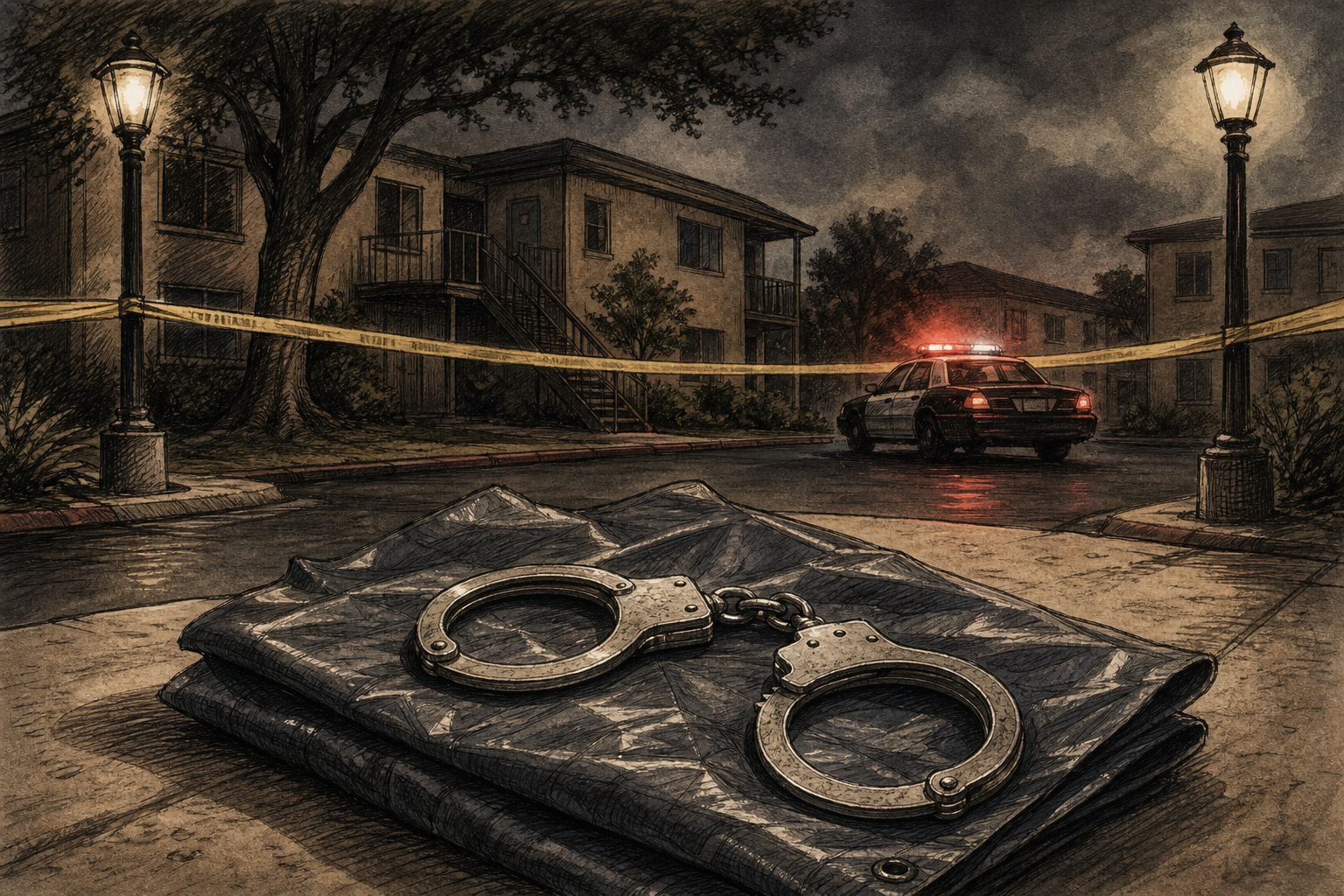
Twenty Years, One Ocean, No Escape.
In September 2005, a 30-year-old woman named Maria Morfin-Rojas was found stabbed to death in her Lenexa, Kansas, apartment. Her boyfriend and co-worker, Angel Maria Herrera, an illegal alien from El Salvador, was already gone — across the border into Mexico, then home to Central America, out of reach of any Johnson County warrant.
For eighteen years the case sat cold. Then it broke. Herrera was arrested in El Salvador, extradited in September 2024, and put on trial. What turned a two-decade dead end into a conviction was a piece of quiet federal work most readers never see: Homeland Security Investigations Kansas City tracked down two key witnesses and flew them to the United States to testify. In January 2026 a jury convicted. In March, a judge gave Herrera a “Hard 50.”
- 20yearsfrom the 2005 murder to the 2026 conviction — ICE / HSI Kansas City
- 50years'Hard 50' sentence, no parole, plus 34 consecutive months — Johnson County DA
- 2witnessesflown to the U.S. by HSI Kansas City to testify at trial — ICE
- 1detectiveworked the Lenexa file for 18 years without closing it — Lenexa PD

On Sept. 15, 2005, Lenexa police responded to a report of suspicious activity at an apartment in the 11900 block of West 77th Terrace. Inside, in a basement unit, they found Maria Morfin-Rojas, 30, dead of multiple stab wounds. Investigators believed she had been killed several days earlier — around Sept. 9 — and that the body had lain undiscovered. (Sources: Lenexa Police Department media release, case number 2005-11788; Johnson County Post.)
Detectives moved fast on a suspect. Morfin-Rojas’s boyfriend and co-worker, Angel Maria Herrera — an illegal alien from El Salvador — had disappeared. On Sept. 17, 2005, the Johnson County District Attorney’s Office charged him with premeditated first-degree murder, aggravated burglary, theft and criminal damage. According to investigators, Herrera stole the victim’s van and fled the country before local authorities could arrest him, crossing into Mexico and eventually returning to El Salvador. (Source: KCTV5; Johnson County Post.)
The victim: Maria Morfin-Rojas, 30, of Lenexa, Kansas — stabbed to death in her own apartment in September 2005.
The accused, now convicted: Angel Maria Herrera, an El Salvadoran national in the country illegally, identified by detectives as the victim’s boyfriend and co-worker. Charged within two days of the discovery; convicted by a Johnson County jury in January 2026.
The gap: Roughly two decades between the killing and the verdict — almost all of it spent by Herrera outside U.S. jurisdiction, in El Salvador.
Most cold cases stay cold because the people who care about them move on — retire, transfer, die. This one didn’t, because one Lenexa detective refused to let it. The lead investigator kept the file open and active for eighteen years, long after the trail had gone silent, according to the Lenexa Police Department and Kansas City-area reporting.
“You figure 19 years later, somebody could have retired, gotten out of law enforcement. But not only was he still with us, but he still, over those years, continued to investigate the case.”
Lenexa Police Officer Danny Chavez, on the lead detective · via Johnson County Post
That persistence is why the case was ready to move the instant the break came. When word arrived that Herrera had surfaced abroad, there was still a detective who knew the file cold, still a prosecutor’s office holding a two-decade-old charging document, and still a paper trail solid enough to take to a jury. Cold-case justice is not luck. It is somebody choosing, year after year, not to close the drawer.

On April 27, 2023, Lenexa detectives were notified that Herrera had been taken into custody in El Salvador and was being held pending extradition to the United States. After nearly eighteen years, the fugitive was finally inside a system that would hand him back. (Source: Lenexa Police Department; KSHB 41.)
The return itself came in September 2024. The Lenexa detective who had carried the case since 2005 flew to El Salvador alongside federal agents to take physical custody of Herrera and escort him home. He was booked into the Johnson County Adult Detention Center in the small hours of the morning and, a day later, faced a Kansas judge for the first time — nineteen years after the charges were filed. (Sources: KSHB 41; Johnson County Post; KCTV5.)
Herrera’s case is one thread in a broader pattern of accused killers who left the country and assumed the border was a permanent firewall. Federal enforcement of international-fugitive extraditions — often coordinated through Homeland Security Investigations, the FBI, and partner governments — is designed to prove exactly the opposite: that fleeing the jurisdiction buys time, not immunity.
Extraditing Herrera got him into a Kansas courtroom. Convicting him required something more: witnesses who could put the case in front of a jury — and the two most important ones were not in the United States. This is where Homeland Security Investigations Kansas City did the work that its news release calls its “major contribution.”
According to ICE, HSI Kansas City agents organized and coordinated the travel of two key witnesses to the United States so they could testify against Herrera. That testimony was central to the January 2026 verdict on premeditated first-degree murder and aggravated burglary. Moving witnesses across an international border — the logistics, the documentation, the security — is the kind of unglamorous federal capability that either exists when a local DA needs it or doesn’t. Here it existed. (Source: ICE / HSI Kansas City news release.)
“Justice transcends time and distance. I'm extremely proud of our agents for working with multiple partner agencies to bring these two key witnesses to the United States to provide crucial testimony. While we can't bring the victim back, we can bring closure to her friends and family, and reassurance to the public that HSI never gives up in our efforts to hold criminals accountable to the fullest extent of the law.”
Rick Sabatini, Special Agent in Charge, HSI Kansas City · ICE news release
Two decades. Two key witnesses flown in to testify. One conviction. HSI Kansas City is proud to have helped bring a 20-year murder fugitive to justice — because justice transcends time and distance.
A criminal illegal alien fled the country after a 2005 Kansas murder. He was extradited, tried, and convicted — and is now serving a 'Hard 50.' HSI never gives up on holding criminals accountable.
The trial, prosecuted by the office of District Attorney Stephen Howe (R), ran six days in Johnson County District Court before Judge Christina Dunn Gyllenborg. In January 2026, the jury returned guilty verdicts on premeditated first-degree murder and aggravated burglary. (Sources: Johnson County Post; KCTV5; FOX4 Kansas City.)
In March 2026, the court imposed the sentence Kansas reserves for its most serious murders: a “Hard 50” — life in prison with no possibility of parole for fifty years — plus an additional 34 months for the aggravated burglary, to run consecutively. For a defendant already in his forties, it is, functionally, the rest of his life. (Sources: FOX4 Kansas City; KSHB 41; Border Hawk.)
Fleeing the country does not put you beyond the reach of American justice. A criminal illegal alien who murdered a Kansas woman in 2005 and ran to El Salvador is now serving 50 years. We will find the worst of the worst — no matter how long it takes.
Paraphrased commentary · not a verbatim post
Truth Social · paraphrase of DHS public messaging on criminal-alien enforcement
A killer who fled to El Salvador thought he got away with it for twenty years. Our great federal agents brought him back and he will spend the rest of his life in prison. This is what real law and order looks like!
Paraphrased commentary · not a verbatim post
Truth Social · paraphrase of the president's stated position on criminal-alien prosecutions
It would be easy to file this under a familiar headline about illegal immigration and violent crime, and the facts fit: an alien in the country illegally, a dead American woman, two decades of evaded justice. But the more useful lesson runs the other way — it is a story about the machinery that works when the people running it don’t quit.
A local detective who wouldn’t close a file. A district attorney’s office that kept a 2005 charge alive. An extradition partnership with El Salvador. And a federal agency, HSI Kansas City, that had the reach to move witnesses across a border so a jury could hear them. Take away any one of those pieces and Herrera would still be living free in Central America. Together, they turned a cold case into a conviction and a “Hard 50.”
Maria Morfin-Rojas was 30 years old when she was killed. She waited two decades for a verdict she never saw. As the agent who helped deliver it put it: justice could not bring her back, but it could reach across time and an ocean to find the man convicted of taking her life — and refuse to let distance be the same thing as escape.