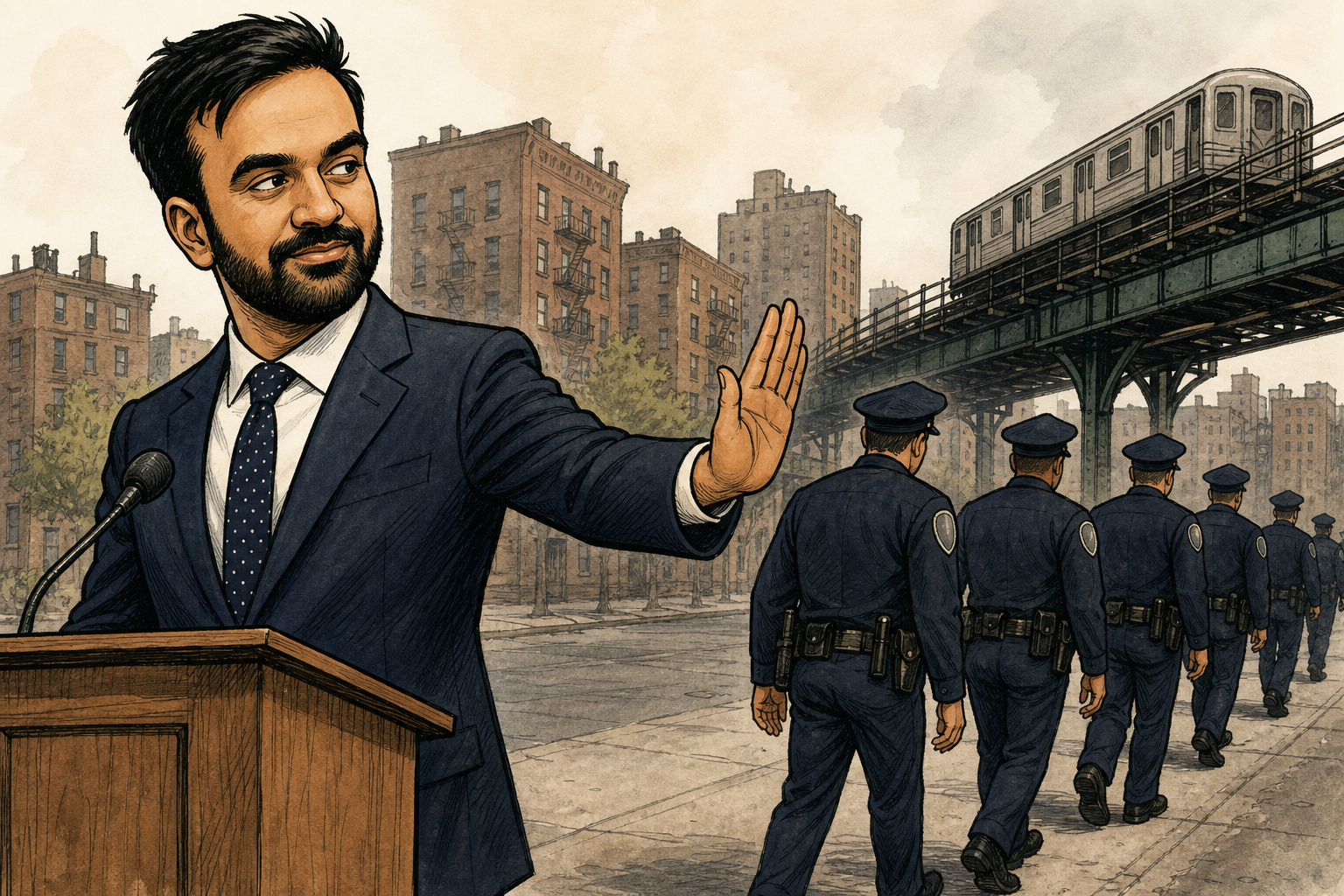
A Child Rapist Was Days From Deportation. Walz’s Board Pardoned Him.
On June 10, 2026, the Minnesota Board of Pardons voted unanimously to pardon Tou Lue Vang, 42, a Laotian national who pleaded guilty in 2006 to first-degree criminal sexual conduct for repeatedly assaulting a 10-year-old girl. The three-member board that erased his conviction: Gov. Tim Walz (D), Attorney General Keith Ellison (D), and Minnesota Supreme Court Chief Justice Natalie Hudson.
U.S. Immigration and Customs Enforcement says the pardon landed roughly a week before Vang was scheduled for removal to Laos — and the conviction the board wiped out was the very thing that made him deportable in the first place.
The Department of Homeland Security called it “madness.” Walz’s office and Ellison’s office point to a letter the victim herself wrote asking for mercy, and say DHS is “lying” about whether the pardon shields him from deportation at all. Republican critics went further — they say the governor traded public safety to, in one legislator’s words, “stick it to Trump.” Here is what the record actually shows.
- 3-0voteunanimous Board of Pardons vote to grant the pardon, June 10, 2026 — MN AG's office
- 10years oldage of the victim Vang admitted repeatedly assaulting, 2002–2004 — 2006 court filings
- ~1weekgap between the pardon and Vang's scheduled ICE removal to Laos — ICE statement
- 1994arrivedyear Vang entered the U.S. as a child refugee before losing status on his conviction

The action itself is not in dispute. At its June 10, 2026 meeting, the Minnesota Board of Pardons voted to grant Tou Lue Vang a pardon that sets aside his 2006 felony conviction for first-degree criminal sexual conduct. The three members — Gov. Tim Walz (D), Attorney General Keith Ellison (D), and Chief Justice Natalie Hudson — were unanimous. Ellison’s office confirmed the vote and described “an exhaustive process which included a statement of support for the pardon from the victim, a recommendation to grant the pardon from the Clemency Review Commission and a large number of community support letters.”
The reason this ordinary-sounding clemency detonated into a national story is the timing and the immigration stakes. Vang came to the United States as a child refugee from Laos in 1994 and became a lawful permanent resident. His 2006 conviction stripped that status: on October 31, 2006, a federal immigration judge ordered him removed from the country. For years the order sat unexecuted — Laos historically accepted few deportees — until 2026, when ICE moved to carry it out. The pardon arrived, by ICE’s account, about a week before his scheduled removal.
The act: a Minnesota pardon setting aside Vang’s felony first-degree criminal-sexual-conduct conviction — not a commutation of a prison term (he never served the underlying stayed prison sentence, only eight months in a county workhouse), but an erasure of the conviction on his record.
The vote: 3-0. All three board members — the governor, the attorney general, and the chief justice — voted yes.
The stated basis: the victim’s written support, a Clemency Review Commission recommendation, and community letters.
The consequence in dispute: whether erasing the conviction also erases the legal ground for his deportation. DHS says yes. Minnesota’s attorney general says no.
Vang was not accused. He was convicted — on his own guilty plea. According to the 2006 court filings, Vang repeatedly sexually assaulted a girl beginning when she was about 10 years old, over a span running from roughly 2002 to 2004. He pleaded guilty to first-degree criminal sexual conduct in a plea agreement that gave him a 144-month (12-year) prison sentence, stayed in favor of 30 years of supervised probation — though he did serve eight months in the county workhouse under the stayed sentence’s terms. There is no pending case here and no presumption of innocence to weigh: the conduct is a matter of adjudicated fact.
The Department of Homeland Security, quoting those same filings, added two details that have driven much of the public reaction. On at least one occasion, DHS said, Vang offered the child $10 to stay quiet about the abuse. And when questioned by police, he attempted to justify the conduct by telling investigators that for him “it is a cultural thing…to marry and have sex with girls as young as 12.” These are the facts the pardon does not undo; they remain in the record regardless of the conviction’s legal status.

Accuracy matters here, because the shorthand “Walz pardoned a child rapist” overstates one man’s power and understates the responsibility of the others. Minnesota is one of the few states that vest clemency not in the governor alone but in a three-member Board of Pardons: the governor, the attorney general, and the chief justice of the state Supreme Court. For most of state history, a pardon required all three to agree — a single “no” killed it.
That changed in a 2023 reform. Under current law, a pardon passes if the governor and at least one other board member vote yes. In other words, Gov. Walz (D) could not have granted this pardon by himself — but no pardon could have passed over his objection, either. His vote was necessary. So was one of the other two. In this case all three said yes, so the accountability is shared, not solitary: the governor, the attorney general, and the chief justice each signed off. A separate nine-member Clemency Review Commission, created by the same 2023 reform, vetted the petition first and recommended granting it.
DHS condemns Gov. Walz after Minnesota's Board of Pardons cleared a man convicted of child sexual assault — a decision the agency says could block his deportation.
That distinction cuts both ways. It rebuts the loosest version of the attack — this was not a governor unilaterally springing a predator on a whim. But it also removes an excuse. Walz was not outvoted, did not dissent, and did not use the leverage the law hands him. The chief executive of Minnesota looked at this file — the plea, the victim’s age, the $10, the statement to police — and voted to erase the conviction.
The Trump administration responded on July 1 with a formal DHS statement titled, in full capitals, “MINNESOTA MADNESS.” The agency accused Walz and, in its words, “his fellow sanctuary politicians” of shielding a convicted child rapist from removal. A DHS spokesperson called the decision “disgusting,” and the agency argued the pardon “will take away this child rapist’s qualifying convictions that made him removable from the United States.”
DHS Secretary Markwayne Mullin (R), sworn in earlier this year, amplified the condemnation directly, calling the decision to pardon “an illegal alien child rapist” horrific. U.S. Rep. Tom Emmer (R-MN), the House majority whip, said he was angered by the pardon as well. The reaction was not confined to Washington: it dominated Minnesota’s own local newscasts for days.
MINNESOTA MADNESS: Gov. Tim Walz and his fellow sanctuary politicians pardoned a criminal illegal alien convicted of sexually assaulting a 10-year-old girl — a decision that could shield him from deportation just as we moved to remove him.
Paraphrased commentary · not a verbatim post
Truth Social · paraphrasing the DHS “Minnesota Madness” statement of July 1, 2026
A Minnesota governor voting to PARDON an illegal alien child rapist so he can stay in our country is horrific. We were a week from removing him. Minnesotans deserve better than leaders who put a predator ahead of a 10-year-old girl.
Paraphrased commentary · not a verbatim post
Truth Social · paraphrasing DHS Secretary Mullin's public condemnation, reported by Townhall and Breitbart
The sharpest framing came from Minnesota Republicans, who cast the pardon not as misplaced mercy but as a political stunt aimed at the White House. State Sen. Julia Coleman (R), the Senate assistant minority leader, put it bluntly: “This is a reckless abuse of power that totally undermines justice for the victim and betrays every Minnesotan. The Governor offered up the safety of our communities so he could ‘stick it to Trump’ and score points with his far-left extremists.” The conservative outlet PJ Media ran the charge as a headline: Walz “literally pardoned a child abuser to spite Trump.”
“The Governor offered up the safety of our communities so he could 'stick it to Trump' and score points with his far-left extremists.”
State Sen. Julia Coleman (R) · Minnesota Senate Assistant Minority Leader · July 2026
The motive claim — that Walz acted to spite the president — is the critics’ charge, not an established fact, and this page notes it as such. The board did not say it was resisting a deportation to embarrass Washington; it said it was honoring a victim’s request. The timing, one week before removal, is what makes the “spite Trump” reading land: whatever the stated reason, the practical effect of erasing the conviction was to complicate an active federal removal. Readers can weigh the stated rationale against the timing themselves — but they are entitled to both facts.
Federal agencies are blasting Gov. Tim Walz over the Minnesota Board of Pardons' decision to pardon a man convicted years ago of a child sex offense, weeks before his planned deportation.
The defense rests almost entirely on the victim. In a letter to the board, she wrote: “What happened to me was wrong, but I have had many years to think about this. I have made my peace with it. I forgive him.” She asked that Vang’s family be allowed to stay together, writing that his children need their father and that “the family has suffered enough.” Ellison’s office notes that such statements of support carry real weight in clemency review, and that the board has denied pardons to three other men convicted of sex crimes who were facing deportation. Whether one victim’s forgiveness should override the public-safety and immigration consequences of erasing a child-rape conviction is precisely the judgment the three officials made — and the one voters can now judge in turn.

One factual question is still genuinely open: does the pardon actually stop the deportation? Here the two sides are not merely spinning — they are describing two different legal mechanisms, and both are partly right.
DHS’s position: the 2006 criminal-sexual-conduct conviction is the “qualifying conviction” that made Vang removable, so setting it aside removes the legal basis for that specific removal order. Ellison’s office fired back that “DHS is lying through their teeth about this pardon” and that “it does not protect Vang from deportation.” The reconciling truth, per immigration-law analysts cited across the coverage: a pardon can eliminate a conviction as a ground of removability, but it does not confer lawful status — a person who is in the country unlawfully can still be removed on that separate basis. So the pardon likely blunts the sharpest, fastest deportation route without granting Vang any right to remain.
A convicted child rapist, on a two-decade-old removal order, was days from deportation. Minnesota’s three top clemency officials — two of them elected Democrats — voted 3-0 to erase the conviction that made him removable.
They did it on the strength of the victim’s own plea for mercy, and they insist the pardon does not actually free him from deportation. Federal officials call that a fig leaf and the vote “madness.”
Both of those things can be true at once. The victim’s forgiveness was real; so was the decision, by officials sworn to public safety, to weigh it above every other consideration on a first-degree child-sexual-conduct case — the week ICE came to collect.
Secretary of State Marco Rubio (R) made the legal dispute in §06 moot by going around it. Rubio told Fox News Digital he personally terminated Tou Lue Vang’s legal status in the United States — a federal action independent of the Minnesota pardon — clearing U.S. Immigration and Customs Enforcement to remove him anyway. “Americans should never have to live in fear that foreign sex predators — shielded by their own elected officials — could endanger them or their children,” Rubio said. “That’s why I terminated his legal status in the United States.”
On X, he was blunter: Walz’s pardon had cleared Vang to stay; Rubio’s revocation cleared him to go. “Then, I revoked his legal status,” he wrote. “@ICEgov has removed him from the U.S. and he will never endanger another American.” Neither Rubio’s office nor Fox News’ reporting specified the exact statutory mechanism used, or the date and destination of the removal flight — this page will update those details if and when they are confirmed on the record.
Tou Lue Vang, convicted in 2006 of raping a 10-year-old girl, is out of the United States. Rubio’s office used a separate federal lever to remove him regardless of which side was right about the pardon’s legal effect — ending, in practice, the argument Minnesota’s Democratic leadership and DHS had been having in public since July 1.
New clemency-file documents reported by Fox News Digital add a screening step this page had not previously covered. Before the Board of Pardons in §01 ever voted, a separate nine-member Minnesota Clemency Review Commission — chaired by Mounds View Mayor Zach Lindstrom — screened Vang’s petition first. The commission voted 4-2 to recommend the pardon, a closer and earlier vote than the board’s unanimous 3-0.
The documents also explain where this update’s headline comes from. “No future” is Vang’s own language, not a finding by the board or the commission: in his pardon application he wrote that deportation to Laos would leave him with “no family, no home, and no future,” and that “I carry deep shame and regret for the harm I caused.”
“My fear is that, if deported, my children will grow up without a father, like I did.”
Tou Lue Vang · pardon application, quoted by Fox News Digital, July 13, 2026
Commissioners split on that record. Lindstrom, weighing Vang’s six children, called it “a very tough case but the kids not having a father is not in the best interest of society.” Nadine Graves, managing attorney at the Hennepin County Public Defender’s Office, cited the victim’s forgiveness and noted that Vang “retracted his prior statement about this being a result of culture. He admits this was wrong then and will always be wrong.” University of Minnesota law professor Perry Moriearty pointed to “substantial evidence of rehabilitation, remorse and acceptance of responsibility” despite “the extraordinary severity of the underlying offense,” and Cornerstone executive director Artika Roller raised the deportation consequences directly. Two commissioners voted no, citing the offense’s severity; Fox News Digital’s reporting did not name them, and this page does not guess.
Ramsey County Assistant Attorney Tami McConkey argued against the pardon in the same file, writing that Vang “does not share any thoughts or insight about what the victim must have gone through.” The documents also surface a detail from Vang’s original 2006 arrest this page had not previously reported: according to police records independently corroborated by Alpha News MN, Vang told officers at the time that the victim “should be arrested also because she was as much at fault.”
The earlier vote: a 9-member Clemency Review Commission voted 4-2 to recommend the pardon before the Board of Pardons ever took it up.
The petitioner’s words: the “no future” framing driving this update is Vang’s own, from his application — not a board or commission finding.
The dissent: a Ramsey County prosecutor and two unnamed commissioners argued against clemency on the severity of the offense alone.
Days after Rubio's removal ended the practical standoff in §07, Gov. Tim Walz (D) spoke publicly and on the record about the pardon for the first time, defending the board's decision rather than distancing himself from it. Asked to justify the vote given the deportation that followed anyway, Walz responded with three questions of his own: “Did that make us any safer? Did that make the children that are left behind any more stable? Did it improve the idea that we can’t all be judged by our worst day?”
“Did that make us any safer? Did that make the children that are left behind any more stable? Did it improve the idea that we can't all be judged by our worst day?”
Gov. Tim Walz (D-MN) · on-record defense of the pardon, July 14, 2026
Walz did not dispute the underlying conviction. “These are horrific crimes,” he said. “They often are.” But he argued the deportation itself accomplished nothing, given Vang’s six children and his decades in the United States: “I can find no reason how Minnesota is safer or better if Mr. Vang is deported to a country he has not been to since he was a child.” That framing — weighing family stability against a first-degree child-sexual-conduct conviction — is the same tradeoff §01 and §08 already documented in the board's and commission's own language; what changed on July 15 is that the governor made the argument himself, publicly, rather than leaving it to Ellison’s office and the clemency file.
Tim Walz pardoned a child rapist. This will not happen on my watch.
What's new: Walz's own on-record rationale, in his own words, delivered five weeks after the pardon and days after Vang's actual removal — the first time he has defended the decision publicly rather than routing all comment through Ellison’s office.
What hasn’t changed: Walz does not contest the conviction, the victim’s age, or the severity of the underlying conduct. His defense is entirely about whether deportation, on top of the pardon, served any purpose — not about whether the pardon itself was warranted.
Standing criticism: MN House Speaker Lisa Demuth (R) made the charge above when the pardon first became public on July 2 — before Walz had said anything himself. Her line reads just as pointed applied to his July 14 defense, which is why it's reproduced here, but it predates that defense; no fresh Demuth statement on the July 14 remarks specifically has been published as of this writing.

The pardon found an unexpected defender in Minnesota’s largest newspaper. In her weekly “Cheers & Jeers” column published July 17, Star Tribune columnist Rochelle Olson, a roughly 26-year veteran of the paper, offered “Cheers to Gov. Tim Walz” for what she framed as standing firm under pressure — writing that the governor had “refused to back down” from the criticism detailed in §04 through §09 of this page. Olson noted that Vang “had not committed additional crimes in the past two decades” and, like Walz’s own defense in §09, pointed to the victim’s forgiveness letter as the moral basis for the pardon.
Olson’s most pointed argument was a direct comparison to a different set of pardons entirely.
“Vang's actions 20 years ago were awful, but so were the violent protests at the U.S. Capitol on Jan. 6, 2021, and those folks received presidential pardons.”
Rochelle Olson · Star Tribune, “Cheers & Jeers” column, July 17, 2026
The comparison drew immediate, sharp pushback. Conservative media aggregator Twitchy ran the column under the headline “Crass Media: Minnesota Star Tribune Columnist Cheers Tim Walz for Pardoning Illegal Alien Child Rapist,” with writer Warren Squire arguing that equating a first-degree child-sexual-conduct conviction to a riot charge trivialized the former. Alpha News MN’s reporting on the column drew a response from Rep. Tom Emmer (R-MN), the House majority whip already quoted in §04: “No one should read this depraved rag,” Emmer wrote, accusing the paper of “cheering on Tim Walz protecting an illegal alien monster who raped a 10 year old girl.” “They are sick,” he added. Readers reacting to the column made the same objection in blunter terms, with one commenter writing, “He raped a 10-year-old for two years and she is celebrating Walz!”
What’s new: a Star Tribune columnist, not a Walz spokesperson, is now making the case for the pardon in print — and doing so by comparing Vang’s conviction to the January 6 Capitol riot, a framing neither the Board of Pardons nor Walz himself used in §01 or §09.
What hasn’t changed: the underlying facts in §02 — the conviction, the victim’s age, the guilty plea — are not disputed by Olson any more than they were by Walz. Her column argues the pardon was justified; it does not argue the crime was minor.
The reaction: the column, rather than settling the debate, became its own flashpoint — drawing condemnation from a sitting member of House GOP leadership and reinforcing, for critics, the original charge in §05 that Minnesota’s political and media establishment closed ranks around the pardon rather than reckoning with it.