College Football’s Declaration of Independence Has a Price Tag. 41 Cut Programs Already Paid It.
For the Fourth of July, On3’s Tennessee affiliate floated a breakaway 64-team “Super Division” — a standalone league it billed as the best football product outside the NFL, complete with salary caps and Premier League-style relegation. It is a fan-facing thought experiment, not a real proposal.
The fantasy is fiction. The money underneath it is not. A $7 billion Big Ten media deal, a $20.5 million per-school pay cap, and a bipartisan Senate report documenting a 584% revenue-gap explosion are all on the record — and that gap has already cut 41 Olympic-sport programs.
The July 4 hook is a doorway into the real story: the top two conferences’ revenue has already declared independence from everyone else’s. Here is what that independence costs the schools it leaves behind.
- $20.5McapHouse-settlement revenue-sharing cap per school in Year 1 (2025-26), rising annually — Ropes & Gray / CUPA-HR
- $40–50Mper schoolprojected annual revenue advantage the Power Two (SEC/Big Ten) hold over the rest of the Power Four — industry projection
- $43M+gapper-school revenue gap over lower-tier FBS in 2023, up 584% since 2002 — U.S. Senate Commerce Committee
- 41programs cutDivision-I Olympic-sport programs eliminated since May 2024, affecting 1,000+ athletes — Senate Commerce

The peg is a piece of holiday sports fiction. On3’s Tennessee site, Volquest, marked the Fourth of July by imagining college football “celebrating its independence” — a breakaway league it calls the Super Division. It is expressly a staff thought experiment, endorsed by no conference and no governing body, so we treat it as one: a fan’s napkin sketch, not a plan on anyone’s desk.
The sketch is detailed. It starts at 68 teams, trims to 64 each year via relegation, and arranges them as eight 8-team divisions — 18 Big Ten, 16 SEC, 16 Big 12, and 18 ACC schools with Notre Dame folded into the ACC bucket. Four commissioners would each oversee two divisions. It imposes hard salary caps a professional league would recognize, a compressed schedule, and a promotion-and-relegation ladder borrowed from English soccer. The one thing it is not is real — and it invents hypothetical 2026 win-loss records to populate its relegation table, which we omit, because the 2026 season does not kick off until September.
Structure: 68 teams to start, trimmed to 64 via annual relegation, arranged as eight 8-team divisions — a standalone league, not the NCAA and not one merged conference.
Salary caps: a football-staff cap of $20–25M per year (head coach through analysts, every dollar counted) and a player cap of $40–50M, with a $200,000 minimum per player and at least $10M earmarked for freshmen.
Season: 12 games in 13 weeks, September through Thanksgiving, feeding a 16-team playoff of eight division winners plus eight wildcards.
Reality check: a thought experiment. No conference, and not the NCAA, has proposed or endorsed it.
“Super Division is not a new NCAA entity or one big conference; this is a new league that sees itself as absolutely the best football product outside of the NFL.”
On3 / Volquest Staff · the Super Division thought experiment · July 2026
The reason a napkin sketch is worth taking seriously is that its economics are already half-built. The two conferences at the center of every breakaway scenario, the Big Ten and the SEC, sit on media contracts that dwarf everyone else’s. In 2022 the Big Ten signed a seven-year deal worth about $7 billion with Fox, CBS, and NBC, running through the 2029-30 season and projected to pay its members somewhere between $75 million and $100 million per school per year. The SEC’s ten-year ESPN deal, which began in 2024, is worth roughly $3 billion — about $300 million a year — and the conference distributed $52.6 million to each of its 14 members for 2023-24 alone, against $853 million in total revenue.
On top of the television money, the sport now has a real salary structure — the one piece of the Super Division fantasy that has already come true. Under the House v. NCAA settlement, approved by Judge Claudia Wilken on June 6, 2025 and effective July 1, schools may pay athletes directly, capped at $20.5 million per school in the first year and rising over the deal’s ten-year term, with a separate $2.8 billion in back pay owed to athletes from 2016 through 2025. The thought experiment’s $40–50 million player cap is fiction; the $20.5 million cap that actually governs the sport is not.
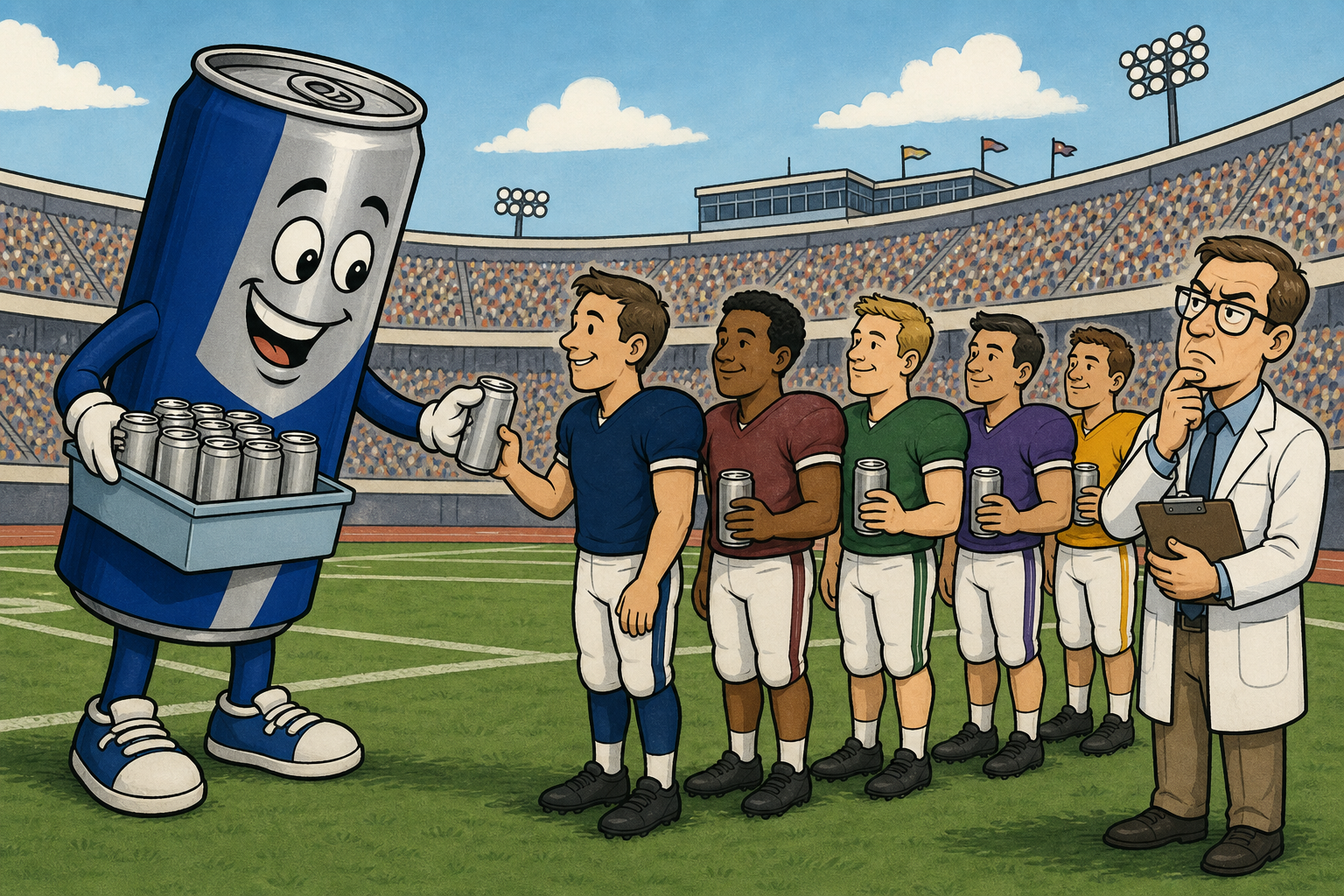
The Super Division isn’t the first breakaway sketch — it is the latest entry in a genre that already has real money and real names attached. The most developed is Project Rudy, reported by CBS Sports: a 70-team reimagining of the sport backed by roughly $9 billion in private equity through Smash Capital, whose principals include former Disney executives Evan Richter, Kevin Mayer, and Tom Staggs, with former Notre Dame athletic director Jack Swarbrick advising. Its tiered payout model would route the most money to a top group of schools and progressively less to everyone below them.
A rival blueprint, the College Student Football League led by Turnkey ZRG chief Len Perna, pitched a roughly 72-to-80-team structure whose backers warned it would trigger an “implosion of FBS” if the sport did not reorganize; it was scrapped in January 2025. On3’s own Andy Staples has separately war-gamed a 48-team super league. What every one of these plans shares — Project Rudy, the CSFL, Staples’ 48-team model, and now the Super Division — is the same load-bearing move: it eliminates games against Group of Five and FCS opponents and locks them out of the postseason entirely.
Here is where the fantasy stops being harmless. A breakaway’s central premise — separating the richest programs from the rest — is not hypothetical. It is already measured. In September 2025 the U.S. Senate Commerce Committee published an analysis of the widening gap between power-conference schools and everyone else, and the numbers are stark: the annual revenue gap grew from about $6 million per school in 2002 to more than $43 million per school in 2023 — a 584% increase — with power-conference schools now taking in nearly twelve times as much from conference revenue distributions as those in lower-tier FBS leagues.
That gap has a body count in scholarships. The same Senate analysis found that 41 Division-I Olympic-sport programs — the non-revenue sports that football money has historically subsidized — have been cut since May 2024, affecting more than 1,000 athletes, disappearing first at the schools with the least football money. And the collapse is not theoretical for the schools already outside the tent: after the Pac-12 dissolved, Oregon State projected an 84% drop in its conference and media revenue, from $42.7 million in fiscal 2024 to $6.7 million in fiscal 2025. The relegation gimmick in the Super Division sketch dresses up as meritocracy what the money has already decided.
“Power-conference schools now receive nearly 12 times more from conference revenue distributions than those in lower-tier FBS conferences.”
U.S. Senate Commerce Committee · The Growing College Sports Funding Gap · September 2025
Breakaway talk gains oxygen because the sport’s own governance keeps stalling. The clearest example is the fight over the College Football Playoff format. Greg Sankey, the SEC commissioner, has favored a 16-team field; Tony Petitti, his Big Ten counterpart, has pushed a 24-team model built on automatic qualifiers and play-in games; and Big 12 commissioner Brett Yormark has described the discussions as ongoing while ACC commissioner Jim Phillips manages a conference whose athletic directors have taken meetings with super-league financiers. With no consensus, the Playoff will stay at 12 teams for 2026.
Conference commissioners have decided to 'start over' on the 2026 College Football Playoff format. The Big Ten and SEC initially wanted four automatic qualifiers each, with two apiece for the ACC and Big 12 — but the ACC and Big 12 pushed back, and SEC coaches later publicly did not support the 4-AQ model.
No agreement on College Football Playoff expansion after commissioners met Sunday. 'We still have more work to do,' Big Ten's Tony Petitti said. 'Discussions ongoing,' Big 12's Brett Yormark said. If no agreement on new format by Friday, playoff will remain at 12 teams in 2026.
The governance vacuum is exactly what private capital is circling. NCAA president Charlie Baker, in his January 2026 State of College Sports address, urged caution on the private-equity pitches now common in the sport, warning schools to “be really careful” and flagging the mismatch between a fund’s three-to-five-year horizon and a university’s far longer one. The SEC and Big Ten, for their part, have publicly shown a united front against private-equity involvement even as they explore a scheduling partnership between themselves — a two-conference alliance that looks, structurally, a lot like the first draft of a Super Division. Meanwhile the SCORE Act, the House bill meant to set federal rules for the new pay era, advanced through committee only to be pulled from the floor twice.
The format fight: Sankey (16 teams) and Petitti (24 teams) cannot agree, so the Playoff stays at 12 for 2026 — a stalemate at the very top of the sport.
The capital: private-equity groups are pitching $9 billion breakaway leagues while NCAA president Charlie Baker warns schools to “be really careful.”
The law: the SCORE Act, Congress’s attempt to write federal rules for the pay-for-play era, cleared committee but was twice pulled before a floor vote.
Read as fiction, the Super Division is a fun Fourth of July riff — caps, relegation, a clean 64-team bracket. Read as a mirror, it is a fairly accurate reflection of a split that has already happened financially. The Power Two hold a projected $40–50 million-per-school revenue advantage over the rest of the Power Four and a $43 million-plus gap over lower-tier FBS; every breakaway blueprint on record cuts the same schools loose, and the bill for that separation is already being paid in cut programs and vanished scholarships.
The On3 “Super Division” is a thought experiment, and its invented 2026 records are fiction. But the money that would make such a breakaway possible is real and already sorted: a $7 billion Big Ten deal, a $20.5 million pay cap, and a 584% revenue gap the Senate Commerce Committee has documented in a bipartisan report.
The independence in the July 4 framing is not the sport’s. It is the independence of the top two conferences’ revenue from everyone else’s — and, per the Senate’s own numbers, 41 Olympic-sport programs and more than a thousand athletes have already paid for it.