
China’s 2019 E-Commerce Law Never Mentioned Algorithms.
The Rewrite Adds Them, Plus AI Agents —
And a Clause to Blacklist Foreign Firms.
On July 4, 2026, China’s State Administration for Market Regulation and Ministry of Commerce jointly opened public comment on a draft amendment to the E-Commerce Law — the statute’s first substantive rewrite since it took effect on January 1, 2019. The 20-article draft is open for comment through August 4, 2026, according to SAMR’s own posting.
The amendment does something the original law never did: it names algorithms. Regulators have described the draft as the legislative output of a specific instruction in China’s 15th Five-Year Plan (2026–2030), which calls for “stronger oversight of platform companies’ data, algorithms, traffic rules, and operating practices.” The rewrite folds AI-powered shopping agents, live-streaming sellers, logistics providers, and payment processors into a single regulated category — what regulators now call the “platform economy” — well beyond the marketplace-and-merchant scope the 2019 law was built for.
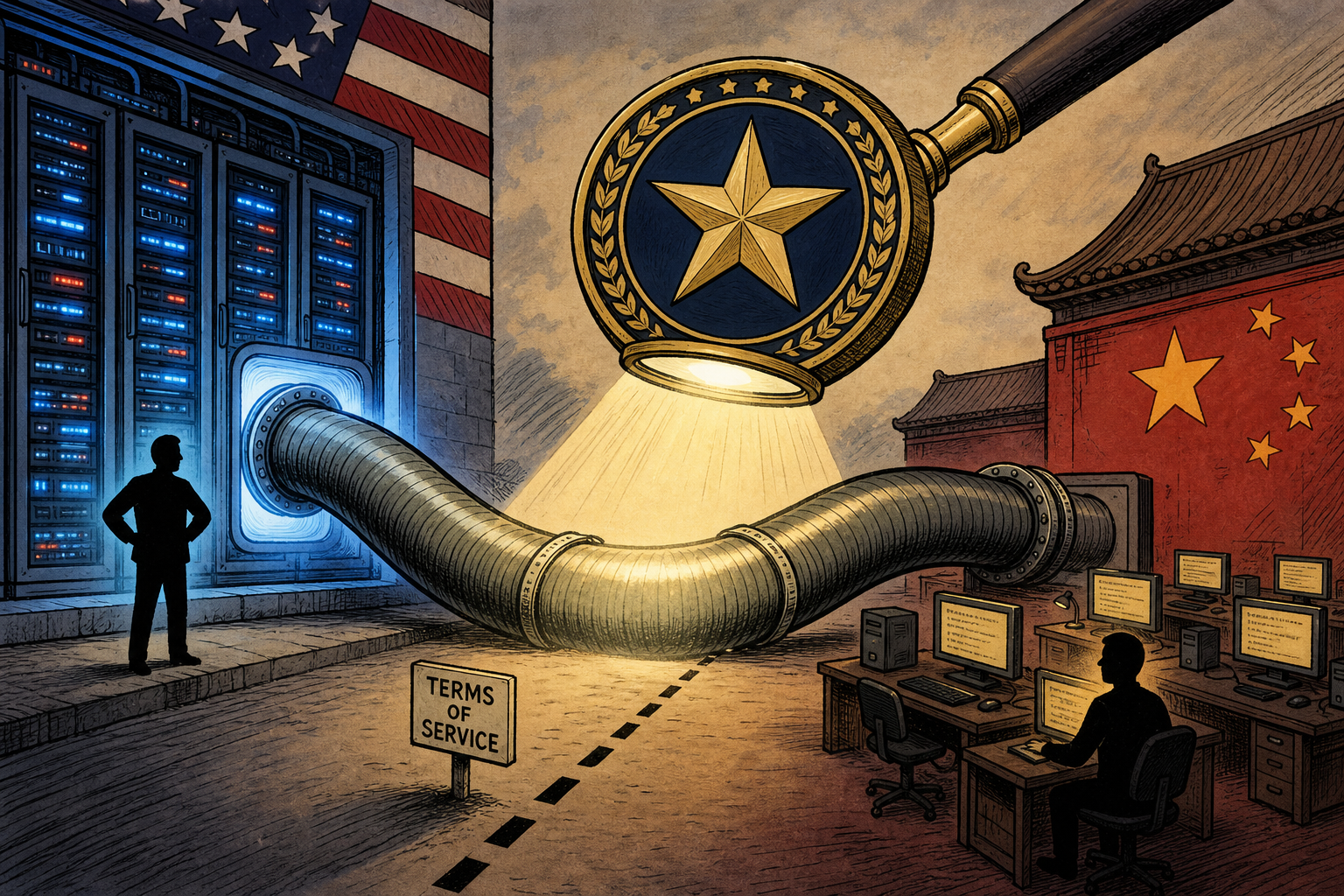
The draft’s most closely watched language, though, has nothing to do with algorithms. Two new articles let China take “corresponding countermeasures” against foreign governments that discriminate against Chinese e-commerce companies, and let commerce authorities place foreign firms that violate fair-trade rules on an “unreliable entity list” — restricting their ability to invest in China’s e-commerce sector. The provisions arrive as Temu and Shein absorb a coordinated tightening from Washington and Brussels on tariffs, de minimis exemptions, and product-safety fines.
- 20provisions in the draftSAMR + Ministry of Commerce joint amendment draft to the 2019 E-Commerce Law, opened for public comment July 4, 2026
- 30 Dayspublic comment windowComment period runs July 4 to August 4, 2026 — Round 2 of consultation; Round 1 ran August-October 2021
- $528MApril 2026 SAMR fineAlibaba, JD.com, PDD Holdings, Meituan, and ByteDance's Douyin fined a combined 3.6 billion yuan for failing to block unqualified food-delivery merchants
- $2.8B2021 record Alibaba fine18.2 billion yuan — 4% of Alibaba's 2019 China revenue — for 'choose one from two' merchant-coercion abuse of dominance
The 20 articles group into five areas, per Global Times’ breakdown of the consultation text: expanding the law’s scope beyond platforms and in-platform merchants to the full “platform economy”; new platform liability tools beyond the current binary of fixed fines and business-suspension orders; clearer coordination mandates between central and local regulators, plus consistent enforcement whether a business operates purely online or blends online and offline; provisions to “rectify” practices that have “drawn significant public concern”; and deepened international cooperation — the section that contains the countermeasures clauses detailed in §03 below.
SAMR and the Ministry of Commerce said in their joint statement that authorities would “optimize the draft amendment in light of public feedback and work to advance the revision as soon as possible, providing a strong legal foundation for innovation and sound development in the platform economy,” per Xinhua’s official readout.
| Dimension | 2019 Law | 2026 Draft Amendment |
|---|---|---|
| Scope | Online marketplaces and in-platform merchants only | The full “platform economy” — AI shopping agents, live-streaming sellers, logistics, payment processors, data infrastructure |
| Liability Tools | Fixed fines, business-suspension orders | Adds “routing oversight” mechanisms alongside existing fines and suspensions |
| Algorithm / Data Oversight | Not addressed | Explicit 15th Five-Year Plan mandate covering platform data, algorithms, traffic rules, operating practices |
| Regulatory Coordination | Largely agency-siloed enforcement | Explicit cross-agency mandate + consistent online/offline enforcement |
| International Provisions | None | New “countermeasures” + “unreliable entity list” articles targeting discriminatory foreign measures |
| Public Consultation | 4 rounds of NPCSC deliberation, 2016–2018 | Round 2 public comment, July 4–Aug 4, 2026 (Round 1 ran Aug–Oct 2021) |

This isn’t a rules amendment operating in a vacuum. It arrives roughly seven months after regulators already wrote binding algorithm rules into force. On December 20, 2025, the National Development and Reform Commission, SAMR, and the Cyberspace Administration of China jointly issued the “Internet Platform Pricing Conduct Rules”— 29 articles, effective April 10, 2026, running through April 10, 2031. Those rules already ban platforms from using “traffic throttling, search ranking demotions, or algorithm penalties” to coerce merchants into lowest-price deals, and separately bar algorithmic price discrimination — charging different consumers different prices for identical goods based on data about their “willingness or ability to pay” without disclosure, a practice popularly known in China as “big data price gouging” (South China Morning Post).
Two and a half weeks later, on January 7, 2026, SAMR further extended the pattern by releasing 69-provision “Measures for Supervision and Management of Live-Streaming E-Commerce,” effective February 1, 2026 — rules that require any AI-generated “digital human” livestream host to be clearly labeled as synthetic, with continuous reminders shown to viewers throughout the broadcast.
China’s 15th Five-Year Plan (2026–2030) explicitly directs “stronger oversight of platform companies’ data, algorithms, traffic rules, and operating practices.” Multiple outlets — Bloomberg, Xinhua, Global Times — describe the July 4 draft as the legislative vehicle converting that Plan directive into binding statute, rather than a standalone policy choice.
China unveiled broad regulations that ban major platforms such as Alibaba from coercing online merchants into promotions, one of a raft of new measures intended to cool rapidly intensifying e-commerce competition.
Multiple outlets call the draft’s international provisions its “most novel” content. Two new articles under the “deepening open cooperation” heading function less like consumer-protection law and more like a trade-retaliation statute. Per Global Times’ reading of the text: if foreign countries adopt discriminatory measures against Chinese e-commerce, “China may take corresponding countermeasures in light of actual circumstances.” A second article lets commerce authorities investigate foreign entities found violating non-discrimination and fair-trade rules, place them on an “unreliable entity list,” and restrict their ability to invest in China’s e-commerce sector.
The context for why now: Temu and Shein, both majority China-sourced platforms, have spent the past 14 months absorbing a coordinated tightening from Washington and Brussels. In May 2025, the U.S. ended the $800 de minimis exemption for Chinese-origin parcels, replacing it with a 54% tariff or a flat $100 fee; Temu reportedly lost “more than half” of its daily U.S. users in the aftermath. On July 1, 2026, the EU followed, ending its own €150 de minimis threshold and imposing a flat €3-per-item customs charge — a bill that stacks per tariff category inside a single parcel — while separately fining Temu €200 million under the Digital Services Act for selling unsafe products.
Beijing’s draft doesn’t reverse any of that. What it does is give Chinese regulators an explicit legal hook to respond in kind, while formalizing a mechanism — the unreliable entity list — that China has used since 2020 against targets in other industries.
China's largest online marketplace operator (Taobao/Tmall). Paid the record $2.8B antitrust fine in 2021; named in every SAMR summons since February 2026.
Direct-retail rival to Alibaba. One of five platforms fined a combined $528M in April 2026 for food-delivery merchant violations.
Parent of Temu. The draft's international “countermeasures” provisions are aimed squarely at protecting Temu's overseas operations from US and EU tariff and de minimis actions.
Not U.S.-listed, but named alongside Temu in coverage of the draft's international provisions — facing the same EU de minimis change and a €200M Digital Services Act fine.
Operates Douyin's e-commerce arm. Fined in the April 2026 SAMR action; summoned to the February 2026 anti-involution meeting.
Food-delivery and quick-commerce leader. Its Hong Kong shares moved the most (+14%) on the March 2026 price-war truce signal.
“These foreign-related provisions mark a significant step forward in China's legal framework for cross-border digital trade.”
Wang Peng, Beijing Academy of Social Sciences · Global Times · July 2026
Zhu Keli of the China Institute of New Economy told Global Times the alignment with international standards “will help lower institutional barriers for domestic enterprises operating globally” — reframing a defensive statute as an offensive one for Chinese platforms expanding overseas.

The July 4 draft is not an isolated event. It is the latest entry in a five-year arc of platform-liability enforcement that began with Alibaba’s record 2021 fine and accelerated sharply through 2026’s “anti-involution” campaign against ruinous, deflation-fueling price competition.
SAMR fines Alibaba a record 18.2B yuan ($2.8B) for “choose one from two” merchant coercion — the abuse-of-dominance case that set the modern template for platform-liability enforcement.
NDRC, SAMR, and the Cyberspace Administration of China jointly issue the 29-article “Internet Platform Pricing Conduct Rules,” banning algorithmic price coercion and “big data price gouging” (effective April 10, 2026).
SAMR formally releases 69-provision live-streaming e-commerce measures requiring labels on AI-generated “digital human” hosts (effective Feb 1, 2026); Bloomberg covers the release as part of a broader regulatory salvo against online-commerce competition.
SAMR summons Alibaba, ByteDance's Douyin, Baidu, Tencent, JD.com, Meituan, and Alibaba's Taobao Shangou unit, demanding an end to aggressive discounting ahead of the June “618” shopping festival.
Meituan shares jump 14% in Hong Kong — its biggest one-day gain since October 2024 — Alibaba +4.6%, JD.com +4.9%, after SAMR holds a seminar on unfair competition and state-run Economic Daily publishes a column calling for an end to price wars.
SAMR fines Alibaba, JD.com, PDD Holdings, Meituan, and ByteDance's Douyin a combined 3.6B yuan ($528M) for failing to block unqualified food-delivery merchants.
Bloomberg: Alibaba and JD.com “lead China selloff” after a fresh Beijing warning on price-cut promotions.
CNBC reports Beijing is “summoning executives again,” but Rhodium Group calls it “calibrated signaling rather than a sustained crackdown” — distinct from 2021's trillion-dollar market-cap wipeout.
The EU ends its €150 de minimis exemption, imposing a flat €3-per-item customs charge on parcels from Temu, Shein, and AliExpress.
SAMR and the Ministry of Commerce jointly open a 30-day public comment period on the E-Commerce Law's first substantive rewrite since 2019.
Meituan, Alibaba, and JD.com vow to curb “disorderly competition” and limit their price wars in China’s food-delivery space after a warning from Chinese regulators (Bloomberg)
Analysts are split on how sharply to read the 2026 enforcement wave against the 2021 crackdown that erased more than $1 trillion in Chinese tech market capitalization.
“Calibrated signaling rather than a sustained crackdown.”
Ciel Qi, Research Analyst, Rhodium Group · CNBC · June 23, 2026
Li Chengdong, founder of e-commerce consultancy Dolphin, framed the underlying merchant grievance the algorithm rules target: large platforms have typically leveraged their scale to demand that brands guarantee the lowest price on their platform, forcing brands to create different product variants and driving up operational costs for merchants, he told South China Morning Post.
“The amendments address new business models like live-streaming commerce and expand regulatory scope for both domestic and cross-border needs.”
Liu Dingding, Industry Analyst · Global Times · July 2026
Markets have treated Beijing’s platform-economy enforcement as a two-way signal rather than a one-directional crackdown. When SAMR’s seminar and a state-media column called for an end to food-delivery price wars on March 25, 2026, Hong Kong-listed Meituan jumped 14% — its biggest single-day gain since October 2024 — with Alibaba up 4.6% and JD.com up 4.9%, per Bloomberg. U.S.-listed shares of the same companies moved in tandem the same trading session.
U.S.-LISTED SHARES OF ALIBABA UP 3.3%, JD.COM UP 4.4% AFTER CHINESE REGULATOR, STATE MEDIA CALL END TO PRICE WAR #ALIBABA $BABA $JD #MEITUAN $MPNGY
That same dynamic cuts the other way: Bloomberg reported Alibaba and JD.com leading a China tech selloff on June 11, 2026 after a fresh regulatory warning on price-cut promotions — a reminder that the enforcement arc behind the July 4 draft moves both stock prices and platform behavior in real time, well before any amendment becomes binding law.
The draft still has a long legislative road ahead. Per NPC Observer’s tracker, this is only the second public consultation round — the first ran August to October 2021 — and the original law itself took four separate rounds of NPC deliberation across 2016–2018 before its 2019 effective date. On that precedent, a final, binding version of the amendment is unlikely before late 2026 at the earliest, and the current 20 articles may still change materially before any NPCSC vote.
China’s 2019 E-Commerce Law never mentioned algorithms. The draft amendment SAMR and the Ministry of Commerce opened for public comment on July 4, 2026 does — folding AI shopping agents, live-streaming sellers, and algorithmic pricing into a single regulated “platform economy,” the direct legislative product of a 15th Five-Year Plan directive. It also adds something the original law never needed: a legal trigger letting Beijing take “countermeasures” against foreign governments and blacklist foreign companies on an “unreliable entity list,” aimed at shielding Temu and Shein from tariffs and fines in the U.S. and EU. The draft arrives five years after Alibaba’s record $2.8 billion antitrust fine and eight months into a 2026 “anti-involution” campaign that analysts call calibrated signaling, not a repeat of 2021’s trillion-dollar crackdown. Public comment closes August 4, 2026; a binding, final version remains at least months, and likely longer, away.

Tier 1: Xinhua's official state-news confirmation, SAMR's own consultation posting (via Xinhua and Global Times), NPC Observer's legislative tracker, and Alibaba's SEC filing of its 2021 penalty decision. Tier 2: Bloomberg, CNBC, South China Morning Post, Euronews. Tier 3: TheNextWeb, Yahoo Finance/Investing.com, aggregator and company social posts used only to corroborate facts already reported by Tier 1/2 outlets. Figures in U.S. dollars are converted from yuan or euros at approximate contemporaneous exchange rates as reported by the cited outlet. The draft amendment is not yet law; provisions described here reflect the July 4, 2026 consultation text and may change before any NPC Standing Committee vote.