Nvidia Will Guarantee Up to $105 Billion for OpenAI’s Newest Data Center. It’s Built on the Site of a Cold War Uranium-Enrichment Plant in Rural Ohio.
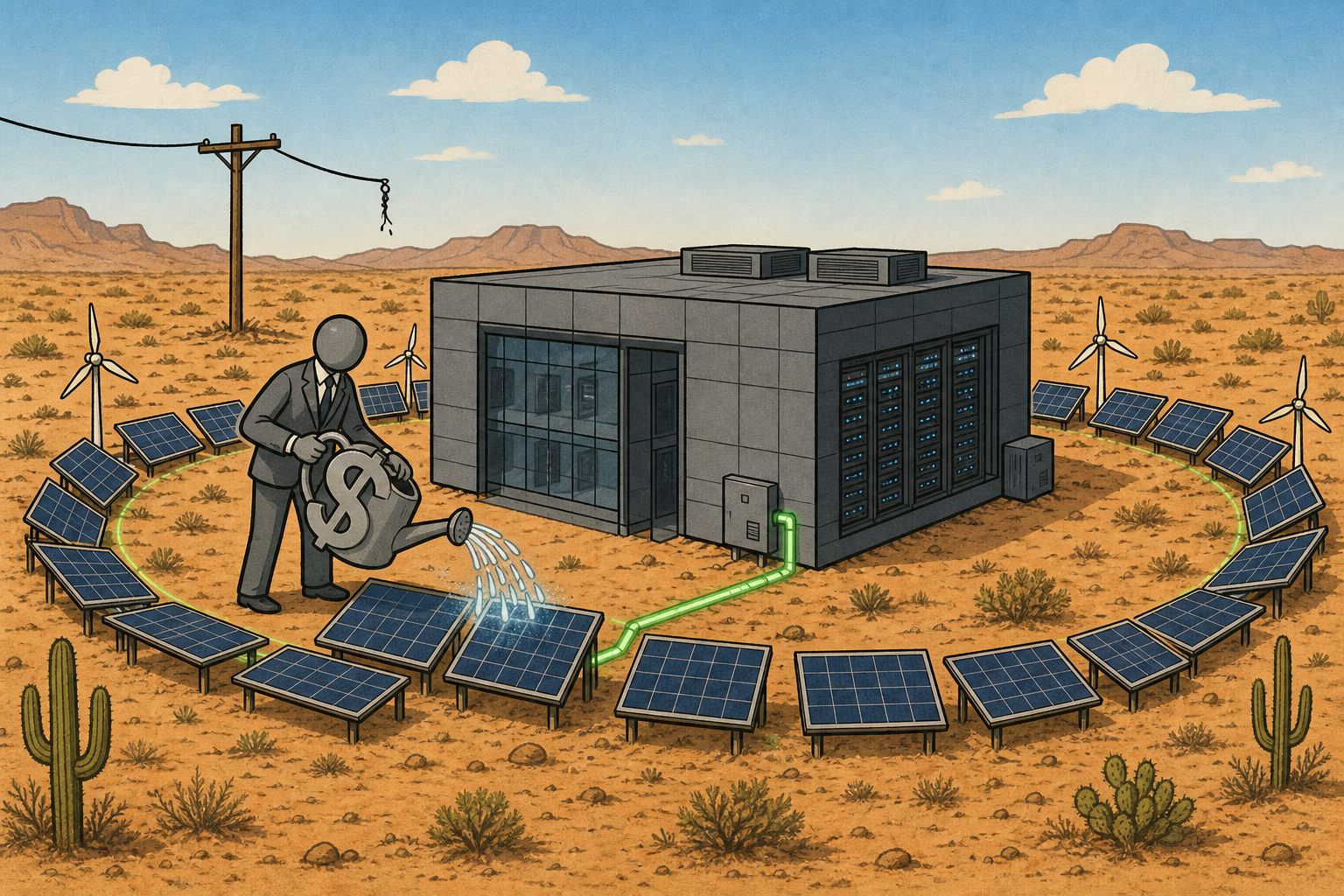
On Aug. 17, 2026, Nvidia, OpenAI, and SoftBank’s SB Energy announced a 20-year lease for an 8-gigawatt data center campus at the PORTS-Pike Technology Campus in Pike County, Ohio — the decommissioned Portsmouth Gaseous Diffusion Plant, a Cold War uranium-enrichment facility that once consumed roughly 3 percent of the nation’s electricity supply. Nvidia will guarantee up to $105 billion of the site’s lease and power payments for its first phase, and separately invest $1.5 billion directly in SB Energy, joining SoftBank Group and OpenAI as investors in the developer.
The number moved fast. Three weeks earlier, on July 26-27, reports said Nvidia was in talks to guarantee as much as $250 billion for the same 10-gigawatt Ohio campus — on top of up to $350 billion in separate chip purchases. By Aug. 16, financial trackers reported the number had already been cut to under $120 billion amid investor pushback. The final figure landed at $105 billion for roughly half the planned capacity, with Nvidia’s CEO Jensen Huang publicly rejecting comparisons to “circular financing” along the way.
OpenAI CEO Sam Altman called it “a huge site, with enough computing power to help millions of people use AI to do things we can only start to imagine today.” The project is also a jobs and cleanup story for a county that ranks among Ohio’s poorest: OpenAI says the six-year buildout will support 35,000 construction jobs and 2,500 permanent ones, on land the Department of Energy is still remediating from decades of nuclear-weapons-program contamination.
- $105B — the maximum Nvidia will guarantee for lease and power payments on the site's first phase · Source: Bloomberg, Nvidia
- 8 GW — total planned IT capacity at the Pike County campus, up from an initial 4.25 GW · Source: Nvidia Newsroom
- 35,000 — construction jobs OpenAI says the six-year buildout will support through 2032 · Source: OpenAI, Nvidia
- $1.5B — Nvidia's separate equity investment directly in site developer SB Energy · Source: Nvidia Newsroom
- 2028 — the year the first 800 megawatts of capacity are expected to come online · Source: Nvidia, CNBC
The deal has three separate moving parts, according to Nvidia’s own Aug. 17 announcement. First, SB Energy builds, owns, and operates the physical campus and leases it to OpenAI for 20 years. Second, Nvidia provides credit support — “defined portions” of the lease and power payments, capped at $105 billion — covering the initial 4.25 gigawatts of capacity, with an option for SB Energy to bring the remaining 3.75 gigawatts online later. Third, Nvidia becomes the site’s exclusive AI compute provider, with reporting from Bloomberg and its wire partners putting the total chip deployment at roughly 1.5 million Nvidia GPUs and $150 billion to $200 billion in potential chip revenue through 2030.
Huang framed the arrangement as a new kind of bet: “AI is becoming infrastructure — the foundation for intelligence in every industry — and land, power and shell have become vital in the age of AI.” SB Energy co-CEO Rich Hossfeld said the company is “building power-first infrastructure at unprecedented scale,” while SoftBank Group Chairman Masayoshi Son called it infrastructure “built at unprecedented speed and scale.” Goldman Sachs and JPMorgan advised SB Energy on the transaction; Morgan Stanley advised Nvidia.

The Portsmouth Gaseous Diffusion Plant operated from 1954 to 2001, enriching uranium for the U.S. nuclear-weapons program and commercial reactors. At its peak it drew roughly the same electricity as New York City, and the Department of Energy is still spending an estimated $14 billion to $18 billion to decontaminate and dismantle it, per reporting from The National Desk. Pike County ranks third-lowest in Ohio for per capita income.
Local reaction has been closer to disbelief than protest. Steve Shepherd, executive director of the Southern Ohio Diversification Initiative, told The National Desk he was “very surprised. Maybe, still in shock” when he learned the scale of the project: “We dream big, but I don’t know that anybody could dream this big.” Jennifer Chandler, who chairs the Scioto Valley-Piketon Area Council of Governments, called the redevelopment a way of finally putting the contaminated land to “appropriately industrial use.” OpenAI is pairing the buildout with $164 million in Ohio-specific spending: an $80 million community grant fund split evenly with SB Energy, plus up to $84 million in Codex/ChatGPT credits for roughly 844,000 eligible Ohio college and technical-school students, per Ohio Tech News.
Powering an 8-gigawatt campus requires roughly 10 gigawatts of new generation — most of it new natural-gas plants — plus a $4.2 billion transmission buildout with AEP Ohio. The Department of Energy says the arrangement complies with the White House’s Ratepayer Protection Pledge: SB Energy, not Ohio households, is contractually on the hook for the new generation and transmission costs under a dedicated data-center rate structure. Part of the financing traces to a $550 billion U.S.-Japan trade and investment deal announced in March 2026, which DOE says is funding roughly $33.3 billion of the buildout.
The Pike County announcement lands eleven days after Ohio Gov. Mike DeWine paused consideration of new data-center property-tax exemption requests statewide, directing the Ohio Tax Credit Authority to hold new applications while a legislative committee studies the industry’s growth. DeWine has said data centers are “the future” but argued they should “pay their own way” — the same principle DOE cites for the Pike County power arrangement, even as the tax-incentive question for future Ohio projects remains unresolved.
OpenAI has entered into an agreement to utilize capacity at the PORTS-Pike Technology Data Center in Pike County, Ohio, working with SB Energy, NVIDIA, and the U.S. Department of Energy. Pike County helped power American industry in the last century. Here's how we'll ensure this…

The Ohio campus didn’t appear overnight. Nvidia and OpenAI first announced their broader compute partnership in September 2025 — up to $100 billion invested progressively as OpenAI deploys at least 10 gigawatts of Nvidia systems. “Compute infrastructure will be the basis for the economy of the future,” Altman said at the time. Ohio entered the picture that fall, and federal, state, and local officials broke ground at the Pike County site in March 2026 as part of the U.S.-Japan trade deal.
Nvidia and OpenAI announce a strategic partnership: Nvidia to invest up to $100 billion in OpenAI as it deploys at least 10 gigawatts of Nvidia systems, first gigawatt targeted for H2 2026.
Federal, state, and local officials break ground at the PORTS-Pike site in Pike County, Ohio, on land the Department of Energy is leasing to an SB Energy-affiliated entity.
Reports surface that Nvidia is in talks to guarantee up to $250 billion for OpenAI's proposed 10-gigawatt Ohio campus, on top of up to $350 billion in chip purchases. Jensen Huang rejects the “circular financing” label on X.
Ohio Gov. Mike DeWine pauses new data-center tax exemption requests statewide, pending a legislative study of the industry's growth.
Financial trackers, citing people familiar with the matter, report Nvidia has scaled its guarantee back to under $120 billion amid investor pushback.
Nvidia, OpenAI, and SB Energy formally announce the finalized structure: up to $105 billion in guarantees for the first phase, a $1.5 billion Nvidia equity stake in SB Energy, and 8 gigawatts of planned capacity.
The guarantee number itself shrank under public scrutiny. When the $250 billion figure leaked in late July, Huang moved immediately to head off the “circular financing” framing on X, and by mid-August, people familiar with the negotiations told financial trackers the number had already fallen toward $120 billion. Nvidia’s own release frames the final $105 billion as a declining, phased-in exposure — it steps up as data centers open between 2028 and 2030 and shrinks as OpenAI makes its lease payments, not a lump sum written today.
From accelerating scientific discovery to advancing healthcare, AI can transform every industry — but the infrastructure behind it must keep pace. At SB Energy's PORTS-Pike Technology Campus in Southern Ohio, NVIDIA will be the exclusive AI compute infrastructure provider, with…
The skepticism didn’t start with Ohio. Investor Michael Burry disclosed and expanded a short position against Nvidia in a July 24, 2026 Substack post, arguing that roughly $879 billion in hyperscaler commitments now circle through Nvidia — inflating reported revenue without necessarily reflecting new end-customer demand. NPR framed the broader pattern in an Aug. 2 piece headlined “Nvidia is about to spend $750 billion on AI. Critics are calling it a bubble.” 24/7 Wall St. put the industry-wide off-balance-sheet exposure across major hyperscalers as high as $1.65 trillion.
“No. OpenAI will pay the lease.”
Jensen Huang, Nvidia CEO, on X — rejecting the circular-financing framing, per Yahoo Finance and Benzinga, July 2026
Huang has argued OpenAI’s broader infrastructure plans could represent roughly $600 billion in Nvidia compute through 2030, and that the guarantee only covers a fraction of the site’s cost. The Motley Fool’s read is more of a wager than a rebuttal: Nvidia could see about $200 billion in chip sales from just the first 4.25 gigawatts, but OpenAI is separately on the hook for roughly $750 billion in infrastructure commitments over the next four years while still losing money on its core business. Nvidia shares barely moved on the announcement, closing near $225, down 0.07 percent.
Nvidia is no longer just OpenAI’s chip supplier — on a former nuclear-weapons site in rural Ohio, it’s now the guarantor standing behind OpenAI’s rent. The number fell by more than half in three weeks of public scrutiny, from a rumored $250 billion to a finalized $105 billion covering just the first phase of an 8-gigawatt campus. Whether that’s prudent risk management or, as critics like Michael Burry argue, one more strand in a web of AI financing that circles back on itself, depends entirely on whether OpenAI’s revenue ever catches up to what it has already promised to pay.