
The FTC Says It Can Preempt State AI Law. Its Own Star Example Already Changed.
On July 1, 2026, the Federal Trade Commission — down to just two sitting commissioners — voted 2–0 to publish a proposed policy statement claiming a novel power: preempting state AI laws under Section 5 of the FTC Act, the 88-year-old federal ban on “unfair or deceptive acts or practices.” The statement argues that state laws forcing AI companies to alter their models’ truthful outputs to avoid discrimination liability are themselves a form of consumer deception — and are therefore “impliedly preempted” wherever they conflict with federal law.
The theory traces to Executive Order 14365, which President Trump signed December 11, 2025, ordering the FTC to produce exactly this kind of statement. Eight days later, IAPP Managing Director Cobun Zweifel-Keegan previewed the fight in an analysis titled “Can the FTC preempt state AI laws?” — concluding that a nonbinding policy statement could not, on its own, preempt anything, and that any real preemption claim would face “an uphill battle” against the Supreme Court’s presumption against preemption.
Six and a half months later, the FTC tried anyway — and its chosen example undercut its own argument before the ink was dry. The statement names Colorado’s Artificial Intelligence Act as the paradigm case of a state law forcing companies to suppress accurate outputs. But Colorado had already gutted that exact provision on May 14, 2026, when Gov. Jared Polis signed SB 26-189, stripping the law’s discrimination-prevention duty and replacing it with disclosure rules. The FTC’s flagship target had already been rewritten by the time the FTC named it.
- 2–0FTC vote to publishcast by Chairman Andrew Ferguson and Commissioner Mark Meador — the only two sitting FTC commissioners, both Trump appointees, three days after a Supreme Court ruling ended the agency's bipartisan structure
- 88 Yearsage of the deception lawSection 5's ban on 'unfair or deceptive acts or practices' dates to the 1938 Wheeler-Lea Act — the vehicle the FTC is using to try to preempt state AI regulation
- 7 Weeksbefore the FTC named its own targetColorado signed SB 26-189 on May 14, 2026, stripping the discrimination-prevention duty from its AI Act — the FTC cited that same law as needing preemption on July 1
- 1,561state AI bills, 2026 aloneintroduced across 45 states as of March 2026 per MultiState's tracker — on top of roughly 100 AI measures enacted by 38 states in 2025, per NCSL
The FTC’s proposed statement, titled “Concerning the Suppression of Accuracy in Artificial Intelligence Systems,” applies the Commission’s standard three-part deception test under Section 5: a representation, omission, or practice is deceptive if it is likely to mislead a reasonable consumer acting reasonably, in a way that is material to their decisions. The FTC’s claim is that AI companies making representations about accuracy while secretly steering outputs toward “undisclosed ideological objectives” may violate that standard — because, per the statement, consumers “have a reasonable expectation that AI systems aim to give truthful and accurate outputs” and no basis to assume otherwise.
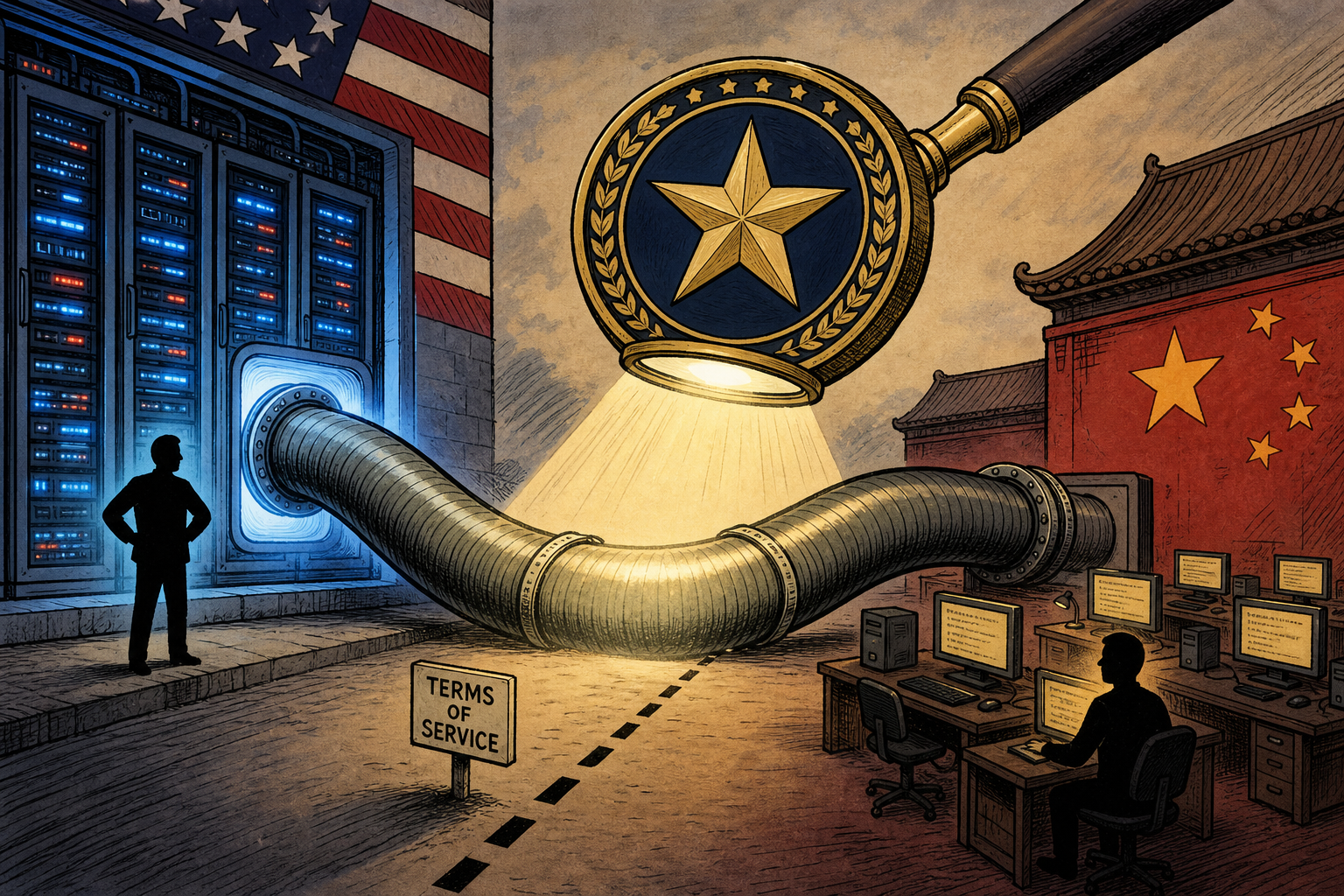
The statement draws a specific line: unintentional AI “hallucinations” from technological limitations don’t raise Section 5 concerns. Intentional ideological steering — including, the FTC suggests, guardrails trained to avoid discriminatory responses in order to comply with a state law — potentially does. Companies can avoid liability through disclosures, but the bar is specific: “clear, conspicuous, and adequate” notice that is “sufficiently prominent and persistent” to reset a consumer’s expectations. A disclaimer buried in terms of service does not count.
This past December, President Trump asked the @FTC to issue a policy statement about our authority over deception in AI models. Pursuant to his EO, we have released for public comment a policy statement on the suppression of accuracy in AI systems.
Ferguson framed the move as fact-finding, not a final rule: “The FTC wants to hear from businesses and consumers about their experiences and concerns regarding the subversion of AI systems for ideological ends. This crucial input will help the Commission formulate a final policy that advances President Donald Trump’s goal of expanding America’s global dominance in artificial intelligence,” he said in the Commission’s press release. The public comment window runs through July 31, 2026.

The legal problem predates the statement itself. IAPP’s Cobun Zweifel-Keegan flagged it within a week of the executive order: the FTC Act “was specifically designed to allow for states to have their own… Little FTC Acts or UDAP statutes,” and contains no express preemption clause. The FTC can occasionally preempt conflicting state law through formal trade regulation rules — Zweifel-Keegan cites the 1980s Credit Practices Rule, upheld by the D.C. Circuit because it was “carefully constructed” to address only direct conflicts — but a nonbinding policy statement, he concluded, “could not create new preemptive effect.”
TechFreedom’s Andy Jung went further in a February 2026 analysis, laying out why a real preemption rule — as opposed to a policy statement — is procedurally hard to produce at all.
1. No express preemption clause. Section 5 neither explicitly preempts state law nor occupies the entire field of consumer protection. Every state has its own consumer protection statute, and the FTC routinely collaborates with states on enforcement rather than displacing them.
2. The conflict-preemption bar is high. The only viable path requires showing it is impossible to comply with both federal and state law simultaneously — not merely that state law is inconvenient or costly.
3. The presumption against preemption. Federal law does not supersede state law “unless that was the clear and manifest purpose of Congress.” Section 5 was deliberately framed in general terms in 1938 and has never been read as displacing state consumer-protection authority.
4. Formal rulemaking, not a memo. Binding preemption would require notice-and-comment rulemaking under the Administrative Procedure Act and the heightened Magnuson-Moss Act procedures — preliminary and final regulatory analyses, and potential hearings on disputed facts. “A policy statement simply will not suffice,” Jung concluded.
The FTC’s policy statement is the third mechanism the administration has tried since December, running in parallel with a DOJ lawsuit and a congressional draft bill. None has yet actually preempted a single state AI law.
- Dec 11, 2025Trump signs Executive Order 14365
Orders the FTC to issue a policy statement on whether Section 5 of the FTC Act preempts state AI laws that require altering AI models' 'truthful outputs.'
- Dec 19, 2025IAPP previews the fight
Managing Director Cobun Zweifel-Keegan publishes 'A view from DC: Can the FTC preempt state AI laws?' — concluding a nonbinding policy statement 'could not create new preemptive effect.'
- Feb 6, 2026TechFreedom: 'a lengthy, complex rulemaking process'
Associate Counsel Andy Jung argues real preemption would require formal APA and Magnuson-Moss Act rulemaking — notice-and-comment, regulatory analyses, hearings — that a policy statement cannot substitute for.
- Apr 9, 2026xAI sues Colorado
Elon Musk's xAI files suit against Colorado AG Phil Weiser challenging SB 24-205, the state's AI anti-discrimination law.
- Apr 24–28, 2026DOJ intervenes; law stayed
The Justice Department joins xAI's suit; a federal judge stays enforcement of Colorado's law pending resolution.
- May 14, 2026Colorado rewrites its own law
Gov. Jared Polis signs SB26-189, repealing SB 24-205's duty-of-care and disparate-impact framework and replacing it with disclosure-only rules. New effective date: January 1, 2027.
- Jun 4, 2026Congress drafts a third track
Reps. Jay Obernolte (R-CA) and Lori Trahan (D-MA) release the 269-page Great American AI Act discussion draft, proposing a 3-year preemption of state laws regulating frontier AI model development.
- Jun 24, 2026Washington Post tests chatbots for bias
An investigation using a 2025 Stanford-Dartmouth framework finds most major chatbots lean left on contested political questions — background the FTC's 'ideological objectives' framing leans on.
- Jun 29, 2026Supreme Court decides Trump v. Slaughter
6–3, the Court overturns the 1935 precedent Humphrey's Executor, upholding Trump's 2025 firing of FTC Commissioners Rebecca Slaughter and Alvaro Bedoya.
- Jul 1, 2026The FTC votes 2–0
Chairman Andrew Ferguson and Commissioner Mark Meador — the Commission's only two sitting members — publish the proposed policy statement, naming Colorado's AI Act as the state law it says is 'impliedly preempted.'
- Jul 31, 2026Comment period closes
The public comment window on the proposed statement ends. No court, agency, or Congress has yet preempted a single state AI law.

Colorado’s original AI Act, SB 24-205, signed by Gov. Polis in May 2024, was the first state law requiring developers and deployers of “high-risk” AI systems to use reasonable care to prevent algorithmic discrimination in employment, housing, lending, and education decisions. It is the law the FTC’s July 1 statement describes as coercing companies into suppressing a correct result “in favor of one designed to avoid a disparate outcome for protected groups.”
That was true of the 2024 law. It stopped being true on May 14, 2026, when Polis signed SB 26-189 — passed by bipartisan 34–1 and 57–6 votes — repealing the duty-of-care and impact-assessment framework entirely and replacing it with a narrower disclosure regime.
| Dimension | Original law (2024) | Rewritten law (May 2026) |
|---|---|---|
| Name | SB 24-205 · “Colorado AI Act” | SB 26-189 · “Automated Decision-Making Technology Act” |
| Core duty | Duty of care to prevent algorithmic discrimination | Removed — replaced with notice and disclosure duties |
| Risk assessments | Mandatory impact assessments + risk-management program | Removed |
| Consumer notice | Notice when AI substantially affects a decision | Pre-use notice + post-adverse-outcome disclosure within 30 days |
| Consumer rights | Right to correct data and appeal adverse decisions | Right to correct data + limited human review, narrower scope |
| Enforcement | AG only, high-risk systems across 5 sectors | AG only, ADMT across 7 defined sectors |
| Effective date | June 30, 2026 (delayed once already) | January 1, 2027 |
The DOJ’s lawsuit against Colorado — joined to xAI’s challenge on Equal Protection grounds — remains pending even though the law it targeted no longer exists in its original form; the litigation and the legislative rewrite have been running on separate, only loosely coordinated tracks.
Looks like Colorado's AI law SB24-205 is on pause for now, and so is xAI's lawsuit challenging it. On Friday, the parties jointly agreed to suspend all case deadlines while Colorado works through potential changes to the law. Enforcement is also on hold during this process.
The 2–0 vote is not incidental to the story. In March 2025, President Trump fired Democratic FTC Commissioners Rebecca Slaughter and Alvaro Bedoya without the “inefficiency, neglect of duty, or malfeasance” cause the statute requires. Slaughter sued; a district court reinstated her; the fight went to the Supreme Court. On June 29, 2026 — three days before the AI policy statement was published — the Court ruled 6–3 in Trump v. Slaughter, overturning the 91-year-old precedent Humphrey’s Executor and upholding the removal. The ruling effectively makes FTC commissioners at-will employees and ends the agency’s congressionally mandated bipartisan structure. A separate departure — Commissioner Melissa Holyoak left in November 2025 to serve as interim U.S. Attorney for Utah — had already left the Commission with only Ferguson and Meador seated.
That means the vote to publish the AI preemption statement was cast by two commissioners from the same administration that ordered the statement written in the first place — with no opposing commissioner seated to dissent. For a fifty-year stretch of FTC history spanning multiple administrations, the Commission operated with commissioners from both parties by statutory design; as of July 2026, that design no longer binds the president.
The FTC statement is one of three simultaneous federal efforts to preempt state AI regulation, each moving at a different speed and through a different branch.
Executive branch, in court: the DOJ’s intervention in X.AI LLC v. Weiser, challenging Colorado’s (now-superseded) AI Act on Equal Protection grounds — detailed in Civic Intelligence’s prior coverage of Executive Order 14365.
Executive branch, by agency theory: the FTC’s July 1 Section 5 policy statement covered in this story — nonbinding, nationally applicable in theory, and legally contested by scholars across the spectrum.
Legislative branch, by draft bill: the 269-page Great American AI Act discussion draft, released June 4, 2026 by Reps. Jay Obernolte (R-CA) and Lori Trahan (D-MA), proposing a 3-year preemption limited to state laws “specifically regulating the development” of frontier AI models — not their use or deployment. The draft names California’s AB 2013 training-data disclosure law and part of SB 942’s watermarking requirement as provisions it would preempt. Supporters include the Business Software Alliance and the Information Technology Industry Council; Brad Carson of Americans for Responsible Innovation called the preemption provision “a generational mistake.”
Some may ask, 'why are people shouting about preemption of state AI regulations? What even is that?' If these questions interest you, a brief primer is below. The short answer is: Congress may try to preempt states from regulating AI in the National Defense Authorization Act.
The backdrop to the FTC’s “ideological objectives” framing is a Washington Post investigation published June 24, 2026, using a methodology drawn from a 2025 Stanford-Dartmouth framework: it found OpenAI’s GPT-5.5 gave exclusively left-leaning arguments in 80% of responses to contested political questions, while Google’s Gemini presented both sides in over 90% of its answers. That study does not appear in the FTC’s own document, but it is the political and media context the Commission’s theory is landing in — against a backdrop of 45 states that had already introduced 1,561 AI-related bills of their own by March 2026, per MultiState’s tracker, on top of the roughly 100 measures 38 states enacted in 2025, per NCSL.
On July 1, 2026, two FTC commissioners — the only two seated, both Trump appointees, three days after the Supreme Court ended the Commission’s bipartisan structure — voted to propose that an 88-year-old ban on deceptive trade practices can preempt state AI law. Its named example, Colorado’s AI Act, had already been rewritten seven weeks earlier to remove the exact provision the FTC describes. Legal scholars at IAPP and TechFreedom say a nonbinding policy statement cannot legally do what it claims regardless. The public comment period closes July 31, 2026. As of this writing, no federal court, agency, or act of Congress has preempted a single state AI law.

Tier 1: the FTC’s own press release and proposed policy statement, Executive Order 14365, IAPP’s original December 2025 analysis, the Colorado General Assembly’s bill text for both SB 24-205 and SB 26-189, the Supreme Court’s opinion in Trump v. Slaughter, NCSL’s official positions and legislation tracking, and the Great American AI Act discussion draft’s own sponsor summary. Tier 2: TechPolicy.press, Consumer Financial Services Law Monitor, Davis Wright Tremaine, Colorado Public Radio, Roll Call, NPR, and Axios. Tier 3: SAN and MultiState’s legislative tracker. Where the FTC’s proposed statement could not be independently re-verified against the primary PDF due to server access restrictions, facts are cross-confirmed against at least two independent legal or news analyses that quote the document directly. This is a proposed, nonbinding policy statement, not a final rule — the FTC’s legal authority to preempt state law through it is contested by legal scholars cited throughout this story.