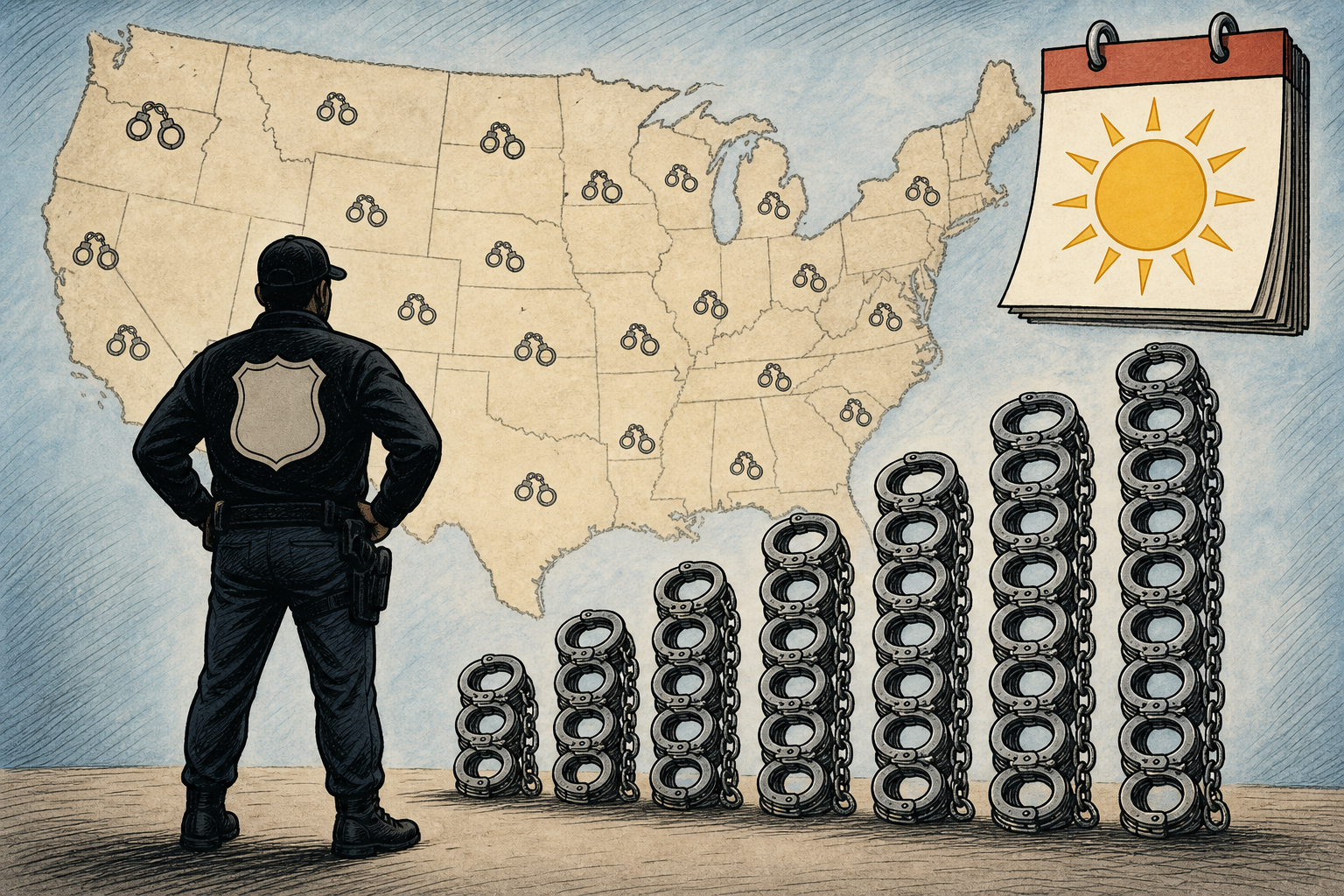
Your July Social Security Check Arrives This Week. The Program That Sends It Has Six Years of Full Funding Left.
The first birth-date-based Social Security payment of July lands Wednesday, July 8 — for anyone born on the 1st through the 10th of the month. Checks for later birthdays follow on July 15 and July 22, and this is a rare month with two Supplemental Security Income payments, one on July 1 and another on July 31.
Below is the full 2026 calendar, plus what the average and maximum checks actually pay after this year’s 2.8% cost-of-living raise. That is the part most people search for. The part almost no one reads is the number on the other side of the ledger.
The government’s own trustees now project that the fund paying today’s retirement checks runs dry in late 2032 — and that if Congress does nothing before then, every retirement benefit is cut about 22% automatically, no vote required. This is the arithmetic behind the check in your account this week.
- July 8first roundJuly payment for birthdays on the 1st–10th; then July 15 (11th–20th) and July 22 (21st–31st) — SSA 2026 calendar
- $2,071per monthaverage retired-worker benefit after the 2026 COLA, up about $56 — SSA
- 2.8%2026 COLAcost-of-living raise for 2026, versus 2.5% in 2025 — SSA, announced Oct 24, 2025
- $5,181max/monthmaximum 2026 benefit, for a worker retiring at 70 after 35 years at the taxable max — SSA
- Q4 2032runs dryprojected depletion of the OASI retirement trust fund — 2026 Trustees Report
- ~22%auto cutacross-the-board benefit cut at depletion if Congress does not act (78 cents on the dollar) — 2026 Trustees Report
Social Security does not pay everyone on the same day. Since June 1997, the agency has staggered retirement and survivor payments across three Wednesdays each month, assigned by the beneficiary’s birth date. Anyone who was already on the rolls before May 1997 stayed on the older schedule — the 3rd of the month. SSI, the separate program for low-income aged, blind, and disabled people, normally pays on the 1st. Here is how those rules land in July 2026.
- Wed, July 1SSI recipients — the regular monthly Supplemental Security Income payment.
- Thu, July 2Beneficiaries on the rolls since before May 1997, people who receive both SSI and Social Security, and beneficiaries living abroad. Normally paid the 3rd — but because Independence Day is observed Friday, July 3, the check moves up a day.
- Wed, July 8Birthdays on the 1st–10th of any month — the Washington Examiner's “first round.”
- Wed, July 15Birthdays on the 11th–20th.
- Wed, July 22Birthdays on the 21st–31st.
- Fri, July 31SSI again — because August 1 is a Saturday, August's SSI check arrives early, on July 31. July is a double-SSI month; August has none.
Two quirks trip people up every year. First, when a payment date falls on a weekend or federal holiday, SSA pays earlier, not later — which is why the usual 3rd-of-the-month check arrives July 2 this year, ahead of the observed Independence Day holiday on July 3. Second, because August 1 is a Saturday, August’s SSI payment is pushed back into July, landing July 31. That makes July a two-SSI-check month and August a zero-SSI month — a recurring source of “where is my check” confusion. One more piece of civic literacy worth knowing: Social Security pays in arrears. The check that arrives in July is your June benefit.
On October 24, 2025 — nine days later than usual, because of the government shutdown — SSA announced a 2.8% cost-of-living adjustment for 2026, up from 2.5% the year before. For the typical retiree that raised the average monthly benefit by about $56, to roughly $2,071. The COLA reached about 75 million Americans once SSI is included; roughly 71 million Social Security beneficiaries and about 7.5 million SSI recipients got the bump.
The maximum is a different story, and it depends entirely on when you claim. A worker retiring at 62 in 2026 can draw at most $2,969 a month; at full retirement age, $4,152; and by waiting until 70, up to $5,181 — but only after 35 years of earning at or above the taxable maximum, which itself rose to $184,500 in 2026. Most retirees are nowhere near that ceiling; the average check is the honest picture. For SSI, the 2026 federal payment standard is $994 a month for an individual and $1,491 for a couple.
Average retired-worker benefit: ~$2,071/month after the 2.8% COLA (up about $56).
Maximum benefit, 2026: $2,969 at 62 · $4,152 at full retirement age · $5,181 at 70.
SSI federal standard: $994 individual · $1,491 couple.
Who gets paid: about 70 million people receive Social Security; roughly 75 million, counting SSI, got the 2026 raise.

Now the part the calendar posts leave out. On June 9, 2026, the Social Security and Medicare trustees released their annual report — the government’s official actuarial statement on whether the program can keep its promises. It could not have been much blunter. The Old-Age and Survivors Insurance (OASI) trust fund — the account that pays retirement and survivor benefits — is now projected to be depleted in the fourth quarter of 2032, one quarter earlier than the 2025 report estimated. That is roughly six years of full funding from today.
“Depleted” does not mean the checks stop. Payroll taxes keep flowing in, and after the reserves are gone that incoming revenue still covers most benefits — but not all of them. At OASI depletion, continuing tax income covers about 78% of scheduled benefits. The combined OASI-and-Disability funds, viewed as a single theoretical pool, last until 2034, at which point about 83% would be payable. The Disability fund on its own is solvent across the entire 75-year projection window. Combined reserves fell $160 billion in 2025 alone, to $2.56 trillion.
“Washington is sleepwalking into a retirement crisis, allowing our nation's most important trust funds to go insolvent at the expense of over 70 million beneficiaries who count on these programs.”
Maya MacGuineas · President, Committee for a Responsible Federal Budget · June 9, 2026
New analysis of the 2026 Social Security Trustees' Report: the retirement trust fund is now projected to run dry in late 2032, triggering an automatic cut to every benefit check unless Congress acts.
Turn the trustees’ percentages into a household number and the stakes get concrete. If the OASI fund hits depletion in late 2032 with no congressional fix, the automatic across-the-board cut is about 22% — because only 78 cents of every scheduled dollar can be paid. Applied to today’s average $2,071 retirement check, that is a loss of roughly $456 a month, dropping it to about $1,615. Today’s youngest retirees would be 68 when it hits.
Independent analysts put the practical cut even higher by the time it arrives. The Committee for a Responsible Federal Budget, in its June 3, 2026 “No State Spared” study, estimates the reduction at roughly 24% — about $500 a month for a typical retiree couple, hitting more than 60 million beneficiaries in every state. Keep the two figures straight: 22% is the trustees’ number (78% payable at depletion); the 24% / $500 figure is CRFB’s projection of the cut’s size by the year it lands.
CRFB’s wider math is the sobering context. The program’s 75-year shortfall now stands at 4.42% of taxable payroll — about 1.5% of GDP, or roughly $31 trillion in present value — the largest gap since 1977 and about 16% worse than a year ago. Over just the next decade, the system is projected to run cash deficits of about $3.8 trillion.
Average check today: about $2,071/month.
After a 22% cut: about $1,615/month — a loss of roughly $456 every month, or more than $5,400 a year.
The statement number: 78 cents on the dollar — what every scheduled retirement check becomes in late 2032 if Congress does nothing.
This is a bipartisan failure, and the record says so plainly. “Politicians have known about and neglected these programs for 40 years now,” MacGuineas noted in the same June statement. But 2026 has its own stewards. The current SSA commissioner is Frank Bisignano, confirmed by the Senate in May 2025 and still in office — he testified before the House Ways and Means Social Security Subcommittee, chaired by Rep. Ron Estes (R-KS), on June 10, 2026. The administration’s message has been reassurance.
Let me be clear: President Trump and I will always protect, and never cut, Social Security. — SSA Commissioner Frank Bisignano
The reassurances collide with the arithmetic. The trustees and CRFB both note that part of the 2026 deterioration traces to the One Big Beautiful Bill Act, signed July 4, 2025: its new senior tax deduction reduces the revenue that taxation of benefits sends back into the trust funds, nudging the depletion date earlier. That law also became the vehicle for a widely repeated claim — that the government had “eliminated” taxes on Social Security. Start with the pledge that predates it.
SENIORS SHOULD NOT PAY TAX ON SOCIAL SECURITY!
Verbatim campaign-era post, widely documented (Forbes, Kiplinger, NPR)
With the One Big Beautiful Bill signed into law, we have eliminated federal income taxes on Social Security for most seniors.
Paraphrased commentary · not a verbatim post
Paraphrase of repeated administration claims — fact-checked by PBS NewsHour and Forbes
Fact-checkers at PBS NewsHour and Forbes found that claim overstated. The 2025 law did not eliminate taxes on Social Security benefits or change how they are taxed — Senate reconciliation rules barred any direct Social Security change. What it created was a temporary $6,000 senior deduction, running 2025 through 2028, that reduces some retirees’ overall income-tax bills without touching the benefit-taxation formula. On the Democratic side, Rep. John Larson (D-CT) has pushed for years to lift the payroll-tax cap to shore up the fund; that proposal, like the others, carries no enacted floor action. The plain summary the record supports: no one in Washington has fixed the 2032 problem.
The 2032 cliff is not fate — it is a math problem with a small menu of well-understood solutions, none of them painless. Congress can raise revenue (increase the payroll-tax rate, or lift or scrap the $184,500 taxable-wage cap so higher earners pay on more of their income). It can trim promised benefits (change the benefit formula, or raise the full retirement age). It can transfer money from the general fund. Or it can mix all of the above. The Committee for a Responsible Federal Budget even publishes an interactive “Reformer” tool that lets anyone try to close the gap with their own combination of choices.
The reason nothing moves is that every option has an organized constituency against it, and the deadline is far enough away that each Congress can hand it to the next. A bipartisan Cole-Suozzi bill to create a Social Security commission exists, but has seen no floor vote. The trustees have now warned, in report after report, that waiting makes the eventual fix larger — the shortfall is 16% worse than it was just a year ago. The check in your account this week is safe. The one a 68-year-old opens in late 2032 is the one Washington keeps declining to protect.
Your July 2026 Social Security payment goes out on schedule — July 8, 15, or 22 by birth date, with SSI on the 1st and again on the 31st. The 2.8% COLA lifted the average check to about $2,071.
But the government’s own trustees say the retirement trust fund runs dry in late 2032, and that absent congressional action, every benefit is automatically cut about 22% — roughly $456 off the average check. Independent analysts put the hit closer to 24%, about $500 a month.
The fixes are known and the deadline is fixed. What is missing is a vote. Both parties have pledged to protect Social Security; neither has passed the law that would.