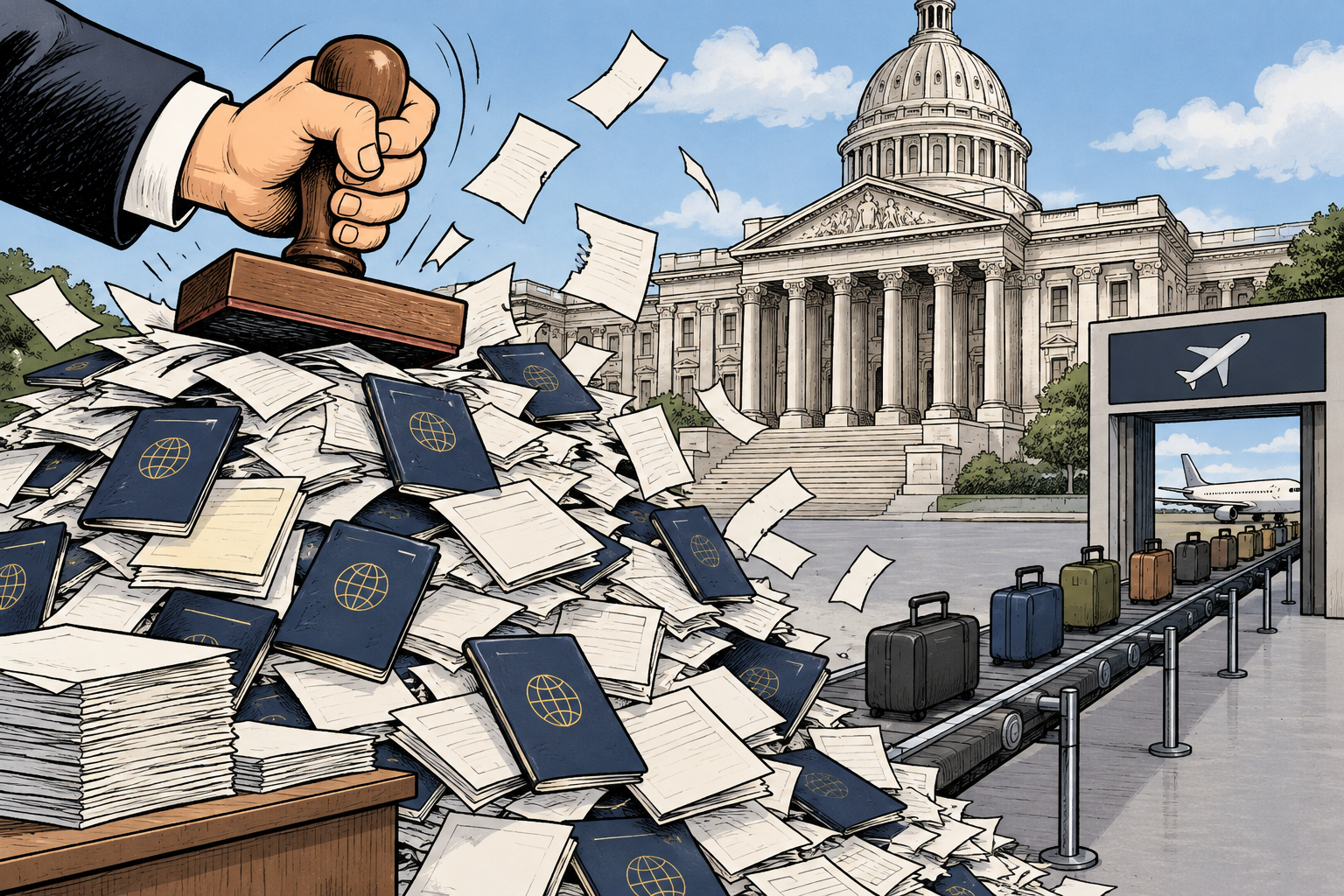
He Approved a Fair Ballot Title in September.
Ten Months Later, His Rewrite Says Citizens Are Prohibited From Voting.
For nearly a year, Californians circulated petitions for a ballot measure officially titled “Establishes Additional Voter Identification and Citizenship Verification Requirements.” More than 1.3 million of them signed anyway.
Then, days after Proposition 39 qualified for the November 3, 2026 ballot, Attorney General Rob Bonta (D-CA)’s office rewrote the title voters will actually see: “Prohibits Citizens From Voting Unless They Present Government-Issued Identification.” Assemblyman Carl DeMaio (R), the measure’s co-author, calls that an outright lie designed to sink it at the polls. He and a coalition of Prop 39 backers sued the week of July 21–25, 2026, asking a court to force Bonta to restore the original wording before ballots print. This is a civil ballot-language dispute — Bonta has not been found liable for anything, and he says the rewrite is routine.
- 1.3M+ signatures Californians gathered to qualify Prop 39 under its original, unchallenged ballot title — Ballotpedia / HotAir
- 10 months the gap between Bonta's original September 2025 ballot title and his July 2026 rewrite — HotAir / California Globe
- 9 of 9 the 2026 voter initiatives Bonta's office says received title revisions this cycle, per his own defense — Democracy Docket / KALW

Proposition 39 — the “Voter Identification, Citizenship Verification, and Registered Voter List Administration Initiative” — is a constitutional amendment that would require a government-issued photo ID to vote in person, the last four digits of a government ID number on mail ballots, free state-issued voter ID cards for anyone who needs one, and annual county-by-county reporting on how many registered voters have had their citizenship verified. Backers gathered more than 1.3 million signatures over roughly a year to qualify it for the November ballot — under a title Bonta’s own office wrote and approved on September 19, 2025: “Establishes Additional Voter Identification and Citizenship Verification Requirements.”
That was the title on every petition 1.3 million Californians signed. On July 21, 2026, after the measure had already qualified, Bonta’s office issued a different title for the ballot itself: “Prohibits Citizens From Voting Unless They Present Government-Issued Identification.” The measure doesn’t stop anyone from casting a ballot — it governs which ballots get counted and how citizenship gets verified. Plaintiffs say the new language flatly misdescribes that. Their legal hook is California Elections Code § 9051, which requires the Attorney General’s ballot title and summary to be a “true and impartial statement” that is not “likely to create prejudice” for or against a measure.
Assemblyman James Gallagher (R-CA) put the timing bluntly on social media: Bonta “couldn’t stop 1.3 million Californians from putting Prop 39 on the ballot. So what does he do? He changes the ballot title to manipulate how voters see voter ID.” Rep. Kevin Kiley (R-CA) went further, proposing to strip ballot-title authority from the Attorney General’s office entirely and hand it to the nonpartisan Legislative Analyst.
Assemblyman Carl DeMaio (R), chairman of Reform California and one of Prop 39’s official proponents, filed suit the week of July 21–25, 2026, naming Bonta and Secretary of State Shirley Weber (D) as defendants. Courthouse News Service reports the case landed in Sacramento County Superior Court; the relief sought is a court order compelling Bonta to restore the original ballot title before ballots go to print. “What happened is corruption, deception at the hands of a Sacramento politician,” DeMaio said, accusing Bonta of trying to “rig the election.” Assemblyman David Tangipa (R-CA) called it “the most blatant form of cheating and rigging for the November election that we have ever seen.”
BREAKING: CA Politicians change ballot title on Prop 39 Voter ID Initiative - trying to RIG ELECTION!
This is a civil lawsuit over ballot-title wording, not a criminal case. No court has ruled on the merits as of publication, and Rob Bonta has not been found liable for anything. Bonta disputes the entire premise, saying the revision is a routine part of the process California law allows. Both sides’ characterizations — “rigging” on one side, “routine clarity” on the other — are advocacy framing until a judge weighs in.
This isn’t the first time a California Attorney General’s ballot-title pen has ended up in court. In 2024, Bonta’s own title for Proposition 5 — which would have lowered the local-bond approval threshold from two-thirds to 55% — omitted that threshold change entirely. The Howard Jarvis Taxpayers Association, led by Jon Coupal, sued; a Sacramento Superior Court judge agreed the label was misleading and ordered it rewritten. The Third District Court of Appeal reversed, ruling Bonta’s original language was “factually accurate” and that the Attorney General is owed “considerable discretion” in drafting ballot materials. Bonta’s language stood. Prop 5 failed anyway, roughly 55% to 45%.
Bonta’s predecessor drew the same complaint, repeatedly. Then-Attorney General Xavier Becerra (D) titled 2020’s gig-worker Proposition 22 as a measure that “exempts app-based transportation and delivery companies from providing employee benefits” — language proponents said mirrored labor-union talking points rather than the neutral “changes employment classification rules” framing they wanted. Uber sued in Sacramento Superior Court; Judge Laurie Earl ruled for Becerra, and an appeal weeks before the election was denied too. Two years earlier, Becerra retitled the gas-tax-repeal Proposition 6 from its circulating name to “Eliminates Certain Road Repair and Transportation Funding.” That time a Sacramento Superior Court judge called the title “fundamentally flawed” and ordered it changed — before a court of appeal overturned him, citing the same broad AG discretion that later saved Bonta’s Prop 5 language. CalMatters columnist Dan Walters tallied that Becerra was sued a record six times over ballot-title language during his tenure as Attorney General.
“The most blatant form of cheating and rigging for the November election that we have ever seen.”
Assemblyman David Tangipa (R-CA) · July 2026
Bonta’s office says this year is different only in scale, not in kind: it points to all nine voter-proposed 2026 initiatives it titled, saying every one of them changed between the circulating version and the ballot version. Whether that pattern shows even-handed practice across nine measures or a defense built after the fact is exactly what the Prop 39 suit will test — the same discretion question that has now reached a California court three election cycles running.
Fact: It is common for ballot titles and summaries to change from the circulating version to the version voters see on the ballot. California law expressly allows these changes. This year, all nine voter-proposed initiatives had changes, including Prop. 39.
Bonta’s office has made the same argument in every public response: “We take our duty to prepare a title and summary and ballot label seriously, and we are confident the court will agree we have faithfully executed that duty here.” Asked directly about the rewrite, Bonta said it “accurately, fairly, descriptively, informatively sets forth what the measure does,” adding that he found the plaintiffs’ own characterization “inappropriate, unfortunate, and false.”
Not every skeptic is a plaintiff. According to secondary reporting on the dispute, veteran California election-law attorney Tom Hiltachk called a complete rewrite of a title already used to qualify a measure “highly unusual,” suggesting the scope of the change points to Bonta’s office being persuaded by Prop 39 opponents’ own polling on which words would do the most damage to the measure’s support. That is an inference, not a finding — no court has examined Bonta’s internal process, and no dollar figure for this specific dispute’s cost has been independently confirmed.
As of publication, no court has ruled. Ballots for the November 3 general election have to be finalized on a fixed printing schedule, which means a decision is likely to come fast — on the same kind of compressed clock that produced the Prop 5, Prop 22, and Prop 6 rulings before it. History offers little comfort for DeMaio’s side: the Attorney General’s office has won every one of these fights in the end — twice on appeal after losing at trial, once outright at both levels — on the theory that the office gets wide latitude to write ballot language. Whether Prop 39 breaks that three-for-three streak is now up to a Sacramento County Superior Court judge.
A neutral title got 1.3 million signatures. Ten months later, a different title reached the ballot itself — the fourth time in eight years a California Attorney General’s ballot-title pen has landed in Sacramento Superior Court, and the second time under Bonta himself. Bonta says the law allows the change and nine other measures got the same treatment. DeMaio says the change was built to lose. Neither claim has been tested by a judge yet. The court’s answer will decide what the last word actually says when ballots print this fall.