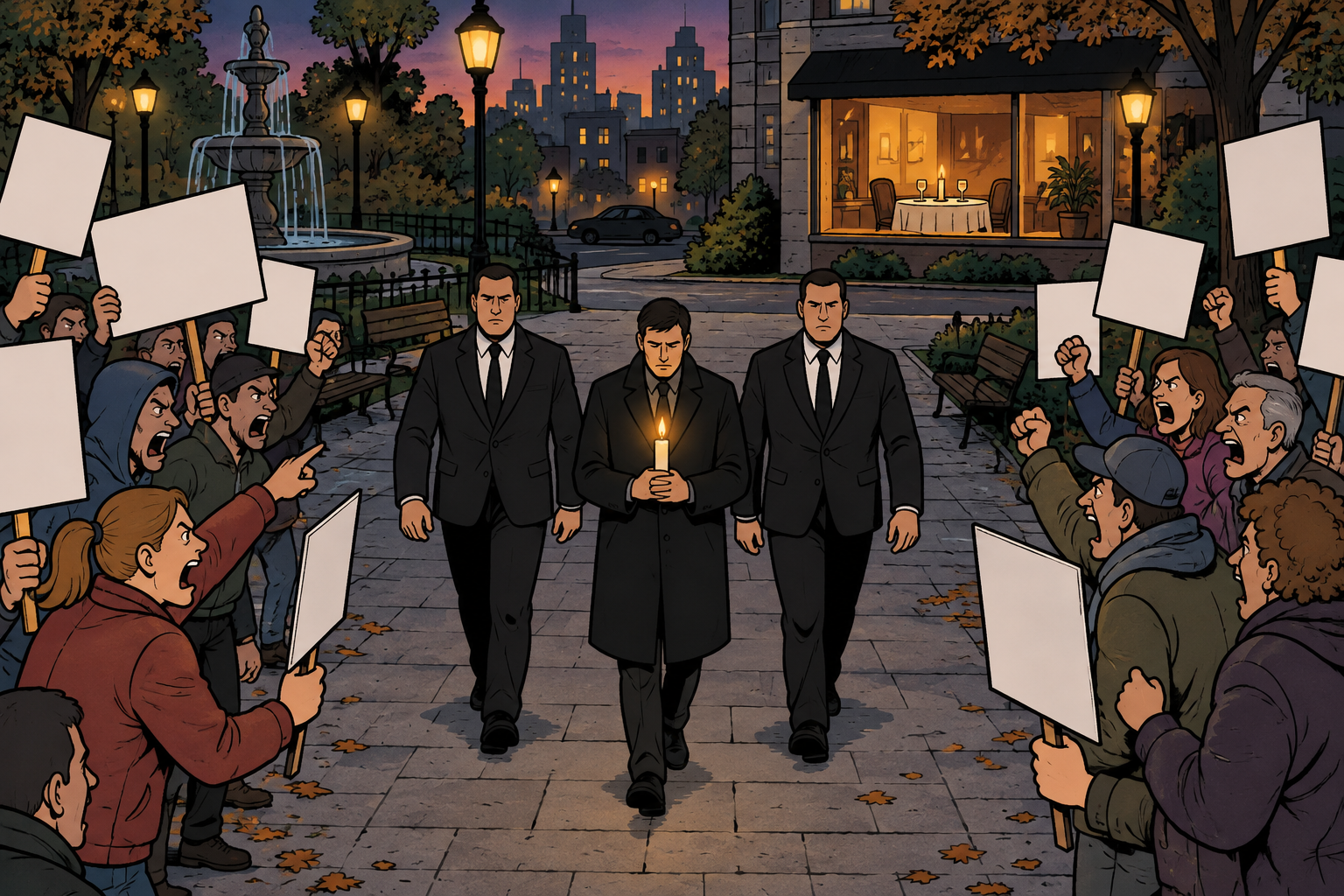
A Justice’s Home Was Swatted.
Critics Trace It to Schumer’s ‘Whirlwind.’
At about 9:02 p.m. on the night of Wednesday, May 27, 2026, a caller dialed the Fairfax County, Virginia non-emergency line, claimed to be a neighbor, and reported that “two or three gunshots” and arguing had been heard at a particular address. The address belonged to Supreme Court Justice Amy Coney Barrett.
It was a swatting attempt — a hoax designed to send armed officers racing to a home under false pretenses. Fairfax County Police, coordinating with the Supreme Court Police detail already stationed at the residence, quickly determined the report was fictitious. No one was harmed. No arrest has been announced; the investigation is ongoing.
Barrett was on the bench the next morning, reading summaries of two of her own opinions and making no mention of the night before. The incident surfaced only when a freelance photographer posted redacted dispatch audio online. To a growing chorus of critics, it was the latest in a documented pattern of threats against conservative justices — and a pattern they trace back to a single 2020 warning from the Senate’s top Democrat.
- 9:02 p.m.May 27, 2026the swatting call hit the Fairfax County non-emergency line — dispatch audio, via reporting
- 564threatsagainst 396 federal judges in FY2025, up from 509 in FY2024 — U.S. Marshals Service
- 3xincreasethreats against judges 'more than tripled' over the decade — Roberts 2024 Year-End Report
- 97 moRoske sentence8 yrs 1 mo for the 2022 plot against Justice Kavanaugh — DOJ; AG Bondi called it 'woefully insufficient'
The call came in at roughly 9:02 p.m. ET on May 27, 2026. According to reporting on the redacted dispatch audio, the caller said he was a neighbor and reported hearing two or three gunshots, along with arguing, at Justice Barrett’s Fairfax County home. Swatting works by exploiting exactly that script: a report of an active, armed, in-progress emergency is the kind most likely to draw a heavy, fast, weapons-drawn police response — which is the point. The hoax weaponizes the police against the target.
What blunted it here was that Barrett, as a sitting Supreme Court justice, has a Supreme Court Police protective detail at her residence. Fairfax County officers responding to the call were able to coordinate with that detail, which knew the situation on the ground was calm. The fictitious report unraveled fast. No shots had been fired. No one was hurt. And, to date, no arrest has been announced — the matter remains under investigation.
The episode did not become public through an official announcement. It surfaced when freelance photographer Andrew Leyden, who posts on X as @PenguinSix, published redacted dispatch audio of the call. NewsBusters subsequently flagged that major broadcast outlets — CBS and NBC among them — were initially silent on a swatting attack aimed at a sitting justice of the United States Supreme Court. Barrett herself said nothing: she took the bench the following morning and read summaries of two of her own opinions as if nothing had happened.
Dispatch audio from the night of May 27: a caller claiming to be a neighbor reports gunshots at a Fairfax County address. The address is the home of a sitting U.S. Supreme Court Justice. It was a swatting attempt.
On March 4, 2020, Senate Minority Leader Chuck Schumer (D-NY) stood on the steps of the Supreme Court during a rally tied to oral arguments in June Medical Services v. Russo, an abortion case, and addressed two of the Court’s newest members by name. His words, captured on video and preserved by C-SPAN, are the reason the word “whirlwind” now recurs in nearly every story about threats to the conservative justices.
“I want to tell you, Gorsuch. I want to tell you, Kavanaugh. You have released the whirlwind, and you will pay the price. You won't know what hit you if you go forward with these awful decisions.”
Sen. Chuck Schumer (D-NY) · Supreme Court steps · March 4, 2020 · via C-SPAN
The framing that critics now apply is direct: this swatting attack is, in the words of The Federalist’s M.D. Kittle, “another hit from Schumer’s whirlwind.” RealClearPolitics has used the same lens. The argument is one of cause and effect — that when the Senate’s top Democrat told two named justices they would “pay the price” and “won’t know what hit” them, he set a permission structure for the campaign of intimidation that followed. Sen. Ted Cruz (R-TX) made precisely this argument in 2022.
When Chuck Schumer stood on the steps of the Supreme Court and said, 'I want to tell you Gorsuch, I want to tell you Kavanaugh, you have released the whirlwind and you will pay the price,' he was threatening them.
Schumer himself walked the comment back the next day, on March 5, 2020, telling the Senate floor: “I should not have used the words I used.” He said he had been referring to political consequences, not physical ones. But the retraction did not erase the line — it preserved it, and the “whirlwind” metaphor has trailed every subsequent threat to the conservative justices since.
What gave the 2020 remark its weight was the response from the man who almost never responds. Chief Justice John Roberts, who guards the Court’s apolitical posture jealously and rarely comments on anything outside an opinion, issued a same-day public statement rebuking the Senate’s Democratic leader by name — an extraordinary step for a sitting Chief Justice.
“Threatening statements of this sort from the highest levels of government are not only inappropriate, they are dangerous.”
Chief Justice John Roberts · public statement · March 4, 2020
Roberts went on to note that justices “know that criticism comes with the territory, but threatening statements of this sort from the highest levels of government are not only inappropriate, they are dangerous.” The fact that the Chief Justice broke his customary silence to say it — the same day, in writing, naming the conduct — is itself part of the record critics now point to.
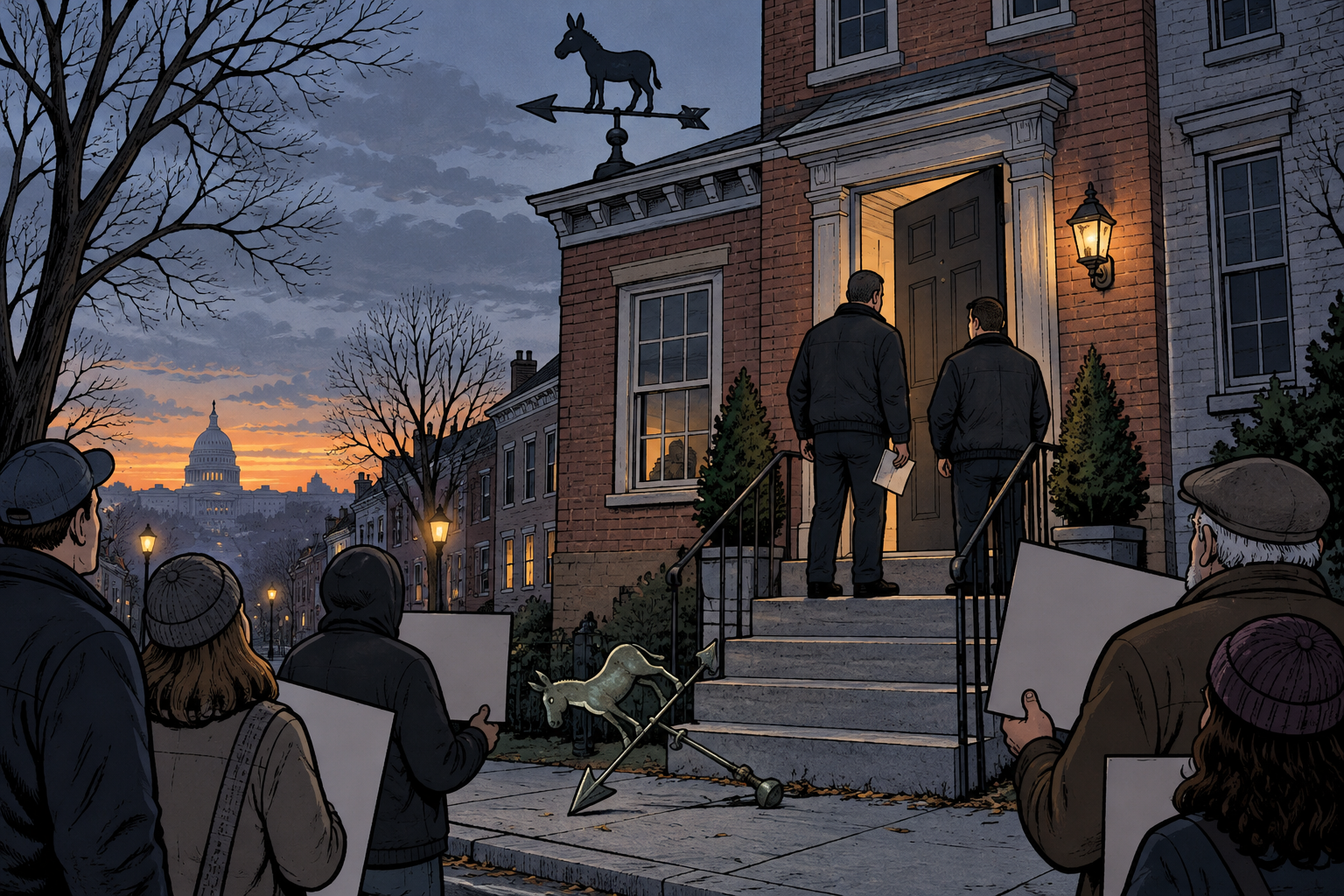
The swatting did not happen in a vacuum. The most serious entry in the pattern is the June 2022 attempted assassination of Justice Brett Kavanaugh. Nicholas Roske (who now goes by Sophie Roske) flew to Dulles International Airport armed with a gun, ammunition, a knife, and zip ties, and was arrested near Kavanaugh’s Maryland home. Roske told authorities the intent was to kill up to three justices and cited the leaked draft of the Dobbs abortion opinion as motive.
On October 3, 2025, Roske was sentenced to 97 months — eight years and one month — in federal prison. Attorney General Pam Bondi (R) called the sentence “woefully insufficient” for an attempt on the life of a Supreme Court justice, and the Justice Department is appealing.
- →June 2022 — Nicholas (now Sophie) Roske arrested near Justice Kavanaugh's home with a gun, ammo, knife, and zip ties; intended to kill up to three justices, citing the leaked Dobbs draft. Sentenced Oct. 3, 2025 to 97 months; DOJ appealing.
- →May 2022 — Following the Dobbs leak, protesters gathered outside the homes of Justices Kavanaugh, Alito, Roberts, and Barrett. The group 'Ruth Sent Us' circulated maps of the justices' home addresses.
- →18 U.S.C. § 1507 — Federal law bars picketing or parading at a judge's residence with intent to influence the judge. Conservatives argued then-AG Merrick Garland (D) declined to enforce it during the 2022 home protests.
- →March 2025 — Justice Barrett's sister, Amanda Coney Williams, received a bomb threat.
- →May 27, 2026 — The swatting attack on Justice Barrett's Fairfax County home. No arrest announced; investigation ongoing.
Sen. Mike Lee (R-UT) condemned the Barrett swatting in stark terms, framing it not as a prank but as an attempt to provoke a lethal police response against an innocent person.
Swatting is an attempt to get an innocent person killed—in this case, a sitting Supreme Court Justice. The proper response will be putting the offender in prison for many, many years.
The argument that this is a trend, not a string of one-offs, rests on the numbers kept by the people charged with protecting the judiciary. The U.S. Marshals Service recorded 564 threats against 396 federal judges in FY2025, up from 509 the year before. The trajectory is the story: the threat count is climbing year over year, and it now touches hundreds of distinct judges, not a handful of high-profile names.
Chief Justice Roberts devoted his 2024 Year-End Report on the Federal Judiciary to the same alarm. He wrote that threats against judges had “more than tripled” over the previous decade, and noted that the U.S. Marshals had investigated more than 1,000 serious threats over five years, with more than 50 people criminally charged. The numbers are why a single swatting call reads, to those tracking the data, as one more data point on a line that keeps rising.
- →564 threats against 396 federal judges in FY2025 (up from 509 in FY2024) — U.S. Marshals Service.
- →Threats 'more than tripled' over the past decade — Chief Justice Roberts, 2024 Year-End Report.
- →1,000+ serious threats investigated by the U.S. Marshals over five years; 50+ people criminally charged.
- →97-month federal sentence for the 2022 plot against Justice Kavanaugh — DOJ; the department is appealing as 'woefully insufficient.'

Running alongside the violent threats has been a quieter, crueler form of intimidation. As documented by The Washington Post, beginning around February 2025 a “pizza doxxing” campaign sent unordered pizza deliveries to the homes of federal judges — a message that the sender knows where the judge lives. Some of those deliveries were placed in the name of Daniel Anderl.
Daniel Anderl was the 20-year-old son of U.S. District Judge Esther Salas. In 2020, a disgruntled litigant came to Judge Salas’s home and shot Anderl to death, wounding her husband. Using his name in a harassment campaign aimed at other judges is, to those who know the case, among the most pointed forms of intimidation imaginable: a reminder that a judge’s family is reachable.
The pizza-doxxing campaign drew bipartisan alarm. Sen. Dick Durbin (D-IL), then chairman of the Senate Judiciary Committee, demanded a federal probe into the deliveries. That the harassment of judges has produced rare cross-party concern underscores how far the climate around the federal bench has shifted — and frames why a swatting call at a justice’s home lands the way it does.
On July 14, 2026, Justices Elena Kagan and Amy Coney Barrett testified before the House and Senate Appropriations subcommittees on financial services and general government — the first time sitting justices had testified before Congress since 2019. They asked for $228.4 million in FY2027 security funding, up roughly 10 percent from the $207.8 million appropriated for FY2026. Roughly $14–14.6 million of the increase is earmarked for expanding home protective coverage to round-the-clock teams; another $6.5 million would fund a new visitor-screening facility on the Court’s own grounds.
Kagan cited an anticipated 38 percent rise in threats against the justices for 2026 — but, notably, declined to assign the increase a partisan direction. Asked to characterize who was doing the threatening, she said the danger was “when political figures of any stripe are trying to intimidate judges and justices to do things that they like rather than the things that they don’t — that’s where we really have crossed the line.” That is the sitting justice asking for the money declining to make the case this page’s critics make.
“When political figures of any stripe are trying to intimidate judges and justices to do things that they like rather than the things that they don't, that's where we really have crossed the line.”
Justice Elena Kagan · House & Senate Appropriations testimony · July 14, 2026
The same reporting cycle surfaced a second case this page had not previously covered — and it is a stronger, more direct confirmation of the pattern in §04 than anything filed since Roske. Panos Anastasiou, 77, of Anchorage, sent more than 465 escalating messages to the Supreme Court’s public contact form between March 2023 and July 2024, threatening all six of the Republican-appointed justices — Roberts, Thomas, Alito, Gorsuch, Kavanaugh, and Barrett — and their families with assassination by torture, hanging, and firearms. His plea agreement records his own statement that he wanted President Trump assassinated “along with the six justices.” He pleaded guilty in April 2026 to threatening a federal judge and felon-in-possession of a firearm; sentencing is scheduled for August 4, 2026, with prosecutors recommending probation given his age and health.
Two cases on this page now have a documented, charging-document-confirmed political motive: Roske (Kavanaugh, 2022) and Anastasiou (six justices, 2023–24) — both driven by opposition to the Court’s conservative majority, both predating this administration.
Every incident on this page from 2025 forward — Barrett’s sister’s bomb threat, Barrett’s own May 2026 swatting — still has no suspect identified. The rising threat count Kagan cited to Congress is real and well-documented; a confirmed partisan source for the newest incidents specifically is not.
On May 27, 2026, a caller posing as a neighbor tried to send armed police to the home of Supreme Court Justice Amy Coney Barrett with a fabricated report of gunshots. The hoax failed because a Supreme Court Police detail was already on site. No one was harmed. No arrest has been announced, and the investigation is ongoing — no perpetrator has been identified.
The episode arrives against a documented and rising tide: 564 threats against 396 federal judges in FY2025, threats that have “more than tripled” over the decade, the 2022 attempt on Justice Kavanaugh’s life, home-address mobs, and a pizza-doxxing campaign that invoked a murdered judge’s son. Critics from The Federalist to Sen. Ted Cruz trace the climate back to Chuck Schumer’s 2020 “whirlwind” on the courthouse steps — a line the Chief Justice rebuked the same day, and one Schumer himself said he should not have used.
Two cases now stand as confirmed, documented, anti-conservative political violence: Roske’s attempt on Kavanaugh’s life and Anastasiou’s threats against all six Republican-appointed justices, both driven by opposition to the Court’s majority. On July 14, 2026, Justices Kagan and Barrett asked Congress for $228.4 million to protect against a threat volume that keeps climbing — while every incident filed since 2025 still has no identified suspect.