
Three Shutdowns, 75 Days of Darkened DHS, Zero Wins: ICE Gets Its $70 Billion Anyway.
At 5:23 p.m. on June 9, 2026, the House of Representatives passed S. 2, the Secure America Act, 214–212 — Roll Call 214, not a single Democratic vote, and Rep. Kevin Kiley (I-CA) the only non-Democrat to vote no. The bill sends roughly $70 billion in ICE and CBP funding, locked in through September 30, 2029, to President Donald Trump (R), who signs it Wednesday.
The vote is the last page of an arc that defined this Congress: three government shutdowns in nine months, all driven by Democratic funding blockades — a 43-day full-government shutdown last fall over ACA premium subsidies and Medicaid, a weekend DHS lapse in late January, and then the main event: a 75-day shutdown of the Department of Homeland Security, the longest agency shutdown in American history, waged specifically to force restraints on ICE.
Here is the scoreboard. The shutdowns cost the economy roughly $11 billion permanently, withheld nearly 3 million federal paychecks, delayed food assistance for 42 million Americans, and drove more than 1,000 TSA officers to quit. The reforms Democrats demanded — judicial warrants, no masks, visible IDs, body cameras — number zero in the final law. And ICE emerges with roughly $113 billion in mandatory funding enacted in eleven months, the largest law-enforcement budget in American history, placed beyond Democratic reach until 2029.
- 214–212 — House passage of S. 2, June 9 — zero Democratic votes; Kevin Kiley (I-CA) the lone non-Democrat no · Source: House Clerk, Roll Call 214
- 75 days — DHS dark, February 14 to April 30, 2026 — the longest agency shutdown in U.S. history, fought over ICE restraints that never became law · Source: Federal News Network
- ~$113B — in mandatory ICE funding enacted in 11 months — ~$75B in the One Big Beautiful Bill Act plus $38B in S. 2; ~$140B counting CBP · Source: American Immigration Council, CBO
- 0 reforms — from the Democrats' demand list — no judicial-warrant requirement, no mask ban, no visible-ID rule, no body cameras — in the bill Trump signs · Source: NPR, Congress.gov
S. 2 is the second reconciliation bill of fiscal 2026 — “Reconciliation 2.0,” built deliberately to bypass the Senate filibuster after Democrats proved they would use the 60-vote threshold to keep DHS dark. The Senate passed it 52–47 on June 5, with Sen. Lisa Murkowski (R-AK) the only Republican no — a vote-a-rama we covered in detail in our June 5 report on the Senate passage, including the fight over the $1.776 billion DOJ settlement fund, which survived every amendment aimed at it. Four days later, Speaker Mike Johnson (R-LA) and Majority Leader Steve Scalise (R-LA) pushed it across the House floor with two votes to spare.
The package: $38 billion for ICE, roughly $26 billion for CBP, and a $5 billion discretionary fund controlled by DHS Secretary Markwayne Mullin (R) — about $70 billion in budget authority running through fiscal 2029. The Congressional Budget Office scores it at $72 billion appropriated, roughly $94 billion once debt-service interest is counted. Appropriations Chairman Tom Cole (R-OK) and Homeland Security Chairman Andrew Garbarino (R-NY) shepherded the House side; Minority Leader Hakeem Jeffries (D-NY) held every one of his members against it. President Trump (R) signs the bill Wednesday, June 10, with border czar Tom Homan (R) expected at his side.
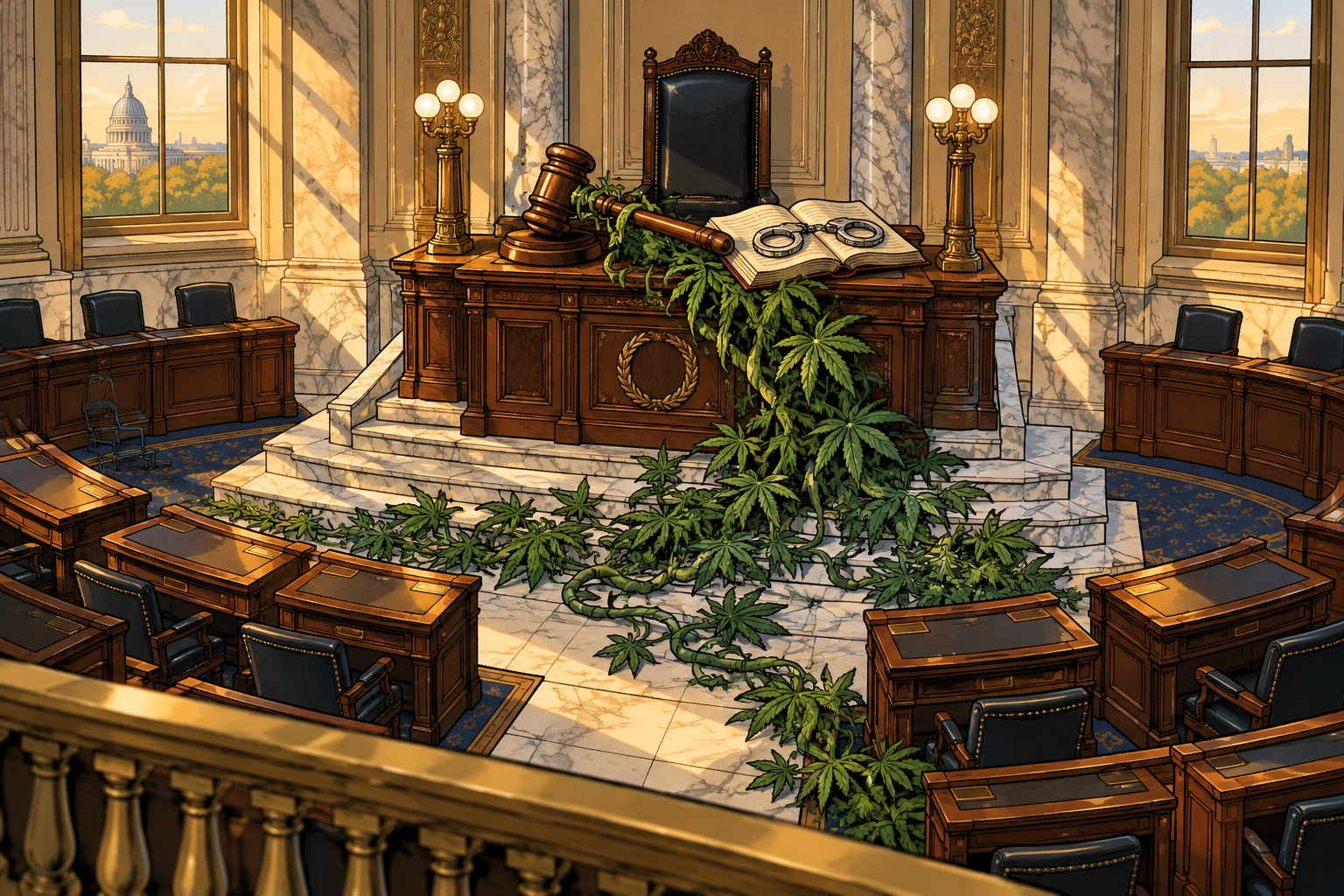
The Secure America Act PASSED... NOT ONE House Democrat voted to fund the ICE agents, Border Patrol agents, and law enforcement officers who secure our border and keep our communities safe.
To understand why Republicans wrote a three-year funding lock into S. 2, you have to count the shutdowns. There were three in this Congress, and Democrats drove all three. The first — October 1 to November 12, 2025, 43 days, the longest full-government shutdown in American history — was not primarily about ICE at all. Senate Democrats refused to pass a continuing resolution unless Republicans extended expiring ACA premium subsidies and reversed Medicaid changes; that was their stated price, and it is the accurate framing of the fight. The shutdown ended with a deal that promised a later vote on the subsidies — and the country got the bill for the standoff either way.
The second was short but telling. In late January 2026, DHS funding lapsed over a weekend as Democrats — led by Chuck Schumer (D-NY) — balked at funding the department whose agents were then conducting Operation Metro Surge in Minneapolis. The Senate resolved it 71–29 with a two-week extension to February 14. That extension is the date that matters: when it expired, the third shutdown began, and this one was about ICE from the first hour to the last.
“A shutdown is not a strategy — even if Chuck Schumer and Senate Democrats treat it like one.”
House Appropriations Chairman Tom Cole (R-OK)
The trigger for the final standoff was Operation Metro Surge, the large-scale ICE enforcement operation in Minneapolis that ran from December 2025 into February 2026 — and the two deaths that came with it. On January 7, 2026, an ICE agent fatally shot Renée Good, a U.S. citizen, during an enforcement stop. On January 24, CBP officers shot and killed Alex Pretti, also a U.S. citizen. Those two killings became the Democrats’ casus belli: they would not fund DHS, they said, unless the bill carried enforcement reforms — judicial warrants for home entries, a ban on masked agents, visible officer identification, and mandatory body cameras.
Republicans refused, and on February 14 the Department of Homeland Security shut down — and stayed shut for 75 days, through April 30, the longest agency shutdown in the history of the United States. The people who paid for the standoff were not the negotiators. TSA screeners, Secret Service agents, Coast Guard crews, and Border Patrol agents — all classified essential — worked the entire 75 days without pay. More than 1,000 TSA officers quit rather than keep working for free. The blockade broke only when Republicans changed the board: they stripped ICE and CBP funding out of the DHS appropriations bill entirely, passed the rest to reopen the department, and pledged to fund immigration enforcement through reconciliation — a vehicle Democrats cannot filibuster. That pledge became S. 2.
We are going to work as fast, and as focused, as possible to replenish funding for our Border and ICE Agents, and the Radical Left Democrats won't be able to stop us.
Paraphrased commentary · not a verbatim post
Posted around April 1, 2026, as Republicans pivoted to the reconciliation strategy — text per the Washington Post and CNN.
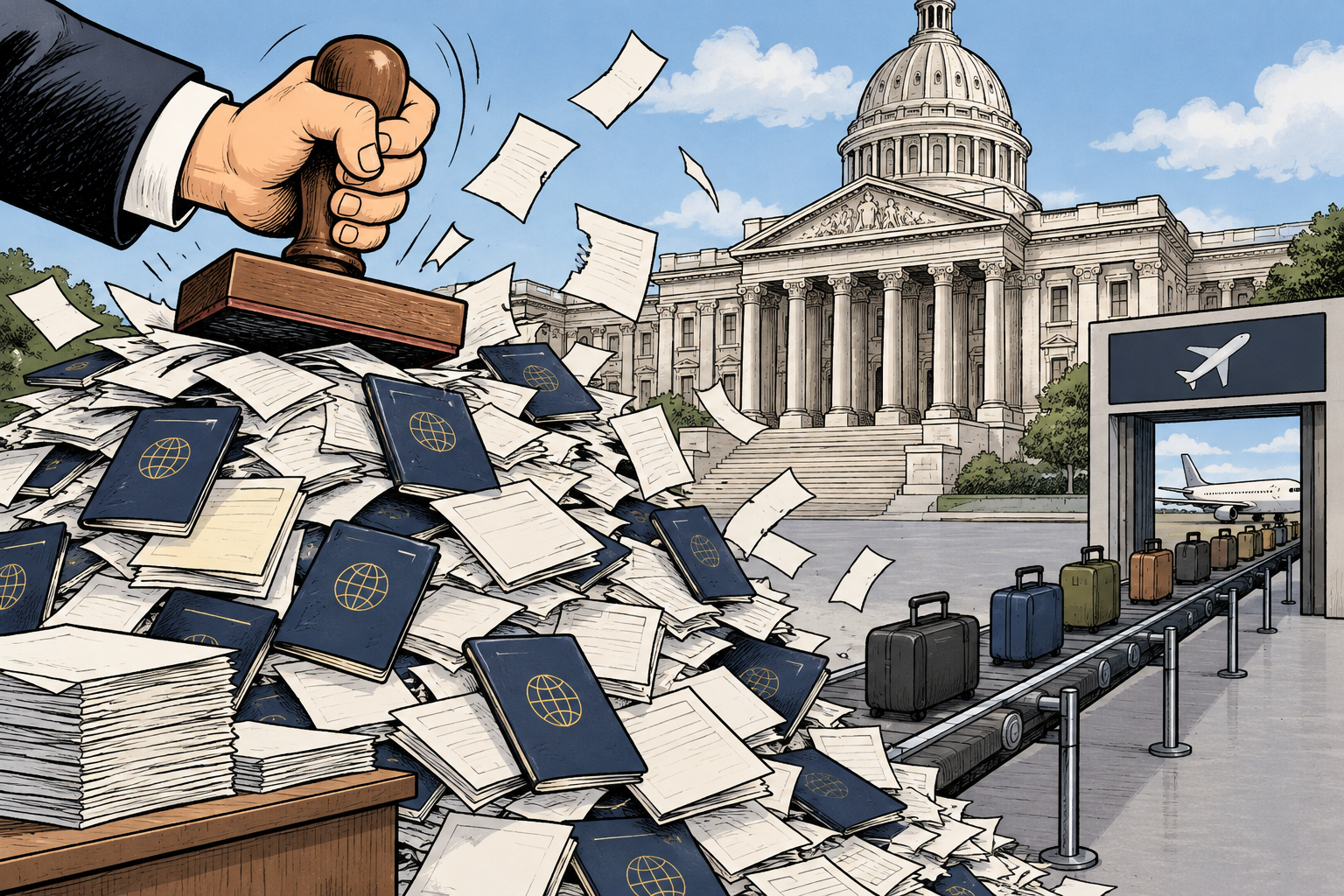
Start with the fall shutdown, because its costs are the best documented. The Congressional Budget Office estimates the 43-day full-government shutdown permanently erased about $11 billion in economic output — money that does not come back when the government reopens. Roughly 670,000 federal employees were furloughed and another 730,000 worked without pay; by the Bipartisan Policy Center’s accounting, nearly 3 million paychecks were withheld, roughly $14 billion in wages. In November, $8 billion in SNAP benefits was delayed for 42 million recipients — food assistance, frozen, for one in eight Americans. And when unpaid air-traffic controllers stopped showing up, the FAA ordered a 10 percent cut in flights at 40 of the nation’s busiest airports.
The DHS shutdown layered 75 more days of the same on the federal workforce that guards airports, coasts, presidents, and the border. The agencies Democrats were ostensibly defending Americans from — ICE and CBP — kept operating throughout, because enforcement personnel are essential and exempt. What the shutdown actually interrupted was their paychecks, and the paychecks of every TSA officer and Coast Guard rescue crew in the country. Whatever one thinks of Operation Metro Surge, the 75-day blackout did not pause it, did not reform it, and did not defund it. It just made a few hundred thousand federal workers carry the cost of a negotiation that went nowhere.
Measure the strategy by its own goals. Democrats shut down DHS to win four reforms: judicial warrants, a mask ban, visible IDs, body cameras. S. 2 contains none of them. NPR’s assessment as the bill cleared the Senate was unsparing: “This standoff is ending without Democrats achieving the reforms they pressed for.” The party’s closing argument was volume, not victory. Rosa DeLauro (D-CT), the top Democrat on Appropriations, branded the bill a “$70 Billion Slush Fund” for ICE and Border Patrol; Jeffries took the floor to call it a “Republican scheme” and a blank check. Every Democrat voted no. The bill passed anyway, and the president signs it in the morning.
The asymmetry is the story. From February 14 to June 9 — 115 days — Democrats successfully blocked new ICE and CBP appropriations. That is the entirety of what the blockade achieved: a delay. And the delay’s endpoint is an ICE funded at a level no Democratic demand touched, through a vehicle no Democratic filibuster can reach, for a duration no Democratic Congress can shorten before 2029. A party that began the year demanding body cameras ended it with less leverage over immigration enforcement than any congressional minority has had over any federal law-enforcement agency in modern memory.
“I rise today in strong opposition to this Republican scheme to waste $70 billion in taxpayer money to give a blank check to ICE without any guardrails, any oversight or any accountability.”
House Minority Leader Hakeem Jeffries (D-NY) · floor remarks, June 9, 2026
Cutting your Social Security and giving a $70 billion blank check to ICE. House Democrats are a HELL NO.
What Democrats demanded: judicial warrants for enforcement entries, a ban on masked agents, visible officer identification, mandatory body cameras — the price for funding DHS, held through a 75-day agency shutdown.
What Democrats got: none of it. Zero reforms in S. 2. NPR: “This standoff is ending without Democrats achieving the reforms they pressed for.”
What ICE got: $38 billion in S. 2 on top of ~$75 billion in the OBBBA — roughly $113 billion in mandatory funding in 11 months, ~$140 billion with CBP, locked through September 30, 2029, beyond the reach of the 119th and 120th Congresses.
What Americans got: ~$11 billion in permanent economic loss, ~3 million withheld paychecks, $8 billion in delayed SNAP for 42 million people, 10% flight cuts at 40 airports, and 1,000+ TSA officers gone.

Stack the numbers. The One Big Beautiful Bill Act, signed in July 2025, gave ICE roughly $75 billion in mandatory funding — $45 billion for detention capacity and about $30 billion for operations, including 10,000 new officers. S. 2 adds $38 billion more for ICE and roughly $26 billion for CBP. That is approximately $113 billion in mandatory ICE funding enacted in eleven months — about $140 billion counting CBP — plus the $5 billion fund Secretary Mullin (R) can move at his discretion. The Brennan Center, no friend of the project, concluded that the funding boom “more than tripled ICE’s annual budget and made it the largest federal law enforcement agency.” The detention population stands near 70,000 — the highest in American history — with the system on track for more than 100,000 beds.
And the three-year horizon is not an accounting detail; it is the strategy. Speaker Johnson (R-LA) said it plainly: funding through 2029 means “Democrats will have no ability to defund these agencies in the 119th or 120th Congresses.” Even if Democrats win the House in November, the appropriations hostage they took this year cannot be retaken — the money is already law. Sen. Mitch McConnell (R-KY), asked whether the reconciliation well had another bucket in it, closed the chapter: “I think it’s safe to conclude there will not be another reconciliation bill.”
“By funding it for three years, we've taken away their ability to cut that funding or to take hostage the funding for the remainder of the Trump administration.”
Speaker Mike Johnson (R-LA) · June 9, 2026
The Radical Left Democrats have kept DHS shut down since February 14th… Republicans are UNIFIED, and moving forward on a plan that will reload funding for our FANTASTIC Border Patrol and Immigration Enforcement Officers.
Paraphrased commentary · not a verbatim post
Composite of his April 2026 posts on the DHS shutdown and the reconciliation plan, as reported by the Washington Post and CNN — marked paraphrase.
Strip the noise and the ledger of this Congress reads simply. Democrats chose the shutdown as their instrument three times in nine months — over health-care subsidies in the fall, over DHS in January, over ICE from Valentine’s Day to the end of April. The fall shutdown was the longest full-government shutdown ever; the DHS shutdown was the longest agency shutdown ever. Both records now belong to a strategy that produced no ACA subsidy extension in the deal that ended round one, no enforcement reform in the law that ended round three, and a combined bill to ordinary Americans — in lost output, withheld wages, delayed food assistance, and canceled flights — that no one in the negotiating rooms personally paid.
On Wednesday, June 10, Trump (R) signs the Secure America Act, and the agency Democrats spent 115 days blockading becomes the best-funded law-enforcement agency in the history of the country, untouchable until the next presidential election is over. Johnson’s verdict will sting precisely because the record supports it: “This is good news for everybody except Washington Democrats. They gained absolutely nothing.” Whatever else this Congress is remembered for, it settled one question — the shutdown, as a weapon, fires backward.
“This is good news for everybody except Washington Democrats. They gained absolutely nothing from their reckless crusade to return our country to open borders and unfettered mass migration.”
Speaker Mike Johnson (R-LA) · post-vote remarks, June 9, 2026
Democrats shut down the government three times this Congress and have nothing to show for it. ICE and Border Patrol are now funded through 2029 — they will not be taken hostage again.

- 1.Clerk of the U.S. House — Roll Call 214: S. 2, the Secure America Act, passed 214–212, June 9, 2026
- 2.Congress.gov — S. 2, Secure America Act, 119th Congress (bill text, actions, votes)
- 3.Congressional Budget Office — cost estimate for S. 2: $72 billion appropriated, ~$94 billion with debt-service interest
- 4.Congressional Budget Office — 'The Effects of the 2025 Government Shutdown on the Economy': ~$11 billion in permanent economic loss
- 5.White House — 'The Secure America Act Ends Democrat Obstruction, Fully Funds CBP, ICE, and President Trump's Border Security Agenda,' June 9, 2026
- 6.Washington Examiner — 'House Republicans pass immigration enforcement funding package,' June 9, 2026
- 7.House Appropriations Committee — Chairman Tom Cole statement on the Secure America Act
- 8.House Appropriations Democrats — DeLauro statement on Senate passage of '$70 Billion Slush Fund for ICE and Border Patrol,' June 2026
- 9.Office of Leader Hakeem Jeffries — floor remarks: 'On the Reckless Republican Budget, Democrats Are a Hell No,' June 9, 2026
- 10.NPR (via OPB) — 'House passes immigration bill with billions for ICE,' June 9, 2026
- 11.NPR — 'Senate passes immigration enforcement bill without limits on Trump settlement fund,' June 5, 2026
- 12.American Immigration Council — fact sheet: immigration and border-security funding in the One Big Beautiful Bill Act (July 2025)
- 13.Brennan Center for Justice — 'How ICE's Budget Boom Is Changing Immigration Detention'
- 14.Federal News Network — 'House approves bill to fund the Department of Homeland Security and end the record shutdown,' April 30, 2026
- 15.Bipartisan Policy Center — 'Who Is Missing Paychecks in the 2025 Shutdown, When and Where': ~670,000 furloughed, ~730,000 working without pay, ~$14 billion in withheld wages
- 16.Committee for a Responsible Federal Budget — 'CBO Scores FY 2026 Reconciliation: $72 Billion' (explainer)
Last updated June 10, 2026