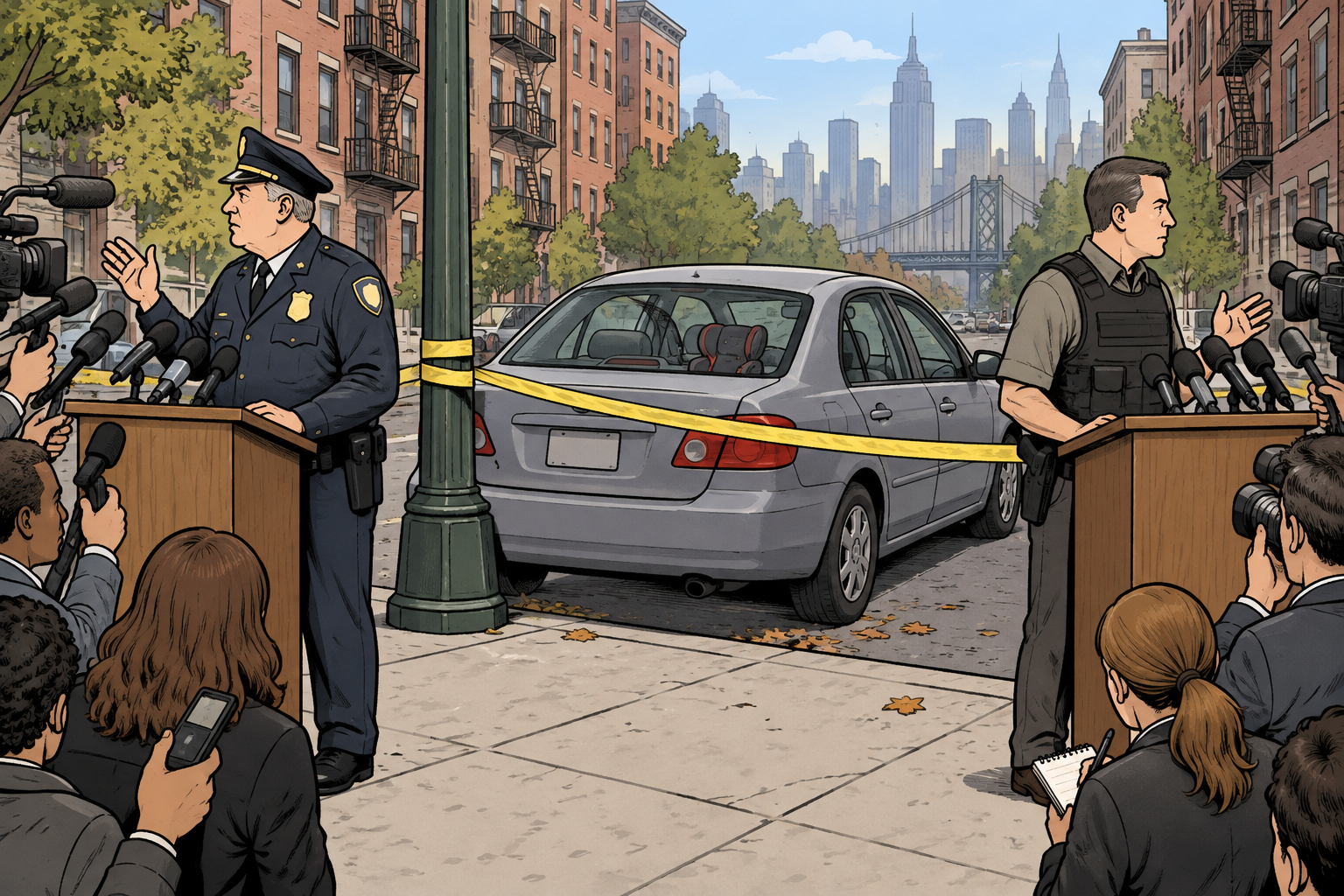
CBS Torches Stephen Colbert After His Exit.
The $55 Million Swing.
Nine days after Stephen Colbert taped an emotional series finale of CBS’s “The Late Show” — Paul McCartney in the chair, 6.7 million people watching, the most-watched weeknight episode the franchise ever drew — the network did something a grieving institution rarely does. It opened the books.
A CBS spokesperson laid out the economics in numbers that read like an autopsy: the show had been losing roughly $40 million a year. The deal that hands the 11:35 p.m. slot to Byron Allen’s “Comics Unleashed” turns that loss into about $15 million in profit. Management called it a $55 million swing.
For a year, critics insisted Colbert was fired because President Donald Trump (R) pressured Paramount into silencing its loudest late-night antagonist. CBS’s own ledger, finally made public, points somewhere blander: a money-losing show got canceled because it was losing money. Both readings are below.
- $40Mannual losswhat CBS attributes to The Late Show — CBS spokesperson, via Deadline / LateNighter
- $55Mswingfrom annual loss to profit under the Byron Allen "time buy" — theGrio, LateNighter
- 6.7Mfinale viewersColbert's send-off — the franchise's most-watched weeknight ever — CNN Business
- $221Mad collapseABC/CBS/NBC late-night ad revenue in 2024, down from $439M in 2018 — WSJ
The disclosure, reported in detail by PJ Media columnist Matt Margolis on May 30, 2026, did not feature any CBS executive attacking Colbert by name. The humiliation was quieter and arguably sharper: the network publicized the exact size of the hole Colbert’s hour had been digging, and praised the cheaper syndicated show replacing it. “Torches” is editorial framing. The underlying facts — the loss figure, the swing, the replacement — are the network’s own.
The mechanism is a syndication arrangement the trade press calls a “time buy.” Instead of paying to produce an original 11:35 p.m. program, CBS hands the slot to Byron Allen’s Allen Media Group, whose “Comics Unleashed” debuted on May 22, 2026 — the night after Colbert’s finale. The economics flip because CBS sheds the production cost of a marquee late-night show, which ran the network roughly $100 million a year to make.
“With this 'time buy' model, we have shifted an hour that was losing roughly $40 million annually to $15 million in profit — a $55 million swing.”
CBS spokesperson · via Deadline / LateNighter, May 2026
One caveat matters, and CBS’s framing glosses over it: the $15 million profit figure is the network’s own characterization and does not fully account for the affiliate and retransmission value a flagship original program can carry into the rest of the schedule. A syndicated panel show that drew about 1.1 million viewers on debut is not a like-for-like replacement for an Emmy-era franchise. The swing is real; whether it is the whole picture is a fair question.
- →Prior model: an original Late Show that CBS says lost roughly $40 million a year
- →New model: a Byron Allen / Allen Media Group "time buy" of the 11:35 p.m. slot
- →New show: "Comics Unleashed," debuted May 22, 2026 — ~1.1 million viewers
- →Claimed result: ~$15 million in profit — a $55 million swing
- →Caveat: the $15M figure is CBS's own and omits affiliate / retransmission value
The timeline is what gave the political-pressure theory its oxygen. On July 14, 2025, Colbert went on air and called Paramount’s $16 million settlement of Trump’s “60 Minutes” lawsuit “a big fat bribe.” Three days later, on July 17, 2025, CBS announced it was retiring “The Late Show” entirely — not just easing Colbert out, but ending a franchise that had run for 33 years since David Letterman launched it.
CBS’s statement called the move “purely a financial decision against a challenging backdrop in late night” and said it was “not related” to the show’s “performance, content or other matters.” The optics were nonetheless brutal: the cancellation landed three days after a public insult to corporate ownership, and weeks before the Skydance-Paramount merger — an $8 billion deal that closed on August 7, 2025, installing David Ellison as chairman and CEO — cleared its final hurdles.
The business backdrop is not in dispute, whatever one believes about motive. Late-night television has been in a slow-motion collapse. Combined late-night ad revenue across ABC, CBS, and NBC fell from $439 million in 2018 to $221 million in 2024 — roughly cut in half in six years — as audiences migrated to streaming and clips and the broadcast model aged with its viewers.
There were, and still are, two readings of why Colbert is gone. Both deserve to be on the page.
The political-pressure theory: the Writers Guild of America called for the New York Attorney General to investigate whether the cancellation was a corporate favor to a litigious president on the eve of a merger that needed federal sign-off. Senators Elizabeth Warren (D-MA) and Adam Schiff (D-CA) publicly demanded answers, framing the timing — insult, then cancellation, then merger approval — as too neat to be coincidence.
The financial theory: the show lost about $40 million a year in a category that is structurally shrinking, the franchise was the most expensive piece on the late-night board, and the network found a syndication deal that turned a loss into a profit. No conspiracy required — just a spreadsheet. The May 2026 disclosure of the $55 million swing is the strongest evidence yet for this reading, because it is CBS putting its own money where its statement was.
“The simpler explanation, that a money-losing show got canceled because it was losing money, remains stubbornly intact.”
Matt Margolis · PJ Media, May 30, 2026
Skeptics on the other side are not satisfied. A Daily Beast analysis noted the final twist in the numbers: a show posting its best ratings in years was still shown the door, which is precisely the pattern critics say a purely financial actor would not follow. The honest answer is that the two theories are not mutually exclusive — a money-losing show is an easy show to cancel for reasons that may also be convenient. What changed in May 2026 is that the financial half of the story is now documented, and the political half is still a theory.
The relationship between Colbert and Trump was openly hostile long before the cancellation. After one Trump jab, Colbert replied on air with a blunt “go f--- yourself,” a moment Variety catalogued in its cancellation coverage. So when the news broke, the president’s response was unrestrained.
On July 18, 2025, Trump posted to Truth Social a celebration that named names up and down the late-night roster — and elevated Fox’s Greg Gutfeld, whose “Gutfeld!” averaged around 3.1 million viewers, well above Colbert’s final-season average of 2.7 million.
I absolutely love that Colbert got fired. His talent was even less than his ratings. I hear Jimmy Kimmel is next. Has even less talent than Colbert! Greg Gutfeld is better than all of them combined, including the Moron on NBC who ruined the once great Tonight Show.
Gutfeld, for his part, leaned into the ratings story rather than the politics. His on-air framing — that Fox keeps beating the broadcast incumbents in the demos that matter — was echoed by the Washington Examiner, which reported him touting the comparison after the cancellation news. The clips below capture the Fox victory lap.
Gutfeld has spent the aftermath making one point on repeat: the cheaper Fox show keeps out-rating the prestige broadcast hours, and the market — not a monologue — is what late night ultimately answers to. (Paraphrased.)
The end itself was genuine television. Colbert’s May 21, 2026 finale, with Paul McCartney as the final guest, drew 6.7 million viewers — the most-watched weeknight episode in the franchise’s history and a number most cancelled shows never approach. The sign-off was emotional, a 33-year institution closing its doors.
Colbert's feed framed the finale as a goodbye to a 33-year institution — the same host who once answered a Trump jab with a two-word reply that became a defining late-night moment. (Paraphrased; the original on-air line was profane.)
What it cost is the part the May disclosure quantified. The replacement, “Comics Unleashed,” debuted to about 1.1 million viewers — roughly a third of Colbert’s final-season audience. CBS is trading a larger, prestige audience it was paying dearly to keep for a smaller one it can run at a profit. Whether that is shrewd portfolio management or the slow surrender of a broadcast institution depends on which set of numbers you weight — and CBS, for now, is weighting the ones in black.
Matt Margolis's PJ Media analysis is the load-bearing reporting here: the network's own $55 million math, he argues, is the simplest answer to a year of conspiracy theories about why Colbert was let go. (Paraphrased.)
The political-pressure theory is not disproven, and the timing in July 2025 — insult, cancellation, merger approval — will keep it alive. The WGA and Senators Warren and Schiff are entitled to their questions, and a show at its ratings peak being shown the door is a fair thing to find odd.
But the strongest documented fact in the entire saga is now a financial one. A network that was losing $40 million a year on an hour of television found a way to make $15 million on it instead, and said so out loud. That is the $55 million swing — CBS’s own number, affiliate value aside — and it is the part of this story that is on the record.