Do Socialists Know Why Socialism Fails?
New York Is About to Find Out.
On May 31, 2026, the Washington Examiner ran a guest op-ed by James L. Payne, an independent social scientist, titled “Do socialists know why socialism fails?” His answer is unsparing: socialism’s leaders, he argues, mistake appealing goals for simple ones, act impulsively, wreck the economy — and then hold power by force rather than admit the model was wrong.
Payne writes that he sent Sen. Bernie Sanders (I-VT) an open letter in April 2026 asking a single question: what went wrong in Cuba, Venezuela, and the other regimes that tried it? He says he never got a reply. The column names those countries but cites no figures — its one weakness. The numbers below are the ones it left out.
The reason the question is no longer academic sits in City Hall. On January 1, 2026, Zohran Mamdani (D/DSA) was inaugurated mayor of New York City — sworn in by Sanders himself, with Rep. Alexandria Ocasio-Cortez (D-NY) looking on — vowing to “govern as a democratic socialist.” America’s largest city is now the experiment. The record of the regimes Payne named is the control group.
- ~80%GDP collapseVenezuela’s economy contracted roughly 80% from 2013 to 2025 — the largest peacetime contraction in modern history (IMF, CFR, PIIE)
- 130,060%inflationVenezuela’s 2018 annual inflation rate — up from 274% in 2016 (IMF, PIIE, Cato)
- $3,000/sq-ftbuild costMamdani’s ~9,000 sq-ft flagship East Harlem city-store at ~$30M — vs ~$800/sq-ft for Whole Foods (The City, TIME)
- $70M5-store programBudgeted for NYC’s city-owned grocery pilot; experts project a ~$300K/yr loss per flagship store, rent-free (The City, Fox Business)
James L. Payne is not a senator and not a partisan operative. He is an independent social scientist who has spent decades writing about the behavior of governments. His May 31, 2026 op-ed in the Washington Examiner poses a question that sounds rhetorical but is meant literally: do the people who advocate for socialism actually understand why its real-world attempts have collapsed?
Payne’s thesis is behavioral rather than ideological. Socialist leaders, he argues, assume that appealing goals — cheaper food, free transit, guaranteed housing — are simple to execute. They are not. An economy is a dense web of prices, incentives, and information that no central authority can fully see. When the simple plan meets that complexity and the results turn bad, Payne contends, the leadership rarely reverses course. It doubles down, and then reaches for coercion to stay in power.
“Socialism's leaders assume appealing goals are simple to execute, act impulsively, wreck the economy, then cling to power through state coercion.”
James L. Payne · paraphrase of his thesis, Washington Examiner, May 31, 2026
To make the point personal, Payne writes that in April 2026 he sent an open letter to Sen. Bernie Sanders (I-VT) — the most prominent democratic socialist in American politics — asking him to explain what went wrong in Cuba, Venezuela, and the other regimes that ran the experiment. According to the column, Sanders never replied. That silence is Payne’s real argument: if the model’s leading champion cannot account for its most spectacular failures, what confidence should anyone have in the next attempt?
New op-ed: 'Do socialists know why socialism fails?' Independent social scientist James L. Payne argues socialism's leaders mistake appealing goals for simple ones, wreck the economy, then hold power by force — and that its champions can't explain Cuba or Venezuela.
Payne’s column names Venezuela but does not quantify it. The quantification is brutal. According to the International Monetary Fund, the Council on Foreign Relations, and the Peterson Institute for International Economics, Venezuela’s economy contracted by roughly 80% between 2013 and 2025 — the largest peacetime economic contraction recorded in modern history. GDP fell from about $482 billion in 2014 to roughly $44 billion by 2025.
“Venezuela's GDP fell roughly 80% from 2013 to 2025 — the largest peacetime economic contraction in modern history.”
International Monetary Fund · DataMapper, Venezuela profile
The currency told the same story faster. Venezuela’s annual inflation rate ran at 274% in 2016, jumped to 863% in 2017, and reached an almost unreadable 130,060% in 2018, according to IMF figures cited by PIIE and the Cato Institute. This is not a story about sanctions or bad luck. Venezuela sits on the world’s largest proven oil reserves. It nationalized industry, fixed prices, printed money to cover the gap, and watched the bolívar evaporate.
- →GDP contraction: ~80% from 2013 to 2025 — largest peacetime contraction in modern history (IMF, CFR, PIIE)
- →GDP collapse: ~$482B (2014) → ~$44B (2025)
- →Inflation 2016: 274% annual (IMF)
- →Inflation 2017: 863% annual (IMF)
- →Inflation 2018: 130,060% annual — hyperinflation (IMF / PIIE / Cato)
- →Context: world's largest proven oil reserves; collapse followed nationalization, price controls, and money-printing
This is the data spine Payne’s column gestures at but never lays out. It is also the answer to the question he put to Sanders. The mechanism is not mysterious: when the state sets prices below cost, the goods disappear; when it prints money to paper over the shortfall, the currency dies. The economist F.A. Hayek called the root of it the knowledge problem — the idea that no central planner can ever possess the dispersed information that market prices coordinate automatically.

On November 4, 2025, Zohran Mamdani won the New York City mayoral election with 50.4% of the vote. He had run openly as a member of the Democratic Socialists of America. He did not soften the label after winning. At his inauguration on January 1, 2026 — with Sen. Bernie Sanders administering an oath and Rep. Alexandria Ocasio-Cortez (D-NY) present — he made the point unmistakable.
“I was elected as a democratic socialist, and I will govern as a democratic socialist.”
Zohran Mamdani (D/DSA), Mayor of New York City · Inauguration, January 1, 2026
What separates this from the usual campaign rhetoric is that Mamdani’s agenda is concrete and partly under way. The platform he ran on and has begun implementing includes city-owned grocery stores, a rent freeze on rent-stabilized units, fare-free city buses, universal childcare, a $30 minimum wage by 2030, and higher corporate and wealth taxes to fund it. Each of these is a specific, costable policy — which means each is measurable.
I was elected as a democratic socialist, and I will govern as a democratic socialist. New York will show the country that government can deliver for working people — city-owned grocery stores, a rent freeze, and fast, free buses.
The clearest test case is the one Mamdani made central to his campaign: city-owned grocery stores. The pilot budgets roughly $70 million for five municipally run stores meant to undercut private supermarkets on price. The flagship, a roughly 9,000-square-foot store planned for East Harlem, carries a build estimate near $30 million.
Run the arithmetic and the problem appears before a single can of beans is sold. Thirty million dollars across 9,000 square feet is more than $3,000 per square foot — against roughly $800 per square foot to build out a comparable Whole Foods, according to reporting by The City and TIME. And that is only construction. Retail analysts cited in the coverage project the flagship would lose on the order of $300,000 a year in perpetuity — and that is with the city providing the space rent-free, an advantage no private grocer enjoys.
- →Program: ~$70M budgeted for 5 city-owned stores
- →Flagship: ~9,000 sq-ft store in East Harlem, ~$30M build estimate
- →Build cost: >$3,000/sq-ft vs ~$800/sq-ft for a comparable Whole Foods
- →Projected operating result: ~$300K/yr loss in perpetuity — even rent-free
- →The structural problem: a municipal store with no profit motive and political pricing absorbs losses taxpayers cover
This is the knowledge problem in miniature, and at a scale where the stakes are a single neighborhood rather than a nation. A private grocer that builds at $3,000 per square foot and loses $300,000 a year goes out of business. A city-run store does not — it absorbs the loss and bills the taxpayer. Payne’s warning is not that the goal (cheaper groceries in a food desert) is bad. It is that the chosen mechanism ignores the economics, and that when the bill comes due, the instinct is to expand the program rather than rethink it.
The grocery stores are the headline, but they are not the whole agenda. Mamdani has moved to freeze rents on the city’s roughly one million rent-stabilized units, primarily through his appointments to the Rent Guidelines Board — the body that sets allowable increases. Rent control is the most-studied policy in economics, and the consensus across the political spectrum is consistent: caps below market hold down rents for current tenants while reducing the supply and quality of housing over time, because the incentive to build and maintain it falls.
The rest of the platform follows the same shape: fare-free buses (removing a revenue stream from a transit system already running deficits), universal childcare, and a $30 minimum wage by 2030, all financed by higher corporate and wealth taxes in a city whose top earners are unusually mobile. Each policy is popular on its face. The question Payne raises is whether the people advancing them have modeled what happens when the revenue assumptions miss and the wealthy tax base moves to Florida.
Congratulations to Zohran Mamdani. New York City is showing the nation what's possible when working people organize: affordable housing, free buses, and a government that fights for the many, not the few.
To be fair to the program, New York City is not Caracas, and a democratic socialist mayor operating inside American courts, a state legislature, and a federal currency cannot print money or nationalize industry the way Venezuela’s government did. The guardrails are real. But that is precisely the experiment’s value: it isolates the policies from the authoritarianism, and lets the country watch the economics on their own.
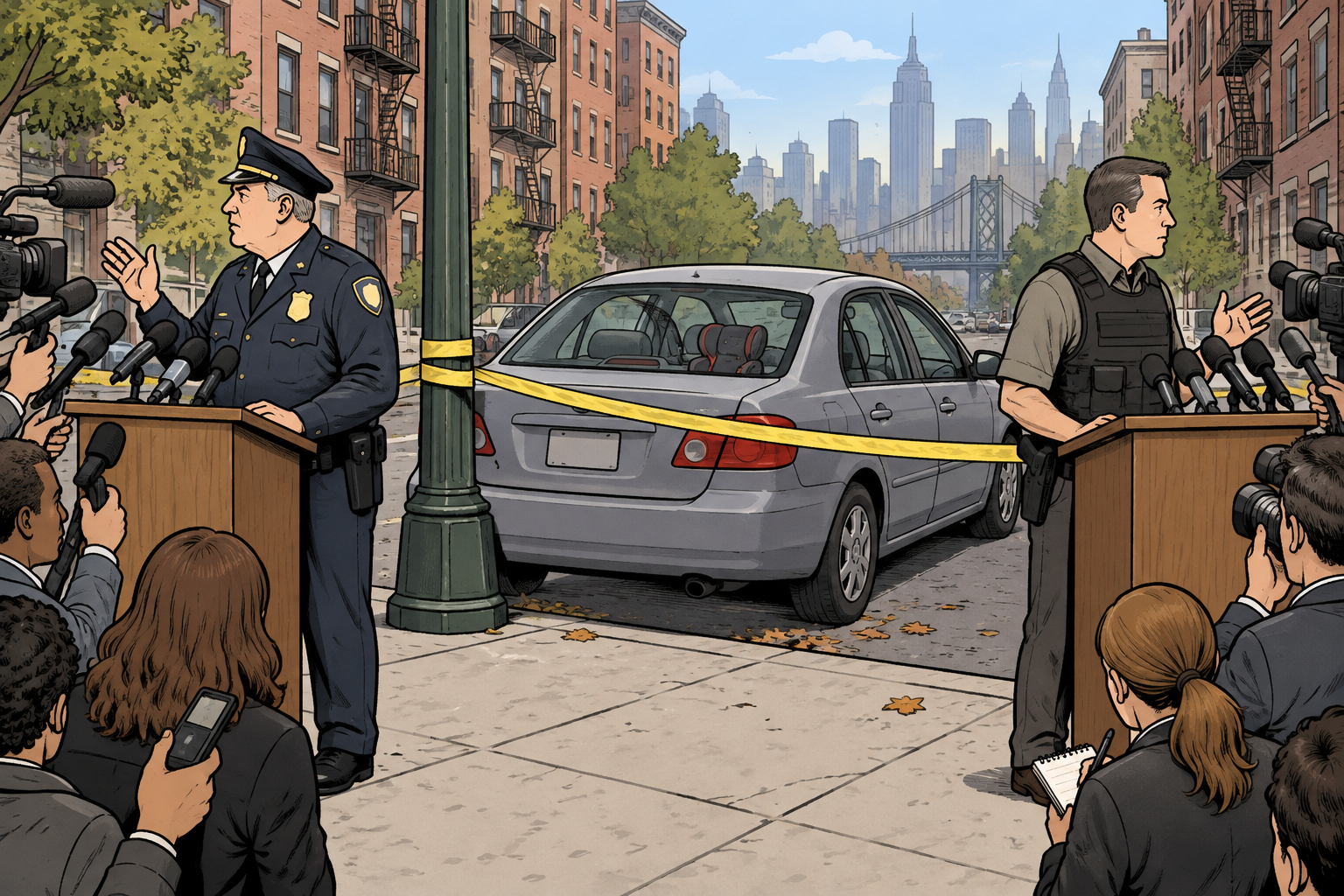
The national reaction was immediate and lopsided. President Donald Trump (R) attacked Mamdani directly on Truth Social, branding him a “100% Communist Lunatic.” In the House, Republicans passed a resolution condemning “the horrors of socialism,” and Rep. Chip Roy (R-TX) introduced legislation he styled the “MAMDANI Act” — a pointed signal that the mayor of one city had become a national symbol.
A 100% Communist Lunatic just won the Democrat Primary for Mayor of New York City. He will be a complete and total disaster.
Paraphrased commentary · not a verbatim post
On Zohran Mamdani's rise. Wording paraphrased; documented by Time, Fox News, and NBC New York.
The rhetoric runs hot in both directions, and it is worth separating the heat from the substance. “Communist” is not an accurate label for a democratically elected mayor operating within a constitutional system — Mamdani is a democratic socialist, which is a different thing, and he won fairly. But the underlying anxiety the backlash expresses is not nothing. It is the same question Payne asked Sanders, restated as politics: when the rent freeze suppresses housing supply and the city store loses money every year, will the response be a correction or an escalation?
Payne’s op-ed is opinion, and so is the frame of this page. But the data underneath both is not. Venezuela’s 80% collapse and 130,060% inflation are IMF figures. The $3,000-per-square-foot grocery store and the projected $300,000 annual loss are drawn from local and national reporting on Mamdani’s own published plan. The argument is not that New York will become Caracas. It will not. The argument is narrower and harder to dismiss: the policies share a common assumption — that a central authority can set prices and allocate goods better than markets — and that assumption has a track record.
An independent social scientist asked the country’s leading democratic socialist to explain why socialism failed in Cuba and Venezuela, and got no answer. The numbers that answer it are stark: Venezuela’s economy fell ~80% from 2013 to 2025 and its inflation hit 130,060% in 2018 (IMF). New York’s new mayor, sworn in vowing to “govern as a democratic socialist,” is now running a milder version of the same playbook.
His city-owned grocery flagship is budgeted to build at ~$3,000/sq-ft and lose ~$300K a year, rent-free. Whether that is a one-off cost or the first chapter of a familiar story is the experiment the next four years will settle — in public, with receipts, in America’s largest city.