Congress Moves to Rein In the “Wild West” of College Sports NIL
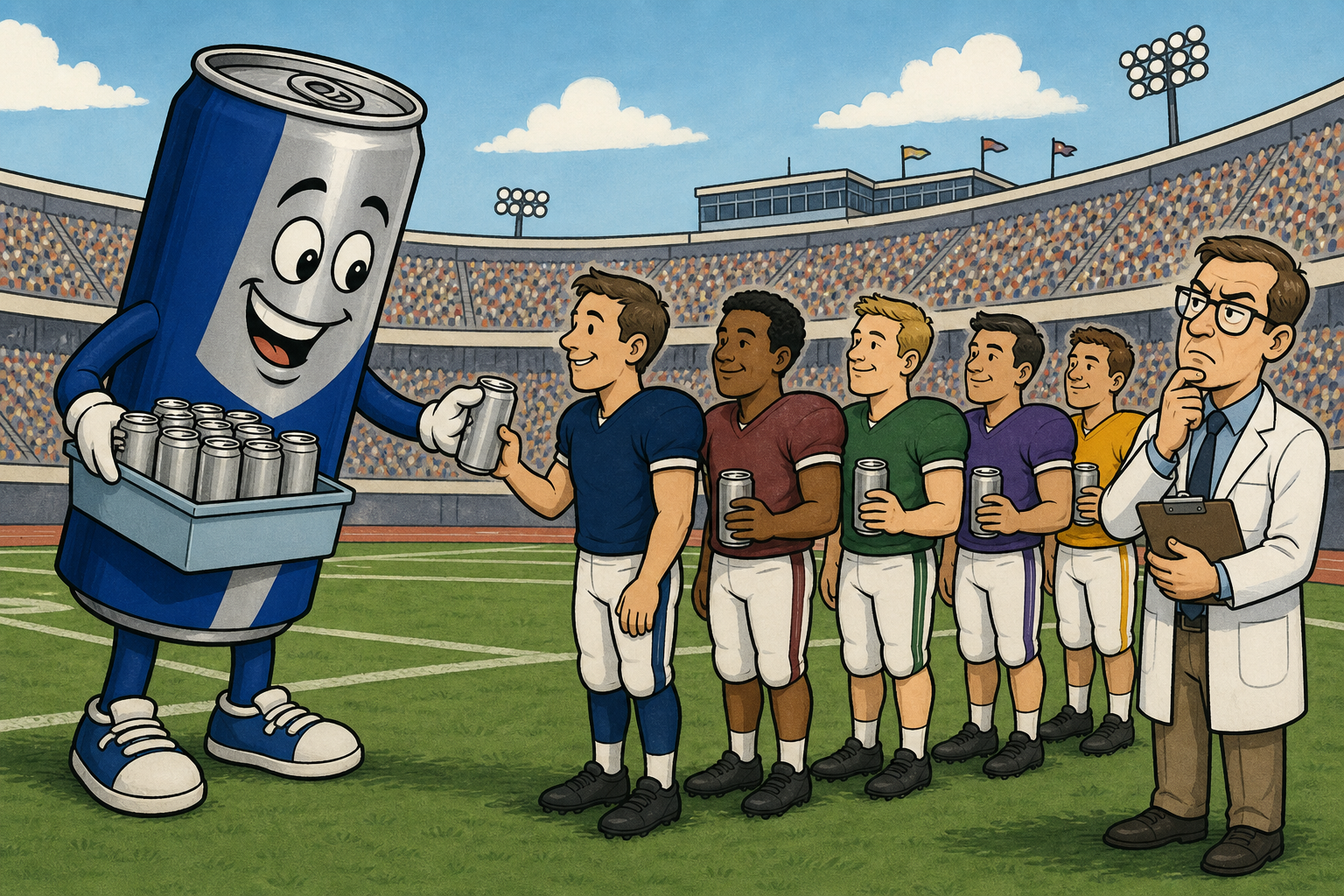
For four years, college athletes have been able to cash in on their name, image, and likeness — and for four years, Washington could not agree on rules for it. The result is a 28-state patchwork that coaches, athletic directors, and the NCAA alike call the “Wild West.”
Now two bipartisan federal bills — one in the House, one freshly released in the Senate — are trying to impose a single national standard. One of the nine original House co-sponsors is Rep. Shomari Figures (D-AL), whose role gave the effort an Alabama hook even though Alabama itself no longer has a state NIL law on the books.
The House version cleared committee, then stalled when leadership pulled it from the floor in December. The Senate version, unveiled May 27, is the latest attempt to thread a needle that has split players, leagues, and both parties.
- H.R. 4312the billthe federal SCORE Act, the House NIL framework — Congress.gov, 119th Congress
- 30-23committeethe House Energy & Commerce vote to advance it — House E&C, July 2025
- 210-209the rulethe procedural rule that passed before leadership pulled the floor vote — CT Mirror, Dec. 2025
- May 27Senate billthe day the bipartisan Senate companion was released — Roll Call, 2026
The phrase belongs, in part, to Sen. Tommy Tuberville (R-AL), the former Auburn head coach who has repeatedly called the current NIL landscape a lawless free-for-all. Since the NCAA opened the door to athlete compensation in 2021, recruiting has increasingly turned on who can assemble the biggest collective of donor-funded NIL deals — and because each state writes its own rules, schools in permissive states gain an edge over schools in restrictive ones.
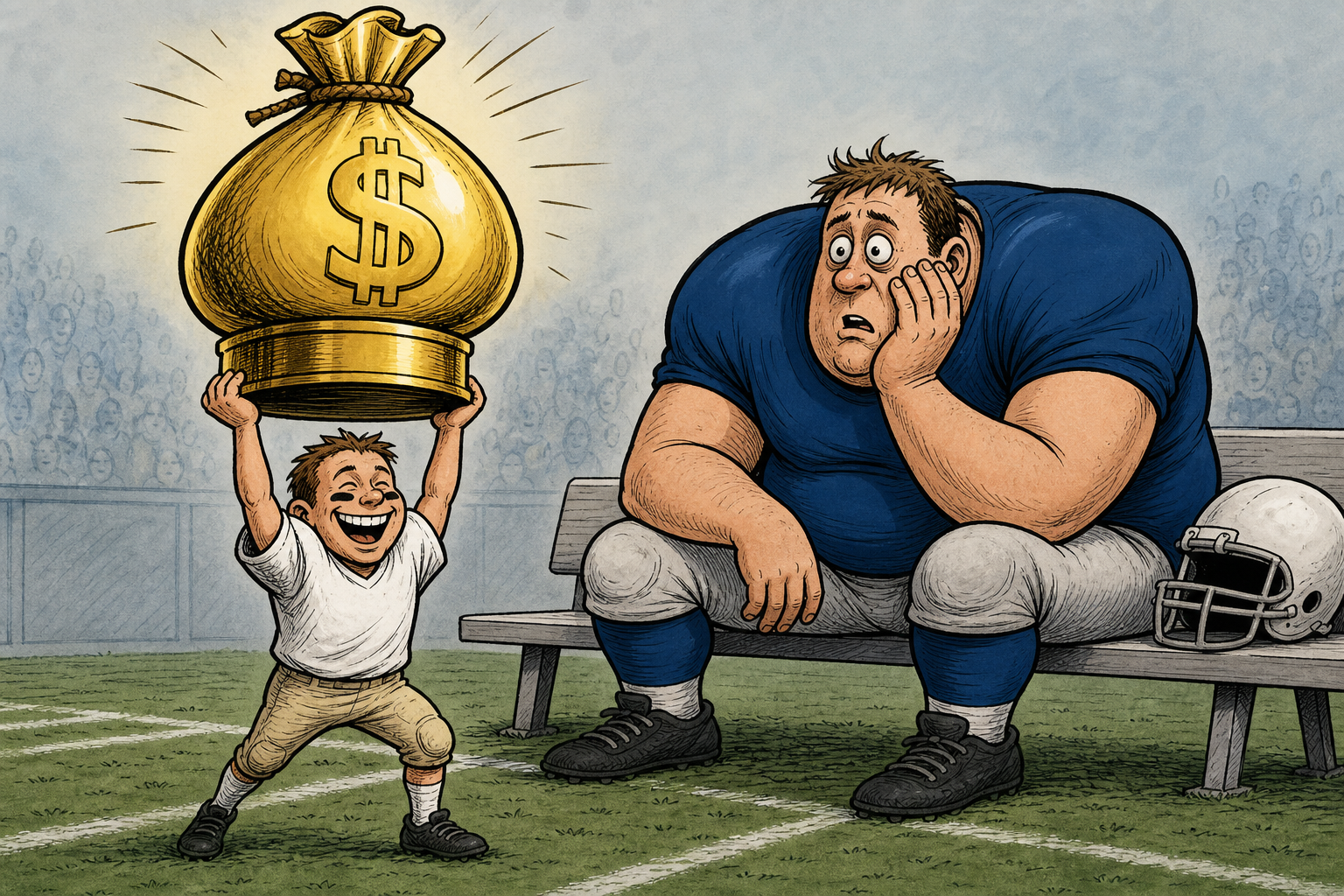
The pressure intensified in 2025. On June 6, U.S. District Judge Claudia Wilken approved the roughly $2.8 billion House v. NCAA settlement, which cleared the way for schools to pay athletes directly. The revenue-sharing era began July 1, 2025, with each school permitted to share up to roughly $20.5 million a year with its athletes. That settlement made a federal framework feel urgent: schools were now writing checks with no uniform national rulebook behind them.
“College sports are at a breaking point. The Protect College Sports Act is a bipartisan plan to restore order.”
Sen. Ted Cruz (R-TX), Commerce Committee chairman · paraphrased
The House answer is the Student Compensation and Opportunity through Rights and Endorsements Act — the SCORE Act, H.R. 4312, introduced July 10, 2025. Lead sponsor Rep. Gus Bilirakis (R-FL) assembled a bipartisan group of nine original co-sponsors: Bilirakis (R-FL), Janelle Bynum (D-OR), Brett Guthrie (R-KY) (the Energy & Commerce chairman), Tim Walberg (R-MI), Jim Jordan (R-OH) (the Judiciary chairman), Shomari Figures (D-AL), Lisa McClain (R-MI), Scott Fitzgerald (R-WI), and Russell Fry (R-SC).
What the bill does: it codifies a single national NIL standard and preempts the patchwork of state laws, grants the NCAA a limited antitrust exemption, bars athletes from being classified as employees, and codifies the House-settlement revenue-sharing model with its roughly $20.5 million per-school cap.
- →Sets a single national NIL standard and preempts the 28-state patchwork
- →Grants the NCAA a limited antitrust exemption
- →Bars college athletes from being classified as employees
- →Codifies the House-settlement revenue-sharing model (~$20.5M/school cap)
- →Lead sponsor Rep. Gus Bilirakis (R-FL) · nine bipartisan original co-sponsors
It moved fast in committee. The relevant subcommittee advanced it on a 12-11 vote, and the full Energy & Commerce Committee advanced it 30-23 in July 2025.
The Committee has advanced the SCORE Act to establish a single national standard for student-athlete name, image, and likeness rights — and end the confusing state-by-state patchwork.

Committee passage was not floor passage. When House leadership tried to move the SCORE Act in early December 2025, a procedural rule squeaked through 210-209 — but leadership then pulled the bill before a full House floor vote ever happened. A key factor: the Congressional Black Caucus announced unanimous opposition, draining the Democratic votes the bill needed to survive a floor fight.
The substantive objection from the left was that the bill tilted toward schools and the NCAA at the players’ expense. Rep. Lori Trahan (D-MA), a former Division I athlete, and ranking member Rep. Frank Pallone (D-NJ) led the resistance. The provision barring athletes from being treated as employees — and the limited antitrust exemption for the NCAA — also drew opposition from the players’ associations of the NFL, NBA, MLB, NHL, and MLS, which saw it as foreclosing collective bargaining.
“It doesn't feel pro-player.”
Rep. Lori Trahan (D-MA), on the SCORE Act
With the House bill stuck, the action moved across the Capitol. On May 27, 2026, Sen. Ted Cruz (R-TX), chairman of the Commerce Committee, joined ranking member Sen. Maria Cantwell (D-WA), Sen. Eric Schmitt (R-MO), and Sen. Chris Coons (D-DE) to release the Protect College Sports Act of 2026.
Crucially, the Senate bill takes a neutral stance on the employee-status question — the very provision that cost the House bill its Democratic votes. Senate Commerce planned hearings and a markup in June 2026. It is not without critics: athlete advocates and the House-settlement plaintiffs’ camp have ripped the Cantwell-Cruz framework as still too friendly to the institutions.
The Protect College Sports Act of 2026 is a bipartisan effort to stabilize college athletics, protect athletes, and expand revenue sharing — and finally bring order to the NIL Wild West.
College Sports is in $BIG trouble, just like I said it would be. A judge, with no knowledge or experience, ruled and, rather than fighting, the sports reps FOLDED. Can't do that.
The “Alabama-driven” framing is real but specific. It does not mean Alabama passed a new state NIL law. Alabama passed an NIL statute in 2021 and then repealed it via HB 76 in February 2022 to give its schools maximum flexibility under evolving NCAA and settlement rules. A 2025 state tax bill on NIL income, HB 240, stalled. As of today, the state has no active NIL law.
The Alabama hook is instead Rep. Shomari Figures (D-Mobile), who as one of the nine original House co-sponsors put an Alabama Democrat at the center of a Republican-led bill. Alabama athletic director Greg Byrne publicly thanked him for the effort, and SEC Commissioner Greg Sankey has been among the loudest voices pushing Congress to act. NCAA President Charlie Baker has signaled the NCAA is prepared to keep fighting in court if Congress fails to deliver.
“We sincerely thank Congressman Figures for leading a bipartisan solution that provides the best opportunity to preserve broad athletic opportunities.”
Greg Byrne, University of Alabama athletic director
- →House lead sponsor: Rep. Gus Bilirakis (R-FL)
- →Alabama co-sponsor: Rep. Shomari Figures (D-AL)
- →Senate authors: Sen. Ted Cruz (R-TX) and Sen. Maria Cantwell (D-WA)
- →Senate co-authors: Sen. Eric Schmitt (R-MO) and Sen. Chris Coons (D-DE)
- →Key House opponents: Rep. Lori Trahan (D-MA) and Rep. Frank Pallone (D-NJ)
The White House has been active in parallel. President Trump (R) signed a July 24, 2025 executive order titled “Saving College Sports,” and a broader executive order on April 3, 2026 — two distinct actions that should not be conflated. Neither replaces an act of Congress, which is the only vehicle that can grant the antitrust protections and federal preemption the NCAA and the conferences are after.
As an original co-sponsor of the SCORE Act, I'm working across the aisle to give student-athletes one clear set of national NIL rules in place of a confusing state-by-state patchwork.
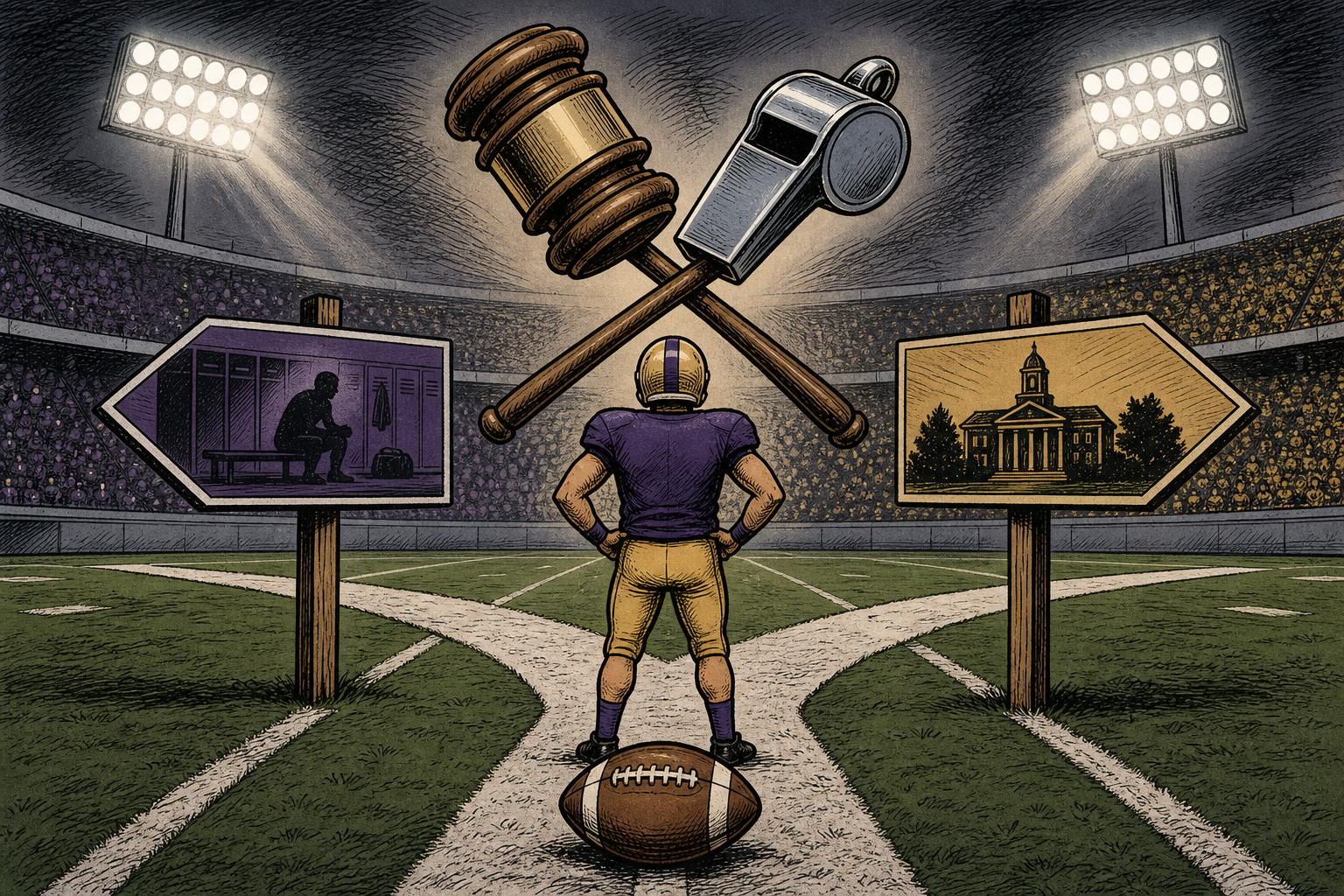
Everyone in college sports — Republicans, Democrats, the NCAA, conferences, and a chunk of the athletes — agrees the status quo is unsustainable. What they cannot agree on is who the new rules should favor. The House SCORE Act tilted toward the schools and died on the floor without a vote. The Senate’s Protect College Sports Act tries to stay neutral on the one issue — employee status — that sank its House cousin.
Whether the Senate’s June markup produces a bill that can actually pass both chambers is the open question. Until it does, the “Wild West” stays open for business — and the courts, not Congress, keep writing the rules.