Nick Saban Told Congress to Pass the College Sports Bill.
The Senate Just Locked In a September Vote.
Nick Saban won seven national championships and walked away from coaching in January 2024. On June 3, 2026, he sat at a Senate Commerce Committee witness table and told a panel of senators that the sport he spent five decades in no longer exists in the form he knew. Two months later he is the most recognizable face pushing a bill that has cleared committee, won over the two conferences that fought it hardest, and still lacks a scheduled vote on the Senate floor.
The Protect College Sports Act (S. 4668 / H.R. 9137), from Sens. Ted Cruz (R-TX) and Maria Cantwell (D-WA), would hand the NCAA and its member schools a narrow antitrust exemption in exchange for a national name-image-likeness framework. Saban co-chairs the President’s Roundtable on Fixing College Sports alongside Texas Tech regent Cody Campbell; the roundtable’s forty-plus signers sent Cruz and Cantwell a coalition letter urging passage. CBS Sports reported that Saban had a part in helping draft some of the bill’s principal features.
What he does not have is a calendar. Majority Leader John Thune (R-SD) said on July 23 the bill would not pass before the break; as of Tuesday, he described it only as “probably trending in the right direction.” The Senate leaves Washington on Friday.
- $48,800,000 — the per-school annual revenue-sharing ceiling the bill would codify and extend past the House v. NCAA settlement's 2035 expiration · Source: Congress.gov, S. 4668; Norton Rose Fulbright
- 19–9 — the Senate Commerce Committee vote that reported the bill to the full Senate, June 18, 2026 · Source: Senate Commerce Committee
- 40+ — signers on the President's Roundtable coalition letter to Cruz and Cantwell, a group Saban co-chairs · Source: CBS Sports; On3
- 2 days — until the Senate's August recess begins Aug. 7 — Majority Leader Thune filed cloture on the motion to proceed Aug. 5, but no final-passage vote is scheduled · Source: ESPN; U.S. Senate Daily Press
- $700,000,000 — the annual media-revenue line above which a conference would be barred from further expansion · Source: Congress.gov; Norton Rose Fulbright
Saban holds no office and casts no vote. He is a retired coach, an ESPN “College GameDay” analyst, and the co-chair of a private advocacy group. What he has instead is standing — and on June 3 the Commerce Committee handed him the microphone. His written testimony, filed with the committee and posted on its own server, is the clearest statement of what the bill’s supporters think it is for.
His argument was not that Washington should run college football. It was that the courts already are, badly, and that a patchwork of conflicting state NIL statutes and antitrust rulings has left the sport with no enforceable rules at all. “All the things that I believed in, for all these years, 50 years of coaching, no longer exist in college athletics,” he told senators. “Now you have schools that have close to $40,000,000 rosters.”
“Congress does not need to micromanage college athletics… [but] does need to fix the mess in the courts and create a national framework.”
Nick Saban — Senate Commerce Committee testimony, June 3, 2026
The exemption at the center of S. 4668 is narrower than its critics and its boosters both tend to describe. It shields the NCAA, the conferences, and member schools from antitrust liability only for the specific conduct the bill itself authorizes — enforcing compensation caps, transfer rules, eligibility limits, anti-tampering provisions, agent registration, and a ban on poaching coaches mid-season. Anything outside that list stays exposed, as the legal analysis from Norton Rose Fulbright lays out.
In exchange, athletes get a federal NIL right that preempts the state-by-state patchwork, and the House v. NCAA revenue-sharing structure gets written into statute: $21,300,000 in direct athlete compensation, a $22,500,000 retention pool, and $5,000,000 earmarked for women’s and non-revenue-sport NIL — roughly $48,800,000 per school per year, extended past the settlement’s 2035 sunset. The bill also caps athletes at one penalty-free transfer, sets a five-year eligibility clock, bars former professionals from re-entering NCAA competition, blocks conferences earning more than $700,000,000 a year from expanding further, permits voluntary media-rights pooling if 75 percent of FBS schools opt in, creates a student-athlete ombudsman, and protects scholarship guarantees for women’s and Olympic sports.
“This bill recognizes the difference between real NIL and disguised pay-for-play. It gives student-athletes a federal right to earn NIL compensation, but it also creates contract, agent, and enforcement rules so the system has integrity.”
Nick Saban — Senate Commerce Committee testimony, June 3, 2026
The Protect College Sports Act has passed out of the Senate Commerce Committee, advancing to the full Senate.
Through the first week of July the bill’s biggest problem was that the sport’s two richest conferences did not want it. The SEC and Big Ten both opposed the legislation “as drafted,” and SEC commissioner Greg Sankey was still refusing to commit as late as July 23: “We have not seen language. We need to see language.”
They got it. A round of amendments — including a fix to the anti-expansion clause that had inadvertently frozen Group of Six schools out of moving up to the Power Four — changed the math. By July 31 both the Big Ten, under commissioner Tony Petitti, and the SEC had reversed and endorsed the bill. That left the NCAA, the conferences, and the roundtable Saban co-chairs pointed in the same direction for the first time since the bill was introduced.
The Big Ten Conference has formally endorsed the Protect College Sports Act following amendments to the bill.
“There is overwhelming consensus that targeted intervention from Congress is necessary… This is the legislation we need now.”
Charlie Baker, NCAA president
Conference endorsements are not school endorsements. On July 6, the University of Alabama — where Saban coached for seventeen seasons and where he remains under a rolling personal-services contract — joined Auburn in a joint statement opposing the bill in its current form. Texas and Texas A&M sent their own letters separately. Alabama has not publicly withdrawn that position since its conference reversed.
Alabama and Auburn have released a joint statement opposing the Protect College Sports Act in its current form, joining Texas and Texas A&M.
Alabama’s own senator is against it too, and on different grounds entirely. Sen. Tommy Tuberville (R-AL), himself a former SEC head coach, objects on federalism grounds: “TV contracts, conference realignments, scheduling, salary caps” are not, in his view, Congress’s business. Opposition also came from the other direction — the Congressional Black Caucus, chaired by Rep. Yvette D. Clarke (D-NY-9), sent senators a letter on June 3, the same day Saban testified, urging them to pause the bill.
Sen. Ted Cruz (R-TX) — Commerce Committee chairman and lead sponsor of S. 4668.
Sen. Maria Cantwell (D-WA) — ranking member and lead cosponsor. Original cosponsors: Sen. Eric Schmitt (R-MO) and Sen. Chris Coons (D-DE); Sen. Shelley Moore Capito (R-WV) and Sen. Peter Welch (D-VT) added July 13.
Rep. Michael Baumgartner (R-WA-5) — sponsor of the House companion, H.R. 9137.
Sen. Tommy Tuberville (R-AL) — opposed, on federalism grounds.
Rep. Yvette D. Clarke (D-NY-9) — CBC chair; the caucus asked the Senate to pause the bill, June 3, 2026.
Source: Congress.gov, S. 4668; Senate Commerce Committee; CBC.house.gov.
The bill has almost everything a piece of legislation is supposed to need. It is bipartisan by construction, with three Republicans and three Democrats on the sponsor line. It cleared committee 19–9. It has the NCAA president, both super-conferences, and the highest-profile figure in the sport’s history publicly asking for a vote — plus a House companion bill already introduced. President Donald Trump (R) has made fixing college sports a White House priority, and Saban appeared at the administration’s “Saving College Sports” event to make the same case.
What it does not have is floor time. Thune said in late July that the bill would not pass before recess; as of August 4, he had gone no further than calling it “probably trending in the right direction.” A Senate that leaves on August 7 and returns in September will be looking at a fall calendar with an election year closing in behind it — and every additional month is another month of the litigation Saban says is running the sport by default.
“If you had the biggest, baddest Ferrari that you could ever have, and it was going 150 miles an hour toward the Grand Canyon, somebody needs to tap the brakes.”
Nick Saban — on the state of college athletics
Overnight, the story shifted from “no floor time” to “maybe just enough of it.” On Wednesday, August 5, Majority Leader John Thune (R-SD) filed cloture on the motion to proceed to S. 4668, the formal step that starts the procedural clock toward a floor vote, according to the bill’s own record on Congress.gov and the Senate’s own daily floor log. Hours later, On3’s Ross Dellenger reported that the Protect College Sports Act “may have the votes” to clear the Senate — but that the calendar, not any single senator, is now the bigger obstacle.
The vote math looks favorable on paper. Original cosponsor Eric Schmitt (R-MO) has told reporters he expects 80-plus votes — comfortably past the 60 needed to break a filibuster — and said the Senate should “stay to get it done, if that means Friday or Saturday.” But that number is Schmitt’s own prediction, not a released whip count; no chamber-wide tally has been made public.
What is public is the traffic jam. Thune has also been working a stopgap spending bill to fund the government past Dec. 11, a Russia sanctions measure, more than seventy stalled executive-branch nominations, and a possible cryptocurrency bill — all competing for the same handful of floor hours before Friday’s recess. Sen. Maria Cantwell (D-WA), the bill’s lead Democratic sponsor, has also been dividing her attention with the wildfire response back home in Spokane. And cloture was filed on the motion to proceed, not on final passage — meaning even a successful Thursday-or-Friday vote only opens debate on the bill itself, with the clock still running against an up-or-down vote before the chamber leaves town.
“We have to stay to get it done, if that means Friday or Saturday.”
Sen. Eric Schmitt (R-MO) — on the Senate vote for the Protect College Sports Act
The Senate did not make it. An all-night session ran past midnight and into Saturday morning — the chamber finally adjourned for August recess around 3:56 a.m. on Aug. 8 — without ever bringing S. 4668 to a final-passage vote. Cloture on the motion to proceed had cleared, but the bill itself never got the up-or-down vote Sen. Eric Schmitt (R-MO) had predicted could happen “Friday or Saturday.” The floor traffic jam — the stopgap spending bill, the Russia sanctions measure, dozens of stalled nominations — won.
What changed is that leadership stopped leaving it to chance. Majority Leader John Thune (R-SD) has now locked in a guaranteed cloture vote for the week of Sept. 15–23, when the Senate returns from recess on Sept. 14 — a firm date on the calendar in place of “probably trending in the right direction.” It still needs 60 votes. The committee tally that got it this far was 19–9: twelve Republicans and seven Democrats for it, with Republicans Roger Wicker (R-MS) and Todd Young (R-IN) joining seven Democrats against.
Cruz framed the stall as the price of the Big Ten and SEC endorsements that finally came through in early August: “We listened to our colleagues, addressed their concerns, and improved an already strong bill.” Thune, for his part, offered the same wait-and-see tone he’d had all summer, just with a deadline attached now: “College sports is something that needs to be fixed. They have a good solution.”
“We listened to our colleagues, addressed their concerns, and improved an already strong bill.”
Sen. Ted Cruz (R-TX) — after the Senate adjourned for recess without a floor vote
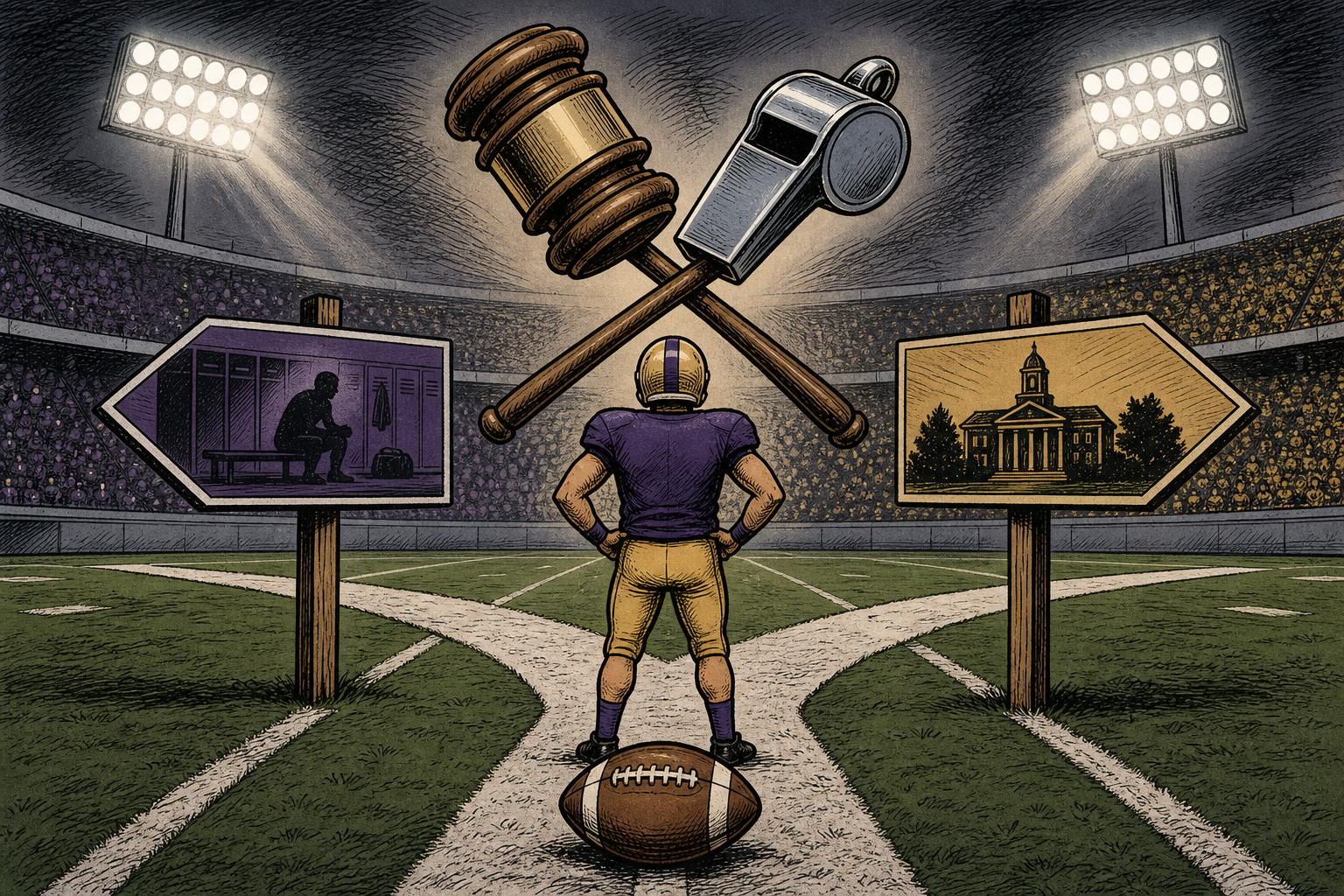
Nick Saban is not a legislator, and the Protect College Sports Act is not his bill. He is one of forty-plus signers on a coalition letter and the most quotable witness the Senate Commerce Committee has had all year — and by his own description the bill is “not perfect but it certainly addresses 80% of the needs.” Both super-conferences have now come around. His old school still has not. The Senate goes home Friday either way.