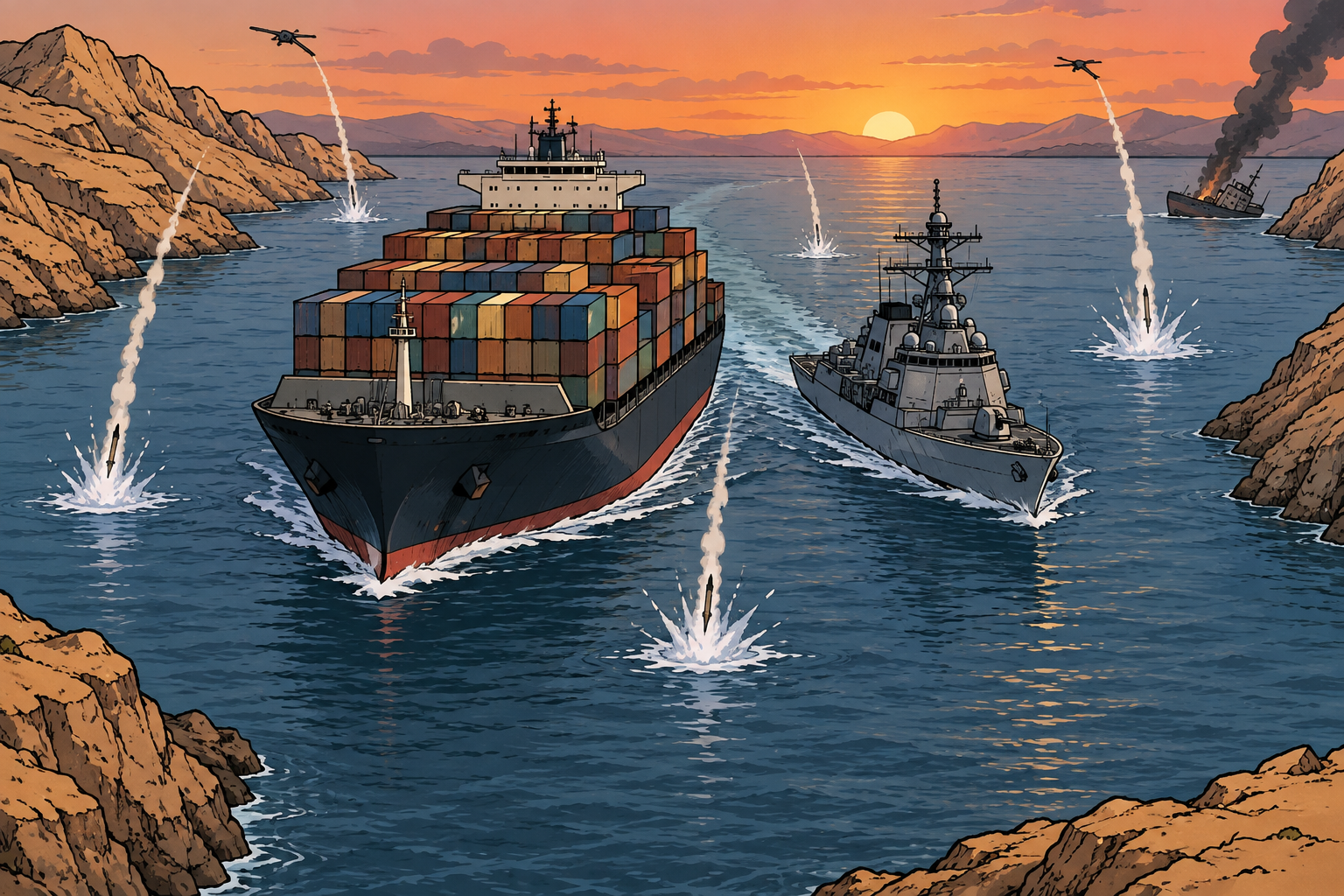
The US Destroyed 5 Iranian Oil Tankers in One Day — and Told Iran to Expect More.
Tuesday, September 8, 2026. U.S. Central Command said its forces destroyed five Iranian crude oil carriers — four in the Gulf of Oman and a fifth near Kharg Island, Iran’s main crude export terminal — after Iran’s Islamic Revolutionary Guard Corps twice targeted a U.S. Navy warship with ballistic missiles over the preceding two days. Both attempts missed. CENTCOM said the warship “successfully evaded” the attacks and continued its patrol, with no American personnel harmed.
The five vessels — M/T Kaviz, M/T Charminar, M/T Horizon 1, and M/T Riesco in the Gulf of Oman, plus M/T Derya off Kharg Island — were part of what CENTCOM calls Iran’s “shadow fleet,” tankers used to move sanctioned oil. American forces directed the crews to abandon ship before striking each vessel. No casualties, American or Iranian, have been reported.
Iran responded within hours, firing ballistic missiles at Al Azraq, a Jordanian base that hosts U.S. forces. Jordan said it intercepted 18 of 20 incoming missiles; the other two landed in unpopulated terrain. No casualties were reported there either. It was the second time in four days CENTCOM has destroyed Iranian tankers in response to an attack on a U.S. warship — and the clearest statement yet of a strategy Adm. Brad Cooper, the CENTCOM commander, put in blunt terms days earlier: shoot at American ships, lose tankers.
- 5tankers destroyedM/T Kaviz, M/T Charminar, M/T Horizon 1, M/T Riesco (Gulf of Oman) and M/T Derya (Kharg Island) — CENTCOM, Sept. 8, 2026.
- 2xmissile attempts on a US warshipIRGC ballistic-missile attacks over two days, both evaded — CENTCOM.
- 18 of 20Iranian missiles interceptedJordanian air defenses over Al Azraq base; 2 fell in unpopulated areas — Jordanian Armed Forces.
- 10Iranian tankers destroyed in one weekCombining the Sept. 5 strike (3 tankers) and the Sept. 8 strike (5 tankers) with earlier hits — CENTCOM.
- $100+/bblBrent crudeCrossed $100 a barrel for the first time since the war's February 2026 start — ABC News, CBS News.
CENTCOM’s account is specific about sequencing: Iran’s IRGC fired ballistic missiles at an American warship twice in the two days before the strike, and both attempts failed to connect. The U.S. response came against the tankers themselves — not against Iranian territory or military installations. Four of the five vessels were struck in the Gulf of Oman; the fifth, M/T Derya, described by CENTCOM as part of Iran’s national fleet, was hit near Kharg Island, the terminal that handles roughly 90% of Iran’s oil exports. Wikipedia’s running tracker of the war specifically documents the Zimbabwe-flagged M/T Riesco as having sunk; CENTCOM’s own language describes all five as “destroyed.”
CENTCOM said American forces directed each tanker’s crew to abandon ship before it was struck — the same disable-don’t-kill approach the command has used against Iranian shadow-fleet vessels since the blockade began. No injuries, on any side, have been attributed to the Sept. 8 strikes.
CENTCOM forces destroyed five Iranian crude oil carriers, Sept. 8, after the Islamic Revolutionary Guard Corps (IRGC) targeted a U.S. Navy warship with ballistic missiles twice over the past two days. The U.S. warship successfully evaded the attempted Iranian attacks and continued to patrol regional waters, with no American personnel harmed.

The Sept. 8 strike was not the first of its kind that week. On September 5, CENTCOM disabled two Iranian tankers — M/T Downy off Kharg Island and M/T Stark 1 near Jask — and completely destroyed a third, M/T Kylo (also identified as the “Noxen”), in the Gulf of Oman, after the IRGC fired missiles at a U.S. aircraft carrier and a guided-missile destroyer. Neither American ship was hit. That strike is where Adm. Cooper first laid out the math publicly.
“If you shoot at two of our ships, we will impose an even higher economic cost — taking out three of yours. We will not hesitate to defend American forces, and if necessary, destroy Iran's limited and exposed oil fleet.”
Adm. Brad Cooper, Commander, U.S. Central Command — statement issued around the Sept. 5 and Sept. 8 strikes
Cooper’s formula tracks the record almost exactly: two missile attempts on Sept. 5 drew a three-tanker response; two more attempts on Sept. 8 drew five. CENTCOM has framed both strikes as defensive and proportionate rather than retaliatory escalation — a distinction that matters for the administration’s legal posture, even as the tanker count keeps climbing. By CENTCOM’s own tally, cited across multiple outlets this week, U.S. forces have now destroyed eight Iranian tankers in four days.
Iran’s Foreign Ministry called the tanker strikes a violation of the UN Charter and, per Al Jazeera’s reporting, described them as a “war crime.” The IRGC said it retaliated by launching ballistic missiles at Al Azraq, and Iranian state media separately claimed Iranian forces struck U.S. Navy destroyers DDG-119 and DDG-53 and attacked roughly ten ships near the Strait of Hormuz. CENTCOM directly disputed the destroyer claim, calling it “completely FALSE” and stating no U.S. Navy warship had been struck and every IRGC attempt had failed. Neither claim is independently verified here; both are presented as contested.
On the ground, the numbers are less disputed. Jordan’s military said its air defenses engaged 20 incoming ballistic missiles over Al Azraq and destroyed 18 of them; the remaining two fell in unpopulated areas. No injuries were reported. Iranian officials named in connection with the response include Ali Abdollahi, chief of staff of Iran’s armed forces, who had earlier warned of strikes on U.S. installations if tanker attacks continued, and Mohsen Rezaei, secretary of Iran’s Supreme National Security Council, who said Iran would establish a new restricted zone outside the Strait of Hormuz. The IRGC also warned tanker crews operating near Kuwait and Bahrain to evacuate their vessels.
Confirmed by both sides: Five Iranian tankers were struck Sept. 8; Iran fired missiles at Al Azraq, Jordan, the same day; Jordan intercepted the large majority of them; no casualties have been reported on any side.
Disputed: Iran says it hit two U.S. destroyers and roughly 10 ships near Hormuz. CENTCOM says no U.S. warship was struck and calls the destroyer claim false. This piece treats both as claims, not as established fact.
NEW: U.S. Central Command says it destroyed 5 Iranian oil tankers on Tuesday, claiming the IRGC had earlier twice targeted a U.S. Navy warship with ballistic missiles over the past two days. CENTCOM said the warship evaded the attacks and no U.S. personnel were harmed.

Secretary of State Marco Rubio, asked about the strikes during a visit to Colombia, made the policy explicit: “Iran continues to try to hit U.S. naval ships, and for every time they do that or try to do that, they’re going to lose tankers. And I think you’ll see that again today.” Rubio’s comment came the same day CENTCOM announced the five-tanker strike, effectively previewing it hours ahead of the official release.
President Trump (R) had set the tone days earlier. On September 1, after Iranian strikes on U.S.-linked positions in Jordan, he posted that American strikes on Iran were “large and powerful,” and warned that Iran would be “hit again at a much harder and higher level” if it retaliated further — though, he added, “not the biggest attack of them all, that is waiting in the wings.”
Oil prices will drop precipitously, like everything else is dropping (but more!), when we WIN the war with Iran. It will all happen quickly, and Iran will never have a Nuclear Weapon. Three Dollars a gallon, but ultimately, below Two Dollars a gallon.
Brent crude crossed $100 a barrel in early trading after the Sept. 8 strikes, its highest level since the war began in late February 2026, with earlier CBS reporting placing the price near $97.54 before the latest spike. West Texas Intermediate traded above $92 a barrel. Trump has repeatedly told Americans that prices will fall once the war ends; in the meantime, U.S. drivers hit a record Labor Day average of $4.15 a gallon, surpassing the prior 2012 high.
The Sept. 8 tanker strike lands more than six months into a war that began February 28, 2026, and has cycled through multiple ceasefires, naval blockades, and strikes on Iranian oil infrastructure. What’s new this month is the explicit, publicly stated formula: an Iranian missile at a U.S. ship now has a fixed, escalating price, paid in Iranian tankers. Whether that math changes Tehran’s calculus, or simply narrows Iran’s shrinking oil fleet further, is the open question CENTCOM’s next statement will answer.
CENTCOM destroyed five Iranian oil tankers on September 8 after the IRGC twice failed to hit a U.S. Navy warship — the second such exchange in four days, bringing the week’s total to roughly ten tankers. Iran fired back at a U.S.-linked base in Jordan; Jordan intercepted 18 of 20 missiles. No one, on any side, has been reported killed or injured. Adm. Brad Cooper has now said the price of shooting at American ships is Iranian tankers, and CENTCOM has collected on that promise twice in a week.