CENTCOM Confirms Two U.S. Soldiers Killed in Iran’s Strike on a Jordan Air Base — Trump Answers With an 8th Night of Strikes on Iran and a Push for Tougher Sanctions on Tehran.
The Iran war that began when a joint U.S.-Israeli strike killed Iran’s Supreme Leader on February 28, 2026, and resumed as “Operation Epic Fury” after a ceasefire collapsed July 7–8, has now produced its first confirmed American combat deaths. U.S. Central Command says Iranian ballistic missiles and drones struck Muwaffaq Salti Air Base, a joint Jordanian-U.S. installation in Jordan’s Zarqa Governorate, on the night of July 17, 2026, killing two U.S. service members, leaving a third missing, and sending four others to Jordanian hospitals — all four have since been discharged.
The strike also wounded 29 Jordanian civilians, hit by shrapnel from projectiles Jordanian and U.S. air defenses intercepted overhead, and brought the war’s cumulative U.S. death toll to 16 at the time, since revised to 17 as detailed in the July 21 update below. Iran’s Islamic Revolutionary Guard Corps claimed responsibility and said it destroyed several aircraft on the ground — a claim no independent source has verified.
Within roughly a day, President Trump (R) answered with an eighth consecutive night of strikes on Iran, while Tehran fired back at U.S.-linked sites in Kuwait, sounded air-raid sirens in Bahrain, and struck a Kurdish base in Iraq. Trump also pushed Congress to fold Iran into a pending Russia sanctions bill the same day, layering economic pressure onto the military response already underway.
- 2 killed, 1 missing — CENTCOM's confirmed toll from the July 17 attack on Muwaffaq Salti Air Base in Jordan — names and ranks withheld pending next-of-kin notification
- 17 — cumulative U.S. service member deaths in the war since February 28, 2026, per CENTCOM (updated July 21)
- 29 — Jordanian civilians wounded by shrapnel from intercepted projectiles — Al Jazeera, Jerusalem Post
- 7 commercial ships — attacked by Iran in the preceding week, per CENTCOM Commander Adm. Brad Cooper — 'nearly a dozen' civilian crew killed, injured, or missing
- ~80 sea mines — estimated by the IMO to be laid by Iran in the Strait of Hormuz's historic center channel, forcing shipping into a narrower, Iran-approved corridor
Muwaffaq Salti Air Base sits in the Al-Azraq area of Jordan’s Zarqa Governorate — a joint Jordanian-U.S. installation that has hosted American aircraft supporting regional operations throughout the war. On the night of July 17, Iranian ballistic missiles and drones struck the base directly. CENTCOM confirmed the toll in a formal statement posted the next day, its most direct acknowledgment yet that this war has now cost American lives on the ground rather than only in the air and at sea.
CENTCOM Statement on Recently Fallen, Missing U.S. Service Members. TAMPA, Fla. — On July 17, two U.S. service members in Jordan were killed in action as U.S. Central Command (CENTCOM) and partner forces defended against Iranian ballistic missile and drone attacks.
Jordan summoned Iran’s charge d’affaires in Amman, calling the strikes “unjustified and blatant.” Iran’s IRGC, for its part, claimed it destroyed several aircraft on the ground at the base — a claim that has not been independently confirmed and that CENTCOM has not addressed directly.

CENTCOM said the eighth consecutive night of strikes on Iran was “designed to further degrade Iran’s ability to threaten commercial shipping in the Strait of Hormuz” and to “swiftly punish” the IRGC forces behind the Jordan attack. The target list, per Al Jazeera and the Jerusalem Post, spanned Iranian military coastal surveillance and air-defense facilities, maritime capabilities, and missile and drone storage sites at Sirik, Hajiabad in Hormozgan province, Qeshm Island, Bandar Abbas, Shadagan, and Abadan, plus a nuclear power plant under construction at Darkhovin.
A water desalination plant near Jask County was also hit, cutting drinking water to roughly 10,000 people across 20 villages — a civilian-infrastructure cost of the campaign distinct from the military targets around it. CENTCOM Commander Adm. Brad Cooper said Iran had attacked seven commercial ships over the preceding week, causing “nearly a dozen civilian crew members killed, injured or missing,” and framed the mission bluntly.
“U.S. forces are holding Iran accountable for unwarranted aggression that continues to endanger innocent lives.”
Adm. Brad Cooper · CENTCOM Commander
Iran retaliated the same night the eighth-night strikes hit. Drones targeted a U.S.-linked ammunition depot at Camp al-Adiri and air-defense and Patriot radar systems at Ali Al Salem Air Base, both in Kuwait — the second consecutive day Kuwait’s power and desalination infrastructure was hit. Air-raid sirens sounded in Bahrain’s capital, Manama. A separate drone struck a Kurdistan Freedom Party base near Erbil, Iraq, wounding eight people.
Being hit across three countries in overlapping strikes in a single stretch — Kuwait twice in as many days, Bahrain with sirens rather than confirmed impact, and a non-Gulf strike in Iraqi Kurdistan — represents a wider simultaneous spread than the Jordan attack alone suggests, and it is the clearest evidence yet that the war's retaliatory cycle keeps widening geographically rather than narrowing.

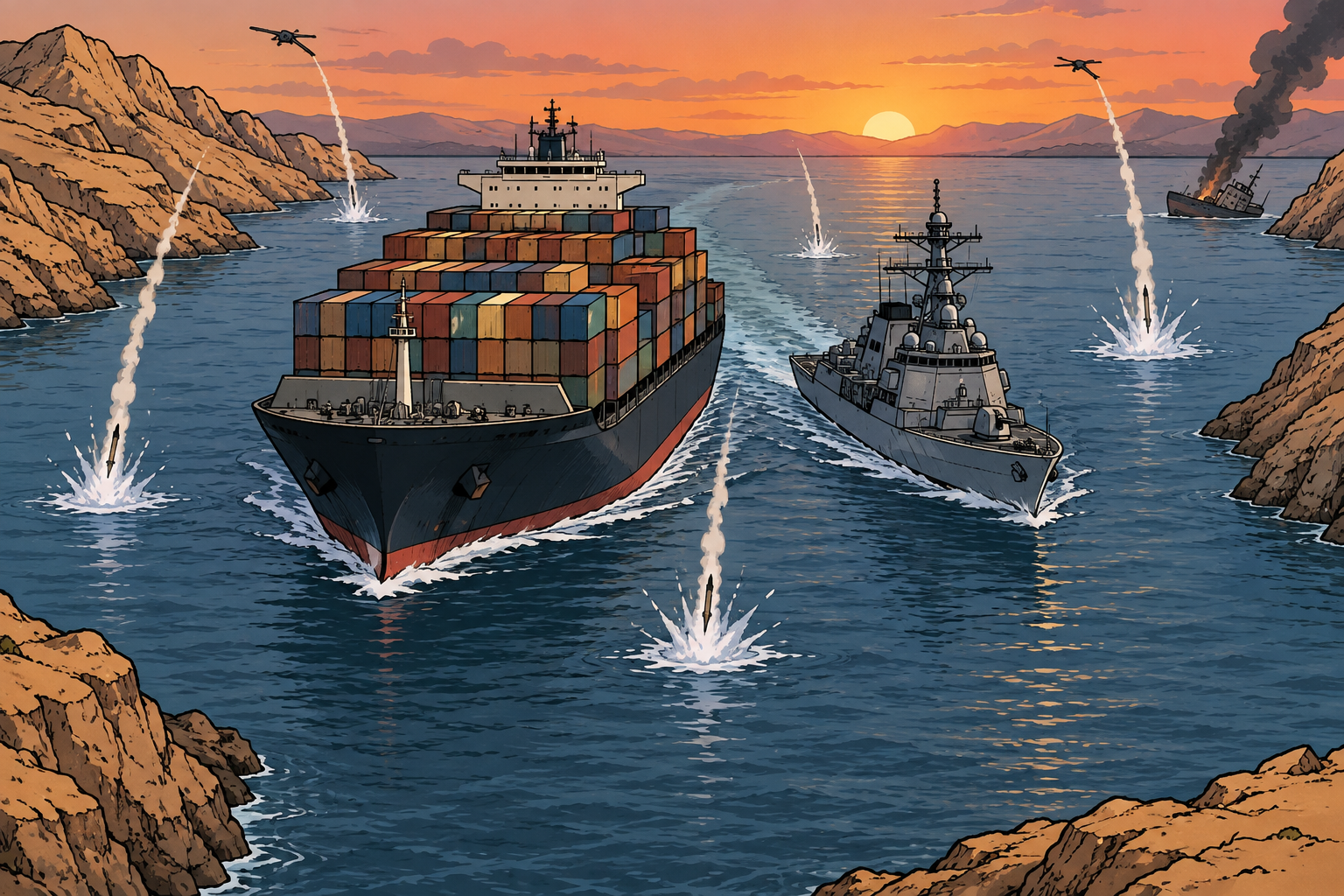
On July 19, Iran’s IRGC Navy said two vessels transiting the Strait of Hormuz “suffered accidents” on an “unsafe route,” and that two more ships abandoned their transit plans after warnings. Iran did not say it attacked the vessels — only that they had “accidents” while off the approved path. That is deniability-flavored language: Iran has effectively forced shipping into a narrow, Iran-approved corridor, and the International Maritime Organization estimates Iran has laid roughly 80 sea mines in the historic center channel of the Strait. A U.S.-backed alternate route, marketed as “mine-free,” hugs Oman’s coast instead.
Read together, the “accidents” framing functions as a warning to shipowners: comply with Iran’s corridor or risk unexplained damage, without Tehran ever claiming credit for an attack it could be held responsible for. It is the same logic as a blockade enforced through ambiguity rather than an open declaration.
President Trump, speaking to NewsNation’s Hannah Brandt, called the deaths “a very sad thing” and added: “We hate to see it happen. They were in service of our country… But never allowing Iran to have a nuclear weapon.” He told the New York Post separately that the deaths were “a shame” but justified, “because they don’t want to see Iran have a nuclear weapon.”
Republicans should add Iran to the Russian Sanctions Bill. That's what Lindsey wanted to do, and it was going to happen. IMPORTANT!!
Posted the same day CENTCOM confirmed two U.S. soldiers killed in Jordan — Trump moved to fold Iran into a pending Russia sanctions bill, adding economic pressure to the military response already underway.
Trump’s Truth Social post that day referenced the late Sen. Lindsey Graham’s push to add Iran to a Russia sanctions bill — tightening the economic screws on Tehran even as U.S. warplanes were already tightening the military ones. Secretary of War Pete Hegseth addressed the fallen directly — reportedly posting on X that they deserved “godspeed” and that their sacrifice would only stiffen U.S. resolve, though this page could not independently verify the exact wording against a live post before publication.
White House Press Secretary Karoline Leavitt said Iran violated the ceasefire framework by attacking commercial vessels and that “President Trump is not going to sit by and allow these acts of terrorism.” From Tehran, Supreme Leader Mojtaba Khamenei called Trump’s signature “utterly worthless and devoid of credibility” and warned of “unforgettable lessons.” Foreign Minister Abbas Araghchi said Iran would “defend every inch of its territory… until its last breath,” and Deputy Foreign Minister Kazem Gharibabadi announced Iran is suspending its commitments under the Islamabad Memorandum of Understanding, the framework that had underpinned the collapsed ceasefire.
In Congress, Senate Minority Leader Chuck Schumer (D-NY) said “I’m heartbroken to learn of the deaths of 2 US service members in Jordan,” and Sen. Chris Murphy (D-CT) said the war is “getting very dark very quickly.” Both remarks land against a backdrop lawmakers had already tried to shape: a non-binding House resolution to limit the president’s authority to keep striking Iran passed 215-208 on June 3, and a Senate companion passed 50-48 on June 23, with Republicans Bill Cassidy, Susan Collins, Rand Paul, and Lisa Murkowski joining Democrats to vote for restraint. Both votes predate the Jordan attack and carry no legal force — but they were cast before Iran had killed a single American service member. The first confirmed U.S. combat deaths of the war are likely to renew pressure for a binding vote, and the lawmakers who voted in June to tie the president’s hands on Iran now do so against the backdrop of two fresh American graves. The missing service member’s status remains unresolved.
President Trump (R) — called the deaths “a very sad thing” but the strikes justified, “because they don’t want to see Iran have a nuclear weapon”; ordered the eighth night of strikes and pushed Congress to add Iran to a pending Russia sanctions bill.
Secretary of War Pete Hegseth — reportedly posted a tribute to the fallen troops on X the day CENTCOM confirmed the deaths.
Adm. Brad Cooper — CENTCOM Commander; ordered the eighth night of strikes to punish the IRGC and protect shipping.
Supreme Leader Mojtaba Khamenei — Iran's Supreme Leader; dismissed Trump's credibility and warned of further escalation.
FM Abbas Araghchi & Deputy FM Kazem Gharibabadi — vowed continued resistance; announced Iran is suspending the ceasefire's Islamabad framework.
Sen. Chuck Schumer (D-NY) & Sen. Chris Murphy (D-CT) — expressed condolences and alarm at the war's trajectory.
House & Senate war-powers resolution backers (incl. GOP Sens. Cassidy, Collins, Paul, Murkowski) — voted in June to limit Trump's authority to keep striking Iran, before the war had claimed a single American life.
The Department of War has since named two more of the fallen from the Jordan strike and identified a third death in a separate incident, raising the war’s cumulative American toll to 17. 1st Lt. Tyler James Feehan, 25, of Ewa Beach, Hawaii (2nd Battalion, 55th Air Defense Artillery Regiment, Fort Bragg) and Pvt. Isabella Gonzales, 19, of Carrollton, Texas (1st Battalion, 57th Air Defense Artillery Regiment) were killed July 17–18 at Muwaffaq Salti. Separately, Sgt. Michael Emmanuel Swinton, 30, of Fayetteville, North Carolina (D Battery, 2nd Battalion, 55th Air Defense Artillery Regiment, Fort Bragg) was killed July 18 in a controlled detonation of an unexploded Iranian drone at Erbil Air Base, Iraq — an incident under investigation, with another soldier injured. The originally missing service member’s status remains unresolved.
Every time Iran kills an American Soldier they will pay for that killing many times over! This directive has been passed on to Secretary of War, Pete Hegseth, Chairman of the Joint Chiefs of Staff, Daniel Caine, and every Leader in the Military.
Posted July 20, 2026, 12:41pm EDT, the day CENTCOM confirmed the war's toll had climbed to 17.
CENTCOM completed a tenth consecutive night of strikes on Iran the evening of July 20, hitting military command centers, maritime capabilities, missile and drone launch sites, and air-defense systems. Iranian state and local media reported explosions at Bandar Abbas, Sirik, Qeshm Island, Bandar Lengeh, Shiraz, Isfahan, Konarak, and Chabahar, with air-defense activity also reported near the Bushehr nuclear site.
Today at 4 p.m. ET, U.S. forces began a new round of strikes against Iran at the Commander in Chief's direction. The strikes are designed to further degrade Iranian military capabilities used to attack commercial shipping in the Strait of Hormuz.
Iran hit back at Gulf states for a fourth consecutive day: Kuwait’s power-generation and water-desalination facilities were struck again, prompting Kuwait’s Foreign Ministry to invoke UN Security Council Resolution 2817 and call the strikes a “dangerous escalation” violating international law. The IRGC also claimed strikes on U.S.-linked air-defense and radar systems near Bahrain’s Muharraq area and Al-Riffa district, and air-raid sirens sounded in Manama. In the Strait of Hormuz, the IRGC said “massive fires” broke out on two oil tankers that attempted the “unsafe” southern transit route; the UK Maritime Trade Operations agency separately confirmed one tanker incident off Oman in which the crew abandoned ship to a lifeboat. Neither vessel has been independently named or flagged as of publication, and this piece does not conflate this incident with an unrelated tanker strike from earlier in July.
A widely shared claim that “the U.S. blockade is turning Chinese ships around” traces to an April 2026 Newsweek report on the blockade’s original imposition — not a new, July development, and this piece does not present it as one. The accurate, current figure: after a gap, the naval blockade was reinstated July 14, 2026, and CENTCOM says it has since redirected seven commercial vessels and disabled one. No Chinese-flagged vessel has been confirmed among them, though a “shadow fleet” tanker using the Chinese-sounding name Wen Yao — renamed Lan Jing, then Azhin, switching its flag from Curaçao to Iran mid-pursuit — was boarded July 16 carrying more than a million barrels of Iranian crude; its actual ownership and flag remain disputed, not confirmed as Chinese state-linked.
Secretary of War Hegseth and Joint Chiefs Chairman Gen. Daniel Caine were set to testify before the Senate Appropriations Committee on July 21 over an $80 billion Iran-war supplemental request — $67 billion of it tied directly to the conflict — amid reporting that the Pentagon has been slow to disclose injury figures, with nearly 100 U.S. troops injured since July 7 (96% have returned to duty).
Three U.S. soldiers are now confirmed dead from the Jordan strike and its aftermath, a fourth remains missing, and the war's cumulative American death toll has reached 17. CENTCOM has answered with a tenth consecutive night of strikes on Iran; Iran has hit back across Kuwait, Bahrain, and the Strait of Hormuz, where two tankers reportedly caught fire on the “unsafe” southern route. The naval blockade, reinstated July 14, has redirected seven vessels and disabled one — a real but more modest figure than the months-old “turning Chinese ships around” claim still circulating. Congress is now being asked to fund the next phase with an $80 billion supplemental. The regime that killed 17 Americans is still escalating — the clearest argument yet for keeping the pressure on Tehran until it stops.