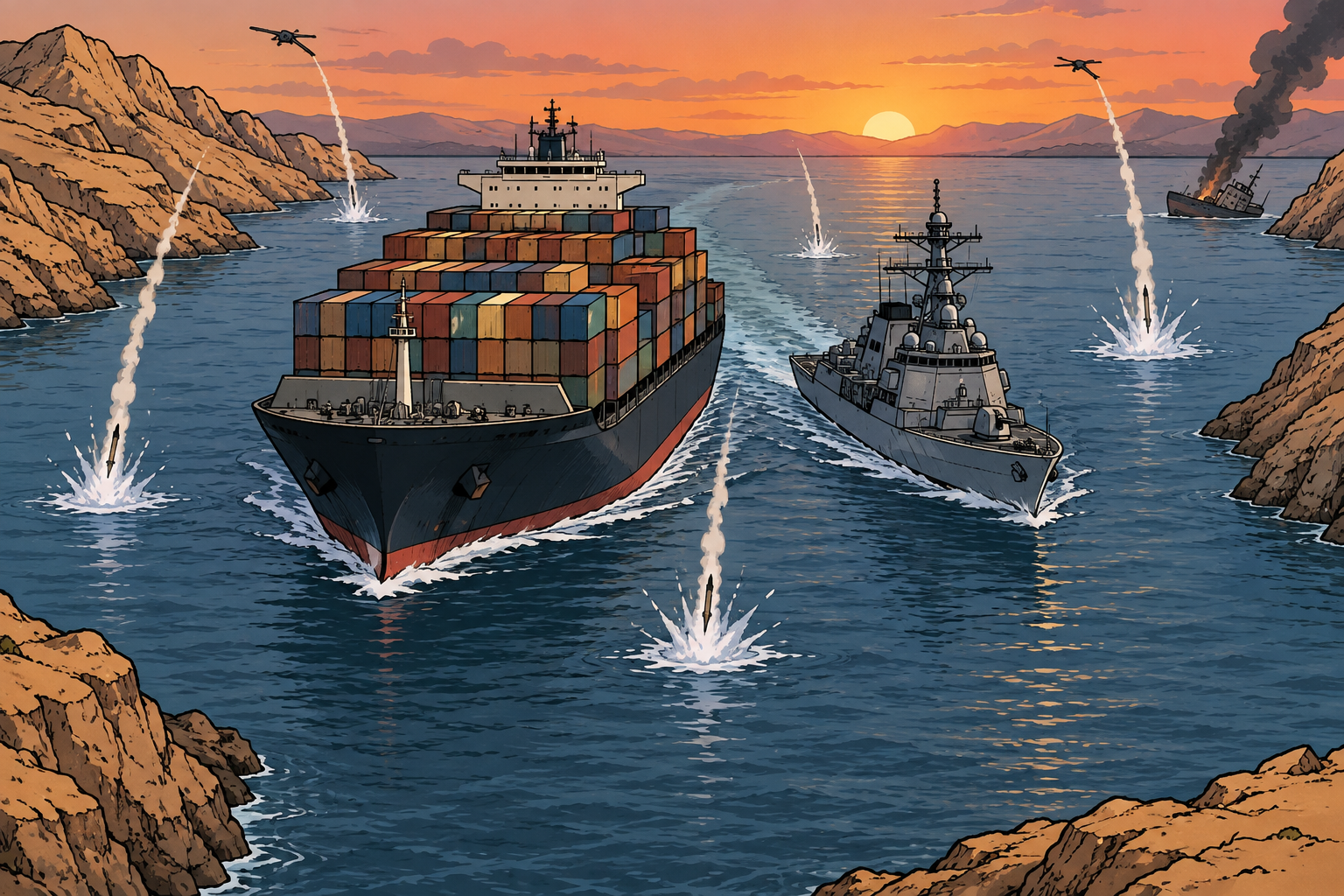
Kurdish Fighters Say Iran Used White Phosphorus in a Drone Strike on Their Iraq Base — Eight Peshmerga Wounded as Tehran’s War on Its Own Kurdish Opposition Escalates.
Iran’s war on the United States has run alongside a quieter, longer one: its campaign against Kurdish opposition groups sheltering in Iraq’s Kurdistan Region. Early on Sunday, July 19, 2026, that campaign crossed a new legal line, according to the Kurdistan Freedom Party (PAK), an Iranian Kurdish separatist group. A drone strike hit PAK’s Jamshar headquarters near the Darashakran camp in Erbil province, wounding eight of the group’s Peshmerga fighters — and PAK says the munitions used contained white phosphorus.
White phosphorus is not a banned weapon in the way chemical nerve agents are — militaries legally use it every day for smoke screens and battlefield illumination. What Kurdish officials and a Norway-based human rights group are alleging is narrower and more specific: that Iran deployed it as an incendiary weapon against people, in a way that could violate Protocol III of the Convention on Certain Conventional Weapons, the treaty regime that actually governs incendiary munitions. Iran has not responded to the allegation.
It would not be the first time. A nearly identical accusation — white phosphorus munitions fired at Peshmerga positions on the Iran-Iraq Kurdish border — dates back to 2018, when the attack killed two fighters. Eight years later, with Iran and the United States trading nightly strikes over the Strait of Hormuz, Tehran’s parallel war against its own Kurdish dissidents keeps running underneath the headlines.
- 8 wounded, 4 critically — PAK Peshmerga hurt in the July 19 drone strike on the group's Jamshar headquarters near Darashakran, Erbil province — Shafaq News, Asharq Al-Awsat
- Protocol III — the Convention on Certain Conventional Weapons provision on incendiary weapons that Kurdish officials say Iran's strike may have violated
- 2018 — the last time Iran was accused of using white phosphorus against Kurdish Peshmerga, per the Democratic Party of Iranian Kurdistan
- 900+ — attacks Kurdish officials say Iran has launched on the Kurdistan Region since the war began Feb. 28, 2026 — Jerusalem Post
- 17 — cumulative U.S. service member deaths in the broader war as of July 19, 2026, per CENTCOM
PAK is one of several exiled Iranian Kurdish opposition parties headquartered in Iraq’s autonomous Kurdistan Region; its fighters, known as PAK Peshmerga, belong to a militia the party calls the Kurdistan National Army, or SMK. Shortly after midnight on July 19, a drone struck the party’s Jamshar headquarters near the Darashakran displaced-persons camp west of Erbil. Shafaq News and Asharq Al-Awsat both reported eight Peshmerga fighters wounded, four of them critically. PAK said its assessment that the munitions contained white phosphorus rested on eyewitness accounts, medical examination of the wounded, and the extent of the fires the strike caused at the site — not on independent chemical testing, which has not been reported.
PAK leadership member Adib Khaledian told Asharq Al-Awsat that “surveillance drones are constantly flying over our positions and gathering information” — a description of the reconnaissance-then-strike pattern the party says has become routine. It was not the first drone to hit this particular facility: an earlier barrage on July 13 struck the same general area without casualties, meaning Jamshar has now been targeted at least twice in under a week.

It is worth being precise here, because “white phosphorus” gets thrown around online as shorthand for “banned weapon,” and that is not quite right. Unlike chemical weapons under the Chemical Weapons Convention, white phosphorus itself is not universally prohibited — it is legally used worldwide for smoke screens, target marking, and illumination. The relevant treaty is Protocol III of the Convention on Certain Conventional Weapons (CCW), which governs incendiary weapons specifically. And Protocol III has a loophole large enough to matter: it defines “incendiary weapon” narrowly and expressly excludes munitions whose incendiary effect is incidental to smoke, signaling, or illumination purposes — the very use white phosphorus is issued for.
What tips a use from legal to unlawful, under Protocol III, is intent and target: deliberately using an incendiary weapon against people, or air-delivering one against a military objective located within a concentration of civilians, is prohibited and can constitute a war crime. That is the specific claim PAK is making — not that Iran possessed a banned substance, but that it fired munitions designed to burn directly at a facility housing personnel. Establishing that requires an investigation into intent that eyewitness accounts and burn injuries alone cannot fully settle.
“This act is not only a grave crime but also a clear violation of the fundamental principles of international humanitarian law.”
Hussein Yazdanpanah · PAK President & SMK Commander
Yazdanpanah added that “the use of munitions that inflict severe incendiary effects and cause widespread harm to people and the environment is incompatible with humanitarian principles and the international legal obligations of states,” and called on the UN Secretary-General, the Security Council, the Human Rights Council, and the International Committee of the Red Cross to hold Iran accountable. The Hengaw Organization for Human Rights, a Norway-registered group that documents abuses against Iran’s Kurdish minority, went further and asked the UN and ICRC to send an independent fact-finding mission to examine the wounded and the physical evidence on-site — the kind of forensic confirmation that, so far, does not exist.
Iran has faced this exact accusation before. In 2018, the Democratic Party of Iranian Kurdistan reported that Iran fired white phosphorus artillery munitions at Peshmerga bases along the Iran-Iraq Kurdish border, killing two fighters — Rahim Rostam Dastan and Idris Derwishi — and said similar munitions had been used against Kurdish forces as far back as 2016. That history does not prove the July 19 allegation, but it establishes that this is not a novel claim invented for this war; it is a recurring one, made by different Kurdish parties across nearly a decade.
The Jamshar strike also sits inside a much larger campaign. Kurdish officials cited by the Jerusalem Post say Iran has launched more than 900 attacks on the Kurdistan Region since the war began on February 28, 2026. Wikipedia’s running tally of the campaign — compiled from Kurdish security ministries, Hengaw, and wire reporting — counts at least eight Peshmerga killed and more than 44 wounded, one Asayish security officer killed, nineteen Iranian Kurdish opposition fighters killed, a French soldier killed and six wounded, and three Kurdish civilians killed, spanning strikes that continued straight through the April 8 ceasefire that was supposed to have stopped them. The white-phosphorus allegation, if substantiated, would not be a change in Iran’s target list — it would be a change in method.
Regional condemnation of Iran’s Kurdistan campaign predates the white-phosphorus claim but frames how it is landing internationally. Two days before the Jamshar strike, Qatar’s Foreign Ministry publicly condemned Iran’s July 17 attack on the Kurdistan Region as a breach of Iraqi sovereignty and international law — the kind of Gulf-state rebuke that has become more frequent as Iran’s Kurdistan strikes have piled up.
Statement | Qatar strongly condemns Iranian attack on Iraq's Kurdistan Region. The State of Qatar strongly condemns the Iranian attack on Iraq's Kurdistan Region, considering it a blatant violation of the sovereignty of the sisterly Republic of Iraq and the Kurdistan Region of Iraq, as well as a flagrant breach of the principles of international law.
Iraq’s Kurdistan Regional Government has separately condemned the broader strike campaign as “unjustified” and called on Baghdad and the international community to intervene. No U.S. government official has commented specifically on the white-phosphorus allegation as of publication. Secretary of State Marco Rubio (Trump administration), speaking the same weekend about the war generally, said Washington remains open to a diplomatic resolution if Iran halts its attacks on shipping in the Strait of Hormuz, and pointed to what he called a “growing split” inside Iran between militant factions and those worried about the economic toll — a remark about the war’s trajectory broadly, not a response to the Kurdistan claim.
The Jamshar strike landed in the middle of the war’s ninth consecutive night of American strikes on Iran, part of “Operation Epic Fury,” the campaign that resumed after the ceasefire collapsed in early July. CENTCOM says the American death toll in the broader conflict has reached 17 since the war began February 28. Iran, meanwhile, has kept up its own two-track approach — missiles and drones against U.S., Jordanian, and Gulf targets on one front, and a steady grind against Kurdish opposition camps in Iraq on another that receives far less coverage.
CENTCOM began conducting a new wave of strikes against Iran at 7 p.m. ET today for the ninth consecutive night. The strikes will continue degrading Iranian military capabilities used to attack commercial vessels and civilian mariners transiting the Strait of Hormuz.
President Trump (R) has used Truth Social throughout the war to signal how hard the U.S. is prepared to hit Iran. On July 11, after U.S. media reported Israeli intelligence pointing to an Iranian plot to assassinate him and Supreme Leader Mojtaba Khamenei vowed “revenge” for his father’s death, Trump posted that “a thousand missiles are Locked and Loaded and aimed at the Islamic Republic of Iran, with thousands of more to immediately follow,” should Iran act on the threat.
A thousand missiles are Locked and Loaded and aimed at the Islamic Republic of Iran, with thousands of more to immediately follow, should the Iranian Government act on its threat. We will completely decimate and destroy all areas of Iran — PRAISE BE TO ALLAH!
Posted after reports of an Iranian plot to assassinate Trump and Mojtaba Khamenei's public vow of 'revenge' — cited here to document his Truth Social posture toward Iran, not as comment on the Kurdistan white-phosphorus claim.
The U.S.A. will be, from this point forward, known as 'THE GUARDIAN OF THE HORMUZ STRAIT,' but as such, and as a matter of FAIRNESS, will be reimbursed, at the rate of 20% on all cargo shipped, for any and all costs necessary to do the job of providing safety and security to this very volatile section of the World.
Trump's proposal to charge shipping tolls through the Strait of Hormuz — part of the same week's escalating posture toward Iran.
None of that touches the Kurdistan front directly — which is itself part of the story. A war that has produced nine straight nights of American airstrikes, 17 dead U.S. service members, and daily headlines about the Strait of Hormuz has left a parallel campaign against Kurdish opposition camps in Iraq running largely on its own, tracked mostly by Kurdish human-rights monitors rather than Washington. An incendiary-weapons allegation against a country already accused of sea mines, ceasefire violations, and hundreds of strikes on a U.S.-aligned region is a serious one — and, absent the independent investigation PAK and Hengaw are both requesting, still an allegation rather than a finding.
Hussein Yazdanpanah — PAK President and SMK Commander; called the alleged white-phosphorus use “a grave crime” and demanded UN and ICRC accountability measures.
Adib Khaledian — PAK leadership member; described the drone surveillance-then-strike pattern targeting the party's positions.
Hengaw Organization for Human Rights — Norway-based monitor; called for an independent UN/ICRC fact-finding mission to examine the wounded and physical evidence.
Qatar's Ministry of Foreign Affairs — condemned Iran's broader Kurdistan Region campaign as a violation of Iraqi sovereignty and international law.
Secretary of State Marco Rubio — said the U.S. remains open to diplomacy if Iran halts Strait of Hormuz attacks; cited a “growing split” inside Iran.
President Trump (R) — has used Truth Social throughout July to signal an escalating military and economic posture toward Iran.
Iran's IRGC — blamed for the Jamshar strike by PAK; has not publicly responded to the white-phosphorus allegation.
Eight Kurdish Peshmerga fighters are wounded, and Iran stands accused — not for the first time in this conflict, and not for the first time in its history — of using an incendiary weapon against people rather than for its lawful battlefield purposes. The legal bar for a Protocol III violation is real and specific, not a rubber stamp, which is exactly why Kurdish officials and human-rights monitors are asking for an independent investigation rather than simply declaring a verdict. What is not in dispute is the pattern surrounding it: a regime waging open war on the United States in the Gulf while grinding down its own Kurdish opposition in Iraq, one drone strike at a time, largely out of the world's view.