
After a Strange Lull, China’s Warplanes Are Back Over Taiwan — in Force.
For several weeks this spring, the sky around Taiwan went quiet. Then it didn’t. Taiwan’s Ministry of National Defense (ROC MND) reported that the People’s Liberation Army (PLA) resumed large-scale flights around the island after an unusual multi-week pause — and the tempo snapped back hard, with recent daily bulletins logging dozens of warplanes pushing across the Taiwan Strait median line into the island’s air-defense identification zone (ADIZ).
One recent June day brought roughly 35 PLA aircraft, with 33 of them crossing the median line into Taiwan’s northern, central, southwestern, and eastern ADIZ, per the MND. Peak days have run far higher — on the order of 130 warplanes paired with 20-plus PLA Navy (PLAN) ships in the surrounding waters. The June 19, 2026 ROC MND daily bulletin documented sorties crossing the median line into Taiwan’s northern airspace.
This is the story of a pattern, not a single drill. The pause-then-surge cycle — quiet stretches with near-zero incursions, then a sudden return to high-volume crossings — is itself the point. Under President Lai Ching-te (DPP), the monthly incursion average has more than doubled the prior two-year baseline. What once read as escalation now reads, increasingly, as the “new normal” over the Strait.
- ~35 aircraft / 33 crossings — a recent single-day June 2026 tally — roughly 35 PLA aircraft detected, 33 of them crossing the median line into Taiwan's northern, central, southwestern, and eastern ADIZ · Source: Taiwan MND; Table.Briefings
- ~130 warplanes — peak single-day count during the resumed surge, paired with 20+ PLAN ships in surrounding waters · Source: Taiwan MND; Janes
- June 19, 2026 — ROC MND daily bulletin documenting PLA sorties crossing the median line into Taiwan's northern airspace · Source: GlobalSecurity.org (ROC MND)
- 300+ per month — average PLA ADIZ incursions since President Lai Ching-te (DPP) took office in May 2024 — more than double the prior two-year average · Source: Taiwan Security Monitor; AEI
- Multi-week lull — the unusual quiet stretch that preceded the resumption — analyzed by the Taiwan Security Monitor as part of a recurring drop-then-resume cycle · Source: Taiwan Security Monitor
What made June notable was not just the volume but the contrast. For a stretch of weeks, Taiwan’s daily MND reports recorded few or even zero PLA aircraft crossing the median line — an unusual quiet that drew its own analysis. The Taiwan Security Monitor at George Mason University’s Schar School examined the drop, noting that these lulls are not necessarily de-escalation so much as a trough in a recurring cycle: the PLA throttles activity down, then resumes it, often around training rotations, weather windows, or political signaling.
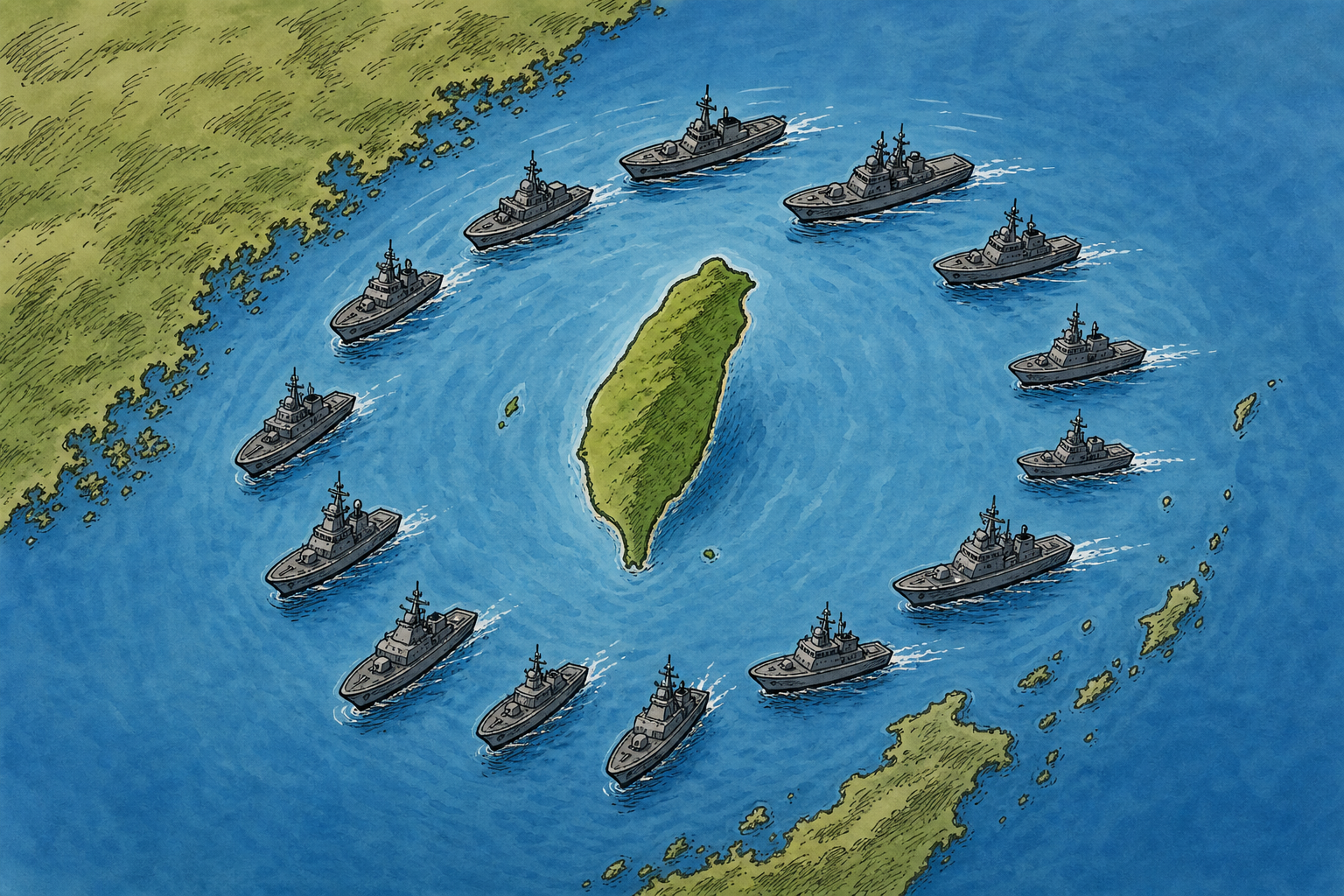
When the resumption came, it came at scale. The MND’s tallies climbed back into the dozens per day, with crossings spread across every quadrant of Taiwan’s ADIZ — north, center, southwest, and east — rather than concentrated in a single approach. That breadth is part of what distinguishes routine gray-zone pressure from a one-off exercise.

The clearest snapshot of the resumed tempo comes straight from the ROC MND’s daily military-status updates. One recent June day logged about 35 PLA aircraft, 33 of which crossed the median line into Taiwan’s northern, central, southwestern, and eastern ADIZ. The June 19, 2026 bulletin, mirrored by GlobalSecurity.org, recorded PLA sorties crossing the median line into the island’s northern airspace. Peak days during the surge have run dramatically higher — on the order of 130 warplanes alongside more than 20 PLAN vessels.
Janes, tracking the longer arc, has documented the PLA setting new records in combined air and sea operations around Taiwan over the past two years — a steady ratchet that the June resumption extends rather than breaks. The median line, an informal boundary down the middle of the Taiwan Strait that both sides once broadly respected, is now routinely crossed; the MND no longer treats a crossing as exceptional so much as a daily count to be logged.
Today's PLA activity around Taiwan: dozens of aircraft detected, with the majority crossing the median line of the Taiwan Strait and entering Taiwan's northern, central, southwestern, and eastern ADIZ. We have monitored the situation and responded with CAP aircraft, naval vessels, and coastal missile systems.
After a stretch of unusual quiet over the Taiwan Strait, the PLA is back in force: Taiwan's defense ministry is again logging dozens of warplanes a day crossing the median line into the island's air-defense identification zone.
Taiwan’s response to each surge is now a practiced routine. When the MND detects incoming PLA aircraft and ships, it scrambles combat air patrol (CAP) fighters, deploys navy vessels to shadow the PLAN, and activates coastal and land-based missile systems to track the formations. The phrasing in the daily bulletins is deliberately steady: the military “monitored the situation and responded appropriately.” That calm is itself a strategy — refusing to let high-tempo pressure read as a crisis every single day.
Air. CAP fighters scramble to intercept and shadow PLA aircraft crossing the median line into the ADIZ.
Sea. ROC Navy vessels deploy to track and shadow the accompanying PLAN ships in surrounding waters.
Land. Coastal and land-based missile systems are activated to monitor and target the formations.
Figures cited are from ROC MND daily military-status bulletins; the median line is an informal Strait boundary the PLA now crosses routinely.
The longer trend is unambiguous. Since President Lai Ching-te (DPP) took office in May 2024, PLA ADIZ incursions have averaged more than 300 per month — more than double the average of the prior two years. Beijing, under Xi Jinping, regards Lai as a separatist and has paired its rhetoric with steadily escalating military pressure: large named drills punctuating a baseline of near-daily crossings. The June resumption sits inside that pattern, not outside it.
What this normalizes is the danger. Each lull resets expectations downward; each surge resets them back up; and the long-run average keeps climbing. The risk is not only a deliberate conflict but an accident — an intercept gone wrong, a misread maneuver — in airspace that is now crowded on most days of the week.
This page tracks the lull-then-resumption pattern and the current daily tempo specifically. It sits alongside two earlier Civic Intelligence stories that cover different facets of the same pressure campaign: a large named PLA drill, and a satellite-documented look at China’s drone and jet basing opposite the island. Read together, they show the layered nature of the squeeze — set exercises, persistent daily crossings, and hardening infrastructure all at once.
“The lull is not peace. It is the trough between waves — and the average between the troughs keeps rising.”
Civic Intelligence — on the PLA's pause-then-surge tempo over the Taiwan Strait
After an unusual quiet, the PLA is again flying dozens of warplanes a day across the median line into Taiwan’s ADIZ, with peak days running into the triple digits and PLAN ships in tow — all documented in Taiwan’s own daily defense bulletins. The numbers are not in dispute; they come from the ROC MND. What matters is the trajectory: the pause-and-surge cycle, the 300-plus monthly average under President Lai, and the steady erasure of the median line as any kind of boundary. The most important fact may be the least dramatic one — this has become routine. We will update this page as the daily tallies move.
- 1.Table.Briefings — 'Taiwan: PLA Resumes Air Activity Around the Island' (primary/manifest), June 2026
- 2.GlobalSecurity.org — ROC Ministry of National Defense daily bulletin, June 19, 2026 (PLA sorties crossing the median line into northern ADIZ)
- 3.Taiwan Security Monitor (Schar School, George Mason University) — 'All Quiet in the Taiwan Strait: Explaining the Recent Drop in PLA Aircraft Activity Around Taiwan'
- 4.Janes — 'China Sets New Records in Air, Sea Operations Around Taiwan'
- 5.American Enterprise Institute — 'China-Taiwan Weekly Update' (PLA ADIZ incursion tracking)
- 6.The Diplomat — coverage of PLA gray-zone pressure and median-line crossings around Taiwan
- 7.Taipei Times — daily ROC MND reporting on PLA aircraft and PLAN vessels around Taiwan
- 8.Reuters / Focus Taiwan — wire coverage of PLA incursions into Taiwan's ADIZ
- 9.Taiwan Ministry of National Defense (ROC MND) — Real-Time Military Status Update (official daily PLA-activity reports)
- 10.TaiwanPlus News — 'Taiwan Reports Chinese Warplanes After Week-Long Lull'
- 11.Council on Foreign Relations — 'China-Taiwan Tensions' background and incursion trend data
Last updated June 20, 2026