‘Tanker for Tanker’ — The US and Iran Are Trading Strikes Across the Gulf Again.
For nearly a month, the U.S.-Iran war had gone quiet enough that the news out of the Gulf was about a collapsing rial and Treasury sanctions, not missiles. On Aug. 30, 2026, CENTCOM ended that lull, striking two IRGC rocket launchers on Iran’s Larak Island. Iran answered within a day — ballistic missiles at U.S.-linked bases in Jordan, a drone claim against the UAE, and, most consequentially, unidentified projectile strikes on two civilian oil tankers near Oman that killed two Filipino seafarers.
Then, on Sept. 1, the exchange escalated sharply. CENTCOM launched a wave of roughly 100 strikes along Iran’s southern coast and, for the first time, hit two Iranian government tankers directly — opening a new “tanker for tanker” policy personally approved by President Trump. Iran answered again, this time reaching toward Kuwait, Bahrain, and Iraq as well as Jordan.
The single most sensitive fact of the week is also the most contested: a U.S. strike that Iranian officials say hit a wedding celebration in Sirik County, with Iranian-sourced casualty counts ranging from 4 to 18 dead. CENTCOM has not confirmed the strike occurred as described, or any casualty figure — a gap this story treats as exactly what it is: an unresolved, one-sided claim, not a verified fact.
- ~100targets CENTCOM says it struck along Iran's southern coast in the Sept. 1 wave — air defense, radar, mine-laying capability, communications, and anti-ship missile launchers — CENTCOM via Axios
- 2Iranian government tankers struck for the first time under the new “tanker for tanker” policy — hit in the engine rooms by drone-launched missiles, per Axios
- 13ballistic missiles Iran fired at Jordan Sept. 1–2 — a separate, larger round than Aug. 31's; 10 intercepted, 3 hit remote areas — Al Jazeera
- 2Filipino seafarers killed when the tanker Sidr was struck near Khasab, Oman, Aug. 31 — Al Jazeera
- 4 to 18reported dead in a disputed, Iranian-sourced-only account of the Sirik wedding strike — CENTCOM has not confirmed the strike as described
- $90.49Brent crude price after the Aug. 30–31 exchange, up about 2.71% — it climbed further, toward $95 a barrel, after the Sept. 1 tanker strikes
On the night of Aug. 30, U.S. forces struck two Islamic Revolutionary Guard Corps rocket launchers on Larak Island, a small Iranian-held island in the Strait of Hormuz near Bandar Abbas — the first American strike inside Iran in a month. CENTCOM spokesman Capt. Tim Hawkins said IRGC forces had been observed “preparing to launch rockets with sea mines” into the strait’s shipping lanes, and CENTCOM described its response as “limited, precise action against IRGC minelaying forces posing an imminent threat.”
Iran answered on Aug. 31. The IRGC fired ballistic missiles at U.S.-linked bases in Jordan and flew a drone at the United Arab Emirates; Jordan’s military said its air defenses intercepted all eight incoming missiles, with no casualties or damage. Separately — and more gravely — two supertankers, the Saudi-flagged VLCC Sidr and the South Korean-flagged Senegal Prosperity, were struck by unidentified projectiles near Khasab, Oman. Two Filipino seafarers were killed aboard the Sidr. Saudi Arabia condemned Iran over the attack.
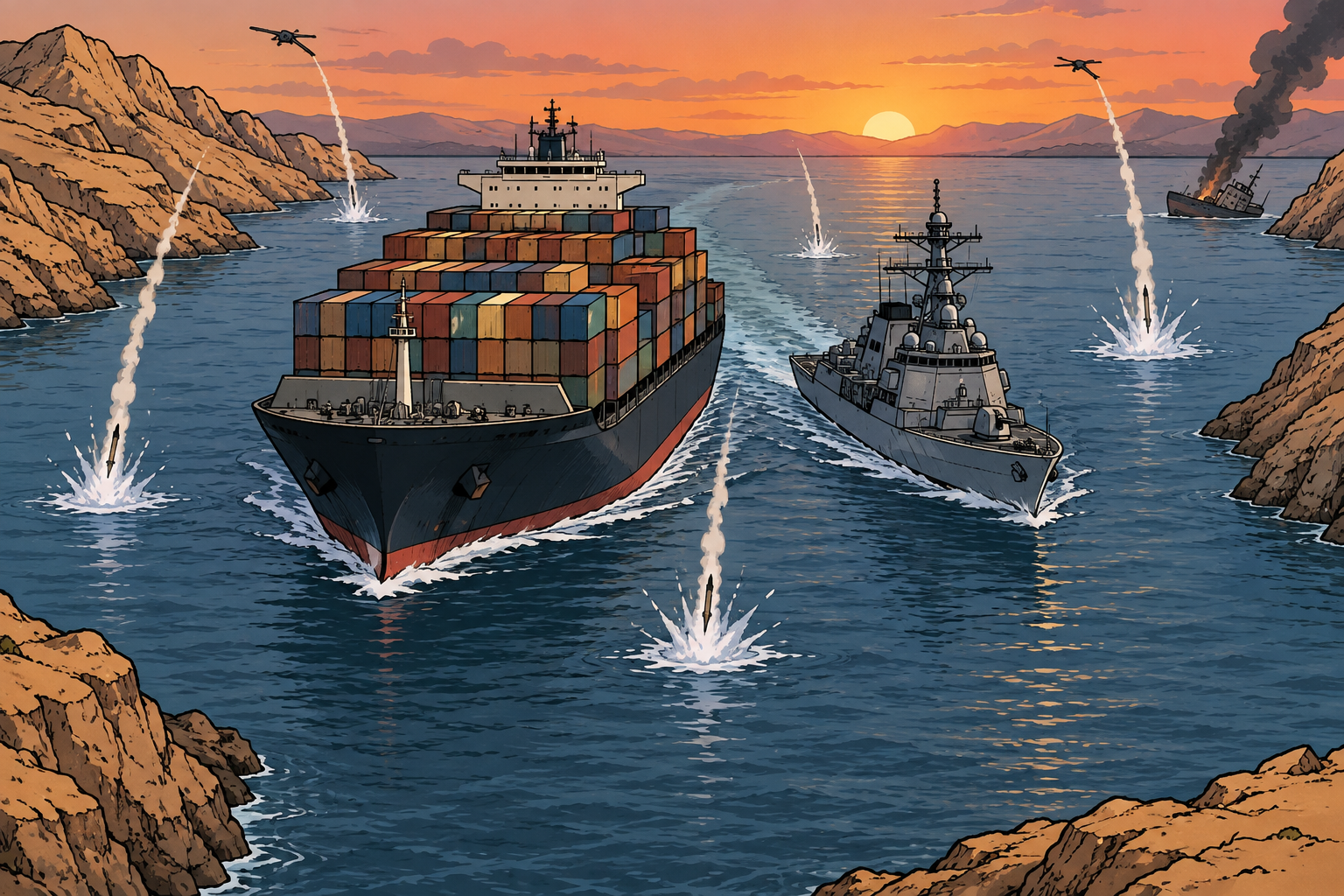
On Sept. 1, the United States answered the tanker attack on the Sidr with a far larger operation than the Larak Island strike. CENTCOM said it hit roughly 100 targets along Iran’s southern coast — air-defense sites, radar installations, mine-laying capability, communications infrastructure, anti-ship cruise-missile launchers, and drone-launch sites. For the first time in the war, U.S. forces also struck two Iranian government tankers anchored north of the existing blockade line, hitting both in the engine rooms with drone-launched missiles.
That is the new “tanker for tanker” policy, and it was personally approved by President Trump. A U.S. official told Axios the Sept. 1 strikes “bought at least a month” of reduced threat to commercial shipping in the strait — the same rationale, on a larger scale, that CENTCOM used to justify the narrower Larak Island strike two days earlier.
U.S. forces conducted precision strikes against Iranian military targets, including air-defense and mine-laying capability, along Iran's southern coast.
President Trump confirmed the scale of the operation himself hours later, posting on Truth Social that the strikes were “large and powerful” and warning Iran against further retaliation.
Posted Sept. 1, 2026, hours after CENTCOM's ~100-target strike wave and the first tanker-for-tanker strikes.
Oil markets moved with the news. Brent crude, which had already risen about 2.71% to $90.49 a barrel after the Aug. 30–31 exchange, jumped further after the Sept. 1 tanker strikes to near $95 a barrel — its highest level since late July, per CNBC. West Texas Intermediate rose 2.47% to $85.46 a barrel over the same window.
The same day as the tanker-for-tanker strikes, a U.S. strike is reported to have hit a wedding celebration in Kuhestak, a town in Sirik County, Hormozgan province, near the Strait of Hormuz. What happened there, and how many people died, is the least settled fact in this story — and the one this piece is most careful to label as contested.
Sirik County governor Reza Shahidiyan put the toll at 4 dead and more than 60 wounded. Iran’s Foreign Ministry gave a different count: 5 dead, including a child. Iranian state and military media went further still, claiming 18 killed and 63 wounded, mostly women and children.
CENTCOM spokesman Capt. Tim Hawkins said the reports “originated from Iranian state media” and stated flatly that “the U.S. military never targets civilians.” The U.S. has not confirmed the strike occurred as described, nor published any casualty count of its own.
Every number above comes from an Iranian government or state-media source. None has been independently verified. This story reports the dispute; it does not resolve it.
On Sept. 2, Iran’s Foreign Ministry called the Sirik strike a “war crime,” and Iran’s Red Crescent asked the International Criminal Court to investigate. Those are Iranian government characterizations and requests, not findings by any international body; the ICC has not opened or confirmed an investigation as of publication.
Iran’s retaliation over Sept. 1–2 was broader than anything in the Aug. 30–31 round. The IRGC fired 13 missiles at Jordan — a separate, larger barrage than the eight Jordan intercepted in full two days earlier — of which Jordan intercepted 10, with three landing in remote areas. Two U.S. officials told Reuters there were no American casualties, directly contradicting IRGC claims to have struck U.S. positions.
Iran also sent drones toward Kuwait, triggering air-defense intercepts and sirens, and claimed a kamikaze-drone attack on Bahrain’s Sheikh Isa Air Base and a missile-and-drone attack near Erbil, Iraq, close to the U.S. consulate. Every one of those three claims — Kuwait, Bahrain, and Iraq — comes solely from the IRGC. None has been confirmed by Bahrain, Kuwait, Iraq, or the United States.
Background — an earlier round of the same campaign, not a reaction to this week’s Kuwait/Bahrain/Iraq claims specifically:
CENTCOM announced a new round of strikes designed to 'further degrade Iranian military capabilities used to attack shipping in the Strait of Hormuz.'
IRGC spokesman Ebrahim Zolfaghari made clear the campaign was meant to widen further, warning that Iran “will no longer exercise restraint regarding Bahrain and Kuwait.”
“Gifts are on the way.”
IRGC spokesman Ebrahim Zolfaghari · Sept. 2026
President Trump told Fox News that Iran would be “totally wiped out” if it retaliates further, and separately called Iran’s strikes on its Gulf neighbors “a very good thing” because, in his telling, Iran “lost all of the support they had” by hitting Jordan, Kuwait, Bahrain, and Iraq.
The reaction in Congress split along familiar lines. Sen. Jack Reed (D-RI), ranking member of the Senate Armed Services Committee, delivered the sharpest criticism of the war’s trajectory.
“Six months later, not a single objective has been achieved. He has weakened our position in the Middle East and the world significantly.”
Sen. Jack Reed (D-RI) · Senate Armed Services Committee
Rep. Mike Rogers (R-AL), chairman of the House Armed Services Committee, offered a different read after a classified CENTCOM briefing, telling reporters simply that military leaders “have got a plan” and signaling he expects the campaign to intensify rather than wind down.
Six months into the war, the pattern is now familiar even as the scale keeps changing: a U.S. strike framed as narrow and defensive, an Iranian retaliation that spreads to more countries each time, an oil market that reprices the risk within hours, and a disputed civilian casualty claim neither side will let the other own. What is new this week is the tanker-for-tanker doctrine itself — a standing U.S. commitment to answer every Iranian tanker attack with an Iranian tanker of its own.
After a month of quiet, the U.S. and Iran are trading strikes across the Gulf again — roughly 100 U.S. targets hit on Sept. 1, two Iranian tankers struck under a new “tanker for tanker” policy, and Iranian retaliation that has now reached Jordan, Kuwait, Bahrain, and Iraq. The one fact still in genuine dispute is also the gravest: how many people, if any, died in a strike near a wedding in Sirik County. Iran says as many as 18. The U.S. has confirmed none of it.