Two Federal Judges, Two Orders:
DHS Caught Between Rulings on Its Citizenship Voter Database
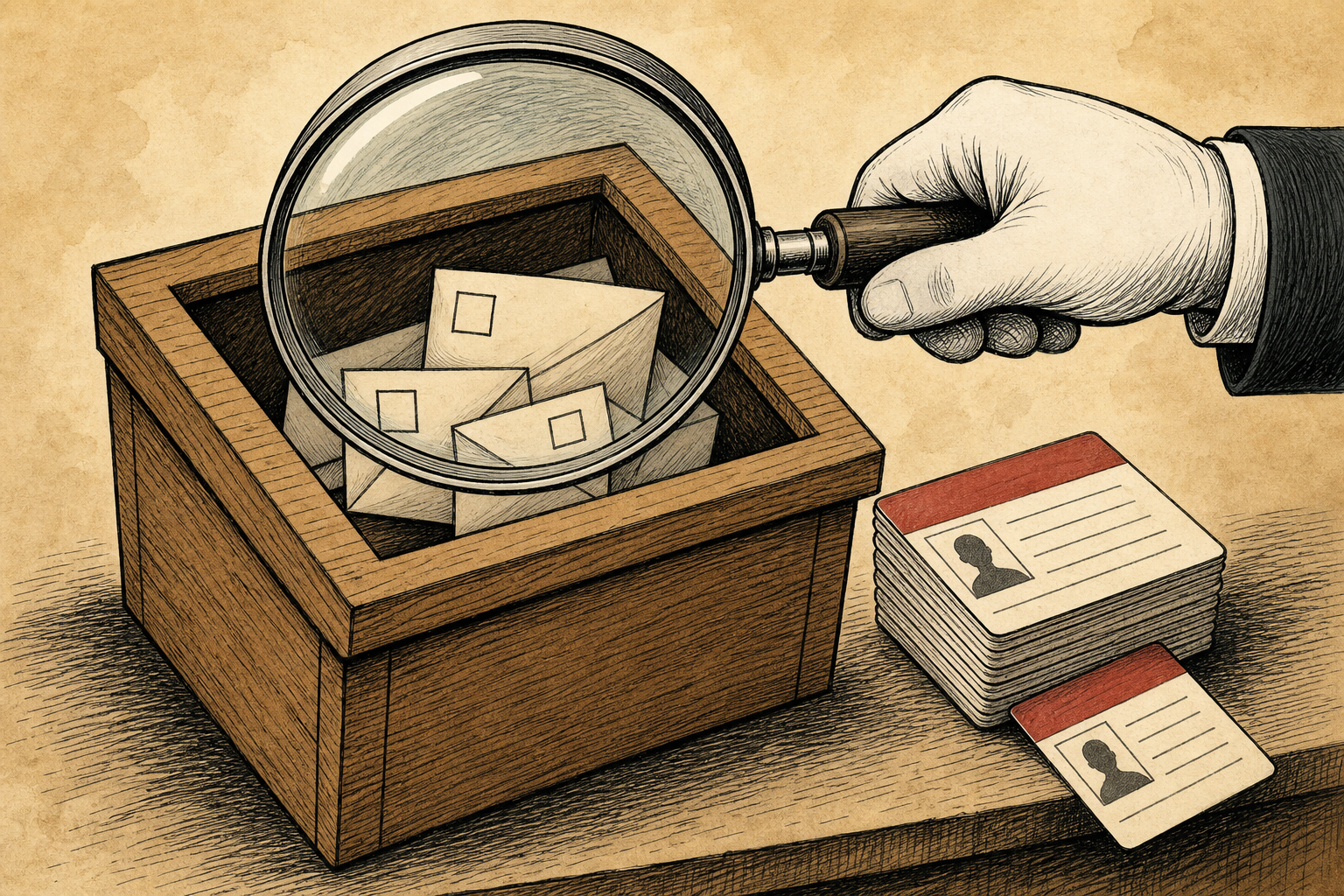
A Biden-appointed judge in Washington says the Department of Homeland Security’s rebuilt citizenship-verification database unlawfully trampled Americans’ privacy rights and voided the whole overhaul, nationwide. A Trump-appointed judge in Florida says DHS broke a binding settlement with four Republican-led states and ordered the agency to turn the same features back on, immediately. Both orders are currently in effect. Both say the other one is wrong.
At the center of the fight is SAVE — the Systematic Alien Verification for Entitlements database, a benefits-eligibility tool the federal government has run since 1986 that DHS and the Social Security Administration rebuilt in 2025 and 2026 into a searchable, bulk-uploadable citizenship-check system that states used to screen voter rolls. That is a distinct thing from the pending SAVE Act in Congress, and this story is careful not to conflate the two.
As of publication, DHS is under two live, directly contradictory federal court orders about the same database — and, per its own Florida-court deadline, owes a judge a written explanation of how it plans to comply with both by July 14, 2026.
- 2 contradictory orders — DHS is simultaneously ordered to keep SAVE's bulk-upload and SSN-search features off (D.C.) and to restore them immediately (N.D. Fla.) · Source: Washington Examiner
- 26.5 million — people whose records sit in the rebuilt SAVE database · Source: Washington Examiner; Democracy Docket
- 67+ million — registered voters screened against SAVE across 25-plus states since the April 2025 rollout · Source: Washington Examiner
- ≈ 0.02% — of roughly 49.5 million registrations checked nationally were referred for further investigation — about 10,000 records · Source: Votebeat
- July 14, 2026 — deadline for DHS to file a compliance status report with Judge Wetherell explaining how it will satisfy both orders · Source: Washington Examiner
On June 22, 2026, U.S. District Judge Sparkle L. Sooknanan of the District of Columbia — appointed by President Biden and confirmed 50-48 along party lines in December 2024 — issued a 75-page summary judgment opinion in League of Women Voters v. DHS voiding DHS’s rebuilt SAVE database nationwide. She found the overhaul violated the Social Security Act’s ban on disclosing Social Security numbers, the Privacy Act of 1974, and the Administrative Procedure Act. “The federal government has knowingly trampled on the privacy rights of American citizens in a manner that threatens the sacred right to vote,” she wrote. “This Court cannot stand idly by while that happens.”
Sixteen days later, a different federal judge reached close to the opposite conclusion in a different case involving the same database. On July 7–8, 2026, U.S. District Judge T. Kent Wetherell II of the Northern District of Florida — a Trump appointee — granted an emergency motion by Florida, Ohio, Iowa, and Indiana to enforce a settlement DHS had signed with those four states months earlier, ordering the agency to “immediately comply… by reinstating Plaintiffs’ access to the bulk-upload and SSN-search features” that the settlement required. “This Court is not bound by Judge Sooknanan’s order,” Wetherell wrote, “and with all due respect, the Court disagrees with the conclusions in that order.” He put the standoff plainly: “One of the orders has to give.”
League of Women Voters v. DHS, No. 1:25-cv-03501 (D.D.C.) — Judge Sparkle L. Sooknanan. June 22, 2026: summary judgment voiding the SAVE overhaul nationwide on statutory and constitutional grounds. July 8–9, 2026: denied DHS’s motion to stay that order pending appeal.
Florida v. DHS, No. 3:24-cv-00509 (N.D. Fla.) — Judge T. Kent Wetherell II. Settled November–December 2025 with Florida, Ohio, Iowa, and Indiana; DHS committed to bulk-upload and SSN-search features. July 7–8, 2026: granted the four states’ emergency motion to enforce that settlement.
Status: DHS owes Judge Wetherell a written compliance status report by July 14, 2026. No appellate court — expected to be the D.C. Circuit — has yet ruled.

A note on names, because the acronym is doing double duty in the news right now. SAVE — the Systematic Alien Verification for Entitlements program — is not new. DHS and its predecessor agencies have run it since 1986, mostly as a background tool state benefits offices used to verify immigration status before granting Medicaid, food assistance, or other public benefits to non-citizens. It is a database and a lookup service, not a law. That is a separate matter from the SAVE Act — formally the Safeguard American Voter Eligibility Act — a bill still pending in Congress that would impose a nationwide documentary-proof-of-citizenship requirement on voter registration. The two share four letters and a subject area. They are not the same thing, and conflating them muddies a story that is complicated enough on its own.
What did change is what SAVE can do and who uses it for what. Following executive orders titled “Ensuring Citizenship Verification and Integrity in Federal Elections” — the first in March 2025, a follow-on order on March 31, 2026 — DHS and the Social Security Administration rebuilt SAVE into a searchable national citizenship-check tool. The rebuild added bulk file uploads, so a state could run its entire voter roll through the system at once instead of querying one voter at a time; full and partial Social Security number search; and deeper integration with SSA records, letting SAVE cross-reference citizenship status against Social Security data directly. States began using the rebuilt tool to screen voter rolls for people who might be registered but not eligible to vote as non-citizens.
Those two added features — bulk upload and SSN search — are exactly the ones now caught in the middle of the two courts’ disagreement: the features Judge Sooknanan says DHS unlawfully turned on, and the features Judge Wetherell says DHS is contractually obligated to keep on for Florida, Ohio, Iowa, and Indiana.
The League of Women Voters and allied groups sued DHS in League of Women Voters v. DHS, No. 1:25-cv-03501, arguing the rebuilt SAVE system violated federal privacy law on multiple fronts: it disclosed Social Security numbers in ways the Social Security Act does not permit, it processed personal data in ways the Privacy Act of 1974 restricts, and DHS rolled the changes out without following the notice-and-comment process the Administrative Procedure Act requires for major agency actions. Judge Sooknanan agreed on all three counts. Her June 22, 2026 opinion runs 75 pages and voids the SAVE overhaul nationwide — not just for the plaintiffs, but as a blanket order covering every state using the rebuilt system.
“The federal government has knowingly trampled on the privacy rights of American citizens in a manner that threatens the sacred right to vote. This Court cannot stand idly by while that happens.”
Judge Sparkle L. Sooknanan, League of Women Voters v. DHS, summary judgment opinion, June 22, 2026
DHS asked Judge Sooknanan to stay her own order while it appealed. On July 8–9, 2026 — the same week as Judge Wetherell’s Florida ruling — she said no. She was sharply critical of the settlement DHS had struck with the four Republican-led states, calling it an improper “do-over” of litigation she had already resolved, and accused the agency of “gamesmanship” for using a separate court to route around her ruling. She went further, writing that Judge Wetherell “erred in significant ways” in his own order days earlier — an unusually direct rebuke between sitting federal judges handling overlapping subject matter in different districts.
NEW: Judge Sooknanan (D.D.C.) grants summary judgment for plaintiffs in League of Women Voters v. DHS, voiding DHS's rebuilt SAVE database nationwide. Finds Social Security Act, Privacy Act, and APA violations. 75-page opinion.
A careful, well-reasoned opinion. The court didn't need to reach the Fifteenth Amendment questions because the statutory violations were so clear — DHS disclosed SSNs and rolled out a system with real privacy consequences without following the law.

The Florida case has a longer, separate history. Florida sued DHS in Florida v. DHS, No. 3:24-cv-00509, seeking access to the same bulk-upload and SSN-search capabilities. In November and December 2025, DHS settled that case with Florida and three states that joined the suit — Ohio, Iowa, and Indiana, all four Republican-led — committing in writing to provide those features. DHS's problem: by mid-2026, in the wake of Judge Sooknanan's D.C. ruling, it had turned those same features off.
The four states went back to Judge Wetherell with an emergency motion to enforce the settlement. He granted it on July 7–8, 2026, finding DHS in plain breach: “Defendants are plainly in violation of the settlement agreement because it is undisputed that they disabled the bulk-upload and SSN-search features that the agreement expressly required.” He ordered DHS to restore access immediately and set the July 14, 2026 deadline for a written compliance status report.
“This Court is not bound by Judge Sooknanan's order, and with all due respect, the Court disagrees with the conclusions in that order. One of the orders has to give.”
Judge T. Kent Wetherell II, Florida v. DHS, enforcement order, July 7-8, 2026
The officials who brought the underlying suit and the enforcement motion are all Republican. In Florida, Attorney General James Uthmeier (R) and Secretary of State Cord Byrd (R) pursued the case; in Ohio, Secretary of State Frank LaRose (R) and Attorney General Dave Yost (R); in Iowa, Attorney General Brenna Bird (R) and Secretary of State Paul Pate (R); in Indiana, Attorney General Todd Rokita (R) and Secretary of State Diego Morales (R). LaRose called the ruling “a massive win for election integrity in Ohio,” adding: “We helped lead a national effort to expand the use of the SAVE system.”
NEW: Judge Wetherell (N.D. Fla.) grants FL/OH/IA/IN's emergency motion to enforce their SAVE settlement, orders DHS to restore bulk-upload and SSN-search access immediately. Writes he is 'not bound' by Judge Sooknanan's D.C. ruling and disagrees with it. Compliance report due July 14.
A federal judge just told DHS to turn the citizenship-check tools back on for the states that actually asked for them. Florida, Ohio, Iowa, and Indiana get their SAVE access back — a real win for states trying to keep noncitizens off the voter rolls.
Set the legal fight aside for a moment and look at what SAVE has actually turned up. The rebuilt database holds records on 26.5 million people. Since the April 2025 rollout, states have run it against more than 67 million registered voters across 25-plus states. Nationally, of roughly 49.5 million registrations checked, about 10,000 — roughly 0.02 percent — were referred for further investigation, not confirmed as noncitizens, just flagged for a closer look.
State-by-state, the hit rate varies widely. Texas checked more than 18 million registrations and flagged 2,724; in Travis County alone, 97 records were flagged, and roughly a quarter of those were already proven citizens on further review — at least 11 confirmed cases of a citizen wrongly flagged as a possible noncitizen. Florida investigated 835 flagged records and deemed 198 “likely noncitizens.” Louisiana flagged 79 out of 2.9 million checked. Utah flagged exactly one voter out of 2 million.
Nationally: ~49.5 million registrations checked; ~10,000 (≈ 0.02%) referred for further investigation.
Texas: 18M+ checked; 2,724 flagged. Travis County: 97 flagged, ~25% already proven citizens, 11+ confirmed wrongly flagged.
Florida: 835 investigated; 198 deemed “likely noncitizens.”
Louisiana: 79 flagged out of 2.9 million checked.
Utah: 1 flagged out of 2 million checked.
That last figure — the confirmed wrongly-flagged citizens in Travis County — is not an isolated glitch. A February 2026 investigation by ProPublica and The Texas Tribune found the SAVE database “doesn’t always reflect when people became naturalized citizens,” meaning a citizen who naturalized after their record was last updated in the system could be flagged as a noncitizen even though they are fully eligible to vote. The investigation forced DHS to issue corrections after the database misidentified citizens as noncitizens in multiple cases. It is a legitimate, documented limitation of the tool both sides of the legal fight are arguing over — and it cuts against a simple narrative in either direction: the database is finding real discrepancies at a very low overall rate, and at least some of what it finds is its own error, not fraud.
The clash between two federal judges has become its own political story, separate from the underlying database dispute. DHS General Counsel James Percival posted on X after Judge Sooknanan’s stay denial: “It’s amazing how hard the Left will fight to stop us from solving problems they insist do not exist.” Rep. Abe Hamadeh (R-AZ) went further, filing articles of impeachment against Judge Sooknanan on July 6–7, 2026: “Her power grab against President Trump cannot be tolerated.” Sen. Joni Ernst (R-IA) tied the criticism to Sooknanan’s pre-bench career as an immigration defense attorney: “Activist Judge Sparkle Sooknanan spent over 3,000 hours defending illegal aliens in deportation proceedings. She is now blocking the federal government from making sure those illegals aren’t on our voter rolls. We need to pass the SAVE America Act NOW!”
Activist Judge Sparkle Sooknanan spent over 3,000 hours defending illegal aliens in deportation proceedings. She is now blocking the federal government from making sure those illegals aren't on our voter rolls. We need to pass the SAVE America Act NOW!
President Trump (R) also posted repeatedly on Truth Social attacking Judge Sooknanan around July 4–5, 2026, including comments about her background — she was born in Trinidad and Tobago before becoming a U.S. citizen — according to reporting by Yahoo News and The Daily Beast. No verified permalink for those specific posts was available at publication, so this page describes them only as reported by those outlets rather than quoting or embedding them directly.
Groups on the other side of the case framed the June 22 ruling as a privacy and voting-rights victory. Marcia Johnson, chief of activation and justice at the League of Women Voters, called it “a resounding victory for voters.” John Davisson of the Electronic Privacy Information Center said the ruling safeguards “not only our privacy rights but also the bedrock of our democracy: the right to vote.” Democracy Forward Foundation CEO Skye Perryman, along with Citizens for Responsibility and Ethics in Washington and the Fair Elections Center, echoed that the rebuilt database posed real privacy risks to citizens, not just noncitizens, given the scale of the SSN searching involved.
Worth reading past the headline: the court didn't rule DHS can't ever check voter rolls against SAVE — it ruled DHS broke specific federal privacy statutes in how it built the bulk-upload and SSN-search features. That distinction matters for what happens on appeal.
Neither side disputes the basic mechanics anymore: DHS built a bigger, faster version of a database that already existed, four Republican-led states got a contractual promise of access to it, and a different court found the underlying build violated federal privacy law. What remains genuinely contested is which court’s order controls — a question DHS itself cannot resolve by picking one, since the agency answers to both.
DHS rebuilt a 40-year-old benefits-verification database into a searchable citizenship-check tool that Republican-led states used to screen tens of millions of voter registrations — and turned up a discrepancy rate of about two-hundredths of one percent, some meaningful share of which was the database's own error, not fraud. A Biden-appointed judge in Washington voided the whole rebuild for violating federal privacy law. A Trump-appointed judge in Florida ordered DHS to restore it for four states under a signed settlement, and said flatly that his D.C. colleague got it wrong. Both orders stand today. DHS owes a written explanation of how it squares that circle by July 14, 2026, and the fight is headed for the D.C. Circuit next — where, for now, nobody has ruled on the merits of either judge's reasoning.