
California Quietly Housing Violent Juvenile Offenders in Unregulated Homes
- $490Mper yearstate block grants to counties for juvenile justice — with zero state enforcement authority (LAO, 2024)
- 11%of $88Mallocated to LA County was actually spent on direct services — State Auditor Report 2023-134
- $543,015per child / yearcost at SF Juvenile Hall in 2025 — more than double the 2018 figure (SF Standard)
- 36%vacancy ratesworn officer vacancies at LA County Probation; 85% of staff unavailable on some shifts (CalMatters)
- 2 daysat largeMarch 2026: Jose Angel Aguilar (22), convicted juvenile murderer, cut GPS monitor — Anaheim SWAT recaptured him 48 hours later
In January 2019, Governor Gavin Newsom (D-CA) stood before the cameras and promised to “end juvenile imprisonment as we know it.” He made good on it. A Democratic-only coalition in the legislature passed SB 823 in 2020 over unified Republican opposition. The state’s Division of Juvenile Justice closed its last facility in June 2023. Every young person convicted of a violent offense — murder, rape, assault with a firearm, carjacking — was transferred to county probation departments that had neither the staff, the infrastructure, nor the legal obligation to replicate what the state had done.
Two years later, a state auditor has documented what happened to the money sent to help counties manage the transition. In Los Angeles County, the state allocated $88 million for juvenile justice services. County officials spent $9.7 million of it — 11 cents on the dollar — on actual direct services. The rest sat in accounts, was redirected, or remains unaccounted for. The oversight body created to monitor county compliance, the Office of Youth and Community Restoration (OYCR), has no enforcement authority. It cannot compel counties to spend the money. It cannot pull a grant for noncompliance. It issues recommendations.
Meanwhile, California’s most violent juvenile offenders — young people convicted of murder, armed robbery, gang-related crimes — are being placed in county programs ranging from secure facilities to group homes to, in documented cases, unsupervised community placement. A convicted juvenile murderer cut his GPS monitor in March 2026 and was at large for two days before Anaheim SWAT tracked him down. The state will spend $490 million on the juvenile justice block grant system in 2024–25 with no mechanism to verify whether a single dollar reached a single youth in a supervised setting.
The policy originated with a governor’s announcement and a legislative majority that did not need a single Republican vote. On January 22, 2019, Governor Newsom declared his intent to close California’s state youth prisons, calling the Division of Juvenile Justice a “failed system.” The Department of Finance estimated at the time that the DJJ was spending approximately $200,000 per ward per year — a figure critics called exorbitant and reform advocates called evidence that the money would be better spent closer to home.
SB 823, authored by Senate Public Safety Committee Chairman Sen. Nancy Skinner (D-Berkeley) and signed by Newsom on September 30, 2020, was the implementing legislation. It prohibited the state from accepting new juvenile offender commitments after July 1, 2021, required the transfer of all remaining DJJ wards to county custody by January 1, 2023, and created a new block grant — the Juvenile Justice Realignment Block Grant (JJRBG) — to fund county services. Not a single Republican legislator voted yes. The vote in the Assembly was 51-18 on party lines; the Senate followed suit.
“We can no longer afford to rely on a failed system that costs taxpayers $200,000 a year per ward while doing little to reduce recidivism.”
Governor Gavin Newsom (D-CA) · Jan. 22, 2019 · Budget press conference announcing DJJ closure
Newsom's 2019 statement came with a promise of savings. The DJJ at the time held roughly 700 wards at a per-person cost that would approach $300,000 annually by the time the closure date arrived. The argument was straightforward: send the money to counties, let them build local alternatives, keep young offenders close to their communities. The theory of change was never stress-tested against the question of whether counties had the capacity, the will, or the obligation to actually build those alternatives.
Did: Prohibited new DJJ commitments after July 1, 2021. Required all remaining DJJ wards transferred to county custody by January 1, 2023. Created the Juvenile Justice Realignment Block Grant (JJRBG). Established the Office of Youth and Community Restoration (OYCR) as the oversight body.
Did not: Require counties to build secure facilities. Require counties to demonstrate any particular level of service before receiving funds. Give OYCR any enforcement authority over counties that misuse, hoard, or fail to spend grant funds. Set minimum supervision standards for the placement of violent juvenile offenders in community settings.
Source: California Legislative Counsel full text of SB 823; LAO Juvenile Justice Overview (Feb. 14, 2024).
On July 5, 2023, CDCR posted a brief notice on its website: “DJJ Ceases Operations, Transfers Last Youths to Counties.” The state’s youth prison system — which at its 1996 peak held nearly 10,000 wards in facilities including Ventura Youth Correctional Facility, Stark Youth Correctional Facility, O.H. Close Youth Correctional Facility, and the N.A. Chaderjian Youth Correctional Facility — was over. The remaining roughly 660 youth offenders were distributed across California’s 58 counties. That distribution was not the product of any structured assessment of county capacity. CDCR transferred them. Counties received them. What happened next was up to the counties.
The transferred population was not a population of low-level offenders. The DJJ’s final population skewed toward the most serious offenders — youth convicted of murder, robbery with a firearm, sexual assault, and gang-related violence — because less serious offenders had already been diverted to county facilities under earlier realignment measures. The youth transferred to counties in 2023 were the ones that prior realignment rounds had specifically not transferred, precisely because their offenses were severe. Now they all went.
The Marshall Project documented in February 2026 that placement in many counties means a group home, a residential treatment program, or supervised community placement — not a secure facility. Counties vary widely in what “juvenile justice supervision” actually looks like in practice. Some have built dedicated facilities. Many have not. The state cannot compel them to.
In 2023, California State Auditor Grant Parks released Report 2023-134, an audit of the Juvenile Justice Realignment Block Grant. The findings on Los Angeles County were stark.
“Los Angeles County spent only $9.7 million — or 11 percent — of the $88 million in JJRBG funds it received during our audit period on direct services for youth.”
California State Auditor Report 2023-134 · Grant Parks, State Auditor · Official government audit
The report found that LA County had accumulated the unspent funds in reserve accounts, citing planning processes and infrastructure needs. The auditor noted that OYCR — the state oversight body — was aware of the spending gap but had no authority to compel change. It could flag the problem. Counties could acknowledge the flag and continue not spending the money on the intended purpose.
The spending problem is compounded by what the money is being spent on where it is spent. San Francisco’s Juvenile Hall now costs $543,015 per child per year — more than double the 2018 figure of roughly $271,000, according to SF Standard reporting in March 2026. The facility holds a fraction of its original population; fixed costs have not fallen proportionally. The result is a per-child price tag that makes the old DJJ’s $200,000-per-ward cost look like a bargain, with no evident improvement in outcomes.


The Office of Youth and Community Restoration, led by Director Katherine Lucero, is the state body tasked with overseeing how counties use the $490 million in annual juvenile justice block grants. Its mandate is to provide technical assistance, collect data, and make recommendations. What it cannot do is compel a county to spend its allocation, clawback funds from a county that fails to meet service targets, or impose any penalty for noncompliance.
The LAO’s February 2024 overview of the juvenile justice system noted that the block grant structure was designed to give counties “flexibility” in how they deploy funds. That flexibility, in practice, means the state has outsourced both the program delivery and the accountability simultaneously. The Pacific Research Institute documented in a policy analysis that this creates a structural void: money flows out, no minimum service floor is required, and OYCR sits in the middle with a mandate to report and no power to enforce.
What OYCR can do: Collect county data. Issue reports. Provide technical assistance. Hold meetings. Publish findings.
What OYCR cannot do: Suspend or withhold block grant funds for non-performance. Compel counties to maintain minimum supervision standards for violent offenders. Require counties to use secure facilities. Audit county-level placement decisions for individual offenders.
Result: $490 million per year flows to 58 counties with no binding performance floor, no service-delivery standard, and no enforceable consequence for misuse. The money is appropriated. What happens to it after that is effectively county discretion.
Source: LAO Juvenile Justice Overview, Feb. 2024; CA State Auditor Report 2023-134.
The gap between allocated money and delivered services has a human counterpart: the probation and detention staff who were supposed to supervise the newly devolved population don’t exist in the numbers needed. CalMatters reported in February 2025 that LA County Probation had a 36% sworn officer vacancy rate — more than one in three positions unfilled. On some shifts, as few as 15% of assigned staff were available to manage the detained youth population.
The staffing shortage is not an abstract budgetary problem. It translates directly to supervision gaps in facilities housing violent juvenile offenders. Youth who commit assaults within facilities, who forge plans to escape, who exploit shift-change windows to access contraband — all of these scenarios are more likely when a facility is running at 15% of designed staffing. CalMatters documented specific incidents: fights that went uncontrolled, a facility in which youth repeatedly climbed onto the roof because no staff were present to intervene.
“It's a bad idea, and there's no good reason why these folks who are dangerous to the community should be roaming free.”
Don Wagner, Orange County Board of Supervisors · on GPS monitor failures and community placement of violent juvenile offenders
It's a bad idea, and there's no good reason why these folks who are dangerous to the community should be roaming free.
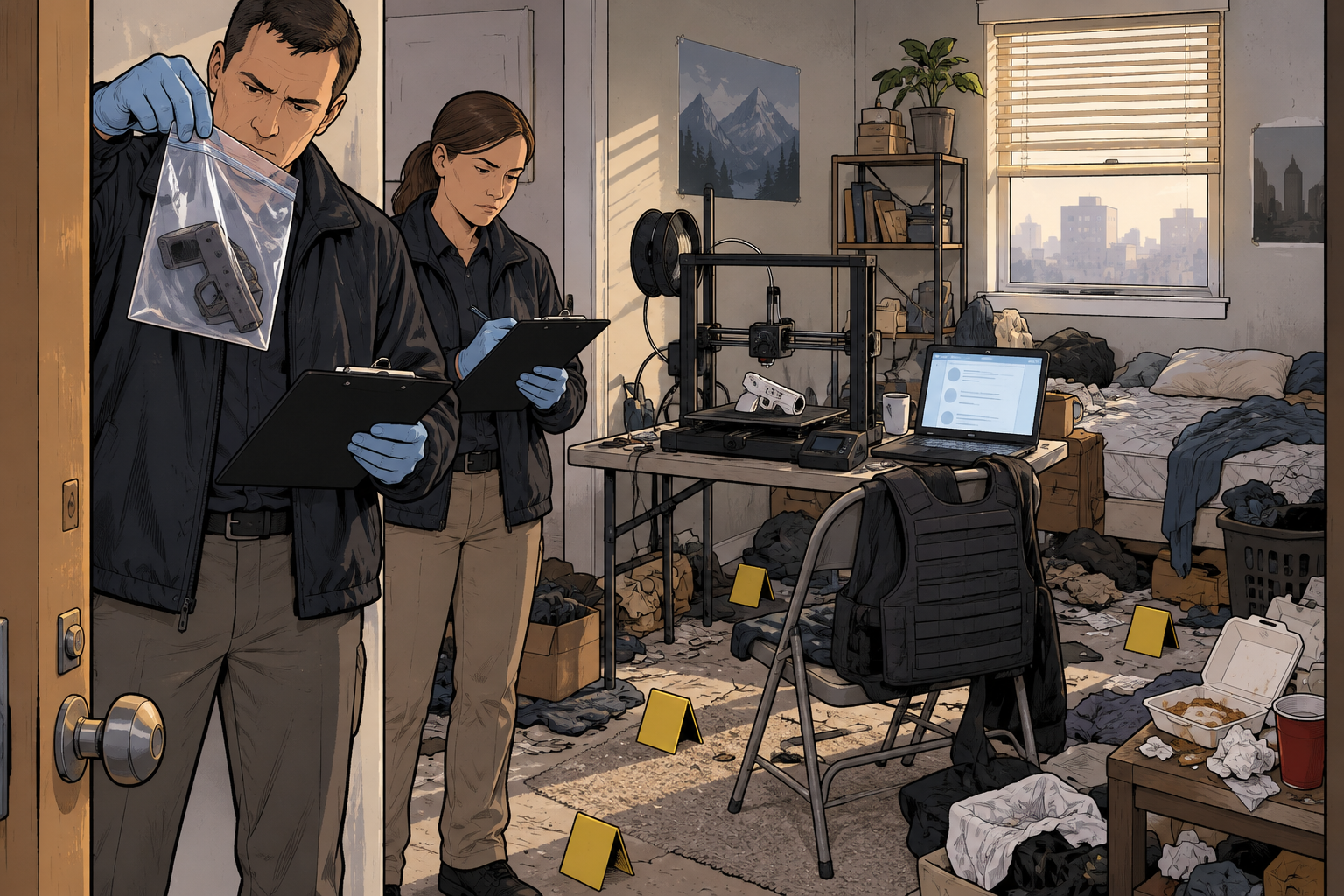
On a day in March 2026, Jose Angel Aguilar, 22, a convicted juvenile murderer who had been transferred from DJJ custody to county supervision under the SB 823 realignment, cut his GPS ankle monitor and walked away from his placement. He was at large for two days. The Anaheim Police Department SWAT team located and recaptured him 48 hours after the monitor went dark.
The Aguilar case illustrates the operational reality behind the policy architecture. GPS monitoring is the primary supervision tool for violent juvenile offenders placed in community settings rather than secure facilities. When it fails — by design, as in deliberate tampering, or by neglect — there is no automatic secondary response mechanism. Probation officers stretched thin across large caseloads don’t have immediate visibility into every tampered monitor. Orange County Supervisor Don Wagner publicly called the situation “a bad idea” and questioned why offenders dangerous to the community were being placed in settings where GPS monitoring was the only check.
The Aguilar incident was not reported to the California Department of Justice as a realignment failure requiring policy review. OYCR has no mandatory incident-reporting system for GPS monitor failures. Counties are not required to track, aggregate, or report to the state how many supervised violent offenders have tampered with or cut monitoring devices. The state’s $490 million investment in the system comes with no data requirement on the metric most directly relevant to public safety.
No statewide incident database: Counties are not required to report GPS monitor failures, tampering incidents, or escapes from supervised community placements to OYCR or CDCR.
No mandatory secondary protocol: When a monitor goes dark, county probation departments set their own response protocols. There is no state-mandated response timeline for violent offender monitor failures.
No placement audit trigger: A monitor failure does not automatically trigger a review of whether the offender should have been in community placement in the first place.
Source: Davis Vanguard, March 2026; Pacific Research Institute policy analysis.
In 2020, when SB 823 came to a floor vote, the Republican legislative minority was unified in opposition. Their specific objections — documented in committee testimony and floor debate — centered on three points that have since proven prescient: counties did not have the infrastructure to house the most violent offenders; the OYCR structure gave the state no enforcement mechanism; and the populations being realigned were qualitatively different from earlier realignment cohorts because they included the highest-severity cases.
Assemblymember James Gallagher (R-East Nicolaus), after the Aguilar incident and the State Auditor’s findings became public, introduced AB 1968, which would add conspiracy to commit murder to the list of offenses that allow a minor to be tried as an adult in California. Gallagher called the Democratic majority’s continued resistance to adult-court transfer for the most violent offenders “tone-deaf” in light of the post-closure evidence.
Sen. Skinner’s earlier bill, SB 1391 (2018), had already removed the ability to try 14- and 15-year-olds as adults for any offense under California law — regardless of the severity of the crime. A 14-year-old who commits a premeditated murder in California now remains in the juvenile system by default. After the DJJ closure, “remains in the juvenile system” means county supervision, which in many cases means community placement with a GPS monitor.
California’s juvenile justice realignment does not exist in isolation. The Marshall Project documented in February 2026 that New York has pursued a parallel path: the state closed its remaining youth prisons and devolved the population to county supervision systems that are similarly under-resourced and similarly exempt from meaningful state oversight. The pattern — close state facilities, block-grant the counties, create a toothless oversight body, call it reform — has appeared in multiple Democratic-governed states as the policy consensus in progressive criminal justice circles since 2020.
President Donald Trump addressed the issue directly on Truth Social on August 11, 2025, calling for a “Comprehensive Crime Bill” targeting repeat offenders and citing California specifically as the leading case study in what he characterized as Democrats’ deliberate choice to deprioritize public safety.
We need a Comprehensive Crime Bill — and we need it now. California is the model of what NOT to do. They closed their juvenile prisons, handed the money to counties with zero accountability, and now convicted murderers are cutting their ankle monitors and walking free for days before anyone notices. Democrats don't have a crime problem, they HAVE THE CRIME. Get tough on repeat offenders!
Paraphrased commentary · not a verbatim post
Paraphrase of Aug. 11, 2025 Truth Social post calling for Comprehensive Crime Bill and citing California as a soft-on-crime case study.
Governor Newsom announced he would end juvenile imprisonment as we know it. He did. What replaced it is a $490 million-per-year block grant system with no minimum service standards, no enforcement authority, and no statewide incident tracking — administered by an oversight body that can write reports but cannot pull a grant, clawback funds, or compel a county to place a convicted murderer somewhere with a locked door. Los Angeles County received $88 million and spent $9.7 million on actual services. San Francisco spent $543,000 per child. A convicted juvenile murderer cut his GPS monitor in Anaheim and was free for two days. Republicans warned about all of this in 2020. The Democratic supermajority passed the bill without them. The auditor found what they said would happen. The oversight body still has no power to change it.