The Big 12 Sold Its Name for $20 Million a Year. Bargain or Blunder?
- $20Mannual deal valueMonster Energy's payment to become the Big 12's football and basketball “entitlement partner” — Front Office Sports, July 8, 2026
- $1M–$1.25Mper school, per yearFront Office Sports put it near $1 million; a straight even split across 16 members works out to $1.25 million — the conference hasn't clarified which
- $710MBig 12's 2026 revenueprojected total conference revenue, up roughly $100 million year over year and a conference record — per On3
- $72.4MSEC's per-school averagethe SEC distributed roughly $1.16 billion across 16 members in FY2024–25 — nearly double the Big 12's full-share average
- 182%sponsorship revenue growth“Sponsorship revenue this year was up 182%,” Commissioner Brett Yormark said at Big 12 Media Days, July 7, 2026
- $4.5MWyoming's own patch dealone Mountain West program's five-year jersey-patch deal with Tallgrass — nearly matching what an entire Power 4 conference just got, per school, from Monster
- 16member schools coveredevery Big 12 football and men's/women's basketball program now wears the co-branded Monster patch, per the conference's own release
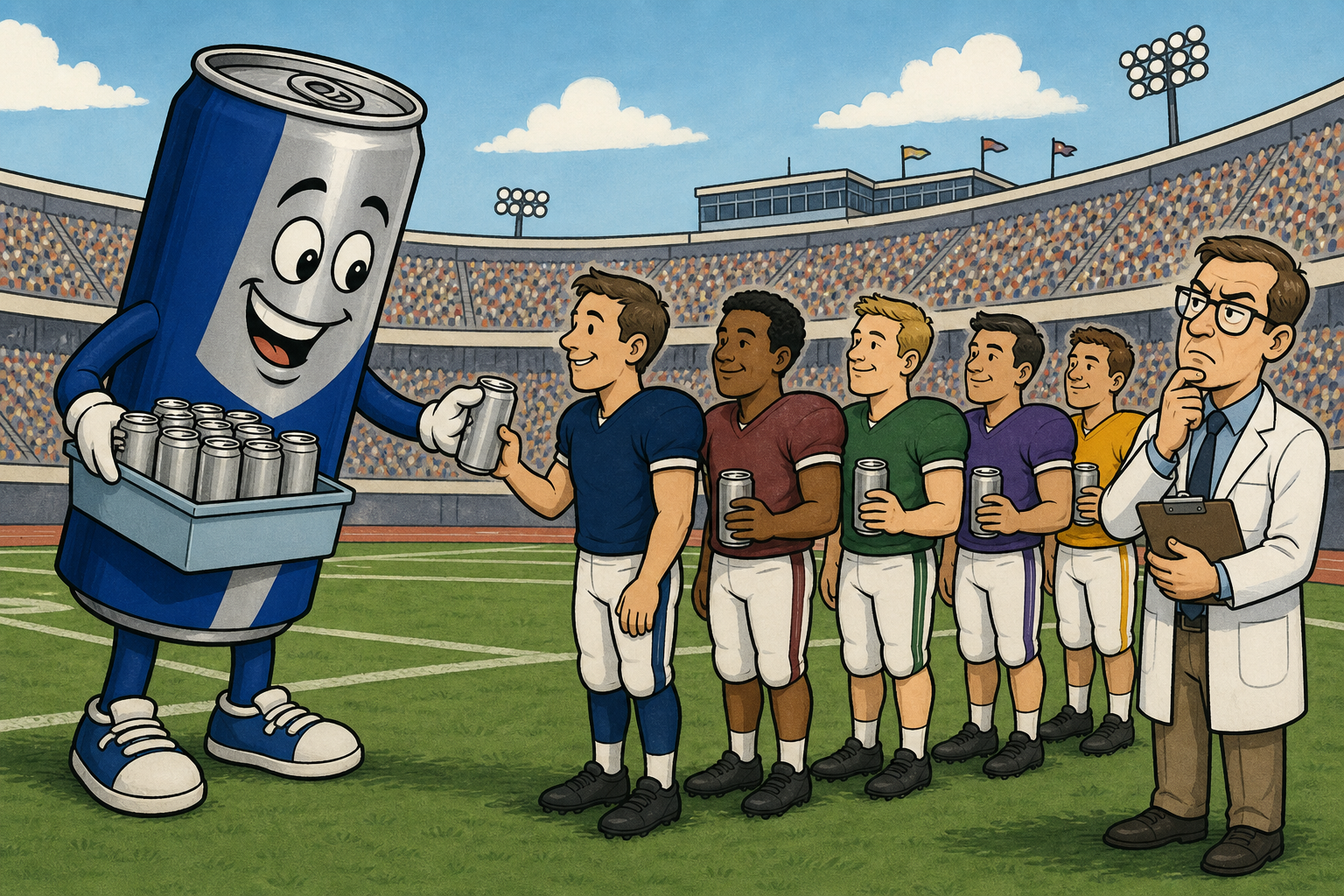
On July 7, 2026, at Big 12 Media Days in Frisco, Texas, Commissioner Brett Yormark announced a multiyear “entitlement partnership” with Monster Energy — the first conference-wide jersey-patch deal in college sports history. For the length of the agreement, Big 12 football and basketball are officially renamed “Monster Energy Big 12 Football” and “Monster Energy Big 12 Basketball” during the regular season. Every jersey across the conference's 16 member schools carries a co-branded patch. Every field and court carries a co-branded logo. Front Office Sports first reported the price: $20,000,000 a year.
Divided across 16 schools, that works out to roughly $1 million per program annually — though some outlets, dividing evenly, calculated closer to $1.25 million, an ambiguity the conference hasn't clarified publicly and one that hints at how the money is actually structured: part of the $20 million funds Monster's own installation and conversion costs, not a direct payout to schools. Either way, reaction inside college sports business circles split immediately. One camp called it smart, low-friction revenue for a conference that has openly admitted it can't out-earn the Big Ten and SEC on media rights. The other called it a fire sale of the conference's entire brand identity for less than a single flagship program could command on its own.
The numbers underneath both arguments are worth walking through — because they say more about the state of the Big 12's finances than about Monster Energy.
The agreement, per the Big 12's own release, makes Monster Energy the “Entitlement Partner” of Big 12 football and men's and women's basketball regular seasons — a step beyond ordinary sponsorship. It builds on a smaller deal from fall 2025, when Monster became the conference's official energy drink. Yormark called it “an important partnership for the Big 12 as we continue to grow our commercial business,” adding that Monster is “a global, culturally relevant brand that aligns with who we are and where we're going.” Mitch Covington, Monster Energy's Chief Partnerships Officer, said the deal continues the company's “tradition of aligning with great sports teams and organizations committed to excellence.”
The mechanics: co-branded Big 12/Monster patches on every football and basketball jersey; co-branded logos on every field and basketball court; and marketing exposure across Monster's distribution footprint, which the company sells in roughly 159 countries. Monster has also committed to spending “dollar for dollar” on its own domestic and international advertising touting the conference — in effect, a second revenue stream in the form of free marketing exposure, separate from the $20 million cash figure. Monster, not the conference or its schools, covers the cost of physically installing the new logos on courts and fields.
Brett Yormark announces that the Big 12 and Monster Energy have entered a multi-year partnership. Big 12 football will be branded the 'Monster Energy Big 12 Football.' Same for men's and women's basketball as well. Monster will have conference sponsorship patches on team jerseys.

The most pointed criticism isn't about the $20 million total — it's about what that figure buys compared to what individual schools, even mid-major ones, are commanding on their own. An unnamed industry source told Front Office Sports the deal was “objectively a terrible deal,” arguing Big 12 schools were worth substantially more than roughly $1 million apiece. Craig Sloan, CEO of the sports-marketing firm Playfly, was more measured but pointed in the same direction: “There is no scenario where a deal like this doesn't have some impact on an individual school's asset rights.”
The peer-deal record backs that argument up. Per Extra Points' running tally of college jersey-patch deals, Wyoming — a single Mountain West Conference program — signed a $4,500,000, five-year deal with Tallgrass for football and basketball patches, or roughly $900,000 a year. That is nearly the entire per-school share the Big 12 just negotiated for its whole conference — 16 Power 4 programs, every sponsor-eligible sport, an entire regular-season rebrand — from one Group of Five school selling patch rights alone. New Mexico State signed a smaller, $1,050,000 three-year deal with Inn of the Mountain Gods covering six sports — a far smaller per-sport dollar figure than what the Big 12 just negotiated per school, but proof a single Group of Five program can sell its own patch rights without a conference deal at all.
Media critic Jason Barrett, publisher of Barrett Media, made the sharpest version of the case, arguing the conference's per-game math undersells its own audience: dividing the $20 million across a full season of football and basketball games, he calculated the deal pays each school roughly $15,000 a game to rename an entire conference. He compared it to MLB fans rejecting “Crunch and Munch” as a replacement for “Cracker Jack” — a reminder that culturally established brand names carry value that a one-time sponsorship check doesn't fully capture. His verdict: the Big 12 “sold its soul for peanuts.”
Big 12 / Monster Energy (conference-wide): $20,000,000/yr, 16 schools, football + men's/women's basketball, entire regular-season naming rights — roughly $1M–$1.25M per school
Wyoming / Tallgrass (one Mountain West school): $4,500,000 over 5 years, football + basketball patches only — roughly $900K/yr
New Mexico State / Inn of the Mountain Gods (one school): $1,050,000 over 3 years, six sports — roughly $350K/yr
Kansas / Ripple (one Big 12 school, separate from the conference deal): undisclosed dollar figure, described by Sports Business Journal as “one of the most lucrative” college patch deals ever signed
The context that makes $20 million look reasonable rather than reckless is the Big 12's standing relative to the two conferences it can no longer catch on media rights alone. The Big Ten distributed a record $1,370,000,000 to its 18 members for the fiscal year ending June 2025 — full-share schools like Ohio State took home as much as $91.55 million. The SEC distributed roughly $1,158,400,000 across 16 members, averaging $72,400,000 per school. Sports-business analytics firm Navigate projects the Big Ten and SEC will finish $40–50 million per school clear of the rest of the Power Four by 2026.
The Big 12, by contrast, is projecting $710,000,000 in total conference revenue for 2026 — a record, up roughly $100 million year over year, per On3 — but still well short of the Big Ten and SEC on a per-school basis. Yormark has been candid about the gap, describing the Big 12 as a “mature startup” and framing the realignment era the conference is living through as “a necessary reset” rather than a retreat. “In 10 years, I think we look back at this period as a positive moment in collegiate athletics history,” he told reporters at Media Days.
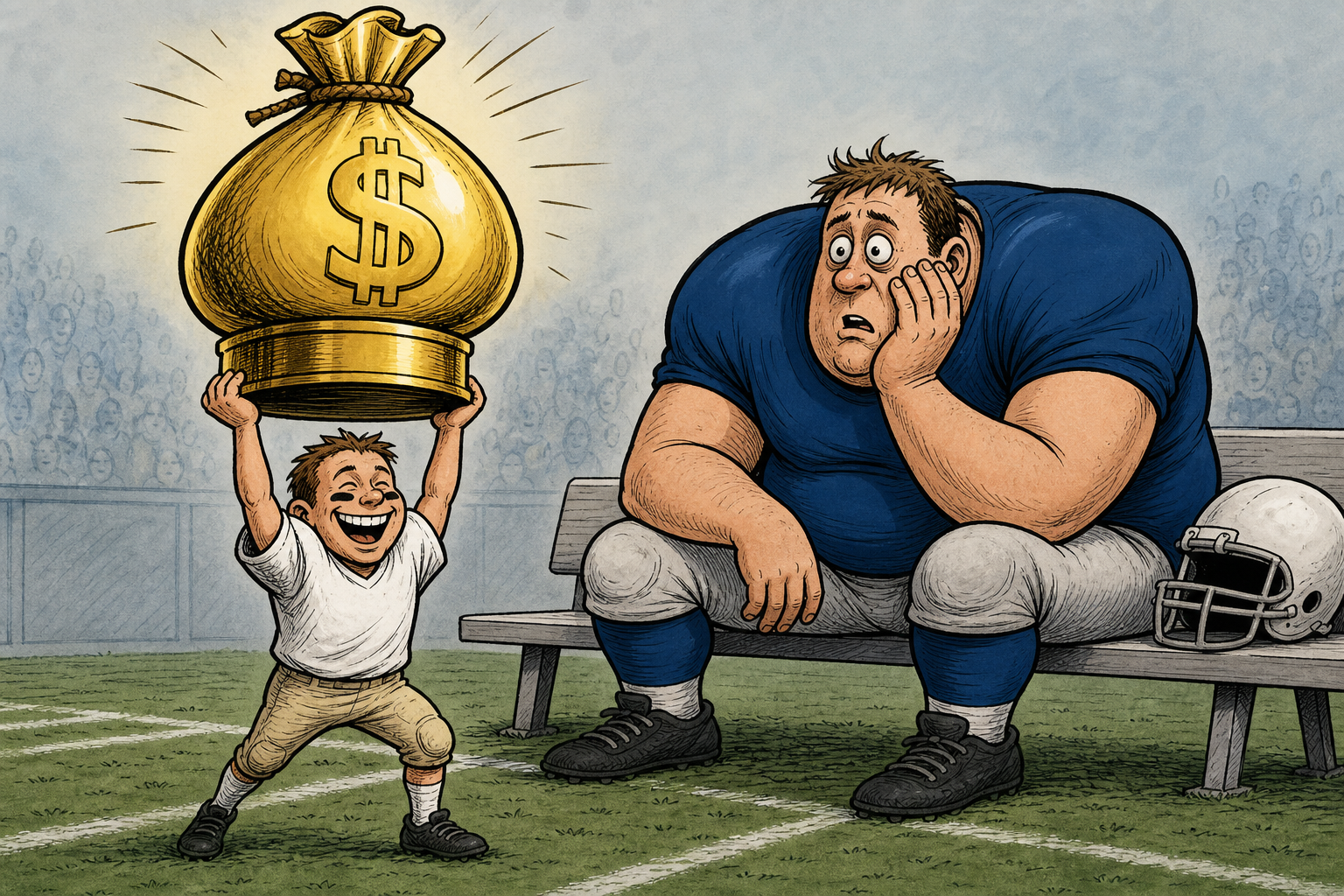
That framing explains the strategy behind the Monster deal: rather than compete for media rights it can't win, the Big 12 is stacking secondary revenue lanes — sponsorship, streaming, and outside capital — on top of its television contract. “Sponsorship revenue this year was up 182%,” Yormark said at Media Days, citing the Monster deal alongside newer arrangements with TuneIn Radio and Microsoft and a forthcoming FAST (free ad-supported streaming television) channel. Seen against that backdrop, $20 million in new, low-effort sponsorship money — with Monster covering installation costs and matching the conference's own marketing spend — reads less like a conference giving away its identity and more like one program in a broader push to diversify revenue it can't otherwise generate.
College basketball analyst Aaron Torres pushed back hardest against the “sold its soul” framing, arguing much of the criticism misreads how the deal works. The Monster agreement is a conference-level co-branding arrangement — it does not preclude individual schools from separately selling their own jersey-patch rights on top of it. Sports attorney Mit Winter, who tracks NCAA commercial-rights law, called the structure “a creative way to avoid MMR right issues” — a reference to the multimedia-rights contracts (with Learfield, ESPN, and similar partners) that already govern how individual schools sell their own sponsorship inventory. A conference-wide umbrella deal sidesteps renegotiating those contracts school by school.
The proof arrived almost immediately. Kansas Athletics announced its own five-year jersey-patch partnership with Ripple, the digital-payments company behind the XRP cryptocurrency, on July 8, 2026— one day after the Monster announcement. The deal, tied in part to Ripple CEO Brad Garlinghouse's Kansas roots, stacks an XRP patch alongside the conference's Monster patch on every Kansas uniform. Neither school nor Ripple has disclosed the dollar figure, but Sports Business Journal's Ben Portnoy described it as one of the most lucrative patch-placement deals in the history of U.S. college sports — exactly the kind of individually negotiated payday critics of the Monster deal say the conference's collective approach leaves on the table for schools willing to go it alone.
Innovative deal from the Big 12. Member school football and men's & women's basketball team jerseys will feature co-branded Big12/Monster Energy patches. Will also be co-branded field/court logos. Schools can still sell their own jersey patches. Creative way to avoid MMR right issues.
“There is no scenario where a deal like this doesn't have some impact on an individual school's asset rights.”
Craig Sloan, CEO, Playfly Sports — via Front Office Sports, July 8, 2026
The honest read sits between the two camps. Twenty million dollars is real, incremental money that costs the conference almost nothing to activate — Monster pays the installation bill and matches the marketing spend — and it doesn't stop a school like Kansas from monetizing its own brand separately, which is precisely what happened within 24 hours. But the per-school math, $1 million to $1.25 million a year for a logo on every jersey, court, and field, and the sport's own name changed for six months a year, looks thin next to what individual Power 4 programs are proving they can command alone. The Big 12 isn't wrong that it needs new revenue lanes to close a gap the Big Ten and SEC have already turned into a chasm. Whether Monster Energy paid the right price for this particular lane is the argument that will keep running every time a broadcast graphic reads “Monster Energy Big 12 Football.”