Hold the Championships Hostage:
The Plan to Turn the NCAA Into a Redistricting Weapon.
It is not every day that a lawyer actively suing the NCAA publishes a plan for Congress to squeeze his own courtroom opponent. But that ran in Sportico on the morning of July 12: an opinion piece urging Democrats to block the Senate’s college-sports bill — the NCAA’s top legislative priority — until the association pulls championships out of eight states that erased or gutted majority-Black congressional districts. Its author, Paul McDonald, is co-counsel for the athlete plaintiffs in Johnson v. NCAA, an active federal case against the NCAA — a professional stake this page discloses up front.
The lever is the Protect College Sports Act — the NIL and antitrust framework the NCAA has chased for years, which cleared the Senate Commerce Committee 19–9 in June and is targeted for a floor vote before the August recess. It cannot reach sixty votes without Democrats. McDonald’s advice: don’t supply them until the NCAA pays a price.
The proposal rides on a year of Republican-led mid-decade redistricting across six states, a Supreme Court ruling that reshaped the Voting Rights Act, a unanimous 54-member Congressional Black Caucus ultimatum, and an NAACP boycott campaign aimed at Southern college sports — all met, so far, by silence: the NCAA, the SEC, and the ACC had not publicly responded as of July 12, 2026, per coverage reviewed.
- 8 states — on the NAACP's “Out of Bounds” priority list — Tennessee, Louisiana, Alabama, Florida, Mississippi, South Carolina, Texas, Georgia · Source: NAACP campaign page
- 54 members — of the Congressional Black Caucus, unanimous in opposing the college-sports bills over the redistricting wave · Source: NPR
- 19–9 — the Senate Commerce Committee vote reporting the Protect College Sports Act to the floor, June 18, 2026 · Source: Senate Commerce Committee
- ~$250M — the estimated value of the 133 championship bids North Carolina stood to lose when the NCAA pulled events over HB2 in 2016 — the precedent McDonald invokes · Source: NCAA; contemporaneous coverage
- 2 months — of documented NCAA, SEC, and ACC public silence since the CBC's May letter, as of July 12, 2026, per coverage reviewed · Source: ESPN; The Hill
Start with who is asking. Paul McDonald is not a columnist. He is co-counsel for the athlete plaintiffs in Johnson v. NCAA, an active federal suit seeking employee status and pay for college athletes — with the NCAA as defendant. One of his five demands is that the NCAA “atone” for an argument its own lawyers deployed against his clients: comparing unpaid college athletes to prisoners performing forced labor. When the man proposing a pressure campaign is suing the very organization it targets, that is part of the story, and this page treats it as such.
The demands are specific. Before Democrats advance the Protect College Sports Act, McDonald argues, the NCAA should ban championships in states that eliminated majority-Black districts, on the model of its 2016 North Carolina pullout; atone for the prison-labor comparison; subsidize HBCU athletics; invest in Black communities; and expand Black hiring in coaching and administration. The target list comes from the NAACP’s “Out of Bounds” campaign: Tennessee, Louisiana, Alabama, Florida, Mississippi, South Carolina, Texas, and Georgia — eight states per the NAACP’s own page, though an Associated Press report counted seven; this page cites the NAACP primary.
“It is past time to play hardball.”
Paul McDonald, co-counsel for the Johnson v. NCAA plaintiffs, writing in Sportico, July 12, 2026

The record begins at the Supreme Court. On April 29, 2026, the Court decided Louisiana v. Callais 6–3, Justice Samuel Alito writing, holding Louisiana’s second majority-Black district an unconstitutional racial gerrymander — and reworking the decades-old Gingles framework for Voting Rights Act Section 2 claims. Plaintiffs must now produce alternative maps satisfying all of a state’s declared objectives, partisan goals included, and show a “strong inference” of intentional race-based dilution. SCOTUSblog’s election-law analysts described the result as gutting Section 2 as a practical tool. The ruling took effect within weeks.
The map wave had already started before the ruling. In July 2025, President Donald Trump (R) publicly pressed Gov. Greg Abbott (R-TX) into a mid-decade redraw after a Justice Department letter flagged four Texas districts — the 9th, 18th, 29th, and 33rd — including seats held by Reps. Al Green, Sylvia Garcia, and Marc Veasey (all D-TX). The Texas House passed the map 88–52 on August 20, 2025; after a federal panel blocked it, the Supreme Court let it take effect on December 4 of that year. Missouri and North Carolina followed that fall. Then Callais opened the floodgates: Tennessee carved its lone majority-Black district three ways eight days after the decision, Florida reworked 21 of 28 districts, and Louisiana dissolved the seat the Court had just ruled on.
Big WIN for the Great State of Texas!!! Everything Passed, on our way to FIVE more Congressional seats and saving your Rights, your Freedoms, and your Country, itself. Texas never lets us down. Florida, Indiana, and others are looking to do the same thing. More seats equals less Crime, a great Economy, and a STRONG SECOND AMENDMENT. It means Happiness and Peace.
via Fox News / The Hill, August 20, 2025
Mirror of President Trump's Truth Social post celebrating the Texas House's passage of the new congressional map: a 'Big WIN for the Great State of Texas,' five more congressional seats on the way, and other states looking to do the same.
Texas — Gov. Greg Abbott (R-TX), pushed by President Trump (R). Passed Aug. 20, 2025, 88–52; targets districts held by Reps. Green, Garcia, and Veasey (all D). In effect since Dec. 4, 2025, by Supreme Court order.
Missouri — Gov. Mike Kehoe (R-MO). Sept. 12, 2025 special-session map guts Rep. Emanuel Cleaver’s (D-MO) Kansas City seat, from 62% to 41% Democratic. Upheld by the Missouri Supreme Court, March 24, 2026.
North Carolina — legislative leaders Phil Berger and Destin Hall (both R), Oct. 21–22, 2025; targets Rep. Don Davis’s (D-NC) NC-1 (48% to 44% Democratic). Gov. Josh Stein (D) has no veto over redistricting.
Tennessee — Gov. Bill Lee (R-TN). May 7, 2026 — eight days after Callais — the state’s lone majority-minority district, Memphis’s TN-9, held by Rep. Steve Cohen (D-TN), is carved three ways.
Louisiana — Gov. Jeff Landry (R-LA). May 29, 2026 map dissolves Rep. Cleo Fields’s (D-LA) LA-6 — the district Callais itself struck down.
Florida — Gov. Ron DeSantis (R-FL) signed HB 1-D on May 4, 2026, after an April special session: 21 of 28 districts reworked, Democratic seats potentially cut from 8 to 4. A Fair Districts lawsuit was filed the same day.
The aggregate is what gives the pressure campaign its charge. A CNN analysis published May 24, 2026 concluded the combined redraws could produce “the largest loss of Black political representation ever,” with six or more Congressional Black Caucus seats at risk before the midterms. In Memphis, the ground-level version is one district — with three new lines through it.
The leverage is real because the NCAA’s legislative agenda is already bleeding. The SCORE Act — H.R. 4312, the House NIL-and-antitrust framework that would also declare athletes non-employees — has been pulled from the House floor twice — December 2025 and May 2026 — without a vote. The second pullback came days after all 54 members of the Congressional Black Caucus announced unanimous opposition, tied by CBC chair Rep. Yvette Clarke (D-NY) to the NCAA’s redistricting silence and amplified by House Minority Leader Hakeem Jeffries (D-NY). The caucus put the condition in writing, in a letter to NCAA president Charlie Baker — himself a former Republican governor of Massachusetts — SEC commissioner Greg Sankey, and ACC commissioner Jim Phillips.
“Silence in the face of injustice is not neutrality — it is complicity.”
Congressional Black Caucus letter to NCAA, SEC, and ACC leadership, May 2026
The same week, the NAACP launched “Out of Bounds,” calling on Black athletes and families to boycott athletic programs in the eight listed states and demanding more than $100 million in commitments to HBCU sports and Black communities. NAACP president Derrick Johnson framed the campaign as a matter of who profits from whom.
“Black athletes should not be asked to generate wealth, prestige, and power for state institutions while those same states strip political power from Black communities.”
Derrick Johnson, NAACP President, May 2026
In the Senate, the pressure point is the Protect College Sports Act, S. 4668, sponsored by Sens. Ted Cruz (R-TX) and Maria Cantwell (D-WA) with Eric Schmitt (R-MO) and Chris Coons (D-DE). Nick Saban testified at its June 3 hearing; the Commerce Committee reported it 19–9 on June 18; leadership wants a floor vote before the August recess. Sixty votes means Democratic votes — the arithmetic McDonald’s argument sits on, and a pressure point Sens. Cory Booker (D-NJ) and Chris Murphy (D-CT) tested with a warning letter to the NCAA in 2025.
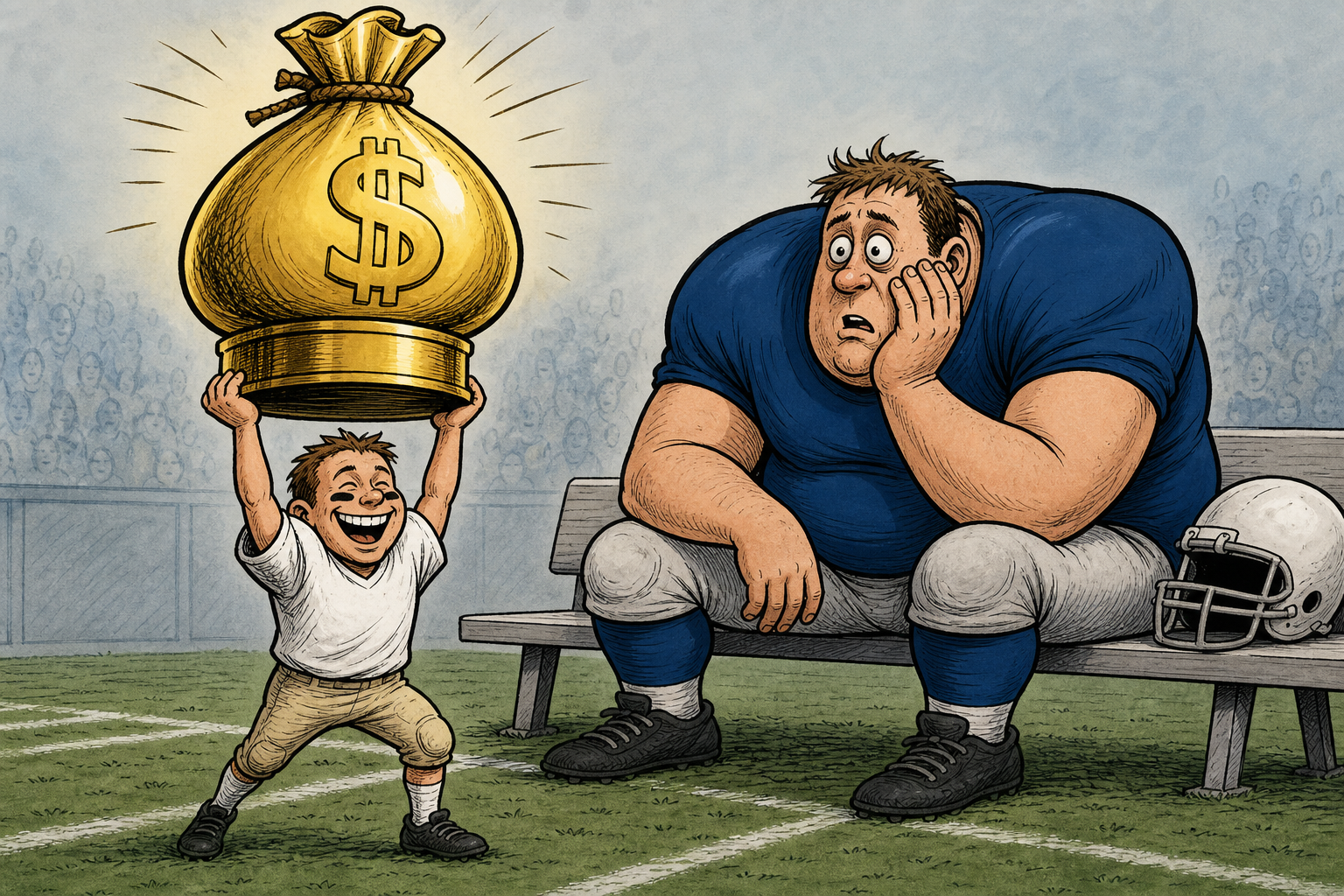
The playbook McDonald invokes has worked before — once. In September 2016, the NCAA pulled seven championship events out of North Carolina over HB2, the transgender bathroom law, and the state stood to lose 133 future championship bids worth an estimated $250 million. In March 2017, the legislature partially repealed HB2 through HB142, and the NCAA returned. Pressure applied; law changed. It is the boycott side’s strongest data point, and it is real.
The counter-precedent — not cited in the Sportico op-ed; this page adds it as context — is Major League Baseball moving the 2021 All-Star Game out of Atlanta over Georgia’s voting law, at an estimated $100 million cost to the Atlanta area. Georgia’s law did not change. Same tactic, same region, opposite result — and the difference matters, because a 2026 championship ban across eight states looks more like the Atlanta gamble than the North Carolina one: these legislatures redrew their maps at the White House’s urging, with the Supreme Court’s blessing, in an election year.
Meanwhile, the three men the CBC wrote to in May — Baker, Sankey, and Phillips — have said nothing. ESPN sought comment from all three organizations when the NAACP campaign launched and got none; none had publicly responded as of July 12, 2026, per the coverage reviewed for this page. That is two months of documented silence against a letter warning that silence “will not be interpreted as neutrality, but rather as a choice.”
The critics’ bench is not small, and its sharpest argument is about who pays. Reason argued the Congressional Black Caucus is holding an athlete-compensation framework hostage to a fight unrelated to college sports; the Washington Examiner made the same case from the right. OutKick was blunter: a boycott of SEC and ACC programs asks Black athletes — the majority of the revenue-sport labor force — to give up scholarships, NIL money, and exposure to punish legislatures that do not much care whether the games get played.
On The View, Alyssa Farah Griffin pressed the same objection against co-host Sunny Hostin’s defense of the campaign: the athletes being asked to sit out are the ones who only recently started getting paid at all. It is the hardest version of the critique precisely because it works inside the boycott’s own moral frame — the cost lands first on the people the campaign says it is defending.
What happens next is a calendar question. If the Protect College Sports Act gets its floor vote before the August recess and Democrats supply the votes, McDonald’s proposal dies quietly. If they withhold them, the NCAA’s antitrust shield stays hostage to a fight it never asked to join — and Baker, Sankey, and Phillips must decide whether two months of silence can survive a floor fight. Either way, the fact set is on the record: six states redrew, the Court cleared the road, 54 members signed the ultimatum, and the NCAA has not answered.
A lawyer suing the NCAA has published the manual for holding his opponent’s legislative priority hostage — and the machinery is already built: a 6–3 Supreme Court ruling, six redrawn states, a unanimous 54-member caucus, an NAACP boycott list, and a bill that cannot pass without Democrats. The precedents split down the middle: the NCAA’s 2016 pullout changed North Carolina law; MLB’s 2021 pullout changed nothing in Georgia. The one party yet to place a bet is the NCAA itself — two months silent against a letter that says silence is a choice.