
A Texas Judge Ruled a Self-Admitted Gambler Eligible. Now the Big Ten Wants to Boycott Texas Tech.
On Monday, June 8, 2026, a Texas judge did something that, a decade ago, would have been unthinkable: he overrode the NCAA. Lubbock County district judge Ken Curry granted Texas Tech quarterback Brendan Sorsby a temporary injunction barring the NCAA from enforcing its ineligibility ruling — a ruling the association had handed down after Sorsby admitted to wagering roughly $90,000 on sports over four years, including bets on his own team’s games.
The reaction was not measured. Within forty-eight hours, Georgia had barred its teams from playing Texas Tech, Nebraska’s athletic director told his staff not to schedule the Red Raiders, and the Big Ten — per ESPN’s Pete Thamel, citing three conference sources — was preparing to discuss a league-wide mandate against playing Texas Tech in any sport. An ACC commissioner called it a “horrendous pattern.” A Big 12 athletic director said college sports had “officially lost our soul.”
Strip away the outrage and what is left is a governance crisis years in the making. State courts are now routinely overriding NCAA eligibility rulings, the association’s enforcement authority is collapsing one injunction at a time, and the most powerful conferences are reaching for the only lever they have left — the schedule — to punish a school for winning in court. None of it is settled law. All of it reshapes the sport.
- ~$90,000 — total Sorsby admitted wagering on sports over four years across three schools, including 40 bets on Indiana football as a 2022 freshman · Source: ESPN, CBS Sports
- 2 games — the suspension the injunction left in place — Sorsby sits out Abilene Christian and Oregon State, then returns Sept. 18 vs. Houston · Source: ESPN, CBS Sports
- 3 conferences — the Big Ten weighing a league-wide ban; Big 12 ADs in 'serious' talks; individual schools (Georgia, Nebraska) already refusing to schedule Texas Tech · Source: On3, NBC Sports, Yahoo Sports
Brendan Sorsby’s path through college football is itself a portrait of the modern transfer era. A three-star recruit, he signed with Indiana, appeared in a single game as a true freshman in 2022, then transferred to Cincinnati in December 2023. He started two seasons for the Bearcats and was named a Davey O’Brien Award semifinalist after a strong 2025 start. In January 2026 he entered the portal again and landed at Texas Tech, expected to lead a team with national ambitions.
Then, on April 27, 2026, ESPN reported he was under NCAA investigation for sports gambling. The numbers Sorsby himself acknowledged are staggering: at least 2,900 bets totaling more than $30,000 during his two years at Indiana, at least 165 bets totaling at least $38,000 during his time at Cincinnati, and continued betting after he arrived at Texas Tech — roughly $90,000 in all. He admitted to 40 bets involving Indiana football while he was a freshman on the roster, and to routing more than $65,000 through friends to place wagers on his behalf. Betting on your own sport, and your own team, is among the few bright-line prohibitions the NCAA still enforces.

Sorsby sued in Lubbock County district court on May 18, asking a judge to block the NCAA from enforcing an expected ineligibility ruling — a preemptive filing common in eligibility-injunction cases. The NCAA formally denied his reinstatement request eight days later, on May 26, ruling him ineligible. His attorneys argued the NCAA had “weaponized his condition” — diagnosed gambling and anxiety disorders — “to shore up a facade of competitive integrity, while simultaneously profiting from the very gambling ecosystem it polices.”
On June 8, Judge Curry agreed Sorsby would suffer “probable, imminent and irreparable injury” without the chance to play in 2026, and enjoined the NCAA from barring him from practicing or competing. The injunction was not a clean win — Curry left a two-game suspension in place and required Sorsby to continue counseling and treatment — but the core penalty was gone. Sorsby will sit out Abilene Christian and Oregon State, then return for the Big 12 opener against Houston on September 18. The NCAA filed an accelerated appeal, but as ESPN noted, any final ruling could arrive after the season is already played.
“The NCAA has weaponized his condition to shore up a facade of competitive integrity, while simultaneously profiting from the very gambling ecosystem it polices.”
Brendan Sorsby's legal team, in the Lubbock County filing · per CBS Sports
The response from college sports’ leadership was close to unanimous, and unusually raw. ESPN’s Pete Thamel reported that Big Ten officials, citing three conference sources, were expected to discuss a league-wide mandate against scheduling Texas Tech in any sport. He also reported that Georgia had already forbidden its teams from playing the Red Raiders and that Nebraska athletic director Troy Dannen had told his staff not to schedule them. On3 reported Big 12 athletic directors were in “serious” talks about refusing to play Texas Tech in 2026 — an extraordinary prospect for a conference member.
The named reactions were blunt. ACC commissioner Jim Phillips called the ruling a “horrendous pattern” that is “eroding the integrity of our process.” TCU coach Sonny Dykes asked, “How is anyone ever going to trust the outcome of a game again?” Florida athletic director Scott Stricklin compared it to the 1919 Black Sox scandal and Pete Rose’s ban. A Big 12 athletic director, speaking anonymously, said the sport had “officially lost our soul.” Texas Tech, for its part, was unrepentant: AD Kirby Hocutt said the school did “not believe that the circumstances of Brendan’s case warranted permanent ineligibility,” and coach Joey McGuire said the program would “support his decision to seek professional help.”
REPORT: Big 12 athletic directors are having 'serious' conversations about whether to play Texas Tech in 2026 after Brendan Sorsby was ruled eligible by injunction. The Big Ten is weighing a league-wide mandate against scheduling the Red Raiders in any sport.

The Sorsby injunction did not come out of nowhere. It is the loudest entry in a years-long wave of athletes suing the NCAA over eligibility — and winning, at least at the preliminary-injunction stage. The wave traces to December 2024, when a federal judge granted Vanderbilt quarterback Diego Pavia an injunction letting him play in 2025 by challenging the NCAA’s rule counting junior-college seasons against eligibility. Rather than risk an adverse appellate ruling, the NCAA issued a blanket waiver covering every athlete in Pavia’s situation. A cascade followed: Mississippi quarterbacks Trinidad Chambliss and a group of redshirt-rule plaintiffs, JUCO transfers, and now a gambling case have all tested the courts.
What makes Sorsby different is the conduct at issue. Pavia and the JUCO plaintiffs were fighting bureaucratic eligibility-clock rules — technical limits with no moral weight. Sorsby was fighting a sanction for betting on games, including his own. If a state court will override that penalty, NCAA officials argue, then no rule is safe from a sympathetic judge and a well-funded plaintiff. As one power-conference official told CBS Sports, “What few teeth the NCAA had left are clearly gone.” Attorney Mit Winter noted the association is increasingly vulnerable not just to antitrust claims but to ordinary state-law contract arguments — a far broader exposure.
The athlete: Brendan Sorsby, Texas Tech QB (formerly Indiana and Cincinnati); admitted to ~$90,000 in sports bets over four years, including 40 on Indiana football and wagers routed through friends.
The penalty: The NCAA ruled him ineligible for 2026; denied reinstatement on May 26, 2026.
The ruling: On June 8, 2026, Lubbock County district judge Ken Curry granted a temporary injunction barring the NCAA from enforcing the ban, citing “probable, imminent and irreparable injury.” A two-game suspension and continued treatment remain in place.
The response: The Big Ten is discussing a league-wide mandate against playing Texas Tech; Big 12 ADs are in “serious” talks; Georgia and Nebraska have already refused to schedule the Red Raiders. The NCAA filed an accelerated appeal.
What’s at stake: Whether the NCAA can enforce any eligibility rule — including its bright-line gambling ban — against an athlete willing to go to court.
A scheduling boycott is an unusual weapon, and it cuts both ways. For the conferences, refusing to play Texas Tech is the only enforcement tool left once a court has neutralized the NCAA: if the association cannot punish a school for fielding an ineligible player, the schools can punish it themselves by denying it games, revenue, and a path to the playoff. That is the logic behind Georgia’s and Nebraska’s decisions and the Big Ten’s reported deliberations.
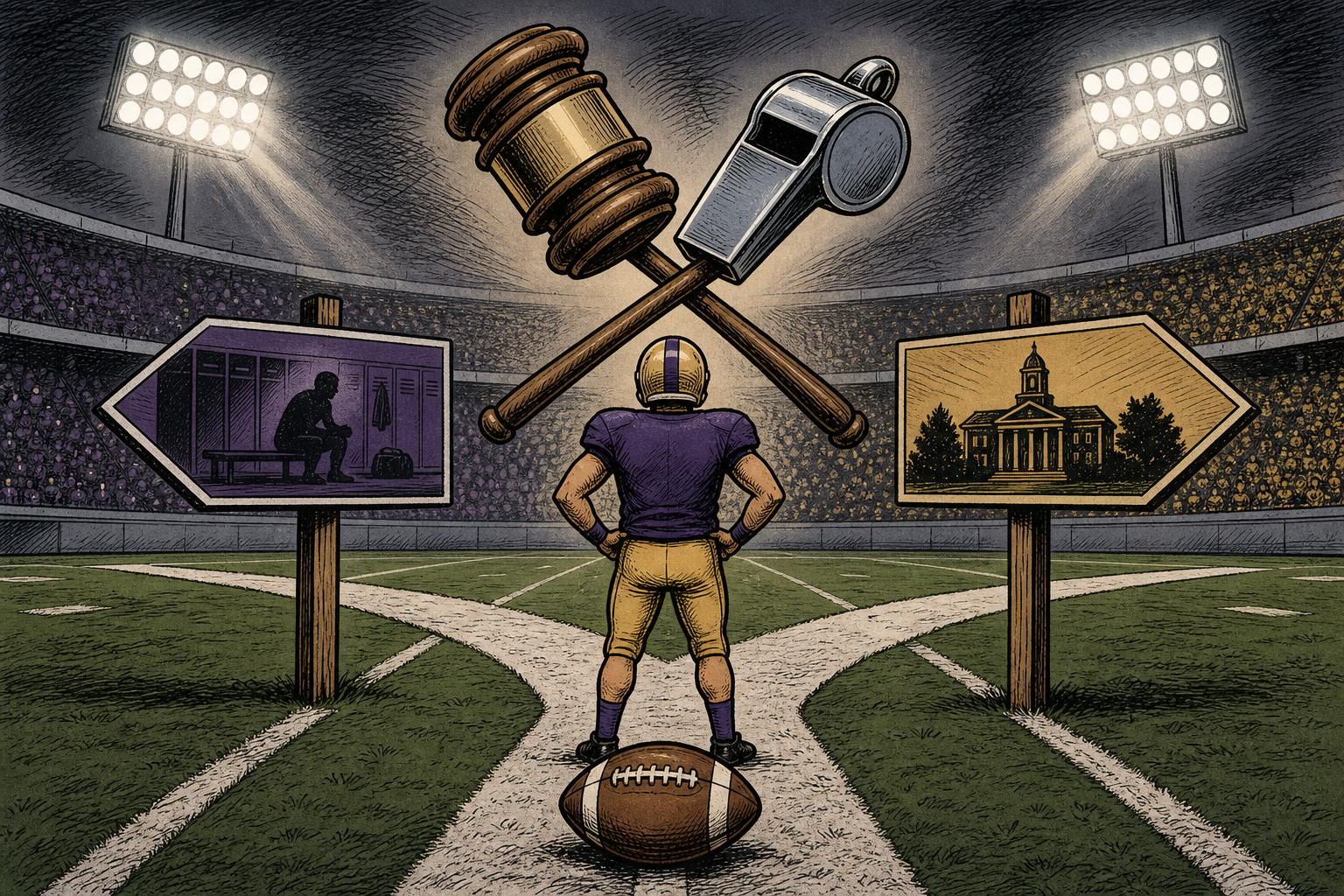
But the move carries its own risks. Texas Tech did not defy a rule — it complied with a court order. Punishing a member school for obeying a judge invites its own lawsuits, including potential antitrust claims about competitors colluding to freeze out a rival. A coordinated Big Ten or Big 12 ban could itself become the next case a court overturns. And it does nothing to fix the underlying problem: a governance structure whose rules evaporate the moment a player with good lawyers walks into a sympathetic courtroom. The boycott is a symptom of the NCAA’s weakness, not a cure for it.
If a state-court judge can wipe out a gambling suspension, what rule is left that the NCAA can actually enforce? The conferences boycotting Texas Tech are admitting the truth out loud: the rulebook now ends at the courthouse door.
Paraphrased commentary · not a verbatim post
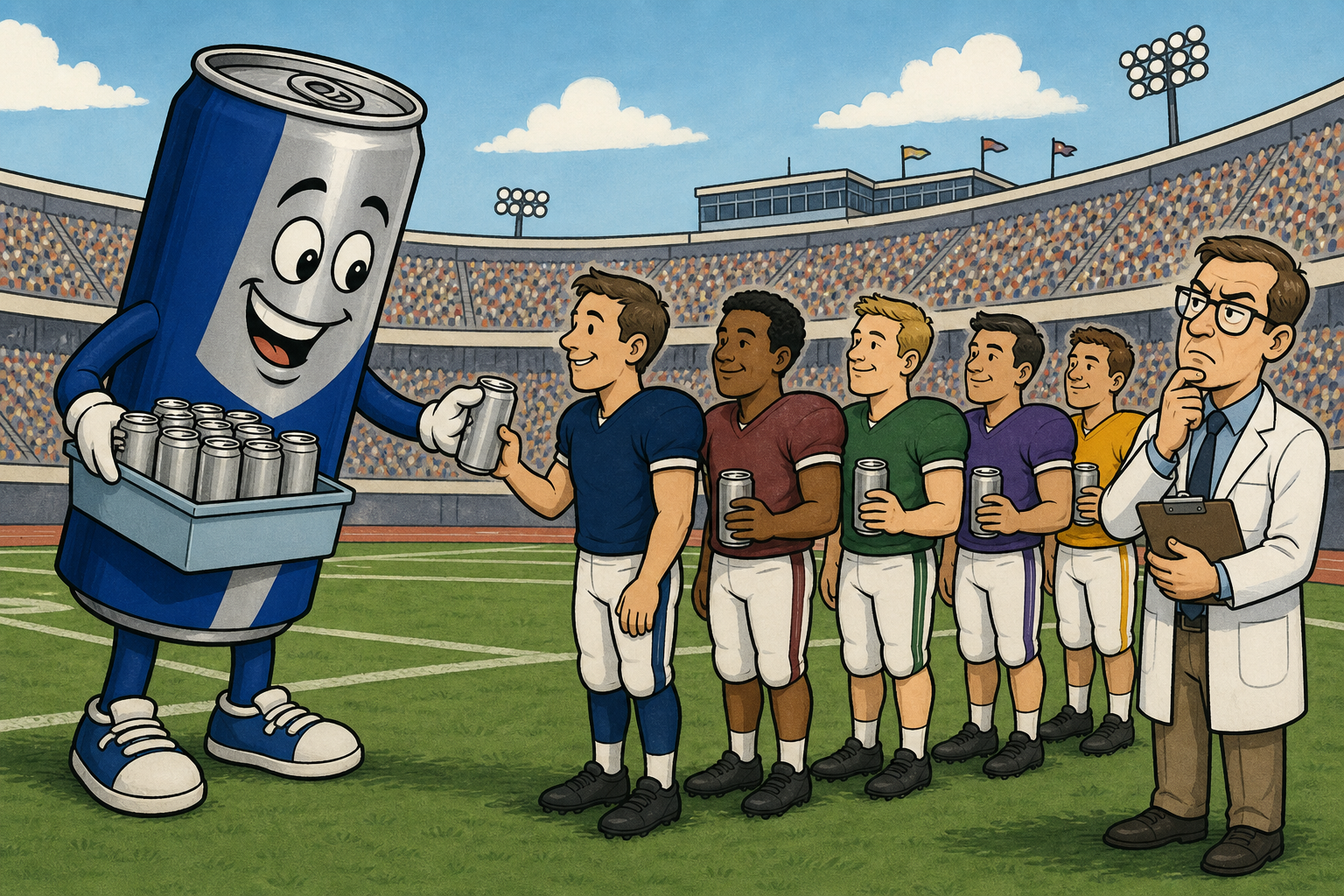
The immediate questions are procedural. The NCAA’s accelerated appeal will test whether a higher Texas court agrees that a gambling penalty can be enjoined — but the calendar favors Sorsby, since a final ruling may not land until after he has already taken the field in September. The Big Ten’s mandate discussion, if it becomes policy, would mark the first time a major conference formally refused to play a sitting member of another power league over an eligibility dispute. Both outcomes would set precedent the sport has never had to absorb before.
The larger question is structural, and it points back to Washington. Commissioners including the Big Ten’s Tony Petitti and the SEC’s Greg Sankey have spent the past two years lobbying Congress for a federal framework — antitrust protection and a uniform eligibility standard — precisely to stop state courts from rewriting the rulebook one injunction at a time. The Sorsby case is the clearest argument yet for why they want it, and the clearest evidence yet that, until they get it, the courts will keep deciding who is eligible to play.
Sources: Big Ten officials are expected to discuss a league-wide mandate against playing Texas Tech in any sport in the wake of the Brendan Sorsby eligibility ruling. Georgia and Nebraska have already moved to avoid scheduling the Red Raiders. The fallout is only beginning.
A judge said the punishment didn't fit the case, the player is in treatment, and he still sits out two games. Now rival leagues want to refuse to play us for following a court order? That's not protecting integrity — that's a grudge. Wreck 'em.
Paraphrased commentary · not a verbatim post
June 10, 2026: Within 48 hours of the injunction, the boycott stopped being talk. Nebraska athletic director Troy Dannen barred all future scheduling of Texas Tech in any sport — a deputy-AD memo posted by Yahoo Sports’ Ross Dellenger instructs staff: “we will not schedule any contests vs. Texas Tech in any sport.” Georgia’s athletic department put the same policy in writing: “Georgia Athletics will not schedule future contests against Texas Tech until further notice.” Georgia AD Josh Brooks went further: “True integrity means holding your program accountable when things go wrong, not buying custom legislation or running to a local courtroom to bypass the rules.” ESPN and Yahoo Sports report Big Ten ADs were set to meet with commissioner Tony Petitti on Wednesday, June 10, about a league-wide mandate — with the caveat that no Big Ten football team currently has Texas Tech on its schedule before Oregon’s 2033 game.
The Big 12 is moving on a formal track with real teeth. On Tuesday, June 9, every conference AD except Texas Tech’s Kirby Hocutt joined what ESPN’s Pete Thamel described as a “spirited” call with commissioner Brett Yormark, united that Sorsby should not play. Step two is a Thursday executive-board meeting chaired by Kansas chancellor Doug Girod; step three, a full board of presidents and chancellors early next week — a body with authority to discipline a member under Big 12 bylaw 3.6, which allows postseason bans, broadcast restrictions, revenue limits, and recruiting penalties. Kansas State AD Gene Taylor’s on-record summary of the mood, expletives redacted by every outlet that quoted him, needed no translation.
The legal clock still favors the quarterback. The NCAA filed its notice of appeal Monday night, sending the case to Texas’s Seventh District Court of Appeals in Amarillo on an “accelerated” track — but ESPN reports the full trial is docketed for February 2027, after Sorsby’s eligibility expires. His attorney Jeffrey Kessler called the injunction “a just result,” noting the two-game sit-down was the deal his side originally offered. NCAA president Charlie Baker took the fight to Congress: “only Congress can equip the @NCAA to apply this common sense rule.” One detail cutting against the institutional panic: sportsbooks have not moved Texas Tech’s numbers at all.
Big 12 ADs tell @YahooSports they've had 'serious' talks on not playing Texas Tech. One SEC AD says there should be conversations about not playing Tech 'in any sports.' The Brendan Sorsby ruling has left an industry jarred.
- 1.ESPN — 'Brendan Sorsby granted injunction vs. NCAA, eligible to play in 2026,' June 8, 2026
- 2.ESPN — 'Coaches, ADs "disgusted," "stunned" with Brendan Sorsby ruling,' June 2026
- 3.ESPN — 'What's next for Brendan Sorsby, Texas Tech and the NCAA?,' June 2026
- 4.CBS Sports — 'Texas Tech QB Brendan Sorsby just blew a hole in NCAA enforcement, a model that might be beyond repair,' June 2026
- 5.CBS Sports — 'Brendan Sorsby granted 2026 eligibility: Texas Tech QB wins injunction vs. NCAA amid gambling probe,' June 8, 2026
- 6.On3 — 'Brendan Sorsby ruling: Big 12 teams reportedly having "serious" talks about not playing Texas Tech in 2026,' June 2026
- 7.NBC Sports / ProFootballTalk — 'Big Ten to discuss a mandate to not play Texas Tech in any sport, given the Brendan Sorsby ruling,' June 2026
- 8.Yahoo Sports — 'Big Ten reportedly weighing league-wide scheduling ban on Texas Tech after Sorsby ruling,' June 2026
- 9.Yahoo Sports — 'Brendan Sorsby ruling: College sports' brass enraged by Texas judge's decision,' June 2026
- 10.Sportico — 'Brendan Sorsby Wins Court Injunction, Eligible for Texas Tech in 2026,' June 2026
- 11.247Sports — 'Texas Tech AD Kirby Hocutt issues statement on Brendan Sorsby,' June 2026
- 12.NFL.com — 'Brendan Sorsby gets injunction vs. NCAA, could play for Texas Tech after gambling ineligibility,' June 2026
- 13.Wikipedia — 'Brendan Sorsby' (Indiana → Cincinnati → Texas Tech eligibility timeline)
- 14.ESPN — 'NCAA denies reinstatement for QB Sorsby; Texas Tech to appeal,' May 26, 2026
- 15.Pavia v. NCAA, No. 24-6153 (6th Cir. 2025) — appellate opinion (eligibility-litigation precedent)
- 16.ESPN (Pete Thamel) — 'Big 12 ADs hold call to air grievances over Sorsby ruling' — the three-step discipline process, bylaw 3.6, Feb. 2027 trial date, June 9, 2026
- 17.CBS Sports — Georgia and Nebraska bar scheduling Texas Tech; Yormark, Brooks, Stricklin reactions, June 9, 2026
- 18.Yahoo Sports (Ross Dellenger) — 'College sports brass enraged by Texas judge's decision,' Nebraska memo, Kessler and Baker quotes, June 9, 2026
- 19.Front Office Sports — NCAA files notice of appeal; Big Ten and SEC schools call for Texas Tech boycott, June 9, 2026
Last updated June 10, 2026