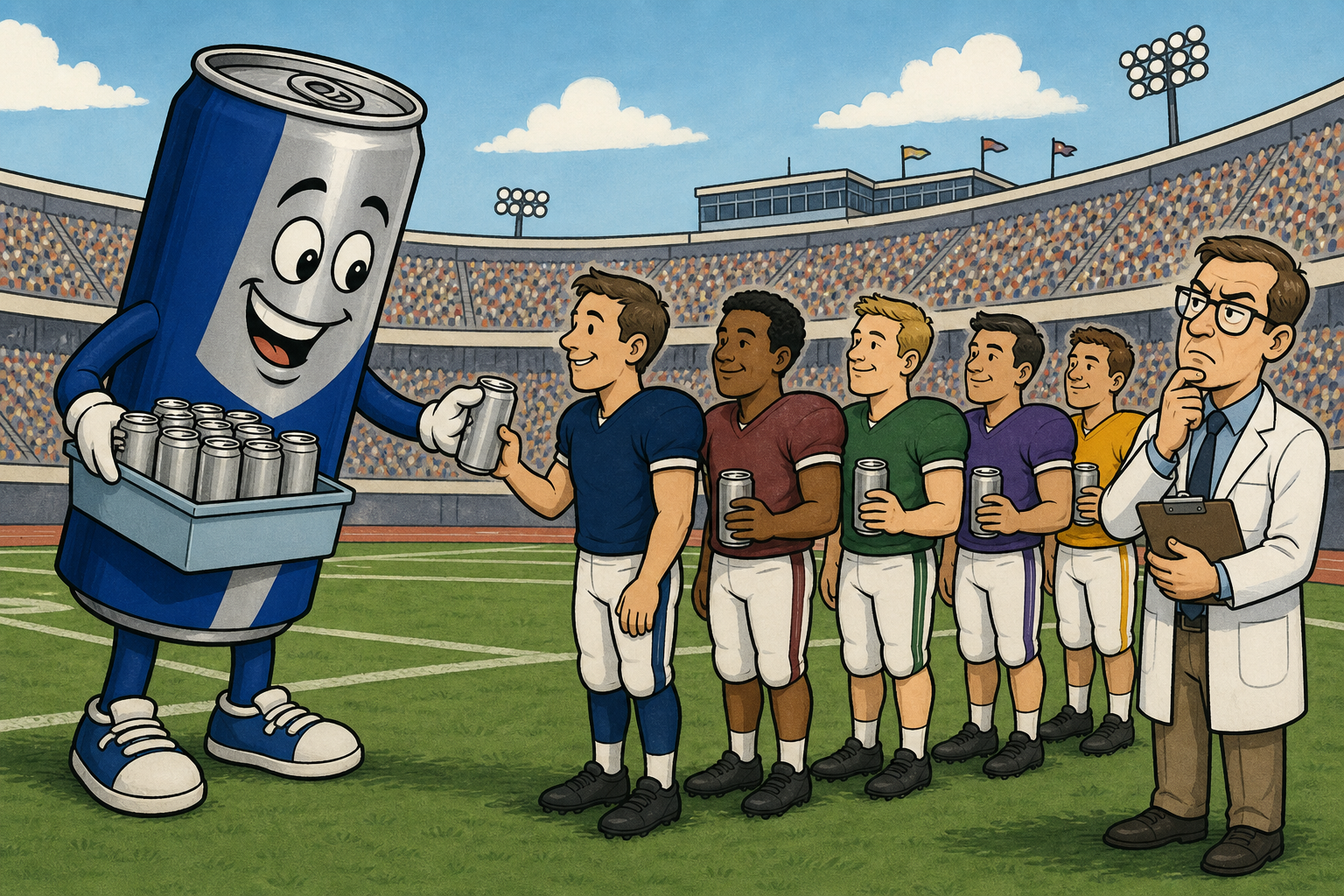
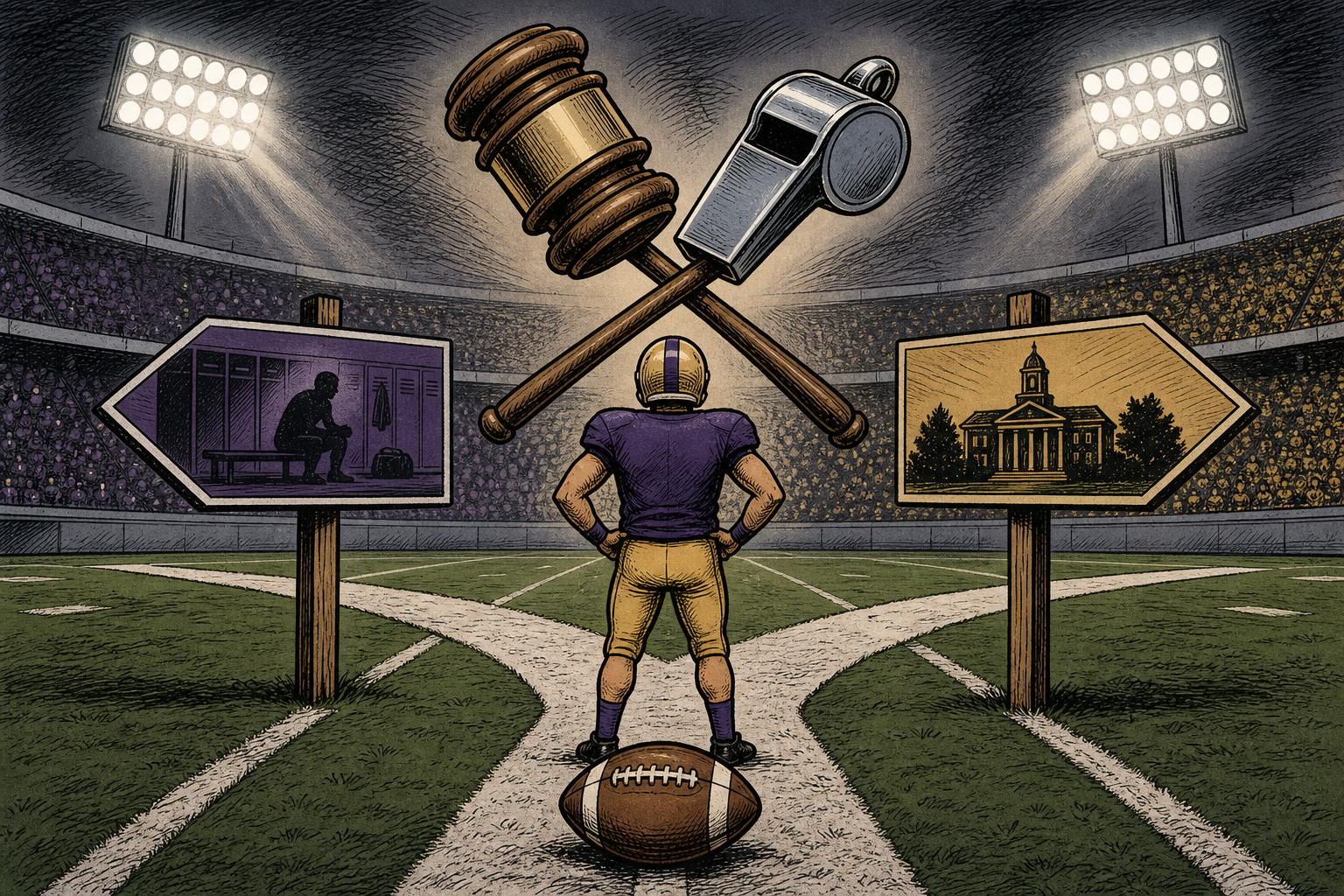
The NCAA Asked Washington to Suspend Betting on College Games.
Six Months Later, Washington Proposed Rules That Legalize It.
On January 14, 2026, NCAA President Charlie Baker sent a letter to newly installed CFTC Chairman Michael Selig, a Trump appointee and former crypto-industry lawyer. “I implore you to suspend collegiate sport prediction markets until a more robust system with appropriate safeguards is in place,” Baker wrote, targeting an estimated $320,000,000 in active college-sport betting-style contracts on platforms like Kalshi and Polymarket.
One day later, federal prosecutors unsealed an indictment charging 26 people in an alleged bribery and point-shaving scheme spanning 39 college basketball players at 17-plus schools. The timing was not a coincidence Baker needed to manufacture — it illustrated exactly the platform risk he was warning about. Six months on, the CFTC has not suspended anything. Instead, on June 10 it proposed a rule that would formally permit moneyline, spread, and total contracts on college games, banning only a narrow slice — bets on officiating calls, injuries, and rogue-participant conduct.
None of it sorts cleanly by party. A bipartisan, 41-state coalition of attorneys general led by a Republican wants the states in charge. Democratic-leaning courts in Massachusetts and New York have split on whether states even have that power. President Trump (R) has publicly defended the CFTC’s authority — while his own son sits on paid advisory boards at both platforms fighting to keep it.
- $320,000,000 — estimated active college-sport prediction-market volume Baker asked the CFTC to suspend · Source: NCAA / Yahoo Sports
- 26 people — charged in the point-shaving indictment unsealed one day after Baker's letter, according to the indictment · Source: DOJ, Eastern District of Pennsylvania
- 41 states — in the bipartisan attorney-general coalition, led by Ohio's Dave Yost (R), telling the CFTC this is gambling and belongs under state law · Source: Ohio Attorney General
- $22,000,000,000 — Kalshi's valuation in its May 2026 Series F, with sports roughly 80% of its trading volume · Source: CoinDesk
- 0 — college-sport prediction markets the CFTC has actually suspended as of publication, six months after Baker's letter · Source: Federal Register NPRM, comment period open through July 27, 2026
Baker's January 14 letter was not a vague plea. It asked Selig for age restrictions — prediction markets allow users as young as 18, versus a 21-and-over norm for sports betting — plus advertising limits, integrity monitoring built with the NCAA, a ban on player-specific prop contracts, and anti-harassment measures. The same day, at the NCAA Convention, Baker tied the ask to the association's eligibility fight: “Whether it’s transfer windows or prop bets, the answer cannot be the status quo.”

One day after the letter landed, federal prosecutors in the Eastern District of Pennsylvania unsealed an indictment charging 26 people in an alleged bribery and point-shaving scheme reaching 39 players across more than 17 schools, with alleged bribes of $10,000 to $30,000 per fixed game. The organizers named in the indictment are presumed innocent. Baker did not need the timing explained to reporters — the association issued a parallel statement the same day calling on remaining states to ban high-risk prop bets, and pointed regulators toward the same conclusion: a market moving fast enough to draw a federal fraud case is not a market with “appropriate safeguards” yet.
“I implore you to suspend collegiate sport prediction markets until a more robust system with appropriate safeguards is in place.”
Charlie Baker, NCAA President — letter to CFTC Chairman Michael Selig, Jan. 14, 2026
Baker's letter did not come out of nowhere. The NCAA had already objected, on October 30, 2025, to Kalshi branding contracts with unauthorized “outcome verified from NCAA” language. Then came the near miss that turned irritation into alarm: on December 17, 2025, Kalshi self-certified markets with the CFTC titled “Will [player] enter/withdraw from the transfer portal?” — letting traders bet on a college athlete's decision about his own future.
“The NCAA vehemently opposes college sports prediction markets,” Baker told ESPN. “Kalshi wants to offer bets on their transfer decisions and status — this is absolutely unacceptable and would place even greater pressure on student-athletes.” Kalshi backed off within hours, telling ESPN it “certifies markets all the time” it never lists. The episode became Baker's Exhibit A that self-regulation wasn't working — five days later, on December 22, Selig was sworn in as the man Baker would be writing to three weeks after that.
NCAA pushing for suspension of prediction markets like Kalshi, etc. Discussed in interview with Charlie Baker last week.
Baker did not let it drop. On March 20, 2026, amid record March Madness wagering and the fallout from the point-shaving indictment, he sent Selig a second letter — four pages, 12 numbered points, including a demand for geolocation tracking of bettors and mandatory integrity-monitoring standards matching licensed sportsbooks. The CFTC has not formally responded to either letter.
Selig's public posture has been about enforcement, not suspension. Testifying to the House Agriculture Committee on April 16, 2026, he pledged to police fraud on the exchanges his agency oversees: “To anyone who engages in fraud, manipulation, or insider trading in any of our markets: we will find you, and you will face the full force of the law.” In May, he told Axios that prediction markets and sports betting are “two separate things” — the position the NCAA has spent six months arguing against.

Senate Republicans pushed back directly. At the May 20, 2026 “No Sure Bets: Protecting Sports Integrity in America” hearing, chaired by Sen. Marsha Blackburn (R-TN), Sen. Ted Cruz (R-TX) said prediction markets have “started offering event contracts on sporting events, which for all intents and purposes are sports bets.” Blackburn called it the first of “several” planned hearings.
Three weeks later, the CFTC showed its actual hand. On June 10, 2026, the agency released a 267-page proposed rule — “Prediction Markets; Public Interest Determinations” — that would formally define which sports contracts are and are not permitted. The proposal would bar contracts tied to officiating decisions, player injuries, fights among participants, and youth sports. It would not bar the moneyline, spread, and total contracts on college and professional games that make up the overwhelming majority of current volume — precisely what Baker asked to have suspended. Critics were blunt about what that leaves standing.
“This is a remarkable attempt to redefine what constitutes sports betting. It makes a mockery of congressional intent while going against a bipartisan coalition of 41 Attorneys General.”
Bill Miller, President, American Gaming Association — response to the CFTC's June 10, 2026 rule proposal
The public comment period closes July 27, 2026, and the CFTC had drawn roughly 3,500 comments by mid-summer. As of publication, the rule remains a proposal — not final, and no college-sport prediction market has been suspended.
This fight does not sort along the usual lines. On April 30, 2026, a bipartisan coalition of 41 state attorneys general — led by Ohio AG Dave Yost (R) and joined by Democratic AGs from California, New York, and Massachusetts alike — told the CFTC that sports event contracts are gambling and belong under state, not federal, authority. “This is gambling, no matter how they try to dress it up,” Yost said, “and that means it belongs under state jurisdiction.”
State courts have split. On January 20, 2026, a Massachusetts judge granted AG Andrea Joy Campbell (D-MA) a preliminary injunction blocking Kalshi from taking sports wagers from state residents without a license — the first state to win one. New York went the other way: on July 7, 2026, Judge Analisa Torres denied Kalshi's bid to block state enforcement, ruling New York's law wasn't preempted by federal commodities law; Kalshi appealed to the Second Circuit the same day. Federal courts have sided with the platforms elsewhere, including a CFTC lawsuit against Wisconsin's own crackdown.
President Trump has taken the industry's side of the jurisdiction fight, even as his own family sits inside it. On May 26, 2026, he posted on Truth Social defending the CFTC's authority over the broader prediction-market category — not a college-sports-specific statement, but the clearest expression yet of where the White House stands on who regulates these platforms.
It is critically important that the CFTC's exclusive authority over Prediction Markets is maintained, and that they will thrive.
Posted amid the administration's lawsuits against several states restricting prediction-market access — a statement about the CFTC's broader authority over the category, not a comment on college sports specifically.
Donald Trump Jr. has been a paid strategic advisor to Kalshi since January 2025 and took an advisory role at rival Polymarket that August — giving the president's son financial ties to both platforms fighting the states his father is siding against. Sen. Elizabeth Warren (D-MA) and more than 40 colleagues raised related ethics and insider-trading concerns about CFTC oversight in a March 2026 letter to the agency and the Office of Government Ethics.
Six months after Baker's letter, nothing he asked for has happened. No suspension. No formal CFTC response to either letter. Kalshi's valuation climbed to $22,000,000,000 in a May 2026 funding round, with sports contracts making up roughly 80% of its trading volume; Polymarket has been in talks for a $15,000,000,000 valuation of its own, with sports around 39% of its volume. The market Baker wanted paused has instead gotten larger while Washington wrote its rulebook.
What happens next depends on a comment period, not a courtroom or a convention speech. If the CFTC's June proposal is finalized close to its current form, moneyline and spread contracts on college football and basketball games become explicitly sanctioned federal products — regulated as commodities, not as the state-licensed sports bets the 41 attorneys general say they actually are. Baker's January warning about a market moving faster than its safeguards reads, six months later, less like an overstatement and more like a preview.
Charlie Baker asked the CFTC to suspend college-sport prediction markets one day before a 26-defendant point-shaving indictment proved his point. Six months later, the agency's actual proposal would formally permit the moneyline and spread contracts he wanted paused, a bipartisan 41-state coalition says the whole category belongs under state law, and the president who backs federal control over the industry has a son drawing paychecks from both of its biggest platforms. The comment period closes July 27, 2026. Nothing has been suspended yet.