China Touts an Arctic Bypass for the Strait of Hormuz. Western Analysts Say: Not So Fast.
- ~20 Days the transit time for Sea Legend's new Ningbo-to-Europe Arctic route, roughly half the ~40 days a Suez Canal voyage takes — Lloyd's List; Maritime Executive
- 7 Vessels the number of Chinese ships Rosatom has permitted for 2026's Northern Sea Route season — the first year of genuinely regular, not experimental, service — gCaptain, Aug. 7, 2026
- 23 Ships total container-ship transits of the Northern Sea Route in 2025, up from 15 in 2024 — real but still modest growth — Breitbart; Fortune; Maritime Executive
- 100+ VLCCs the combined tanker fleet of China's COSCO and CMES that has stopped direct transits through Hormuz and Bab-el-Mandeb since late July 2026 — Breitbart (Middle East)
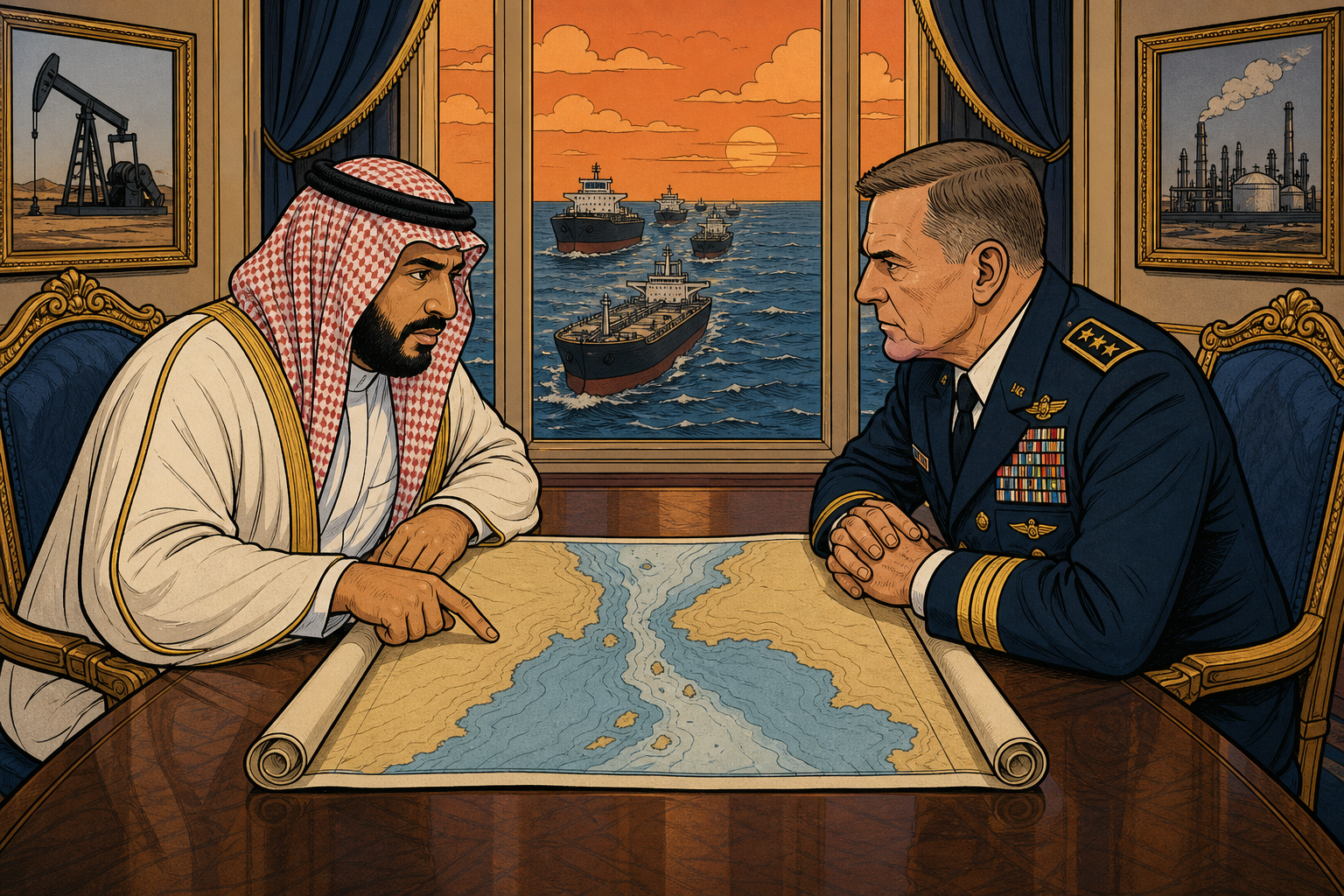
As Iran’s Strait of Hormuz blockade has rattled global energy markets through 2026, Chinese state media has been telling a different story: that China already has a way around it. On August 15, Sea Legend Line launched the first sailing of a new regular container service from Ningbo to Europe, via Russia’s Arctic waters, and state outlet Global Times touted “soaring demand” for the route.
“The Middle East crisis exposed the vulnerability of the Suez Canal and Strait of Hormuz to regional turmoil,” Sea Legend COO Li Xiaobin said, framing the Arctic launch as validated by the very disruption rattling traditional shipping lanes.
Independent analysts are considerably less convinced the comparison holds.
The facts on the water are real and independently verifiable. Sea Legend’s Dubai Tower departed Ningbo-Zhoushan on August 15, 2026, bound for Felixstowe, Rotterdam, Hamburg, and other European ports on roughly a 20-day transit — about half the time a Suez Canal voyage takes. Rosatom, Russia’s state Arctic operator, confirmed seven Chinese vessels permitted for weekly sailings through October, which it calls the first “fully-fledged regular service” after prior years of one-off trial voyages. Container traffic on the route grew from 15 ships in 2024 to 23 in 2025 — genuine growth, though still a small fraction of global shipping volume.
Separately, China’s two largest state tanker operators, COSCO and CMES — a combined fleet of more than 100 very large crude carriers — have stopped sailing directly through Hormuz and the Bab-el-Mandeb strait since late July, shifting instead to ship-to-ship transfers off Fujairah in the UAE. Both threads point the same direction: China is visibly diversifying away from Middle East chokepoints in 2026.

The gap between Beijing’s framing and outside analysis is stark. Asked directly whether the Northern Sea Route can substitute for Hormuz and Suez, RMIT’s Prof. Vinh Thai didn’t hedge.
“So can the northern sea route be used as a substitute for the Strait of Hormuz and the Suez Canal? The short answer is no, not for the moment.”
Prof. Vinh Thai, RMIT University
Nanyang Technological University’s Dylan Loh cited the route’s roughly three-month navigable window and unresolved cost questions: “The route is dependent on when the ice melts, which adds uncertainty… It is an alternative but we will need more time to observe how feasible it is from an environmental, financial and reliability perspective before we can make a conclusion.” Marine insurance premiums for Arctic transits run five to ten times standard rates, and major Western carriers — Maersk, CMA CGM, Hapag-Lloyd — have stayed off the route entirely, citing sanctions exposure and environmental liability.
China just started regular cargo ships across the Arctic - the 'Ice Silk Road.' It cuts shipping time in half & reduces reliance on risky chokepoints in Hormuz & Red Sea. A new trade route the U.S. doesn't control. We should all pay attention.
International Crisis Group’s William Yang put the practical limit plainly: “China is, so far, the only country that can realistically use the route as an alternative to the Strait of Hormuz or the Suez Canal” — a function of its deepening bilateral arrangement with Russia, not a route open to global shipping generally.
The Arctic route runs almost entirely through what amounts to a bilateral China-Russia arrangement. Rosatom’s Alexey Likhachev and China’s Transport Minister Liu Wei signed a roadmap in Harbin in October 2025 targeting 20 million tonnes of cargo by 2030; China already accounts for roughly 15 percent of the Northern Sea Route’s total cargo flow, its largest foreign partner. A March 2026 U.S. House hearing on Arctic security, chaired by Rep. Carlos Gimenez (R-Fla.), warned the cooperation carries strategic weight beyond commerce.
China is opening the first regular cargo route through the Arctic — a story worth watching closely as it reshapes the calculus around traditional maritime chokepoints.
The Arctic Ice Silk Road is a real, growing route carrying real cargo — batteries, EVs, solar equipment — on a genuine speed advantage over Suez. It is not, on the evidence available, a functional substitute for Hormuz’s share of global oil and gas trade, which analysts and Beijing’s own state media are, notably, not making an equivalent claim about. What China has built is a hedge and a deepening partnership with Russia, useful precisely because it is the one route Western sanctions regimes and Middle East instability alike can’t easily touch — not, yet, a chokepoint-replacement at scale.
China's Arctic "Ice Silk Road" launched its first regular weekly service on August 15, 2026, cutting Europe transit time roughly in half versus Suez. Chinese state media frames it as a hedge against Hormuz disruption; Western analysts, including RMIT's Vinh Thai ("the short answer is no") and ICG's William Yang, say it can't substitute for Hormuz or Suez at scale — a roughly three-month ice-free window, high insurance costs, and near-total absence of major Western carriers keep it a niche, largely China-Russia arrangement rather than a global chokepoint replacement. Separately, China's COSCO and CMES tanker fleets have stopped direct Hormuz transits since late July 2026.