France’s Riots Echo 1793 in Pattern, Not in Scale. The American Exposure Is in the Cities That Control the Response.
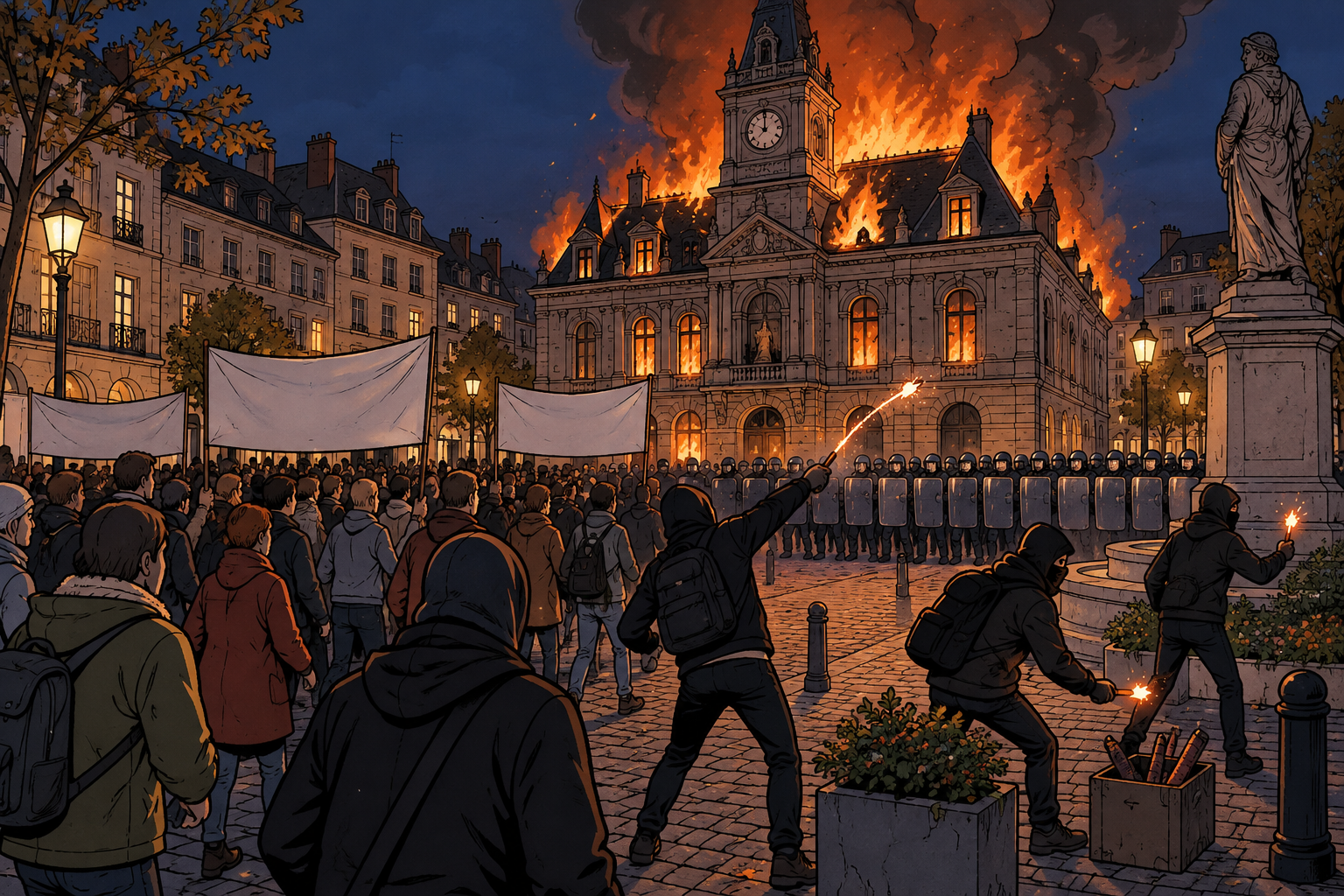
France’s second mass Saturday of protest, October 24, drew 410,000 marchers by the Interior Ministry’s count and nearly 800,000 by the organizers’, with 1,314 arrests and 53 officers hurt, per France 24. A week earlier, riots left some 2,500 people in custody and a burned city hall in Limoges.
President Emmanuel Macron called the October 17 violence “political and seditious acts by ultra-left groups whose aim is to bring down the Republic.” That is the language of 1793. The comparison deserves a hearing, and a ruling on where it fails.
- 2,513 — people in custody after the October 17–18 riots, per Justice Minister Gérald Darmanin · Source: Al Jazeera
- 16,594 — official death sentences in the Terror, within an estimated 35,000 to 45,000 deaths in all · Source: Donald Greer, as summarized on Wikipedia
- $1B+ — insured losses from the 2020 U.S. unrest, the costliest civil disorder in U.S. insurance history · Source: Property Claim Services, via Axios
- 0 — French-style national student or cost-of-living street movements found in the U.S. this month · Source: Civic Intelligence review
The Jacobin radicalization was a ratchet of emergency powers. The Revolutionary Tribunal came in March 1793, the Committee of Public Safety that April, the armed surrounding of the Convention that expelled the Girondins on June 2, the Law of Suspects in September, and the Law of 22 Prairial in June 1794, which simplified trial procedure as executions surged. Robespierre had defended terror in principle that February, in the Fordham translation: “Terror is only justice prompt, severe and inflexible; it is then an emanation of virtue.” Our earlier Jacobin analysis traces that pattern to American politics.
The French government’s response resembles it in kind. Within days it imposed curfews in Paris, Lille, Lyon and Nice; prefect bans on protests, including Lyon; trials within hours, with 149 jailed nationwide by October 20, per the AP; and a request from Darmanin to treat cases as organized crime. Interior Minister Laurent Nuñez floated banning undeclared demonstrations. Darmanin told France 2, “Nous avons failli,” “we failed,” and Macron admitted failures of anticipation and intelligence. Officials blame the ultra-left, and the AP reports French authorities have not linked immigrants to the rioting.
The differences are larger than the likenesses. The Terror was state violence, run by a governing committee through a tribunal; in 2026 the state is the party suppressing disorder through ordinary courts. The Terror produced 16,594 official death sentences and perhaps 35,000 to 45,000 deaths in all, and we found no confirmed protest deaths from violence in the sources we read. It ran inside a civil war and a foreign invasion. There is no 2026 counterpart to the Girondin purge, and the sentences handed down, eight to ten months and suspended terms among them, are not those of the Law of 22 Prairial, which stripped defendants of counsel.
We found no historian who compares 1793 with 2026. The experts the AP quotes place the unrest in a longer French habit: sociologist Magali Della Sudda calls protest “a way to build collective identity and political community,” and Fabien Jobard says that for suburban youth, “the riot is one of the traditional forms of collective expression.” The AP traces the cycle through 1789, 1871, 1968, 2005 and 2023. The grievance is also concrete: school conditions, prices, and public debt near 115% of GDP, per Douglas Murray in The Free Press. Our October 18 report covers who blames whom for the first night.
Reuters reports Milan saw the sharpest spillover: on October 18, 271 young people were detained and 32 arrested, 23 of them minors, with stores looted. In Brussels, several hundred mostly young people clashed with police on October 17, and Belgium’s interior minister promised “all necessary means.” Lisbon saw thousands march peacefully over wages and housing. Two cases are parallel, not spillover: Liège students were protesting a tuition rise from €835 to €1,194, with 107 arrested since early October, and Albania’s protests concern universities and a tourism project. Germany issued advisories but reported no widespread disturbances. A Barcelona figure in one Fox live blog has no second source, so we do not use it.
France: Violence and rioting, tied to ongoing protests, have recently occurred in France and may continue. The French government has indicated they will take steps to curb "illegitimate" protests, while those organized by groups such as trade unions would be allowed to proceed. [link omitted]

The case that France is a warning for the United States is being made by the country’s top officials. Vice President JD Vance (R) wrote on X on October 18 that “Western liberals imported the third world into France” and, per Newsweek, “I hope Americans are paying attention. This is the future congressional Democrats seek for your country.” At a Kansas rally the next day President Donald Trump (R) said, “If you want to see what is at stake in this election, just look at what’s happening in France.”
France is burning! The immigration of people from an entirely different world, people with hatred in their hearts, has shattered that once great country. Close your Borders and take control, before it is too late!
On the American side, the record supports a narrower claim than a spreading movement. The 2020 unrest cost insurers more than $1 billion, per Property Claim Services via Axios, beating the $775 million record set by Los Angeles in 1992. At the March 28 “No Kings” protests, whose organizers claimed more than 3,100 events, the AP reported LAPD arrested 74 people in Los Angeles for failure to disperse, and the Department of Homeland Security said protesters threw rocks, bottles and concrete near a detention center. Most events were mostly peaceful, per the AP. Los Angeles is run by Mayor Karen Bass (D) and California by Gov. Gavin Newsom (D); we found a statement from neither on that event.
The closest American counterpart to France’s curfews came from a Democrat. After clashes at the Delaney Hall immigration detention center on May 30, Newark Mayor Ras Baraka (D) imposed a 9 p.m. to 6 a.m. curfew within a half mile, and Gov. Mikie Sherrill (D) said masked individuals were “throwing projectiles” and “lighting tires on fire in the street,” per the AP. In Minneapolis in January, after ICE shootings, a federal judge restricted federal crowd-control tactics and Gov. Tim Walz (DFL) mobilized the National Guard, per CNN. The point of these cases is who commands the response when disorder comes.
Western liberals imported the third world into France and other countries in the name of diversity and compassion. They ignored fundamental questions of assimilation and compatibility. They were told it would lead to this and they didn't listen. [post continues; text truncated in the source]
A French-style national student or cost-of-living street movement in the U.S.; any October 2026 “No Kings” event; a Department of Homeland Security, FBI or Justice Department statement tying France to U.S. unrest; or any evidence of a causal or operational link between the French riots and U.S. unrest. Ipsos finds 47% of registered voters call the cost of living the top midterm factor, a pressure point, not a street movement.
Dates to watch: November 3 in the U.S. midterms; a French strike day called for November 5 by CGT leader Sophie Binet, per Fox; a National Assembly inquiry due by year-end; and the case of the suspect arrested in the Limoges arson, who is presumed innocent. Macron cannot run again in the 2027 presidential election.
France in 2026 shares the Jacobins’ rhetoric of emergency, not their machinery or their body count. In America the documented exposure is not a spreading uprising but the mayors and governors who decide whether a riot becomes a curfew.