Trump Threatens to Bomb Oman “If It Gets in the Way” of a Hormuz Deal. Iran Says the Map Is Already Drawn.
- “Bomb the S— Out of Them” the phrase President Trump used against Oman on Aug. 17, in a phone interview with Fox News' Trey Yingst, as a 60-day U.S.-Iran negotiating deadline expired — Washington Examiner; NBC News
- ~20% of the world's traded oil and gas normally moves through the Strait of Hormuz — the chokepoint at the center of the dispute — U.S. Energy Information Administration
- 60 Days the negotiating window set by the June 17 Trump–Pezeshkian memorandum, which expired the same day Trump made the threat — CBS News; The National
- <100 Vessels crossed the strait last week, down from more than 120 a day before the war began in February — Reuters wire, via Yahoo Finance
- 2nd Time since May Trump has explicitly threatened to bomb or “blow up” Oman — a formal U.S. ally with a free-trade agreement and no role in the war — Al Jazeera
On August 17, 2026, President Donald Trump (R) told Fox News chief foreign correspondent Trey Yingst, in a phone interview, that the United States would strike Oman if the Gulf sultanate got in the way of ongoing negotiations to reopen the Strait of Hormuz. “If Oman gets in the way, we’ll bomb the s— out of them,” Trump said, according to Yingst’s on-air account of the call.
The remark landed on a consequential day. It was the exact date a 60-day U.S.-Iran negotiating window — set by a memorandum Trump signed with Iranian President Masoud Pezeshkian on June 17 — expired without a broader peace deal. It also came hours after Iran’s Foreign Ministry said Tehran and Muscat had reached an understanding on the map for a new shipping route through the strait — the kind of side arrangement Washington has warned could complicate its own negotiating position. Asked to elaborate later that day in the Oval Office, Trump added: “I don’t think they behaved very well, but we’d handle them very easily, just like we do other things.”
It wasn’t an isolated line. In a Cabinet meeting on May 27, after reports that Oman and Iran had discussed levying tolls on ships transiting the strait, Trump used almost identical language: “Oman will behave just like everybody else, or we will have to blow them up.” Between those two statements sits the substance of the dispute — a strait carrying roughly a fifth of the world’s oil and gas, a Gulf ally the U.S. has relied on for back-channel diplomacy with Iran for more than a decade, and a president who has made blunt public warnings part of how his administration negotiates.
Hours before the Fox News call, Trump had already posted to Truth Social, reaffirming what his administration has called Washington’s “number one Goal” in the war with Iran:
The number one Goal is, and always will be, that Iran cannot have, in any way, shape, or form, a Nuclear Weapon. Thank you for your attention to this matter!
That post made no mention of Oman. The Oman threat came later, in direct response to a reporter’s question about the sultanate’s negotiating position — not as a prepared talking point. Reopening the strait to normal shipping is the administration’s near-term goal; denuclearization is the longer one. Oman’s negotiating role sits squarely inside that first, immediate objective — part of why a threat aimed at Tehran’s negotiating partner, rather than at Tehran itself, drew as much attention as it did.
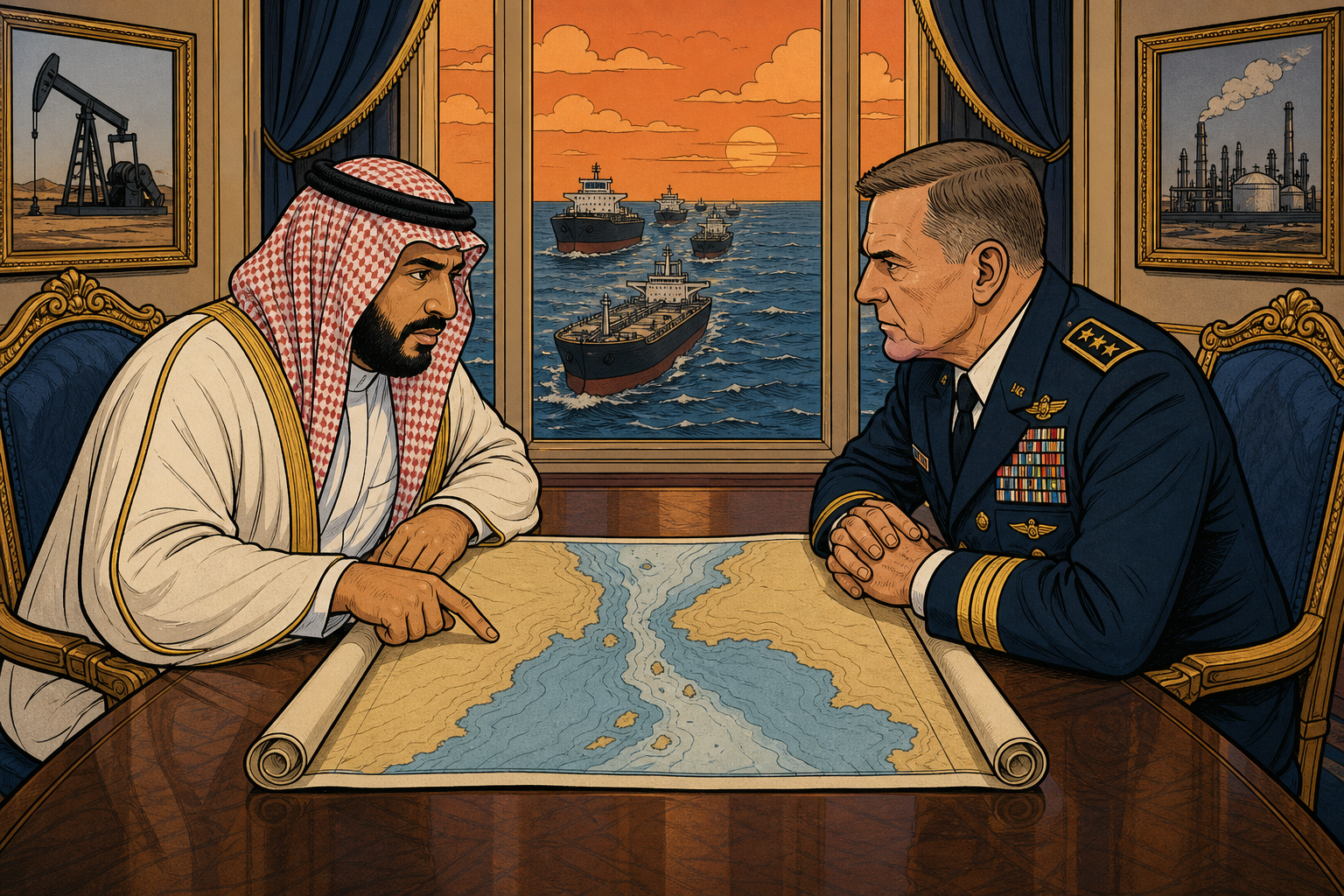
The Strait of Hormuz is the narrow channel between Oman and Iran that carries roughly a fifth of the world’s traded oil and gas and about a third of seaborne crude, according to the U.S. Energy Information Administration — the single most consequential chokepoint in global energy markets, with no full-capacity alternative route if it closes. Whoever controls transit through it, or collects a fee for it, holds leverage that extends far beyond the Gulf.
Oman is not a combatant in the war Israel and the United States opened against Iran on February 28, 2026. It is the two sides’ oldest diplomatic back channel — the same quiet mediation that helped produce the meetings leading to the 2015 nuclear deal — and the government of Sultan Haitham bin Tariq has spent the current war trying to keep it from escalating further across the wider Gulf. Iran’s Foreign Ministry spokesman Esmail Baghaei told reporters in Tehran on Aug. 17 that Iran and Oman had reached “an understanding… regarding the map of the transit route” — a plan under which ships would enter near Iranian waters and exit near Omani waters, transiting toll-free during an interim period.
That word — toll — is the pressure point. A joint Iran-Oman statement in June referenced “costs associated with” administering the waterway, language regional analysts read as an opening toward fees Tehran could collect indefinitely. The Trump administration has called any Iranian toll a red line. Directing a public threat at Oman, rather than only at Iran, reads as an attempt to keep Washington’s actual negotiating partner from finalizing an arrangement the U.S. doesn’t control the terms of.
The threat sits on top of a six-month conflict. Israel and the United States struck Iranian nuclear and military sites starting Feb. 28; Iran closed the strait by declaration in March; a U.S. naval blockade followed in April after talks in Islamabad broke down; and the ceasefire framework Trump signed with Pezeshkian on June 17 gave both sides 60 days — expiring Aug. 17 — to turn a truce into a lasting settlement. That didn’t happen on schedule, and the practical result is a Gulf where escorted commercial traffic, not free transit, is still the norm: fewer than 100 vessels crossed the strait last week, against more than 120 a day before the war.
CENTCOM forces continue to strictly enforce the U.S. blockade against Iran. As of Aug. 9, CENTCOM has redirected 55 commercial vessels, disabled 2, and boarded 2.
Treasury Secretary Scott Bessent (R) paired his own warning with Trump’s the same day, telling reporters the administration would pursue “aggressive” sanctions against Oman and “unprecedented” new economic measures against Iran if the strait wasn’t reopened on U.S. terms. Secretary of State Marco Rubio (R) has been running the quieter parallel track, posting on X days earlier that safe transit through the strait — not a symbolic claim of control — is the actual near-term goal:
In my meeting with UK Foreign Secretary @Ed_Miliband, we discussed the need for Europe to take a greater role in its own security. We also reaffirmed our shared commitment to open transit in the Strait of Hormuz and ensuring Iran never obtains a nuclear weapon.
Rubio separately told reporters that “progress made” on Oman talks was “not finality yet,” describing safe passage as the immediate target and denuclearization as “the ultimate objective” once transit is settled — the calmer diplomatic register that has run alongside, not instead of, Trump’s public threats throughout the war.
Congressional Democrats moved fastest. Sen. Tim Kaine (D-VA) said he will introduce a War Powers Resolution barring military action against Oman once the Senate returns from recess in September, calling the threat part of what he termed Trump’s “increasingly deranged… one-man campaign to threaten and initiate wars all over the globe,” and arguing that targeting a treaty-linked, free-trade partner “makes adversaries like China and Russia rub their hands with glee.” Kaine said he would seek Republican co-sponsors. On CBS News, retired Marine colonel and CSIS senior adviser Mark Cancian described a sitting president publicly threatening to bomb a formal U.S. ally as “pretty extraordinary.”
Oman’s government did not respond publicly. Newsweek said it reached out to the Omani Embassy in Washington and the White House for comment Monday morning; neither had issued an on-record response as of publication. That silence is itself worth noting: Muscat’s diplomatic style, built over decades as an intermediary, has been to absorb blunt rhetoric rather than answer it in public — the same posture it held through Iranian retaliatory strikes on its own territory earlier in the war.
Foreign-policy analysts read the moment two ways. One view treats it as a deliberate, if blunt, negotiating tactic: with Iran and Oman working out shipping-lane terms that could hand Tehran a toll authority Washington opposes, a public threat raises the cost of Oman signing off on those terms without U.S. sign-off first. The other view — echoed in Kaine’s statement and in Cancian’s “extraordinary” characterization — holds that threatening the mediator narrows the very channel the U.S. needs to close a deal at all, since Oman’s usefulness has always rested on being trusted by both sides.
The U.S.A. has total control over the Strait of Hormuz. I THINK WE WILL KEEP IT! Our Naval Blockade is being called, by everyone, 'A WALL OF STEEL,' and there is nothing Iran can do about it.
Posted five days before the Oman threat — part of a running pattern of Trump asserting unilateral U.S. command of the strait's terms.
What’s undisputed is the timing: Trump’s threat, Baghaei’s route-map announcement, and the ceasefire deadline’s expiration all landed on the same Monday, with no finalized U.S.-Iran-Oman agreement and no confirmed change in shipping-traffic reality yet. Rubio’s office continues to describe the Oman track as the more productive one, and nothing in the public record so far shows Washington moving from rhetoric to any military action against Oman itself.
President Trump told Fox News on Aug. 17 that the U.S. would “bomb the s— out of” Oman if it “gets in the way” of a Strait of Hormuz deal — his second explicit threat against the Gulf ally since May, delivered the same day a 60-day U.S.-Iran negotiating deadline expired and hours after Iran said it had already agreed to a shipping-route map with Muscat. Treasury Secretary Bessent separately threatened Oman with sanctions; Sen. Tim Kaine (D-VA) announced plans for a War Powers Resolution barring action against Oman; and the Omani government has not responded publicly. No U.S. military action against Oman has occurred or been ordered, and Secretary of State Rubio continues to describe the Oman negotiating track as the closer path to reopening the strait.