CENTCOM Bombs Iran While Iran Sits at the Negotiating Table. That’s the Whole Point.
On May 25, 2026, U.S. Central Command struck missile launch sites and Islamic Revolutionary Guard Corps boats near Bandar Abbas, along the southern Iranian coast at the mouth of the Strait of Hormuz. CENTCOM spokesman Capt. Tim Hawkins said the strikes were “self-defense” — IRGC boats had been spotted laying mines in the strait, and a surface-to-air missile site near Bandar Abbas had locked its radar onto U.S. warplanes. Three explosions were reported in Bandar Abbas and additional blasts near Sirik and Jask. A U.S. official described the operation as “very small.”
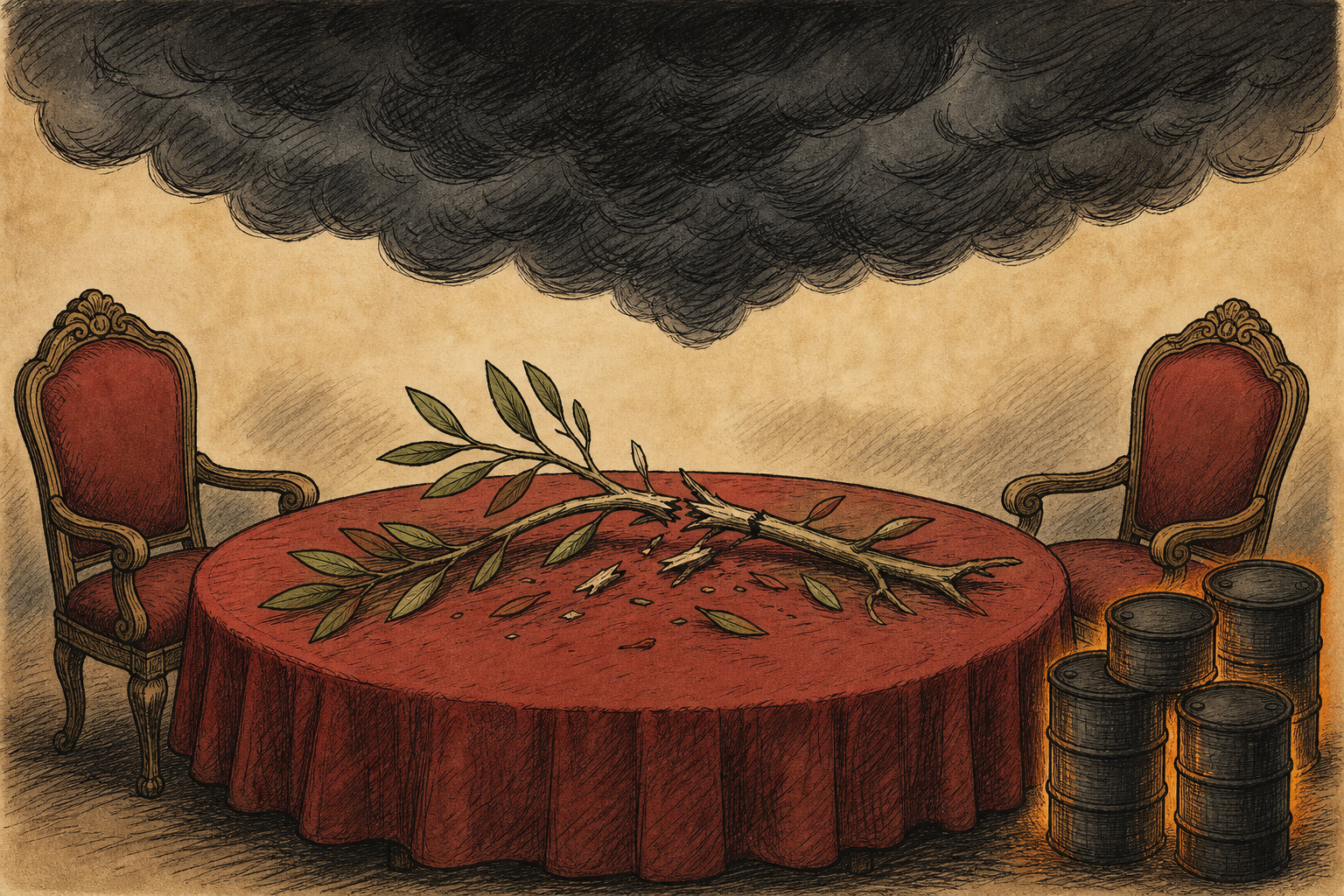
The strikes landed while Iranian negotiators were inside a conference room in Doha. Iran envoy Steve Witkoff (R, Special Envoy to the Middle East) and Secretary of State Marco Rubio (R) are running a Qatar-mediated track aimed at converting the fragile April 7–8 ceasefire into a 14-point memorandum of understanding. President Donald Trump (R) posted to Truth Social hours earlier that talks were “proceeding nicely” — and warned the alternative was “back to the battlefront and shooting, but bigger and stronger than ever before.”
CENTCOM, now under Adm. Brad Cooper (the first Navy officer to hold the post since 2008), insists the ceasefire is still in force. The IRGC issued a statement reserving the right to retaliate. Iran’s foreign ministry pushed back publicly against Trump’s claim that a deal was nearly done. And the entire diplomatic exchange took place under a supreme leader Iranians have not seen since his predecessor was killed: Mojtaba Khamenei, announced as Iran’s third supreme leader on March 9, 2026, after his father Ali Khamenei was assassinated Feb. 28.
- Apr 7ceasefire datethe U.S.–Iran ceasefire under which these May 25 strikes were called “self-defense,” not a resumption of hostilities— Stars and Stripes; CBS News
- 14point MOUthe Witkoff-Rubio-Qatari framework on the table — ceasefire, Hormuz reopening, sanctions relief, uranium handover, nuclear restrictions— Common Dreams; Wikipedia
- 3strike zonesBandar Abbas (Iran’s main naval base), Sirik, and Jask — all three on Iran’s southern coast at the Strait of Hormuz chokepoint— Stars and Stripes; CNN live updates
- 95%deal progress claimFox News quoted senior U.S. officials saying the Iran deal was “95% there” the same day CENTCOM was striking IRGC targets— Fox News Digital, May 25, 2026
The strike-during-talks cycle escalated over the weekend of May 30–31. U.S. Central Command confirmed that Iran shot down a U.S. MQ-1 drone that was, by CENTCOM’s account, operating over international waters in the Persian Gulf. In response, CENTCOM said it “conducted self-defense strikes on Iranian radar and command and control sites for drones in Goruk, Iran and Qeshm Island this weekend.” U.S. fighter aircraft eliminated Iranian air defenses, a drone ground-control station, and two one-way attack drones CENTCOM said “posed clear threats” to ships transiting regional waters. CENTCOM said no American service members were harmed.
Iran’s IRGC offered a competing account, claiming its air defenses downed the MQ-1 after it allegedly entered Iranian airspace in the early hours of Sunday — not over international waters. Within hours, Iran retaliated: projectiles were fired toward U.S.-aligned facilities in Kuwait, and Kuwaiti air defenses were activated. No U.S. casualties were reported.
The two sides’ stories diverge on where the drone was when it was hit — international waters (CENTCOM) versus Iranian airspace (IRGC) — but both governments now confirm the same core fact: a U.S. MQ-1 was shot down, and U.S. aircraft struck Iranian drone-control and radar sites in response.
A note on designation: this June-1 event is a different aircraft from the one in the original story below. On May 26, the IRGC claimed — without independent confirmation — that it had downed a more expensive MQ-9 Reaper and fired on an F-35 and an RQ-4 (covered in § 04). The weekend MQ-1 shootdown is the first drone loss in this conflict that CENTCOM itself has acknowledged on the record, which is what makes it the material development of June 1.
The diplomacy has not collapsed, but it has tightened. As of June 1, President Donald Trump (R) posted that “Iran really wants to make a deal, and it will be a good one for the USA,” while reportedly narrowing the draft framework. Iran’s chief negotiator Mohammad Bagher Ghalibaf said Tehran “will not approve any agreement until we are certain that the rights of the Iranian people have been upheld,” and Foreign Ministry spokesman Esmaeil Baghaei said the two sides are “negotiating in an atmosphere of mistrust.” The open sticking points are unchanged: roughly $12 billion in frozen Iranian assets, the fate of the enriched-uranium stockpile, and the sequence for reopening the Strait of Hormuz.
U.S. Central Command conducted self-defense strikes on Iranian radar and command and control sites for drones in Goruk, Iran and Qeshm Island this weekend, in response to aggressive Iranian actions that included the shootdown of a U.S. MQ-1 drone operating over international waters. U.S. fighter aircraft eliminated Iranian air defenses, a ground control station, and two one-way attack drones that posed clear threats to ships transiting regional waters. No American service members were harmed.
CENTCOM’s public statement, issued by Capt. Tim Hawkins, framed the operation in deliberately narrow language: “U.S. forces conducted self-defense strikes in southern Iran today to protect our troops from threats posed by Iranian forces. Targets included missile launch sites and Iranian boats attempting to emplace mines.” CENTCOM declined to specify the exact platforms used to deliver the strikes or whether the launches came from carrier aviation, land-based aircraft, or surface combatants in the Persian Gulf.
What we know from the on-record reporting: at least one surface-to-air missile (SAM) site in or near Bandar Abbas, Iran’s main naval base, was struck after its targeting radar reportedly locked onto U.S. warplanes. At least one IRGC small-boat formation that was observed deploying naval mines in the strait shipping lanes was also engaged. Three explosions were heard in Bandar Abbas itself, with additional reported blasts near Sirik and Jask — the three locations together bracket the entire northern shoulder of the Strait of Hormuz, the world’s most consequential oil chokepoint.
The Strait of Hormuz carries roughly one-fifth of global seaborne oil traffic. Iran has long held the geographic ability to disrupt that flow by sea-mining the strait or by attacking tanker traffic with anti-ship missiles and small boats.
The May 25 strikes are explicitly described by CENTCOM as prophylactic — designed to deter Iran from re-mining the strait while negotiations over reopening it are still being hammered out at the diplomatic table in Doha.
Iran has imposed what the U.S. calls a “tolling system” on strait passage during the war. Secretary Rubio told reporters May 26 the system is “unacceptable” and “unsustainable for the world” — and that the strait would reopen “one way or the other.”
“U.S. forces conducted self-defense strikes in southern Iran today to protect our troops from threats posed by Iranian forces. U.S. Central Command continues to defend our forces while using restraint during the ongoing ceasefire.”
Capt. Tim Hawkins · CENTCOM spokesman · public statement, May 25, 2026
The strikes did not arrive out of a vacuum. They arrived in the middle of a sustained diplomatic track being run by White House envoy Steve Witkoff, in coordination with Secretary of State Marco Rubio (R), with Qatar’s Prime Minister Mohammed bin Abdulrahman al-Thani serving as the principal mediator. Pakistan has been the formal channel since the war opened in February; Qatar has been the substantive one. Rubio and Witkoff met al-Thani in Miami on May 9 to walk the framework forward.
What is on the table, per multiple outlets that have seen the document, is a 14-point memorandum of understanding: a formal ceasefire backed by a 30-day window to negotiate a broader agreement; reopening of the Strait of Hormuz; easing or lifting of the U.S. naval blockade on Iran; the unfreezing of Iranian state assets abroad; relief from U.S. sanctions; and binding restrictions on Iranian nuclear development. President Trump has separately said Iran’s stockpile of enriched uranium would be turned over to the United States, destroyed inside Iran, or moved to a mutually-acceptable third location.
Ceasefire & negotiation window: 30-day formal negotiating period under a sustained ceasefire (April 7, 2026 ceasefire as foundation).
Hormuz: Reopening of the Strait of Hormuz to international shipping under transparent terms; end of Iran’s “tolling system.”
Blockade: Easing or lifting of the U.S. naval blockade on Iranian ports.
Assets: Unfreezing of Iranian state assets held abroad (figures vary across reporting).
Sanctions: Relief from U.S. economic sanctions tied to specific compliance milestones.
Nuclear: Binding restrictions on Iranian nuclear development plus the disposition of the existing enriched uranium stockpile.
Major disagreements remain over the sequence of sanctions relief and the precise control mechanism for the strait.
On Saturday May 23, Trump declared the deal “largely negotiated.” By Monday, the U.S. was striking IRGC mine-laying boats. Iran’s foreign ministry publicly disputed Trump’s characterization, citing what Tehran called “frequently shifting U.S. positions” and Israeli “sabotage” of the diplomatic track. Mediators told The Wall Street Journal that momentum stalled Monday over Iran’s nuclear program and financial-relief demands.
CENTCOM’s framing — small, limited, self-defense, ceasefire intact — is not accidental. It is the doctrinal position the Trump administration has built since Operation Midnight Hammer (the June 2025 strikes on Fordow, Natanz, and Isfahan) and Operation Epic Fury (the February–April 2026 campaign that produced the current ceasefire). The position is that any IRGC act — mine-laying, radar lock, drone harassment — that endangers U.S. forces triggers an immediate, narrowly scoped response without ending the larger ceasefire framework.
This is the inverse of the “strategic patience” posture that defined the previous administration’s response to tanker attacks and IRGC harassment under President Joe Biden (D) and former Defense Secretary Lloyd Austin (D-appointee), where similar IRGC actions in 2023–2024 routinely went unanswered or were met with delayed and diplomatic responses. The new doctrine, championed by Defense Secretary Pete Hegseth (R) and executed by Adm. Brad Cooper, treats the kinetic response as independent of the diplomatic process and, in effect, as an input into it.
“Negotiations with the Islamic Republic of Iran are proceeding nicely! It will only be a Great Deal for all or, no Deal at all — Back to the Battlefront and shooting, but bigger and stronger than ever before — And nobody wants that!”
President Donald J. Trump (R) · Truth Social · May 25, 2026
Negotiations with the Islamic Republic of Iran are proceeding nicely! It will only be a Great Deal for all or, no Deal at all — Back to the Battlefront and shooting, but bigger and stronger than ever before — And nobody wants that!
The Islamic Revolutionary Guard Corps issued a written statement warning against “any violation of the ceasefire by the aggressive U.S. military” and reserving the “right to reciprocal response” as “legitimate and certain.” IRGC media additionally claimed Iranian air defenses had downed an MQ-9 Reaper drone and opened fire on an F-35 fighter jet and a second drone said to have entered Iranian airspace. CENTCOM did not address those Iranian claims directly in its May 25 statement.
President Masoud Pezeshkian — Iran’s elected reformist president, now operating under Supreme Leader Mojtaba Khamenei — has not directly addressed the May 25 strikes. Iran’s foreign ministry spokesman publicly rejected Trump’s “largely negotiated” characterization, attributing the impasse to shifting U.S. terms and to alleged Israeli sabotage of the mediation channel. Whether that public push-back is a negotiating posture or the foreign ministry expressing genuine internal disagreement with the Witkoff-Qatari track is the open question that mediators in Doha are trying to read.
U.S. forces conducted self-defense strikes in southern Iran today to protect our troops from threats posed by Iranian forces. Targets included missile launch sites and Iranian boats attempting to emplace mines. U.S. Central Command continues to defend our forces while using restraint during the ongoing ceasefire.
The Strait of Hormuz will reopen one way or the other. We will not allow Iran's IRGC to mine international shipping lanes that the world's energy supply depends on. The 14-point framework in Qatar remains on the table — but the pause in strikes was never a license to threaten U.S. forces.
Commander-in-Chief: President Donald J. Trump (R) — ordered the strikes; running the deal personally on Truth Social.
Diplomatic lead: Steve Witkoff (Iran/Middle East envoy) — runs the Witkoff Track.
State: Secretary Marco Rubio (R) — deal negotiator alongside Witkoff; the “one way or the other” Hormuz line is his.
Defense: Secretary Pete Hegseth (R) — signs off on the kinetic strike doctrine.
CENTCOM Commander: Adm. Brad Cooper — the first Navy officer to lead CENTCOM since Adm. William Fallon in 2008; took command August 8, 2025; led U.S. forces through Epic Fury and the ceasefire.
CENTCOM spokesman: Capt. Tim Hawkins — voice of the May 25 statement.
Supreme Leader: Mojtaba Khamenei — announced March 9, 2026 after his father Ayatollah Ali Khamenei was killed in an Israeli airstrike Feb. 28, 2026 during the war. Has not been seen publicly. Statements have been issued in writing only.
President: Masoud Pezeshkian — reformist elected president; survived the war; operating under a leader he has not been seen with in public.
IRGC: The principal Iranian institution actually executing strait operations (mines, boats, SAM sites). Issued the May 25 retaliation-rights statement.
Foreign ministry: The public face of Iran’s pushback on Trump’s “largely negotiated” framing.
Qatar: Prime Minister and Foreign Minister Sheikh Mohammed bin Abdulrahman al-Thani — the substantive mediator. Met Rubio and Witkoff in Miami May 9.
Pakistan: Formal channel since the war opened in February; less prominent in the current phase.
Trump separately posted that Iran's stockpile of enriched uranium will be 'immediately turned over to the United States to be brought home and destroyed,' destroyed in Iran, or moved to 'another acceptable location.' He also called for Saudi Arabia, Qatar, Pakistan, Turkey, Egypt, and Jordan to join the Abraham Accords, saying Iran could 'eventually join' if a deal is reached.
Paraphrased commentary · not a verbatim post
The May 25 strike is small enough to absorb. The structural question is whether the Witkoff track collapses before the MOU is signed. Three indicators will tell the story.
The IRGC reserved “reciprocal response” rights in writing. The question is whether it executes a kinetic retaliation (another tanker attack, drone-on-warship, missile salvo on a regional U.S. base) or absorbs the strike as a tolerated incident inside an unsigned ceasefire.
A kinetic IRGC retaliation in the next 7 days would functionally end the Witkoff track. Silence followed by negotiation team returning to the Doha table would mean the strike-during-talks doctrine has been internalized by Tehran as the new normal.
Iran’s foreign ministry publicly cited Israeli “sabotage” of the negotiations as a reason the deal has stalled. The Israeli government has its own incentives to prefer regime-pressure outcomes over a Witkoff-brokered normalization that re-floods Iranian oil onto world markets and normalizes the post-Khamenei succession.
Watch for Israeli strikes against Hezbollah, IRGC logistics, or Iranian-aligned militias in Iraq or Syria in the next two weeks. Any of those would put renewed strain on the Witkoff track at precisely the moment Qatar is trying to close on the MOU language.
Reopening the Strait of Hormuz to normal commercial traffic is both the most concrete deliverable in the MOU and the most difficult to verify. Iran has the geographic ability to disrupt the strait at will; the U.S. has the geographic ability to police it. The deal needs a sequence: who removes mines first, who lifts blockade first, who suspends “tolling” first.
The May 25 strikes against IRGC mine-layers were, in effect, the U.S. setting the verification bar in the field: any mine-laying triggers a kinetic response. That is leverage. Whether Iran accepts it as part of the deal architecture or treats it as provocation is the actual diplomatic question of the next 14 days.
CENTCOM struck IRGC boats and a missile site in southern Iran the same day the Witkoff-Rubio-Qatari team was trying to close a 14-point MOU in Doha. That is not an accident; it is the doctrine. Trump’s leverage is kinetic; the diplomacy runs on top of it. The ceasefire that began April 7 is still notionally in place. The supreme leader Iran is negotiating under has not been seen since the day he took office. And the difference between “largely negotiated” and “back to the battlefront” is, on the evidence so far, decided week by week by what IRGC boats do inside the Strait of Hormuz.