
122 Ships Diverted, Tanker Disabled, Kuwait Struck. Iran’s Blockade Reaches New Escalation Under Operation Project Freedom.
- 125+ commercial vessels diverted from Iranian interdiction zones as of June 4, 2026 — updated from the June 3 CENTCOM figure of 122 as Operation Project Freedom continues — CENTCOM; MarineTraffic AIS data; updated June 4, 2026
- June 2 date M/T Lexie (Botswana-flagged, IMO 9203277) was disabled by precision strikes as it carried sanctioned Iranian oil through the Strait of Hormuz — U.S. Central Command, June 2, 2026
- 1 killed in an Iranian-backed attack targeting infrastructure near Kuwait International Airport — the Gulf's first fatal proxy strike of Operation Project Freedom — Kuwait Interior Ministry, June 2, 2026
- 0 Iranian oil tankers allowed to transit the Strait of Hormuz while under active U.S. enforcement — per CENTCOM operational posture statement — CENTCOM, Admiral Brad Cooper, June 3, 2026
In approximately 72 hours ending June 3, 2026, U.S. Central Command diverted 122 commercial vessels from Iranian interdiction zones (updated June 4: 125+ vessels as the operation continues) in the Strait of Hormuz and surrounding waters — then disabled an Iranian-linked oil tanker, struck drone command-and-control infrastructure on Iran’s Qeshm Island, and coordinated defense of Kuwait and Bahrain against Iranian-backed missile and rocket attacks. The operation is the most intense sustained use of U.S. naval and air power against Iran since the tanker war of the late 1980s.
Operation Project Freedom — the official designation for the current U.S. freedom-of-navigation enforcement campaign against Iranian maritime interdiction — has, as of June 3, enforced a near-complete blockade of Iranian oil exports moving through the strait. CENTCOM Commander Admiral Brad Cooper confirmed the 122-ship figure at a June 3 press briefing, calling it “the largest single-operational diversion of commercial vessels in CENTCOM history.”
Iran’s response — proxy attacks on Kuwait and Bahrain — signals that the IRGC views U.S. enforcement as a genuine threat to its revenue model, not merely a symbolic deterrence exercise. The question now is whether Tehran escalates further or seeks a diplomatic off-ramp.
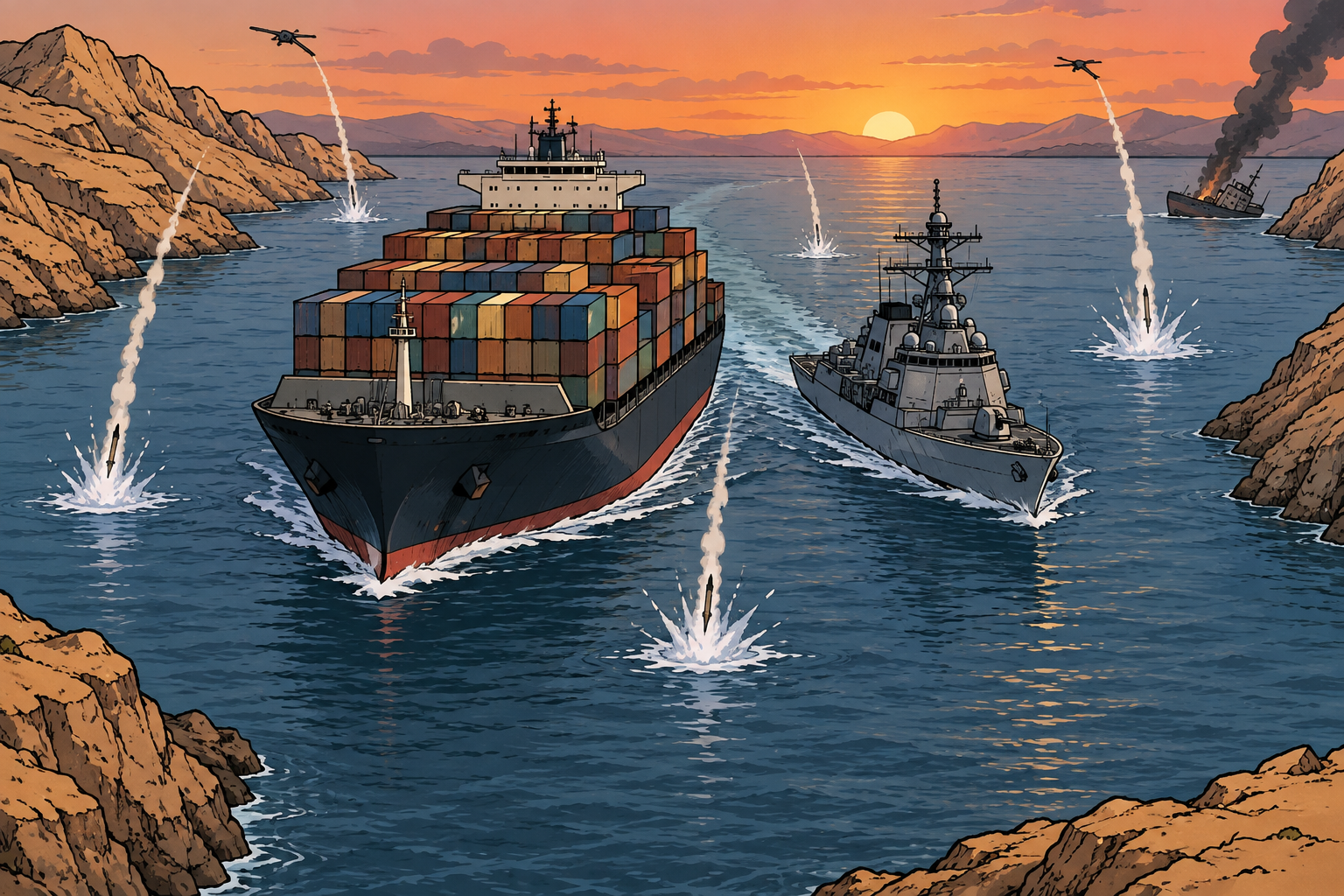
The Strait of Hormuz is the world’s most consequential oil chokepoint — roughly 20 percent of global petroleum supplies transit it daily. Iran has repeatedly threatened to close or disrupt the strait when under pressure from U.S. or European sanctions. What changed under Operation Project Freedom is that the U.S. now actively intercepts Iranian efforts to board or seize commercial vessels rather than simply warning against the threat.
The 122 diversions counted in the CENTCOM release include vessels that changed course on U.S. military advisories, vessels physically escorted by U.S. Navy assets, and vessels whose captains received and complied with direct IRGC Navy boarding demands — only to have U.S. aircraft or ships intervene before the boarding was completed. The AIS tracking data published by MarineTraffic shows a visible northward deviation in shipping lanes during the operational window, consistent with vessels avoiding Iranian patrol corridors.
Admiral Cooper, briefing reporters June 3, said the operational tempo is “deliberate and sustainable.” The U.S. Navy has committed carrier-based air assets, surface combatants, and MQ-9 drone coverage to the strait. “Freedom of navigation is not negotiable,” Cooper said. “Iran does not have a veto over international shipping lanes.”
The M/T Lexie — a Botswana-flagged general purpose tanker with IMO number 9203277 — was disabled by U.S. precision strikes on the evening of June 2, 2026. CENTCOM confirmed the strike in a written statement, describing the Lexie as a vessel identified by U.S. intelligence as carrying sanctioned Iranian crude oil through the Strait of Hormuz in violation of active U.S. Treasury Department sanctions designations. The vessel was not sunk; it was disabled — its propulsion systems targeted — and has been reported drifting approximately 14 nautical miles southwest of Qeshm Island as of June 3 morning.
The strike is significant because it represents the U.S. directly disabling a civilian-flagged vessel on the high seas — an escalation beyond the escorting and interdiction that has characterized earlier phases of Project Freedom. The legal authority cited by CENTCOM is the same executive authority underlying previous tanker-war enforcement actions: the right to enforce U.S. sanctions designations against assets knowingly participating in circumvention, combined with the broader authorities granted under the 2025 Iran Maximum Pressure Restoration Act.
Qeshm Island — Iran’s largest island, located just south of Bandar Abbas at the mouth of the Strait of Hormuz — has served as a key forward basing location for IRGC Navy drone operations. The island hosts ground-control stations for the Iranian drone fleet used to surveil and threaten commercial shipping.
On June 2, U.S. strikes on Qeshm Island destroyed at least one drone ground-control station and a co-located air-defense radar installation. CENTCOM described the strikes as “in direct response to IRGC Navy drone harassment of commercial shipping” in the 48 hours prior. Iranian state media confirmed “hostile airstrikes” on Qeshm but disputed CENTCOM’s characterization of the targeted facilities.
Striking Iranian territory — even an island military installation rather than the mainland — represents a significant escalation from the previous operational posture, which had limited direct strikes to maritime targets and Iranian-linked vessels. It signals that the U.S. is prepared to degrade Iranian military infrastructure ashore to protect freedom of navigation.
“Iran does not have a veto over international shipping lanes. Every vessel attempting to leave the strait carries our clear message: Project Freedom is enforced.”
Admiral Brad Cooper, CENTCOM Commander, press briefing — June 3, 2026
Within hours of the Qeshm strikes, Iranian-backed proxy forces launched retaliatory attacks on two U.S. Gulf partners. An attack on infrastructure near Kuwait International Airport killed one person — a civilian maintenance worker, according to the Kuwait Interior Ministry — and wounded three others. Kuwait’s government summoned the Iranian ambassador and formally lodged a protest with the United Nations Security Council.
A separate missile attack targeting Bahrain — which hosts the U.S. Fifth Fleet’s Naval Support Activity facility — was intercepted by coalition air-defense assets. The U.S. Navy’s USS Bulkeley (DDG-84), which is forward-deployed to Bahrain, fired Standard Missile-3 interceptors that destroyed the incoming munitions before they reached inhabited areas. No casualties were reported in Bahrain.
Both the Kuwait and Bahrain attacks carry the signature of Iranian-backed Shia militia groups active in the region — specifically the Iraqi Popular Mobilization Forces (PMF) factions that have historically struck U.S. and Gulf partner assets in response to pressure on Iran. CENTCOM has not formally attributed the attacks but described them as “consistent with Iranian proxy operational patterns.”

In the past 72 hours, Operation Project Freedom assets diverted 122 commercial vessels from Iranian interdiction, disabled M/T Lexie (IMO 9203277), destroyed IRGC drone GCS and air-defense infrastructure on Qeshm Island, and supported defense of Kuwait and Bahrain partners. Freedom of navigation is not negotiable.
Operation Project Freedom is the Trump administration’s umbrella operational designation for its naval and air enforcement of U.S. Iran sanctions in the Strait of Hormuz and Persian Gulf. It was publicly announced in April 2026 when CENTCOM began releasing operational statements confirming the interception and diversion of Iranian-linked vessels.
The operation draws legal authority from three sources: (1) the longstanding U.S. right of innocent passage and freedom of navigation under international maritime law; (2) Treasury Department OFAC sanctions designations that make facilitating Iranian oil exports a sanctionable activity for any entity, regardless of flag; and (3) the 2025 Iran Maximum Pressure Restoration Act, which explicitly authorizes the use of military force to interdict Iranian sanctions-evading vessels.
The economic effect has been immediate. Iranian crude oil exports have fallen by an estimated 40–60 percent since Project Freedom moved from deterrence posture to active enforcement posture in May 2026, according to shipping analysts at Kpler and Vortexa who track Iranian crude disappearances from satellite and AIS data. The Iranian rial has fallen against the U.S. dollar to new lows since the operational tempo increased this week.
122 — commercial vessels diverted in 72 hours, June 1–3, 2026
M/T Lexie (IMO 9203277, Botswana-flagged) — disabled June 2, drifting SW of Qeshm Island
Qeshm Island — IRGC drone GCS and air-defense radar destroyed June 2
Kuwait — 1 killed, 3 injured in proxy attack on airport infrastructure, June 2
Bahrain — incoming missiles intercepted by USS Bulkeley (DDG-84), June 2
Admiral Brad Cooper — CENTCOM Commander, operational briefing officer
Operation Project Freedom is working. 122 ships freed. Iran's oil money is drying up. The Radical Left wanted to appease Iran forever — we chose FREEDOM. No Iranian oil gets through while I'm President. MAKE AMERICA ENERGY DOMINANT AGAIN!
Paraphrased commentary · not a verbatim post


- U.S. Central Command: Operation Project Freedom operational statement, June 3, 2026
- CENTCOM: Admiral Brad Cooper press briefing on 122-ship diversion, June 3, 2026
- Kuwait Interior Ministry: attack near Kuwait International Airport, June 2, 2026
- MarineTraffic AIS data: Strait of Hormuz commercial shipping patterns, June 1–3, 2026
- Kpler: Iranian crude export tracking — satellite and AIS analysis
- Fox News: Operation Project Freedom escalation — full coverage
- Fox News: Qeshm Island strikes and Kuwait/Bahrain attacks