CENTCOM Strikes Iran Again and Disables a Tanker Bound for Kharg Island — Iran’s Own Parliament Speaker Now Calls This an “Existential War.”
The ceasefire that briefly quieted the Iran war didn’t survive July. It collapsed on July 7–8, and since then US Central Command — under Adm. Brad Cooper — has run wave after wave of strikes against Iranian targets, while Tehran keeps hitting back at American partners across the Gulf. This week the war widened again on multiple fronts at once.
On July 15–16, a US Hellfire missile disabled the Iranian-flagged tanker M/T Belma as it attempted to reach Iran’s main export terminal at Kharg Island. Separately, coalition forces shot down eight explosive-laden drones aimed at the US consulate in Erbil, Iraq, and air-raid sirens sounded across Bahrain, Kuwait, and Jordan as Iranian fire reached toward each.
The rhetoric escalated to match the map. Iran’s Parliament Speaker declared the country in an “existential war” with the United States; President Trump said the strikes continue “until I say” it’s enough. This is, by design, a snapshot of a war that is still moving — the casualty figures below may already be out of date by the time you read them.
- 35 killed, 300+ wounded — toll from this wave of strikes alone, since the ceasefire collapsed July 7–8 — per Iranian health officials
- 8 — explosive-laden drones downed by coalition forces targeting the US consulate in Erbil, Iraq — per Middle East Eye
- 3 countries — sounded air-raid sirens in one stretch — Bahrain, Kuwait, and Jordan — per Al Jazeera and Jordan's Petra news agency
- $85–$86/bbl — Brent crude price range as markets price in the widening war — per Al Jazeera live coverage
- 39 IDF, 23 Israeli civilians, 13 US soldiers — cumulative losses reported since the war began Feb. 28 — per the Jerusalem Post's running tally, still developing and not yet cross-verified
The war traces back to February 28, 2026, when a joint US-Israeli strike killed Iran’s Supreme Leader Ali Khamenei. His son, Mojtaba Khamenei, was sworn in as successor in March but has not appeared publicly since — he was reportedly wounded in the same strike and is said to still be recovering. A ceasefire held for several weeks this spring and early summer, but it collapsed again on July 7–8, and Civic Intelligence has tracked the strikes since: a first wave, then a second night CENTCOM said hit roughly 90 targets, then a third round days later that pushed the multi-night total past 300 targets and closed the Strait of Hormuz to normal traffic.
This administration renamed the Pentagon’s civilian leadership post “Secretary of War” rather than Secretary of Defense; Pete Hegseth holds that title and has overseen the strike campaign alongside CENTCOM commander Adm. Brad Cooper. By mid-July, the fighting had stopped being a single flashpoint in the Gulf and become a rolling conflict touching multiple countries at once — which is the story of the latest 48 hours.
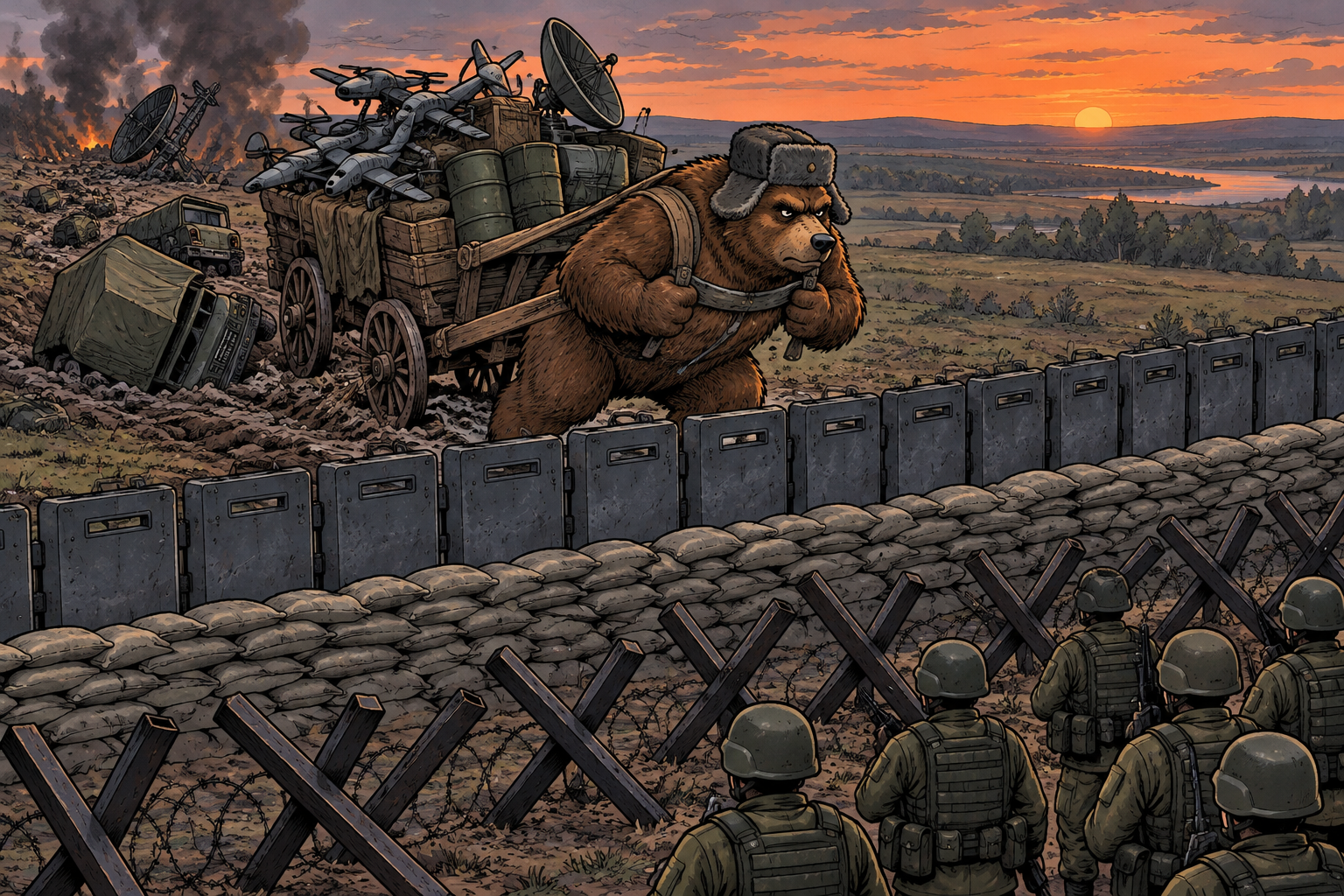
CENTCOM used a Hellfire missile to disable the M/T Belma, an Iranian-flagged tanker, as it attempted to reach Kharg Island — the terminal that handles the large majority of Iran’s oil exports. The operation was small in scale next to the multi-hundred-target strike waves of the prior week, but its purpose was specific: stopping a single cargo of Iranian crude from reaching market.
“The ship is no longer transiting to Iran.”
CENTCOM · public statement
The same stretch of days brought a different kind of target: explosive-laden drones aimed at the US consulate in Erbil, Iraq. Coalition forces shot down eight of them before they reached the compound, according to Middle East Eye’s live coverage — an attack on a diplomatic facility rather than a military base, and a sign the war’s reach now extends into Iraqi Kurdistan.
Air-raid sirens, meanwhile, sounded in three separate countries: Bahrain and Kuwait, both hosts to major US military infrastructure and both frequent targets since the ceasefire collapsed, and Jordan — a country that had largely stayed out of the direct fire until this week. Jordan’s official state news agency, Petra, confirmed elevated air-defense activity as part of the kingdom’s public security response.
Iran’s most visible official through this round of escalation remains its Parliament Speaker and lead negotiator, Mohammad Baqer Qalibaf. Where earlier statements from Tehran framed the conflict as retaliatory and bounded, Qalibaf’s latest remarks dropped that framing altogether.
“We are in an essential and existential war with America.”
Mohammad Baqer Qalibaf · Speaker, Iran's Parliament
Foreign Minister Abbas Araghchi has continued to serve as Iran’s public face on diplomacy even as the military track dominates the news. But the man who is constitutionally in charge of Iran’s armed forces, Supreme Leader Mojtaba Khamenei, still has not appeared in public since ascending to the role — a genuinely unusual absence for a wartime head of state, and one this piece notes without speculating about who is actually directing Iran’s response day to day.
President Trump has been direct about the campaign’s scope and its open-ended timeline, telling reporters the strikes will continue on his own terms.
“The strikes will continue until I say... enough.”
President Trump · via White House pool reports, July 2026
Trump has also threatened to expand the target set to Iran’s “bridges and power plants” — civilian infrastructure, not the military and naval sites CENTCOM has struck to date. As of this writing that threat had not been carried out; it remains a stated warning rather than a confirmed operation.
Secretary of State Marco Rubio and White House Press Secretary Karoline Leavitt fielded questions on the strait exchange at a White House briefing this week, while Israeli Prime Minister Benjamin Netanyahu offered his own read on where things stand: “The war has not yet ended.”
President Trump (R) — has authorized the strike campaign and publicly threatened to expand it to Iranian infrastructure.
Secretary of War Pete Hegseth — the Pentagon’s civilian leader, under this administration’s renamed title.
Adm. Brad Cooper — CENTCOM commander, overseeing the strike waves and the Hormuz enforcement mission.
Secretary of State Marco Rubio — the administration’s public face on diplomacy and briefings.
Mojtaba Khamenei — Iran’s Supreme Leader since March; has not appeared publicly since ascending, reportedly still recovering from injuries.
Mohammad Baqer Qalibaf — Iran’s Parliament Speaker and lead negotiator; now the most visible Iranian official narrating the war.
Abbas Araghchi — Iran’s Foreign Minister, running the diplomatic track.
Congress has already tried once to force a check on this war. Sen. Tim Kaine (D-VA) has been the lead sponsor of Senate War Powers Resolutions aimed at Iran, and in June the Senate discharged one such measure 50–47, with four Republican defections, days after the House passed its own version 215–208 — with four Republicans, Thomas Massie (R-KY), Brian Fitzpatrick (R-PA), Tom Barrett (R-MI), and Warren Davidson (R-OH), crossing over to join Democrats. Neither resolution has forced US forces out of the fight, and this round of strikes shows how little that earlier vote has changed on the ground.
Oil markets are pricing in a war with no clear end date: Brent crude has climbed to roughly $85 to $86 a barrel on the widening strikes and the tanker incident, per Al Jazeera’s live coverage. And the human cost keeps two separate ledgers open at once — the current wave’s toll of at least 35 killed and 300 wounded since July 7–8, and a cumulative war-wide count, reported by the Jerusalem Post, of 39 IDF soldiers, 23 Israeli civilians, and 13 US soldiers killed since February. That second figure comes from one outlet’s running tally and needs further independent verification; we flag it as developing rather than settled.
A war that was supposed to be paused by ceasefire is now touching a tanker off Kharg Island, a US consulate in Iraq, and air-raid sirens in three Gulf-region countries at once. Iran’s own Parliament Speaker is calling it existential; the President says the strikes stop when he decides they stop. Congress has already tried once to force a vote on ending it and failed to change the trajectory. None of that is settled — it's the state of a war still being fought as this page goes live.