Iran Halts Talks With the U.S. and Vows to ‘Completely’ Block the Strait of Hormuz.
Iran’s state-affiliated Tasnim news agency reported on Monday, June 1, 2026, that Tehran’s negotiating team is halting indirect talks with the United States and the exchange of documents through mediators, and that the “resistance front” and Iran have “resolved to completely block the Strait of Hormuz.” The claim is attributed to Iranian state media; it has not been independently confirmed.
According to the Tasnim report, Tehran also intends to “activate other fronts including the Bab al-Mandeb Strait” — the southern chokepoint linking the Red Sea to the Gulf of Aden — and conditioned any return to dialogue on a full Israeli withdrawal from occupied areas of Lebanon and an end to Israeli strikes in Lebanon and Gaza. The announcement was framed as retaliation for what Tehran calls ceasefire violations.
Crude markets reacted within hours. Brent crude rose about 5.4% to roughly $96.05 a barrel and U.S. West Texas Intermediate climbed about 6.4% to roughly $92.95. The reversal cuts hard against the posture of just days earlier, when a 60-day ceasefire-extension framework was awaiting President Donald Trump’s approval. Roughly one-fifth of the world’s oil normally moves through Hormuz.
- ~20% of the world’s oil consumption normally transits the Strait of Hormuz — about 20 million barrels a day — U.S. Energy Information Administration · 2024
- +5.4% jump in Brent crude — to about $96.05 a barrel — on the Tasnim report — CNBC · June 1, 2026
- +6.4% jump in U.S. WTI crude — to about $92.95 a barrel — the same morning — CNBC · June 1, 2026
- 60 days the ceasefire-extension framework that was pending Trump’s approval before this reversal — CBS News · Civic Intelligence reporting · 2026
- 2 chokepoints named in the Tasnim report — the Strait of Hormuz and the Bab al-Mandeb Strait — Tasnim (via CNBC) · June 1, 2026
The claim comes from Tasnim, a semi-official outlet. That attribution is the whole story.
The report came from the Tasnim news agency, a state-affiliated Iranian outlet widely described as semi-official and tied to the country’s hardline establishment, including the Islamic Revolutionary Guard Corps. According to Tasnim, Iran’s negotiating team will stop talking to the United States and stop exchanging documents through intermediaries, accusing Washington of sending mixed signals and dragging out the negotiations. Tasnim said “no dialogue will take place” until Israel fully withdraws from occupied areas of Lebanon and halts all attacks in Lebanon and Gaza.
The most consequential line was about the waterway itself. “The resistance front and Iran have resolved to completely block the Strait of Hormuz and activate other fronts including the Bab al-Mandeb Strait, in order to punish the Zionists and their supporters,” the Tasnim report said, as quoted by CNBC. The phrasing matters: it is a stated resolution reported by Iranian state media, not a confirmed operational order, and not an independent verification that the strait has been newly sealed.
We are attributing this claim precisely because it is a claim. State media in a wartime posture has every incentive to project resolve, and Iran has announced closures of Hormuz before during this conflict. What is independently verifiable is the market reaction and the diplomatic context around it — and those are documented below.
“The resistance front and Iran have resolved to completely block the Strait of Hormuz and activate other fronts including the Bab al-Mandeb Strait.”
Tasnim news agency (Iranian state-affiliated), as quoted by CNBC · June 1, 2026
Iran's state-affiliated Tasnim news agency says Tehran's negotiators will halt indirect talks with the U.S. and that Iran has resolved to 'completely' block the Strait of Hormuz, in retaliation for what it calls ceasefire violations. (Claim attributed to Iranian state media.)
Oil spiked the moment the report crossed. That part is not a claim — it is a price.
Whatever the operational reality behind the words, the announcement moved the one thing that cannot be spun: the oil price. International benchmark Brent crude futures rose about 5.4% to roughly $96.05 a barrel, while U.S. West Texas Intermediate added about 6.4% to roughly $92.95, according to CNBC. The jump signaled that traders read the Tasnim report as a real escalation, not noise.
The move is striking because it reversed a relief rally. Only days earlier, on May 29, oil had fallen roughly 20% from its 2026 peak on optimism that a U.S.-Iran ceasefire was within reach. The June 1 spike erased a meaningful slice of that optimism in a single session. Markets are, in effect, pricing the probability that the chokepoint stays closed — and pricing out the deal that had been forming.
For context on how violent this market has been: Brent traded above $100 in early March and reached roughly $126 at the height of the crisis, before easing as Iran began coordinating limited vessel passage. A “completely blocked” Hormuz, if realized, would put those highs back in play.
- →About 20 million barrels of oil per day moved through the Strait of Hormuz in 2024 — roughly 20% of global petroleum-liquids consumption (EIA).
- →Hormuz flows made up more than one-quarter of total global seaborne oil trade in 2024 and early 2025 (EIA).
- →Roughly 20% of the world's liquefied natural gas (LNG) also transits the strait (IEA).
- →It is the primary export route for Saudi Arabia, the UAE, Kuwait, Qatar, Iraq, Bahrain, and Iran — with most cargoes bound for Asia (IEA).
- →Pre-conflict, around 3,000 vessels used the strait each month; by late May 2026 that had fallen to roughly 5% of normal (House of Commons Library).
Days ago, a 60-day ceasefire framework sat on the President’s desk. This is the breakdown of that posture.
To understand why this is breaking news and not just another wartime communiqué, it helps to track where things stood. Civic Intelligence has been following this story through three earlier turns: the U.S. naval blockade and cargo-ship interdiction, the CENTCOM self-defense strikes that included an MQ-1 drone shot down over the weekend, and the 60-day ceasefire-extension framework that was awaiting President Trump’s approval.
As of June 1, that posture was one of cautious de-escalation: a memorandum of understanding had been edited by Trump — with reported changes focused on the Strait of Hormuz and the destruction of highly enriched uranium — and oil had slid on the expectation of a deal. The Tasnim report is the inflection point. It moves Tehran from “coordinating limited passage and negotiating tolls” to “resolved to completely block” the strait, and from exchanging documents to refusing dialogue.
Two caveats keep this honest. First, Iran has already disputed the U.S. characterization of the framework — the Fars agency claimed the deal did not require reopening Hormuz without tolls — so the “pending” deal was already contested. Second, a state-media declaration is not the same as a verified physical closure. What changed on June 1 is the stated Iranian position and the market’s reading of it, not a confirmed new blockade of the waterway.
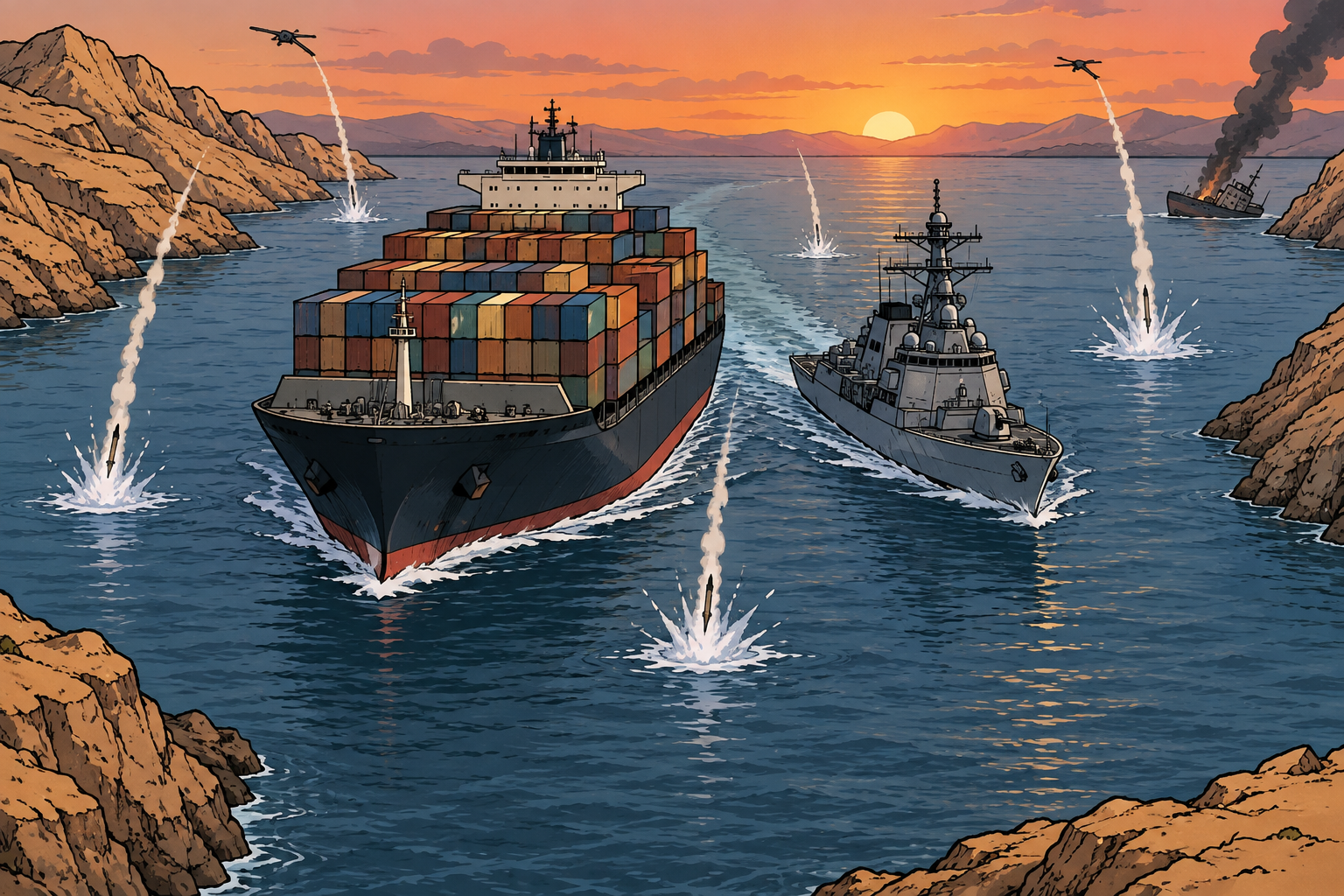
Washington’s line, hours before the reversal, was that a deal was close. The blockade never lifted.
On the morning of June 1, before the Tasnim report dominated the wires, President Donald Trump struck an optimistic note, posting that “Iran really wants to make a deal” and telling Americans to “just sit back and relax.” That same day, CNBC reported a fresh exchange of strikes between the U.S. and Iran, with both sides claiming hits on military targets near the strait — a reminder that the shooting had not actually stopped even as the diplomatic language softened.
On the military side, Defense Secretary Pete Hegseth (R), speaking in Singapore, had signaled that the U.S. naval blockade of Iranian ports in the Strait of Hormuz would remain in place even as talks continued. The U.S. Navy’s 5th Fleet, headquartered in Bahrain, has been the operational backbone of that posture throughout the conflict. In other words, the American side entered June 1 still holding a hard military line beneath the optimistic rhetoric.
We have not seen, as of this writing, an official U.S. government response specifically to the Tasnim “completely block” declaration. CENTCOM and the Pentagon had not, at publication, issued a statement directly addressing the June 1 Iranian announcement. We will update this page when an attributable U.S. response is on the record.
- President Donald Trump (R)President of the United StatesPosted June 1 that 'Iran really wants to make a deal'; had reportedly edited the U.S.-Iran MOU around Hormuz and enriched uranium. The 60-day ceasefire-extension framework awaited his approval.
- Defense Secretary Pete Hegseth (R)U.S. Secretary of DefenseSaid in Singapore that the U.S. naval blockade in the Strait of Hormuz would remain in place amid the Iran talks.
- U.S. Navy 5th FleetNaval command — Bahrain (under CENTCOM)The operational force behind the U.S. blockade of Iranian ports and the escort of merchant shipping near the strait.
- Tasnim News Agency / IRGCIranian state-affiliated media; Islamic Revolutionary Guard CorpsTasnim carried the June 1 declaration that Iran would halt talks and 'completely block' Hormuz; the IRGC has coordinated the strait's closure throughout the conflict.
Iran really wants to make a deal. Just sit back and relax — it will all work out well in the end.
Paraphrased commentary · not a verbatim post
Paraphrased from reporting by CNBC on Trump's June 1, 2026 Truth Social posts; not a verbatim transcription.
Any U.S.-Iran agreement must see the Strait of Hormuz immediately reopened to unrestricted shipping, and Iran's highly enriched uranium destroyed.
Paraphrased commentary · not a verbatim post
Paraphrased from CNBC and CBS News reporting on Trump's Truth Social posts about the U.S.-Iran terms; not a verbatim transcription.
A waterway two miles wide at its shipping lanes carries a fifth of the world’s oil. That is the entire source of the leverage.
The reason a single sentence from a state news agency can move global oil by 5% is geography. The Strait of Hormuz connects the Persian Gulf to the Gulf of Oman and the open ocean, and there is no comparable alternative route for most of the crude that moves through it. The EIA calls it the world’s most important oil transit chokepoint precisely because “very few alternative options exist” if it is closed.
The numbers are unforgiving. About 20 million barrels of oil a day — roughly a fifth of global consumption — moved through Hormuz in 2024, along with about 20% of the world’s LNG. Nearly 15 million barrels a day of crude, about a third of all globally traded crude, passes through, most of it bound for Asia. When that flow is throttled, the shock is not regional; it is a global inflation, shipping, and growth story.
That is also why the “completely block” framing carries weight even as a claim. Throughout this conflict, traffic has already collapsed to roughly 5% of normal and Iran has charged tolls reportedly exceeding $1,000,000 per ship for coordinated passage. A move from selective, toll-gated transit to a declared total closure is the difference between a managed disruption and a hard cutoff — and the market is treating it accordingly.
The Strait of Hormuz carries roughly a fifth of the world's oil and about 20% of its LNG. Iranian state media now says Tehran will 'completely' block it and reactivate the Bab al-Mandeb front — a claim that sent crude sharply higher.
A state-media declaration, a real price move, and a deal that just got further away. Hold the claim and the confirmation apart.
What is confirmed is narrow. Iran’s state-affiliated Tasnim agency said on June 1, 2026, that Tehran is halting indirect talks with the United States and has “resolved to completely block the Strait of Hormuz” and reactivate the Bab al-Mandeb front, conditioning any dialogue on an Israeli withdrawal from Lebanon. In response, Brent jumped about 5.4% to roughly $96.05 and WTI about 6.4% to roughly $92.95.
What is not confirmed is just as important. The closure declaration is a claim by Iranian state media, not an independently verified physical sealing of the waterway, and the U.S. government had not issued an attributable response specific to it at publication. Iran had already contested the U.S. account of the pending framework. The honest version of this story states the claim, attributes it, and reports the verifiable market and diplomatic facts around it — without asserting as fact something only Tehran has announced.
The stakes do not need inflating. Hormuz carries roughly a fifth of the world’s oil, the U.S. blockade and 5th Fleet posture remain in place, and a 60-day ceasefire framework that looked close days ago now looks frozen. When CENTCOM, the Pentagon, or an independently verifiable shipping report establishes what has actually changed in the strait, this page will carry it.