
Three Sailors Dead, Hormuz Closed, Oil Surging: The U.S.–Iran War Just Drew First Blood.
For 103 days the U.S.–Iran war had a strange quality: strike, counter-strike, every Iranian munition intercepted, zero confirmed American casualties, oil barely moving. On June 11, 2026 — day 104 — that quality broke. A U.S. strike on the Palau-flagged tanker Settebello off Oman killed three of its Indian crew, the first confirmed deaths of this phase of the war. India confirmed the toll, summoned the U.S. deputy chief of mission, and lodged a “strong protest.”
Within hours Iran declared the Strait of Hormuz formally closed to all shipping — warning that any vessel attempting passage would be targeted — while the IRGC claimed 18 strikes across U.S. bases in Kuwait, Bahrain, and Jordan. Drone debris injured an 11-year-old girl and damaged homes in Bahrain. An IRGC general vowed to “turn the entire region into hell.” Brent crude climbed toward $95.
And President Donald Trump (R) poured fuel on all of it — promising to hit Iran “VERY HARD TONIGHT,” threatening to seize Kharg Island, the export hub that moves roughly 90% of Iran’s crude, and assume “total control” of Iran’s oil and gas. The shooting war that had been mostly noise now has a body count, a closed waterway, and an oil shock. This is the escalation past the June 9–10 strikes.
- 3 dead — Indian crew of the tanker Settebello killed in a U.S. strike off Oman — the first confirmed casualties of this war phase; 21 of 24 rescued · Source: CBC News, India Ministry of Ports/Shipping
- Hormuz CLOSED — Iran's Khatam al-Anbiya HQ declared the strait shut to all vessels, threatening to target any ship; CENTCOM says commercial traffic continues · Source: Al Jazeera, CENTCOM
- ~$95 Brent — crude climbed toward $95/bbl on day three of strikes — the oil shock the prior rounds never produced · Source: Trading Economics
- 440.9 kg — of highly enriched uranium the IAEA can no longer verify after 97 days without inspector access — the watchdog is demanding answers · Source: ISIS, FDD
The war had killed Iranians by the thousands, per Tehran’s own claims, and 15 Americans since February. What it had not done, in this latest phase, was kill the civilians caught between the two navies. That changed off the coast of Oman. The Settebello, a Palau-flagged oil tanker crewed by 24 Indian nationals and accused by U.S. forces of running Iranian crude through the American blockade, was fired on after, CENTCOM said, it “repeatedly failed to comply with directions from American forces.” A U.S. aircraft put precision munitions into the ship’s engine room. Twenty-one crew were rescued; three were not. Their bodies were recovered and identified.
India did not let it pass. Minister of Ports, Shipping and Waterways Sarbananda Sonowal confirmed the deaths hours after CENTCOM’s announcement. New Delhi summoned the U.S. deputy chief of mission and lodged a “strong protest” over the strike — a sharp diplomatic note from a partner Washington has spent years courting. The dead were not Iranian soldiers or American sailors. They were merchant seamen, and they are the reason day 104 reads differently than day 103.

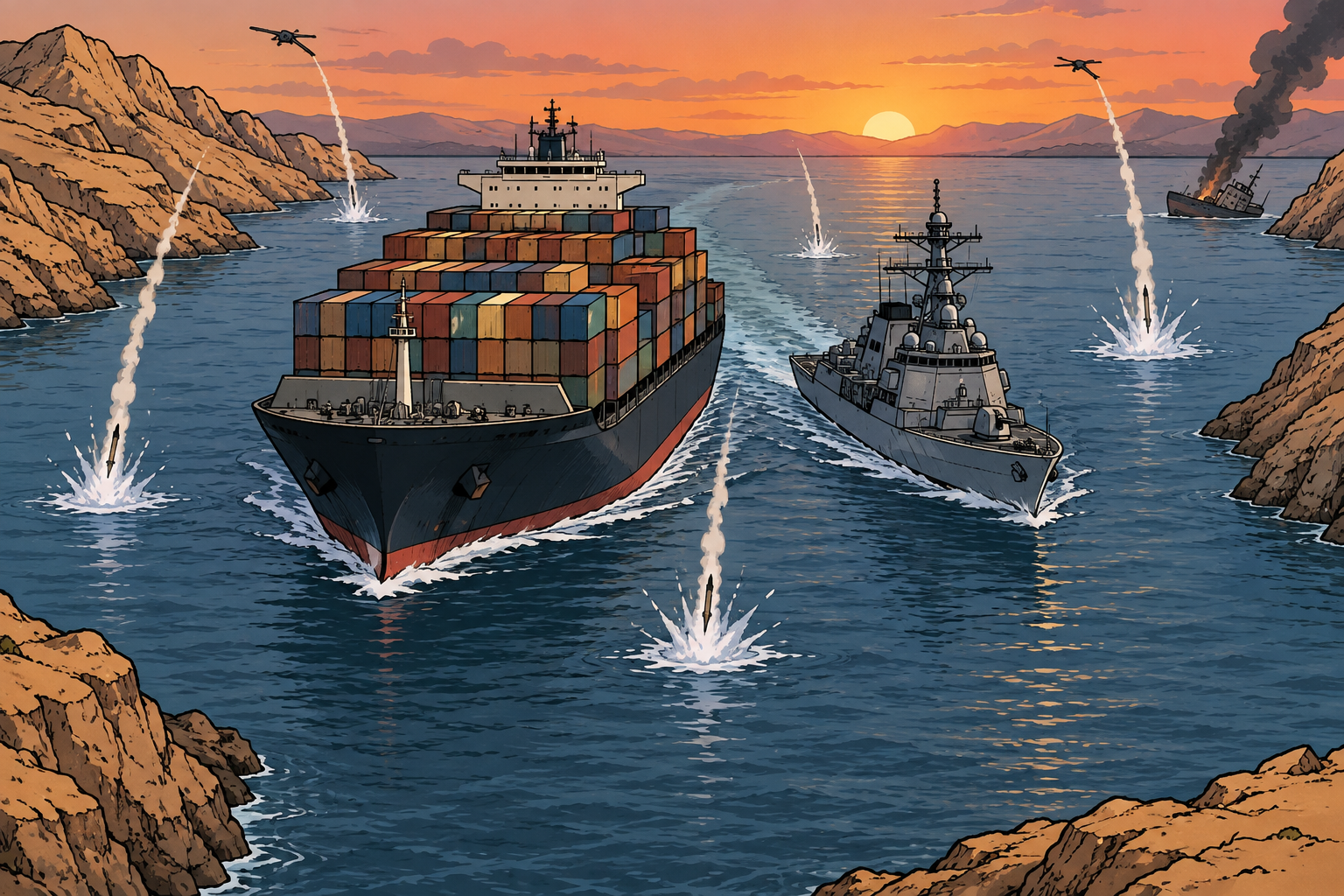
Iran had throttled traffic through the Strait of Hormuz since the war began on February 28, but on June 11 it made the closure formal and absolute. Iran’s Khatam al-Anbiya Central Headquarters announced the strait was completely closed to all ships and warned that any vessel attempting to pass would be targeted. Through the strait flows roughly a fifth of the world’s seaborne crude and a fifth of its liquefied natural gas; a total closure is the single most consequential thing Tehran can do to the global economy short of a wider war.
Washington pushed back fast. CENTCOM posted that “commercial ships are continuing to transit in and out of the Strait,” rejecting the closure as more declaration than fact — and U.S. Energy Secretary Chris Wright (R-appointed) said Gulf vessel traffic and oil exports through the strait were actually rising despite the disruption. Both things can be true at once: Iran can announce a closure it cannot fully enforce, and the announcement alone can still move markets and rattle every shipowner with a hull in the Gulf. The Settebello deaths a day earlier made the warning credible.
“Will you make the sacred Strait of Hormuz unsafe? We will turn the entire region into hell.”
Brig.-Gen. Majid Mousavi, IRGC Aerospace Force commander · June 11, 2026
The IRGC said it struck 18 targets linked to the U.S. military, in two waves, hitting Kuwait’s Ali Al Salem and Ahmed Al Jaber air bases and Bahrain’s Sheikh Isa Air Base, and vowed to keep firing as long as American strikes continued. As with every prior round, the claim outran the confirmation: there was no immediate U.S. acknowledgment of damage, and the true effect of the barrage remained unclear. What is not in dispute is where some of it landed.
In Bahrain, debris from intercepted Iranian drones fell into residential areas of Hamad Town and the capital, Manama. An 11-year-old girl was injured — treated at the scene — and falling fragments set several vehicles on fire and damaged homes. It is the recurring cost of intercepting an attack over a populated Gulf state: the missile is stopped, but the wreckage still comes down on someone’s street. Iran fired on three Arab states — Kuwait, Bahrain, and Jordan — to punish the United States, the same pattern that drew Arab League condemnation a day earlier.

Despite Iranian claims, commercial ships are continuing to transit in and out of the Strait of Hormuz. U.S. and partner forces remain postured to ensure freedom of navigation in international waters.
The Agency has not been able to verify Iran's stockpile of highly enriched uranium. We continue to call on Iran to provide the information and access required under its NPT safeguards obligations.
President Trump (R) spent the morning escalating in every register at once. On Truth Social he wrote that “at some point in the not too distant future, we will be taking Kharg Island, and other oil infrastructure points, and assume total control of their Oil and Gas Markets, much like we have with Venezuela.” Kharg Island is no symbolic target: it handles roughly 90% of Iran’s crude exports, the lifeline keeping oil money flowing to Tehran and on to China. Threatening to seize it is threatening to switch off the Iranian economy at the wall.
On Fox & Friends he went further: “There will be more bombing tonight. It will be bigger — bigger, more powerful,” warning the U.S. would hit Iran “VERY HARD TONIGHT.” Trump also told Fox the U.S. had fired 49 Tomahawk missiles at targets inside Iran, some as close as 40 miles from Tehran — a figure that, like the IRGC’s tallies, awaited independent confirmation. Iran’s Foreign Ministry said the American attacks had “effectively rendered the ceasefire…meaningless,” though it stopped short of formally abandoning the diplomatic track that, only 48 hours earlier, Qatari mediators had flown to Tehran to advance.
At some point in the not too distant future, we will be taking Kharg Island, and other oil infrastructure points, and assume total control of their Oil and Gas Markets, much like we have with Venezuela, which is working out brilliantly for both Venezuela and the United States of America.
Paraphrased commentary · not a verbatim post
Posted June 11, 2026 — text as reported by Euronews, The Hill, and Fox News Digital.
For three months oil markets had treated this war as escalation with an exit — Brent settling in the low $90s even as Hormuz traffic fell by more than 90%. Day 104 cracked that complacency. Brent climbed toward $95 a barrel on Thursday, extending the prior session’s gains as the strikes ran into a third day and the prospect of a negotiated off-ramp dimmed. Goldman Sachs has warned that another full month of Hormuz closure would keep Brent above $100 through 2026; the combination of a formal closure declaration, a dead tanker crew, and a presidential threat to seize the export terminal is precisely the cocktail that gets traders there.
The nuclear file moved in the same direction. The IAEA, locked out of Iran for 97 days, reported it can no longer verify Iran’s stockpile of highly enriched uranium — some 440.9 kg, enough material that its whereabouts alone is a strategic question — and continued to declare Iran in violation of its NPT safeguards agreement. Director General Rafael Grossi has said most of that stockpile is believed to sit in the tunnel complex at Isfahan. With inspectors barred and the war hot, the watchdog’s demand for information is the diplomatic equivalent of shouting into a closed door.
Confirmed: A U.S. strike on the tanker Settebello off Oman killed three Indian crew — the first confirmed deaths of this war phase; India lodged a formal protest. Drone debris injured an 11-year-old girl and damaged homes in Bahrain. Iran formally declared the Strait of Hormuz closed; CENTCOM says commercial traffic continues. Brent crude rose toward $95. The IAEA cannot verify Iran’s 440.9 kg HEU stockpile after 97 days without access.
Claimed, unverified: The IRGC says it hit 18 U.S.-linked targets across Kuwait, Bahrain, and Jordan. Trump says the U.S. fired 49 Tomahawks at targets inside Iran, some 40 miles from Tehran. Neither claim has independent confirmation, and the U.S. has not acknowledged damage to its bases.
Threatened, not yet acted on: Trump’s vow to seize Kharg Island and take “total control” of Iran’s oil, and his promise of “bigger, more powerful” bombing “tonight.”
Open: Whether the Qatar-brokered ceasefire framework survives a war that now has civilian dead, a closed strait, and an oil shock.
Three things turned on June 11 that had held for three months. The casualty line was crossed — not American soldiers, but Indian merchant seamen, dragging a courted partner into a public dispute with Washington. The strait went from throttled to declared-shut, handing Iran its loudest economic lever. And oil, which had shrugged through every prior round, finally moved toward the $95–$100 band that economists have warned about since spring. Each of those is individually survivable; together, on a single day, they describe a war changing gear.
The variables now are stark. Whether Trump’s Kharg Island threat is leverage or a plan — seizing an Iranian oil terminal by force would be a war of a different magnitude. Whether Iran’s next salvo finally evades interception, turning intercepted debris into a direct American death. And whether the Qatari mediation that survived the June 9 strikes can survive three dead sailors, a closed waterway, and a president promising it will be “bigger tonight.” For the first time in this war, the path back down looks narrower than the path up. We will update this page as the facts firm up.
The United States will be hitting Iran VERY HARD TONIGHT. They have taken too long. There will be more, and it will be bigger and more powerful than ever before.
Paraphrased commentary · not a verbatim post
Posted/stated June 11, 2026 — text as reported by CBS News and Fox News Digital from Trump's Truth Social posts and a Fox & Friends appearance.
Iran says it hit 18 targets across US bases in Kuwait, Bahrain and Jordan and has fully closed the Strait of Hormuz, warning ships not to approach. The US says commercial traffic through the strait continues.

- 1.U.S. Central Command (@CENTCOM) — 'Commercial ships are continuing to transit in and out of the Strait of Hormuz,' rejecting Iran's closure claim, June 11, 2026
- 2.CBS News — 'Trump says U.S. to hit Iran "very hard" tonight, eventually seize Kharg Island as war reignites,' live updates, June 11, 2026
- 3.Euronews — 'US will seize and control Iran's Kharg Island and other key oil facilities, Trump says,' June 11, 2026
- 4.The Hill — 'Trump says US will hit Iran again and "will be taking Kharg Island,"' June 11, 2026
- 5.Fox News Digital — 'Trump announces plans to take Kharg Island as US plans more Iran strikes,' live updates, June 11, 2026
- 6.CBC News — 'India condemns deadly U.S. strike in Gulf of Oman that killed 3 sailors,' June 11, 2026
- 7.Middle East Eye — 'US attack kills three Indian sailors in Gulf of Oman,' June 11, 2026
- 8.The Jerusalem Post — 'IRGC general threatens to "turn entire region into hell" if Strait of Hormuz destabilized,' June 11, 2026
- 9.Al Jazeera — 'Iran says 18 targets hit across US bases, Strait of Hormuz closed,' June 11, 2026
- 10.Al Jazeera — 'Iran war day 104: Iran attacks US bases, closes strait after Trump strikes,' June 11, 2026
- 11.Anadolu Agency — 'Bahrain says child injured, homes damaged by debris from intercepted Iranian drones,' June 11, 2026
- 12.Gulf News — '11-year-old girl injured, homes damaged in Bahrain after Iranian attack,' June 11, 2026
- 13.Institute for Science and International Security (ISIS) — 'Analysis of IAEA Iran Verification and Monitoring and NPT Safeguards Reports — June 2026' (97 days of zero access; 440.9 kg HEU unverifiable)
- 14.Foundation for Defense of Democracies (FDD) — 'Analysis of IAEA Iran Verification and Monitoring and NPT Safeguards Reports — June 2026,' June 9, 2026
- 15.Trading Economics — Brent crude climbs toward $95/bbl as US-Iran strikes enter a third day, June 11, 2026
- 16.RFE/RL — 'US And Iran Exchange Strikes For Second Day As Hormuz Oil Blockade Tightens,' June 11, 2026
- 17.Wikipedia — '2026 Strait of Hormuz crisis' (war background and chronology; Hormuz blockaded since Feb. 28, 2026)
Last updated June 11, 2026