
Israel Strikes Inside Iran — Explosions in Tehran and Isfahan After Iran’s Missile Barrage
In the early hours of Monday, June 8, 2026, dozens of Israeli warplanes struck targets deep inside Iran, with explosions reported in Tehran, Isfahan, Tabriz, Karaj and Kermanshah, according to Iranian state media and the Israeli military. The Israel Defense Forces said its air force carried out “an extensive strike against strategic defence systems” across western and central Iran — the most serious direct exchange between the two countries since a fragile ceasefire took hold in April.
The Israeli raid was retaliation. Hours earlier, on the night of June 7, Iran’s Islamic Revolutionary Guard Corps had fired a barrage of ballistic missiles at northern Israel — Tehran’s first direct missile attack on Israeli soil since the April truce. The IRGC said it targeted Israel’s Ramat David airbase in response to Israel having “crossed all red lines” with its strikes on Beirut’s southern suburbs and southern Lebanon. Israel said its air defenses intercepted the incoming missiles.
The exchange unfolded against a separate flare-up in the Gulf, where U.S. Central Command said it shot down four Iranian one-way attack drones launched toward the Strait of Hormuz and then struck Iranian coastal radar sites. Casualty and damage figures on all sides remained contested and unverified as the situation developed; President Donald Trump (R) publicly urged both governments to “stop shooting,” and by Monday Iran said it was halting its attacks — for now.
- 11 MISSILES — Iran fired at Israel on June 7, targeting the Ramat David airbase, per Israel’s ambassador to the U.S.; the IDF said all were intercepted · Source: Axios / Al Jazeera, June 7, 2026
- 5 CITIES — Tehran, Isfahan, Tabriz, Karaj and Kermanshah reported explosions as dozens of Israeli jets struck Iran on June 8 · Source: Jerusalem Post / Al Jazeera live, June 8, 2026
- 4 DRONES DOWNED — Iranian one-way attack drones shot down by U.S. CENTCOM near the Strait of Hormuz, followed by U.S. strikes on coastal radar sites · Source: U.S. CENTCOM via The War Zone, June 2026
This is a fast-moving conflict. Casualty counts, damage assessments, and the exact number and reach of missiles and drones are disputed by the parties and have not been independently verified. Figures below are attributed to the source that reported them. We will update as confirmed information becomes available.
Israel’s operation began overnight into Monday, June 8. Iranian state media reported explosions in Tehran, including near Mehrabad Airport, as well as in Isfahan, Tabriz, Karaj and Kermanshah. The Israeli military confirmed it had “struck several targets throughout western Iran in retaliation” and said dozens of Israel Air Force fighter jets took part in the operation.
According to the Jerusalem Post, the strikes focused mostly on strategic Iranian air-defense systems that Tehran had been rebuilding since the April 7 ceasefire — systems degraded during the earlier round of fighting Israel called Operation Roaring Lion. The IDF said it had hit a petrochemical complex near Mahshahr that it linked to ballistic-missile material production, and that Iranian authorities had evacuated infrastructure at the site. An Israeli military official said the IDF was “prepared for a range of options in Iran,” lasting anywhere from several days to “as long as it takes.”

The chain began the night before. On June 7, at roughly 10 p.m. local time, Iran launched what it described as a wave of ballistic missiles at northern Israel. Israel’s ambassador to the United States, Yechiel Leiter, put the figure at 11 missiles; the IDF reported sirens across northern Israel and said its air-defense systems intercepted the threat, later stating it had “intercepted all missiles from Iran thus far.” It was the first direct Iranian missile strike on Israel since the April 8 truce.
The IRGC said it had targeted Israel’s Ramat David airbase, and, in a later round, named the Nevatim and Tel Nof airbases as well. Iran’s military framed the barrage as a direct response to Israel’s ongoing bombardment of southern Lebanon and Beirut’s Dahiyeh suburbs — the strike that Iranian officials said had “crossed all red lines.” Iran-aligned forces piled on: the Houthis in Yemen said they fired missiles at Israel, triggering another round of sirens in the Tel Aviv area.
“The continued targeting of the southern suburbs of Beirut, known as Dahiyeh, crossed all red lines.”
IRGC Khatam al-Anbiya headquarters, via Al Jazeera · June 7, 2026
Iran’s stated justification was Lebanon. For days, Israel had continued striking southern Lebanon and the southern suburbs of Beirut despite a U.S.-brokered ceasefire with Hezbollah, and Iranian officials warned that Israel must halt the campaign or face attack. When the IRGC fired, it cast the barrage as a response to “the widespread killing and displacement of the oppressed people of the Tyre and Nabatieh regions” of southern Lebanon.
That framing matters because it ties three theaters together — Lebanon, Iran, and the Gulf — into a single, interlocking escalation. The Beirut strike that Iran cited as the trigger is the same one Civic Intelligence covered separately; this exchange is what followed it: a direct Iran-on-Israel missile volley, and then the first Israeli warplanes over Tehran and Isfahan since the spring truce. Iran’s armed forces later announced an end to operations “for now,” while warning of a “more crushing” response if Israel resumed strikes on Lebanon or Iranian territory.
Explosions reported in Tehran, Isfahan, Tabriz and Karaj as Israel launches a wave of strikes on Iran — hours after Iran fired ballistic missiles at northern Israel in response to Israeli attacks on Beirut's southern suburbs. The most serious exchange since the April ceasefire.

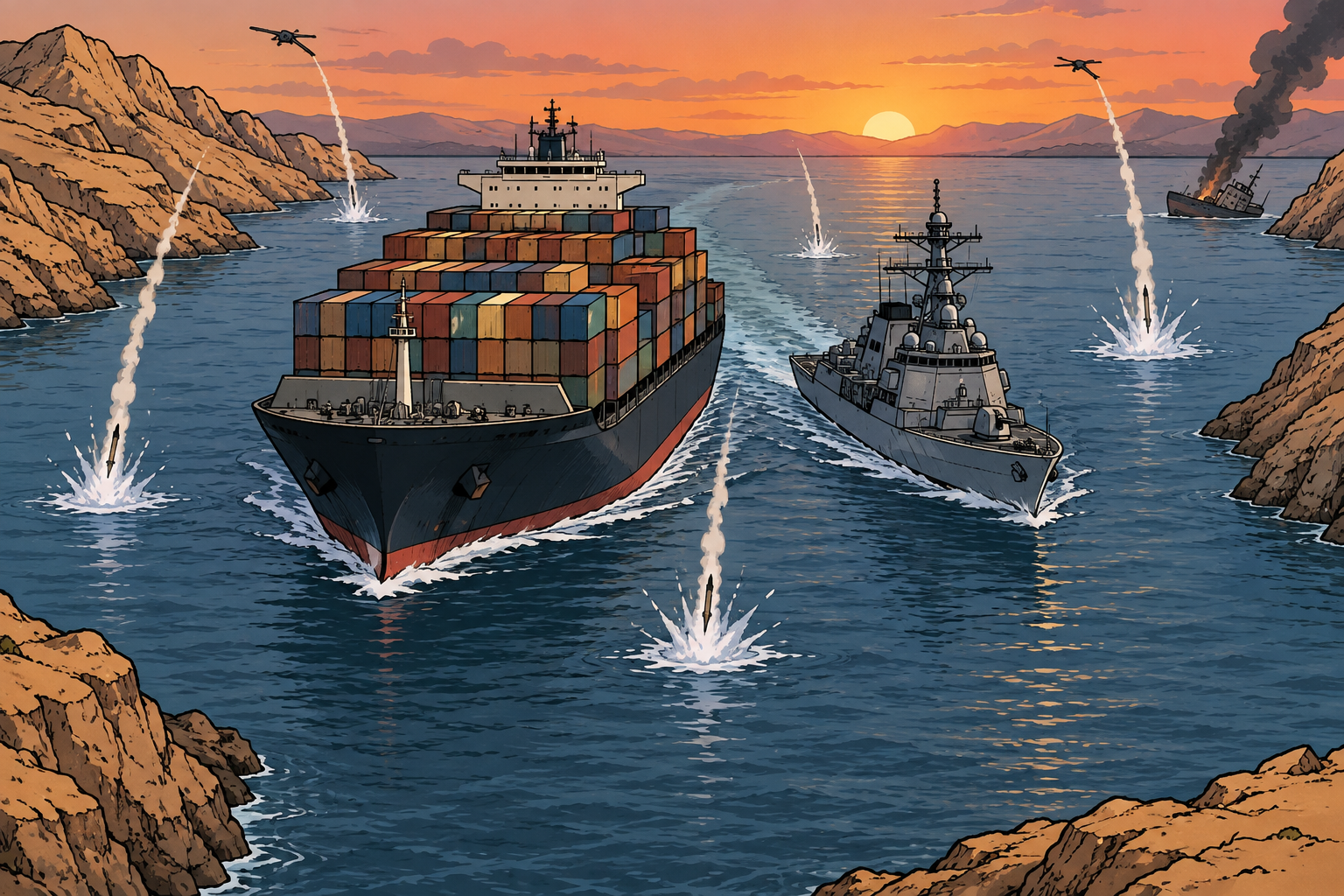
Running alongside the Israel–Iran exchange was a second confrontation at sea. U.S. Central Command said it shot down four Iranian one-way attack drones launched toward the Strait of Hormuz, the chokepoint through which roughly a fifth of the world’s oil moves. “The attack drones posed an immediate threat to regional maritime traffic,” CENTCOM said, adding that U.S. forces then struck Iranian coastal surveillance radar sites at Goruk and on Qeshm Island “to defend against further attacks.”
The Gulf clashes did not stay contained either. Iran-aligned fire reached toward U.S. partners in the region, with reports of ballistic missiles fired toward Kuwait and Bahrain — most of them, per U.S. accounts, intercepted or falling short. Together, the drone-downings at Hormuz and the missile barrages on Israel formed a single picture: a regime testing whether the April ceasefire could be broken on multiple fronts at once.
“CENTCOM forces shot down four Iranian one-way attack drones that were launched toward the Strait of Hormuz. The attack drones posed an immediate threat to regional maritime traffic.”
U.S. Central Command statement · June 2026
The most consequential player on June 8 may have been the one not firing. President Donald Trump (R) moved publicly to contain the spiral, posting that “Israel and Iran must immediately stop ‘shooting,’” and, according to Axios, telling the outlet he would ask Prime Minister Benjamin Netanyahu (Likud) not to retaliate for the Iranian barrage. Trump played down the strikes — “The Iranian strikes didn’t hurt anybody,” he said — and tied his restraint to diplomacy: “We are very close to a final deal with Iran. It is going to be a good deal. I don’t want it to blow up because of what is happening now.”
Netanyahu and Trump spoke by phone, and Hebrew media reported that Netanyahu had given a qualified, pseudo-agreement to Trump’s demand to hold fire after the initial round — though Israel still went ahead with its overnight strikes inside Iran before Tehran declared a pause. Shortly after Trump’s post, Iran’s military said it was halting further attacks, claiming Israel had “learned a lesson.”
Israel and Iran must immediately stop shooting. We are very close to a final deal — a good deal — and I will not let it blow up over this. Nobody got hurt. Everyone should calm down and let us finish the job at the negotiating table.
Paraphrased commentary · not a verbatim post
What makes this exchange different from the dozens of clashes since spring is its directness. For weeks the fighting ran through proxies, radar sites, and tankers; on June 7 and 8 it became Iranian ballistic missiles aimed at Israeli airbases and Israeli warplanes over Tehran and Isfahan — the two capitals of the war striking each other’s soil for the first time since April. The Israeli military signaled it was prepared to keep going “as long as it takes”; Iran warned of a “more crushing” reply if Israel resumed strikes on Lebanon.
By Monday the guns had gone quiet, but the truce that held since April now rests on two contingent promises: that Israel stops striking Lebanon, and that Iran keeps its missiles grounded. Trump is betting a “final deal” can be salvaged before either promise breaks. Whether the pause holds — or whether the next Beirut strike restarts the cycle — is, as of this writing, unresolved. Casualty and damage claims on all sides remain unverified.
Iran's military says it has halted attacks on Israel 'for now' after President Trump called on both sides to stop shooting, but warns of a 'more crushing' response if Israel resumes strikes on Lebanon. Israel says it is prepared to continue operations in Iran 'as long as it takes.'
Iran fired missiles and they hit nothing. Israel responded and our forces protected the Strait of Hormuz. Now everyone needs to stand down. A great deal is within reach, and I intend to get it done. Peace through strength.
Paraphrased commentary · not a verbatim post

- 1.Al Jazeera — 'Iran fires missiles at Israel after Beirut attack ‘crossed all red lines’,' June 7, 2026
- 2.Al Jazeera — 'Israel and Iran exchange attacks as ceasefire falters,' June 8, 2026
- 3.Al Jazeera (live) — 'Iran war live: Explosions in Tehran, Isfahan as Israel launches attacks,' June 8, 2026
- 4.The Jerusalem Post — 'Israel strikes various targets throughout Iran in response to Iranian missiles, IDF confirms,' June 8, 2026
- 5.The Times of Israel (live) — 'Iran says halting attacks on Israel, warns against strikes on Hezbollah; Netanyahu, Trump speak,' June 8, 2026
- 6.Axios — 'Iran fires missiles at Israel for first time since ceasefire,' June 7, 2026
- 7.Axios — 'Trump tells Axios he will ask Netanyahu not to strike back at Iran,' June 7, 2026
- 8.The War Zone (TWZ) — 'U.S. Shoots Down Iranian Drones Launched At Strait Of Hormuz: Official,' June 2026
- 9.RFE/RL — 'US Forces Hit Iranian Coastal Sites After Tehran Launches Drones Toward Strait,' June 2026
- 10.Washington Examiner — 'US downs Iranian drones headed toward Strait of Hormuz,' June 2026
- 11.NPR — 'Israel and Iran exchange missile fire threatening Middle East truce,' June 8, 2026
- 12.The War Zone (TWZ) — 'Iran Launches Ballistic Missile Attacks On Israel,' June 7, 2026
- 13.Axios — 'Israel strikes Iran military targets after Iranian missile attack,' June 8, 2026
Last updated June 8, 2026