Three Nights, 300 Targets: Iran Shuts the Strait of Hormuz
And Sprays Missiles Across Five Nations.
On Saturday evening, July 11, Iran’s Revolutionary Guard attacked the M/V GFS Galaxy, a Cyprus-flagged container ship transiting the Strait of Hormuz — then declared the world’s most important oil chokepoint closed “until further notice.” One civilian crew member is missing and ten were rescued, all Indian nationals according to India’s Ministry of External Affairs. By Sunday the IRGC had fired warning shots at a second merchant ship and hardened its terms: the strait stays shut “until the end of US interference.”
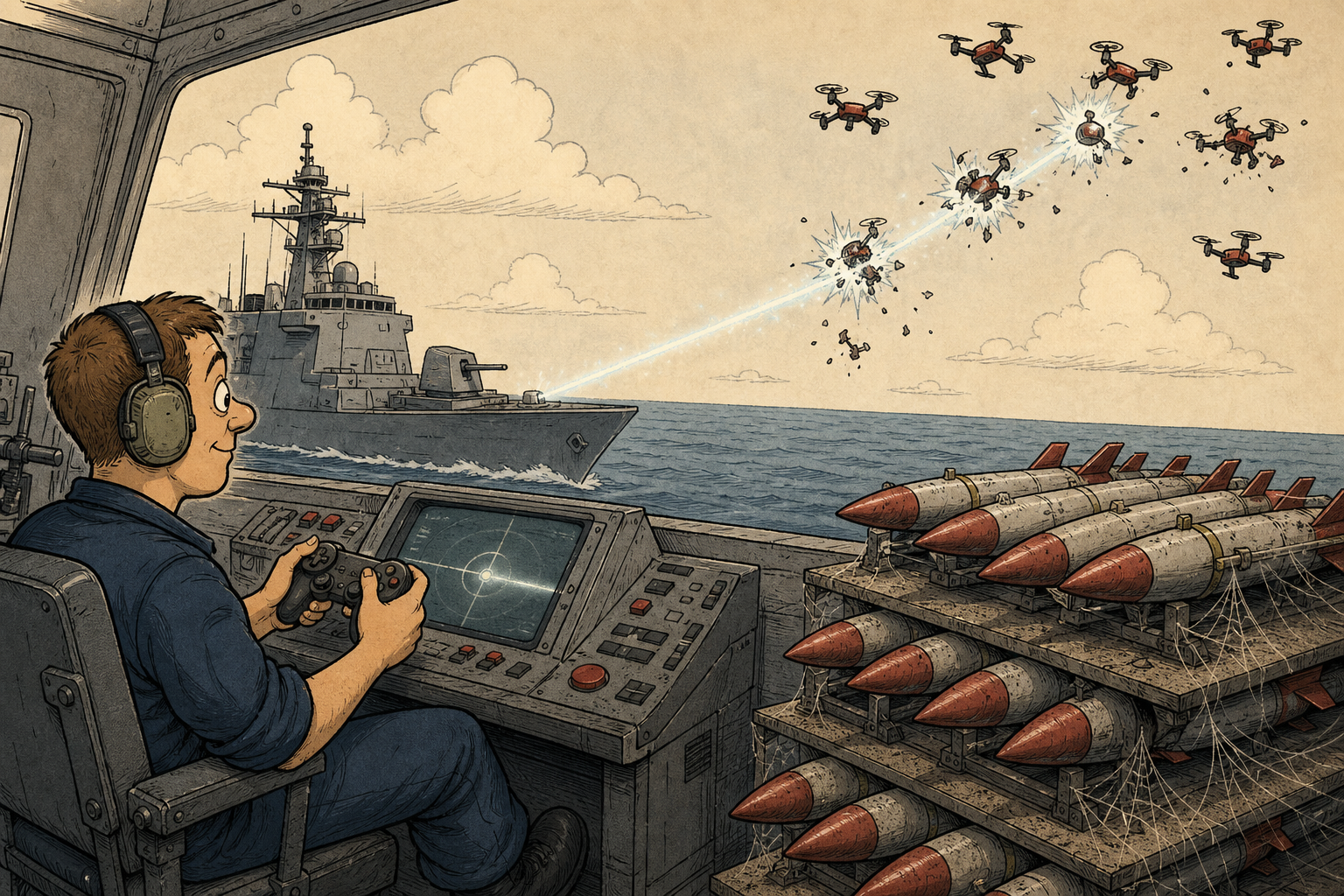
The American answer came at 7:15 p.m. Eastern. US Central Command opened a third round of strikes — roughly 140 targets overnight, pushing the three-night total past 300 — hitting missile and drone launch sites, naval assets, ammunition storage, and coastal surveillance along Iran’s Gulf coast.
Then Tehran answered the answer. By Sunday morning, ballistic missiles and drones were flying at US positions in Qatar, Kuwait, Bahrain, Oman, and Jordan — and with the UAE issuing shelter alerts, six countries were reporting incoming fire or warnings in a single morning. Three people were injured in Qatar, including a child. At American gas stations, the war’s bill kept arriving: $3.88 a gallon and climbing.
- ~140 — targets hit in CENTCOM's third round of strikes overnight July 11–12, via fighter jets, drones, and Navy vessels · Source: CENTCOM; The Hill
- 300+ — total targets struck across three nights of US strikes on Iran · Source: CENTCOM via Al Jazeera
- 6 countries — reporting incoming Iranian missiles, drones, or missile alerts in one morning — Qatar, Kuwait, Bahrain, Oman, Jordan, and the UAE · Source: Al Jazeera; Euronews; The National
- $3.88/gal — national average gas price Friday, July 10 — up roughly 50% since the war began · Source: AAA; PBS NewsHour
- 800+ vessels — escorted through the strait by CENTCOM since early May, carrying some 400 million barrels of oil · Source: Fox News live blog
What Iran calls a closure is not a minefield. The IRGC Navy laid no mines, according to every account of the weekend; it issued a declaration and is enforcing it by attacking ships on what it calls “unapproved routes.” The GFS Galaxy was the first ship hit — disabled Saturday evening, with one crew member still missing. On Sunday, Iran International reported the IRGC stopped a second merchant vessel with warning shots. The declaration’s language shifted overnight from “until further notice” to something more explicitly political: closed “until the end of US interference.”
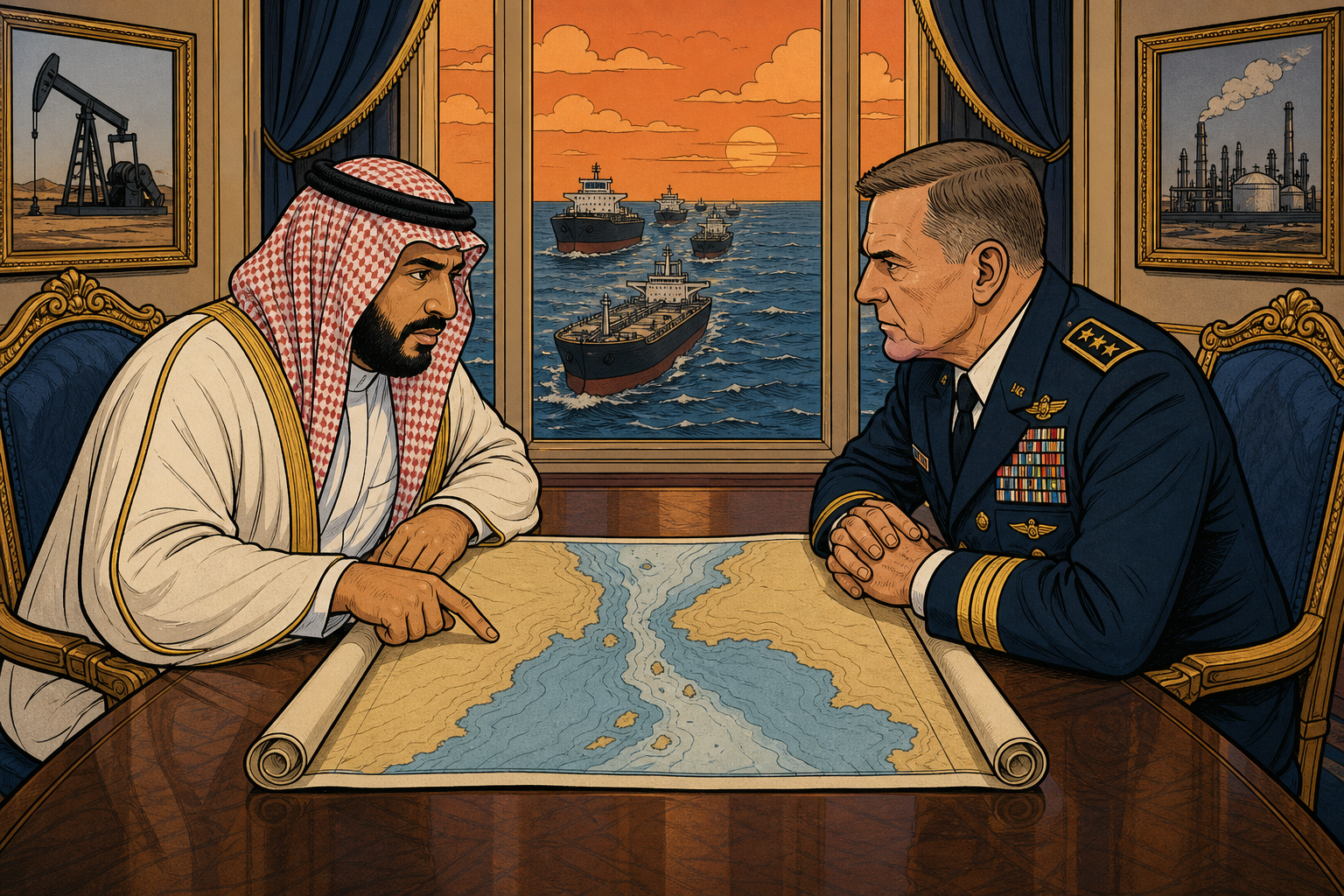
Washington’s position is that the declaration is a bluff backed by piracy. “Iran does not control the Strait of Hormuz,” US officials said, demanding Tehran publicly state that the strait is open to all shipping. NATO Ambassador Matthew Whitaker (Trump administration) put it flatly: “Iran cannot terrorize commercial vessels.” The maritime reality sits between the two claims — the Joint Maritime Information Center rated the threat “severe” but confirmed the southern transit corridor remains open in both directions, and tanker traffic is running at roughly 24 percent of pre-war levels.
A declaration alone moves markets because of what the strait carries: roughly 20 percent of the world’s oil trade passes through Hormuz. Brent crude closed Friday near $76 a barrel — up about 6 percent on the week — with WTI just under $72. Because the closure landed on a weekend, no market has yet priced it; Monday’s reopen will deliver the first verdict. For American drivers the bill is already itemized: a $3.88 national average Friday, up roughly 50 percent since the war began, though still below the May 21 peak of $4.56.
The quieter costs run through shipping ledgers. War-risk insurance for a Hormuz transit is running around 3 percent of a ship’s hull value, with some quotes reaching 5 percent — on a large tanker, millions of dollars per voyage before a drop of oil moves. And the reason any oil moves at all is the US Navy: since early May, CENTCOM has escorted more than 800 vessels carrying some 400 million barrels through the chokepoint. The world’s oil supply is, functionally, an American convoy operation.
~20% — share of global oil trade that transits the Strait of Hormuz.
~24% — current tanker traffic as a share of pre-war levels.
$76 / $72 — Brent and WTI at Friday’s close, before the closure; Brent up ~6% on the week. Markets were closed over the weekend — Monday reopens will price the escalation.
3–5% — war-risk insurance quotes as a share of hull value for a strait transit.
$3.88 — national average gas price Friday, up ~50% since the war began (May 21 peak: $4.56).
800+ vessels / 400M barrels — escorted by CENTCOM since early May.
The path to the third round ran through a collapsed pause. On Friday, July 10, US strikes were on hold while Qatar shuttled proposals between Washington and Tehran — a lull President Donald Trump (R) ended in a single post.
…the Cease Fire is OVER!
via Al Jazeera / NPR reporting
Through Saturday, the administration’s demand was specific: Iran must publicly declare the Strait of Hormuz open to all shipping. Tehran’s answer was the attack on the GFS Galaxy. Trump had already telegraphed what would follow.
Locked and Loaded… decimate and destroy all areas of Iran
via Al Jazeera / NPR reporting
At 7:15 p.m. Eastern, CENTCOM — commanded by Adm. Brad Cooper — announced the third round had begun. By morning, roughly 140 targets had been struck by fighter jets, drones, and Navy vessels: missile and drone launch sites, naval assets, ammunition storage, communications nodes, and coastal surveillance stations, concentrated at Veysian in Lorestan province, the Khondab base, and a string of sites across Bushehr province — Asaluyeh, Dir, Dashti, and Tangestan. No verified count of Iranian casualties from the round existed at publication.
At approximately 7:15 p.m. ET, US Central Command began a third round of strikes against Iranian military targets after the IRGC attacked the Cyprus-flagged merchant vessel M/V GFS Galaxy, leaving a civilian crew member missing — the US is 'imposing a heavy cost' on Iran.
Iran made a poor choice. Now they pay.
Sunday morning brought the widest single wave of Iranian retaliation of the war. By Tehran’s own claimed list, five nations were struck: ballistic missiles at Al Udeid Air Base in Qatar; drones against Patriot batteries, ammunition, and radar in Kuwait; drones at communications and radar sites in Bahrain, home of the US 5th Fleet, which went to its third alert of the war; strikes on platforms at Oman’s Duqm port and drones over Musandam; and ballistic missiles at Jordan’s Prince Hassan Air Base. Count the UAE’s missile alert, and six countries were warning residents or reporting incoming fire in one morning — and Jordan, it should be said, is not a Gulf state at all, whatever Iran’s “five Gulf nations” framing implies.
The human toll of the wave, so far as verified: three people injured in Qatar, including one child hit by shrapnel, per Qatar’s Interior Ministry; minor damage in Jordan, where Fox’s live blog reported three missiles; no US casualties reported in this window. The IRGC’s claim that it destroyed a US command center and MQ-9 drone hangars at Prince Hassan Air Base comes from Press TV — Iranian state media — and stands as Tehran’s account, not a verified result.
“The American-Zionist enemy should know that the continuation of its aggression will bring even more crushing responses… Bring it on, and we will fight back.”
IRGC statement, July 12, 2026, via Al Jazeera / Press TV
Parliament Speaker Mohammad Bagher Ghalibaf posted a screenshot of the mid-June Islamabad memorandum — whose Article 5 addresses reopening the strait — and cast the weekend as America’s breach, not Iran’s. That document, signed when the summer’s first ceasefire was being assembled, is now the legal fig leaf over the war’s most dangerous escalation.
“The era of one-sided deals is OVER. We told you: keep your word or pay the price. Reality is knocking.”
Mohammad Bagher Ghalibaf, Speaker of Iran's Parliament, on X, via The Jerusalem Post
The Gulf capitals Iran claims to be defending from American interference lined up against Tehran instead. The Gulf Cooperation Council held Tehran “fully responsible” for its “destabilizing behavior”; Saudi Arabia issued its own condemnation of the attacks on Gulf states and Jordan; Oman — the war’s quiet mediator — summoned Iran’s ambassador. At the UN, Ambassador Michael Waltz (Trump administration) pressed the Security Council, describing the US campaign as “directly aimed at Iran’s radar sensors, drones and missile batteries right there on the strait – to eliminate and degrade their ability to attack the global economy.”
Trump, on Sunday’s Meet the Press, dismissed the closure outright.
“It's open. We bombed the hell out of them last night.”
President Donald Trump (R), Meet the Press, July 12, 2026, via Fox News live blog
What happens next runs through two ledgers. One is in Tehran, where Supreme Leader Mojtaba Khamenei — who succeeded his father Ali Khamenei after the elder’s killing in February and has pledged to avenge him — must decide whether a fourth round of US strikes is a price worth paying to keep the padlock on the strait. The other opens Monday morning, when oil markets price a weekend in which the world’s most important chokepoint was declared shut, 140 more targets burned inside Iran, and US bases in six countries came under fire before lunch. The Fox segment below, from an earlier phase of the war, captures how the escalation ladder looked before this weekend added three more rungs.
CENTCOM confirmed a fourth round of strikes early Monday, July 13 — “the fourth round of attacks… within a week,” in the command’s own description — hitting “dozens of targets at multiple locations”: air-defense systems, coastal radar, missile and drone launch capability, and small boats. For the first time in the campaign, the round paired aerial drones with one-way attack sea drones, a capability CENTCOM had not previously used against Iran. The geography also shifted east along the coast, into territory the earlier rounds hadn’t touched: Iranian state media outlets Mehr and IRIB reported explosions at Bandar Abbas, on Qeshm Island, and at Sirik and Jask — sites well outside the round-three target list of Lorestan, Khondab, and Bushehr province covered above. Qeshm Governor Hossein Amir Teymouri counted 10 to 11 “enemy” projectiles striking the island; IRIB tallied six explosions there and seven at Sirik, with other outlets counting more than a dozen blasts total. Teymouri’s own account reported no casualties at Qeshm or Bandar Abbas.
The casualty picture this page reported as unverified at publication has since produced Iran’s first specific claims — and they don’t agree with each other. Mehr, Iranian state media, initially said a US strike on Abadan killed two people and wounded three; Al Jazeera’s later, province-wide count for Khuzestan put it at one security guard killed and four injured. Neither figure comes from CENTCOM or any independent count. The same caveat this page has applied throughout to Press TV and IRGC claims applies here: this is Tehran’s account, evolving and internally inconsistent, not a verified result.
Jordan — intercepted 4 missiles Monday, no casualties or damage reported. This is now the third discrete Jordanian incident this week: 8 missiles intercepted July 9, three missiles July 12 (covered above), and 4 more July 13.
Kuwait — intercepted 3 ballistic missiles, 1 cruise missile, and 10 drones. The IRGC claims it destroyed “two missile launchers and nearby storage facilities” there — Tehran’s account, not verified.
Bahrain — the IRGC also claims a strike on a US drone command center in Bahrain and on Kuwait’s Ali Al Salem air base — again Tehran’s own, unverified account.
This page’s own July 12 assessment was that “the diplomacy of July 10 is dead.” Monday’s coverage hardens that line rather than contradicts it: Al Jazeera titled its wrap on the day “ceasefire comes under growing strain,” and CNN’s live coverage described the mid-June Islamabad memorandum as having effectively disintegrated. Neither government has formally withdrawn from the framework, but neither is behaving as if it is operative.
A new front opened outside CENTCOM’s own operations entirely. Yemen’s internationally recognized government said its forces struck the runway at Sanaa International Airport — territory controlled by the Houthis — on Monday, to stop an Iranian Mahan Air flight from landing to retrieve a Houthi delegation that had traveled to Iran for the funeral of Supreme Leader Ayatollah Ali Khamenei, killed in February and succeeded by his son, Mojtaba Khamenei. This was not a US or CENTCOM strike. The Houthis blamed Saudi Arabia instead; spokesman Yahya Saree declared “the end of the de-escalation phase” and vowed retaliation.
Trump, meanwhile, moved from disputing Iran’s closure claim to asserting permanent American administration of the strait. In a Monday phone interview on “Fox & Friends,” he laid out the shift himself.
“We're going to keep the strait, and we'll probably run it. We'll become the guardian of the strait. Maybe we'll call it the guardian angel of the strait… we should be reimbursed for that… a lot of money… because the other nations are very wealthy.”
President Donald Trump (R), 'Fox & Friends' phone interview, July 13, 2026, via The Jerusalem Post / CNBC / Times of Israel
Markets delivered their first verdict Monday. Brent rose roughly 3 to 4 percent to about $78–79 a barrel and WTI rose to about $74, both up from Friday’s close of $76 and just under $72. Shipping-data firm Kpler counted just six vessels transiting the strait on July 12 — a single-day count, sharper than this page’s earlier “roughly 24 percent of pre-war levels” figure, which is a period average; the two numbers measure different things, but both point the same direction — the strait is passable, and nearly empty.
Monday evening, Trump escalated in words before CENTCOM escalated in strikes. On Hugh Hewitt’s radio show he said, “We’re going to hit them very hard tonight, and we’re going to hit them hard tomorrow” — a new venue for the same threat this page has tracked since Truth Social’s “Locked and Loaded” post. CENTCOM answered with a five-hour mission — its own count calls it a “third consecutive night,” while outlets elsewhere label the broader campaign’s “fourth” or “fifth” round; this page treats the round-counting as genuinely disputed rather than picking one number — hitting Bushehr, Chah Bahar, Jask, Konarak, Abu Musa, Bandar Abbas, and Omidiyeh. Four of those seven sites are outside every target list this page has reported since the war began. Iranian media reported four wounded at Omidiyeh. Trump floated a strike on “Pickaxe Mountain,” his name for a fortified nuclear site near Natanz, and said operations could run two to three more weeks.
The “guardian of the strait” line this page quoted from Sunday’s “Fox & Friends” interview has since hardened from rhetoric into policy. Trump announced a 20 percent toll on all cargo transiting Hormuz and a reimposed naval blockade of Iranian ports and coastline, effective Tuesday, July 14, at 4 p.m. Eastern — branding the policy “The Guardian of the Hormuz Strait” and naming Saudi Arabia, Qatar, the UAE, Kuwait, and Bahrain as the nations expected to help cover the cost.
20% — toll Trump has ordered on all cargo shipped through the Strait of Hormuz, effective Tuesday, July 14, 4 p.m. ET.
5 — nations named as expected to help pay: Saudi Arabia, Qatar, the UAE, Kuwait, and Bahrain.
2 tankers — the UAE-flagged supertankers Mombasa and Al Bahiyah, hit by Iranian cruise missiles in Omani waters early Tuesday.
1 killed, 8 wounded — the Mombasa/Al Bahiyah casualties (1 Indian crew member dead; 6 Indian and 2 Ukrainian wounded) — the first tanker deaths of this strike phase.
Iran’s retaliation moved from military targets to commercial shipping directly. Early Tuesday, two Iranian cruise missiles struck the UAE-flagged supertankers Mombasa and Al Bahiyah in Omani territorial waters, killing one Indian crew member and wounding eight — six Indian, two Ukrainian. Both ships caught fire before crews brought the blazes under control. The IRGC claimed the tankers had ignored warnings and used a “mined route” — Tehran’s account, not an independently verified one. A separate UK-linked tanker was struck by an unidentified projectile roughly 40 nautical miles northeast of Oman’s Qalhat, per the UK Maritime Trade Operations center; no injuries were reported there. These are the first tanker casualties of the current strike phase, after weeks in which this page reported ship seizures, warning shots, and a disabled container vessel — but no deaths at sea.
Bahrain sounded sirens Tuesday morning and said it intercepted further Iranian fire; the IRGC claimed — again unverified — hits on the Fifth Fleet’s Juffair base, its air-control radar, and its counter-rocket defenses. In Yemen, the Houthis moved from the vague “end of de-escalation” vow this page already reported to a specific target: spokesman Yahya Saree threatened Riyadh’s King Khalid International Airport and fired ballistic missiles at Saudi Arabia, which intercepted them. The UN separately warned that Yemen risks “full-scale conflict.” Separately reported “first-of-its-kind” sea-drone coverage circulating Tuesday describes the same Corsair-brand drone strike on Bandar Abbas already documented in § 06 above, now with the platform name and target — a submarine and ship-maintenance facility — confirmed, not a new event.
What began as a disputed closure declaration is now an American blockade with a price tag: a 20 percent toll on Hormuz shipping, a reimposed naval blockade of Iranian ports, and five Gulf states named to help pay for it. Iran’s answer has moved from warning shots and a disabled container ship to two tankers hit with cruise missiles and the strike phase’s first confirmed deaths at sea. CENTCOM is now on its third consecutive night of strikes reaching sites it hadn’t touched before, Trump is talking about weeks more of operations and a strike on a fortified nuclear site, and the Houthis have named an airport in Riyadh as a target while the UN warns Yemen could slide into full-scale war. The diplomacy of July 10 isn’t just dead — nobody is pretending otherwise anymore.