
The Iran Ceasefire Lasted Seven Days. Now the Blockade Is Back — and the EU Just Sanctioned the Drone Program.
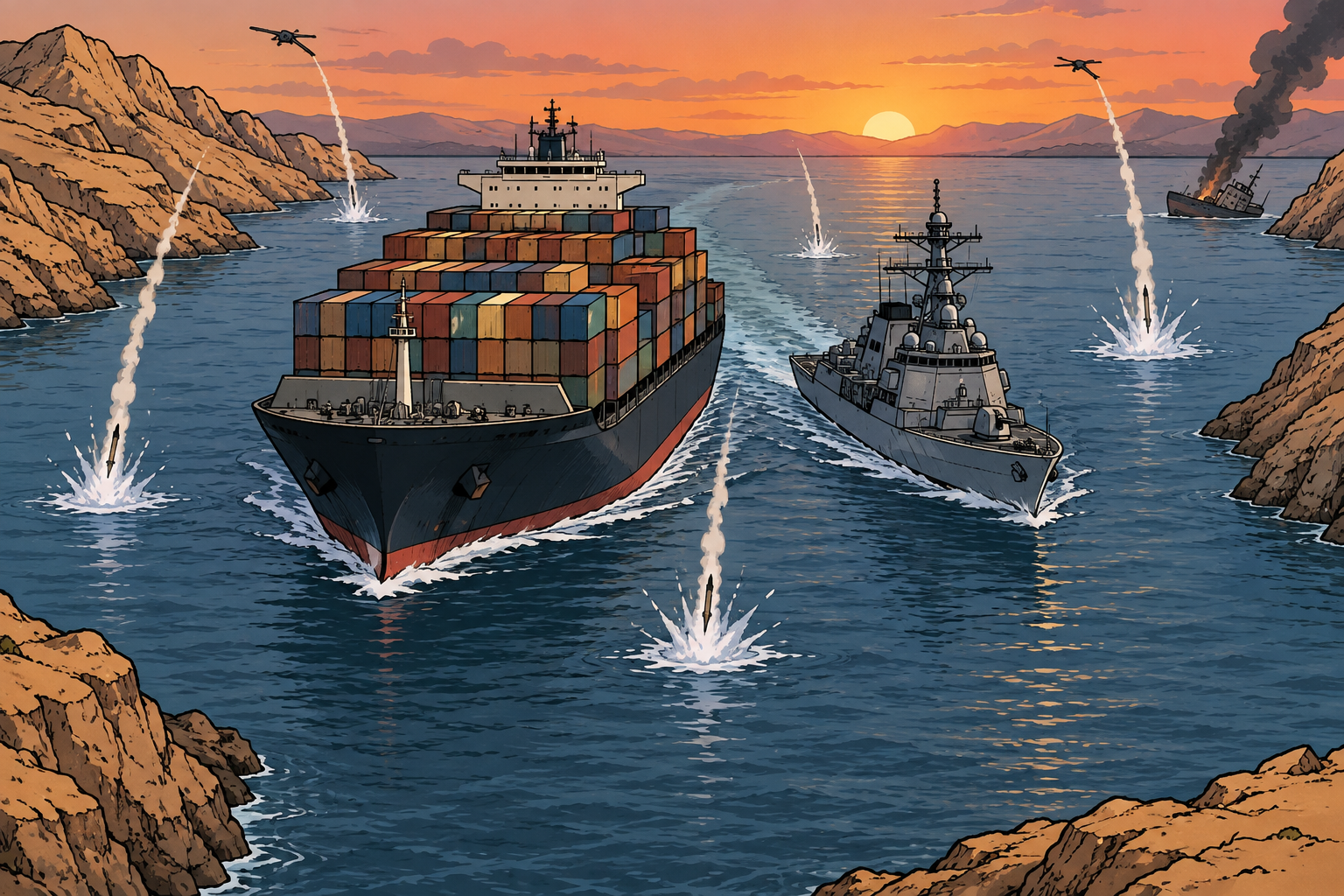
The May 29, 2026 Hormuz ceasefire — negotiated through Qatari and Omani back channels — collapsed in six days. On June 3, an Iranian Shahed-238 drone struck Kuwait International Airport, killing one and injuring 63. The attack — which Iran initially blamed on US Patriot batteries before CENTCOM released video proof — effectively ended the agreement. CENTCOM Commander Adm. Brad Cooper announced on June 5 that full maritime enforcement operations in the Strait of Hormuz would resume Monday, June 9.
The EU moved in parallel. On June 4, the European Council adopted Decision 2026/1157, adding 34 Iranian individuals and 19 entities to the EU sanctions list, targeting the IRGC drone procurement network, Shahed production facilities, and the Iranian defense ministry officials responsible for supply chains to Russia and Houthi forces. Brent crude closed at $94.85 on June 5, up from $88.20 at the time of the ceasefire announcement.
- 7 days — duration of the May 29 Iran ceasefire before Iran struck Kuwait International Airport June 3, killing 1 and injuring 63 · Source: CENTCOM
- June 9 — date CENTCOM announced full Strait of Hormuz maritime enforcement operations would resume · Source: Pentagon statement June 5, 2026
- EU 2026/1157 — European Council Decision targeting 34 IRGC individuals and 19 entities in the drone procurement and production network · Source: EUR-Lex, June 4, 2026
- $94.85 — Brent crude per barrel as of June 5 close — up $6.65 from the May 29 ceasefire day · Source: ICE Brent Futures
The May 29 ceasefire was announced jointly by Qatar and Oman, who both confirmed that CENTCOM and IRGC Navy had agreed to a 21-day mutual stand-down in the Strait of Hormuz. Iranian ships would withdraw from the shipping lane interdiction positions they had held since April 29; the US Navy would suspend active-boarding operations. All parties signed on a one-page memorandum of understanding.
The ceasefire held for less than a week. On June 2, IRGC forces fired a ballistic missile at a Saudi oil tanker transiting outside the exclusion zone — the shot missed, but it violated the stand-down terms. On June 3, the Shahed-238 drone struck Kuwait International Airport. CENTCOM said Iran had “materially and fundamentally violated” the agreement.

EU Council Decision 2026/1157, adopted June 4, is the broadest EU sanctions action against Iran since the 2015 JCPOA era. The 34 listed individuals include the IRGC Aerospace Force commander, the directors of three state-owned drone manufacturing entities (HESA, Qods Aviation, and Paravar Pars), and eight officials implicated in the weapons supply chain to Russia’s war in Ukraine. The 19 listed entities include front companies operating in Turkey, the UAE, and Malaysia that have been used to procure dual-use components for Shahed production.
The US and EU coordinated the sanctions announcement — Secretary of State Marco Rubio (R) and EU High Representative Kaja Kallas held a joint press conference in Brussels on June 4. Rubio: “Iran had a chance at a deal. They chose drones. The international community’s response is unified, measured, and it will be sustained.”
The Strait of Hormuz remains the world’s most critical energy chokepoint. According to EIA data updated for June 2026, approximately 21 million barrels per day of crude oil and petroleum products transit the strait — roughly 21% of global petroleum liquids consumption. During the April–May interdiction period before the ceasefire, 122 commercial vessels had diverted from normal Hormuz transit routes to longer Cape of Good Hope passages, adding 14–18 days of sailing time and $2.8M–$4.1M in additional operating costs per diverted voyage.
With the blockade reimposing June 9, analysts at JPMorgan and Goldman Sachs both revised Brent crude price targets. JPMorgan raised its Q3 2026 estimate to $102/bbl; Goldman cited $98/bbl. The IEA emergency coordination mechanism, last activated during Russia’s 2022 Ukraine invasion, is reportedly being reviewed by member states.
April 29, 2026 — Iran begins Strait of Hormuz shipping interdiction; 3 vessels boarded.
May 2, 2026 — CENTCOM begins Operation Project Freedom; US Navy escorts resume.
May 29, 2026 — Ceasefire announced via Qatar/Oman mediation.
June 2, 2026 — IRGC missile fired at Saudi tanker (missed); first ceasefire violation.
June 3, 2026 — Shahed-238 drone strikes Kuwait Airport; ceasefire declared void.
June 4, 2026 — EU Council Decision 2026/1157 adopted; US-EU joint sanctions.
June 9, 2026 — Full blockade operations resume.

On June 4, the House of Representatives voted 215-208 on H.Res. 542, a resolution invoking the War Powers Resolution to require a presidential report and — if no report is filed within 60 days — a drawdown of US forces from the Hormuz interdiction zone. The resolution passed with all 208 Democratic votes and 7 Republican crossovers, primarily from the libertarian-leaning House Freedom Caucus wing concerned about open-ended naval deployments.
The White House issued a statement calling the resolution “a dangerous and irresponsible attempt to handcuff American military operations during an active crisis.” National Security Adviser Mike Waltz (R) cited the Article II commander-in-chief power and said the administration would not comply with any reporting deadline imposed by the resolution, which it viewed as unconstitutional. The Senate is not expected to take up a companion resolution.
The Islamic Republic of Iran's June 3 drone strike against Kuwait International Airport constitutes a material breach of the May 29 ceasefire agreement. Full maritime enforcement operations in the Strait of Hormuz will resume Monday, June 9. The United States reserves all rights under international law.
When operations resume June 9, CENTCOM will be operating under a more aggressive rules of engagement that allow direct action against any Iranian surface vessel that approaches within 500 meters of a commercial tanker in the Strait without prior authorization — a change from the April–May standing orders that required a show of force before use of force. Defense Secretary Pete Hegseth (R) confirmed the new ROE at a Pentagon briefing June 5.
Iran’s position remains that the Strait is its sovereign territory and that any foreign warship operating within Iranian-claimed waters is subject to IRGC authority. That claim has no standing under UNCLOS — the 1982 Law of the Sea Convention, which Iran ratified — and has been rejected by every Gulf state, the EU, and the G7. Whether Tehran sees the June 9 resumption as an opportunity to push further or to seek a new ceasefire will determine how far this escalates.
Iran broke the deal, AGAIN. Droned Kuwait's airport, killed innocent people, then LIED about it. The Navy is going back in Monday. They should have taken the deal. Their choice.
Paraphrased commentary · not a verbatim post
Today in Brussels I joined EU High Representative Kallas to announce coordinated US-EU sanctions targeting Iran's drone procurement network. EU Decision 2026/1157 designates 34 IRGC officials and 19 front companies. Iran chose drones over diplomacy. Our response is unified, measured, and sustained.
President Trump gave Iran a path to a real deal. They launched drones at Kuwait's airport while the ceasefire was still active. The Navy goes back in June 9. The EU is sanctioning the entire IRGC drone supply chain in parallel. When America leads with strength, alliances follow. Iran chose defiance. They will pay for it.
Paraphrased commentary · not a verbatim post

- 1.CENTCOM — Statement on Iran Ceasefire Collapse and Gulf Security Operations, June 3-5, 2026
- 2.EU Council Decision 2026/1157 — Sanctions Targeting Iran's Drone and Missile Programs, June 4, 2026
- 3.Pentagon — Secretary Hegseth Statement on Iran Strait of Hormuz Operations, June 5, 2026
- 4.U.S. Energy Information Administration — Strait of Hormuz Chokepoint Analysis, updated June 2026
- 5.Congressional Record — H.Res. 542, War Powers Resolution (Iran) Vote 215-208, June 4, 2026
- 6.State Department — Secretary Rubio Joint Press Conference with EU HRVP, June 4, 2026
- 7.Reuters — 'Iran Strikes Kuwait Kills Ceasefire Deal; Navy Blockade Returns Monday,' June 3-4, 2026
- 8.Fox News — 'CENTCOM: Iran Hit Kuwait, Then Lied About It. Blockade Back Monday,' June 5, 2026
- 9.Washington Examiner — EU Council Decision 2026/1157 Analysis, June 5, 2026
- 10.The Hill — House War Powers Vote 215-208 on Iran, June 4, 2026
- 11.ICE — Brent Crude Oil Price Monitor, June 2026
- 12.Bloomberg — 'Brent Crude Tops $94 as Iran Ceasefire Collapses,' June 3, 2026